
01 The three letters
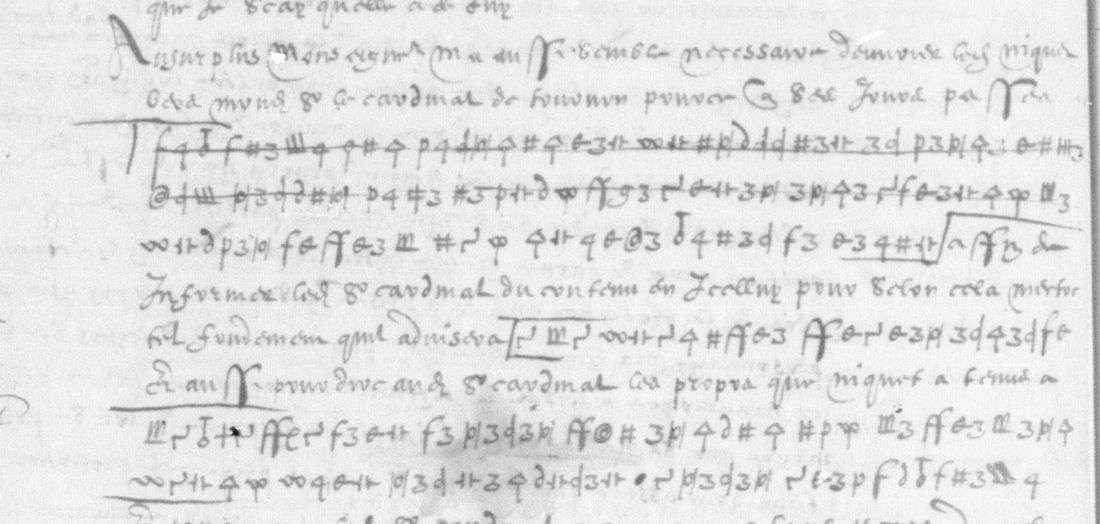
- La Guiche → the duc de Montmorency, Rome, 22 November 1551, fr. 3138 no. 22, f. 60v–61r. The clear text is about cardinals and the Pope’s intentions during the Parma war. It is interrupted by six cipher runs, 406 symbols in all. There is no decipherment on the leaf, in the margin or on the following leaf.
- Noailles → the Cardinal de Lorraine, Venice, 13 November 1558, fr. 3151 no. 33, f. 59–60. The letter is in clear (galleys, Candia, Corfu), with two cipher blocks of three lines on f. 60r. Each has its decipherment written in the inner margin.
- Seure → de Fresne and Henri II, Lisbon, 12 and 27 December 1558, fr. 3151 nos. 39–44. The catalogue listed one letter, no. 39, but the volume holds six, and nos. 40/41 and 43/44 are duplicates. The cipher runs over some eight pages.
02 La Guiche: the decipherment
Normalised spelling. Clear words from the letter are in italics, [?] marks an uncertain reading, and … marks symbols not deciphered.
[struck through: Dom Diego … constituer prisonnier en ce … un Siennois … croy que …] le procès duquel j’ay trouvé moien de veoir, affin de informer led. Sr cardinal du contenu en icelluy pour selon cela mettre tel fondement qu’il advisera. … de ceux de Sienes qui estoit icy, lequel est party pour s’en retorner a Sienes avec Dom Diego. … Le conte [de] Sainte Fiore est mal satisfaict, et que facilement se reduiroit au service du roy … Car ledict personnage qui estoit icy tractant avec moy la faire du sieur +arna+e … vous informer du … que le roy pourroit avoir du dict sieur +arna+e, et aux [?] … des conditions qu’il demanderoit.
“Dom Diego” is Diego Hurtado de Mendoza, Charles V’s ambassador in Rome and the power behind Siena until the Sienese rising of July 1552. The count of Santa Fiora is the Sforza lord, whose family were the pope’s relations. The letter shows La Guiche sounding him out for the French side eight months before Siena turned to France.
03 Method
The cipher was transcribed symbol by symbol from full-resolution crops of each line (guiche_ct.txt). The counts pointed to a simple substitution: 22 distinct symbols, one of them at 16%, the rate of French e. An annealer that allowed several symbols per letter converged on a degenerate i/x solution. A permutation annealer with swap moves, scored with a French 5-gram model without word spaces (fr-1530-despatches), produced le conte sainctefiore est mal satisfaict on its best restart. Four symbols were then fixed from context (qu, p, y, v), and the rest re-annealed. Key: 3=e, t=r, #=i, θ=u, the stemmed 4=t, barred p=s, hook=a, f=d, d=n, open 4=o, curled d=o, p=c, Ⅲ=l, ff=qu, overbarred d=m, φ=y, the circle=v, hooked q=f, ∞=p.
04 Noailles, 1558: deciphered at the time
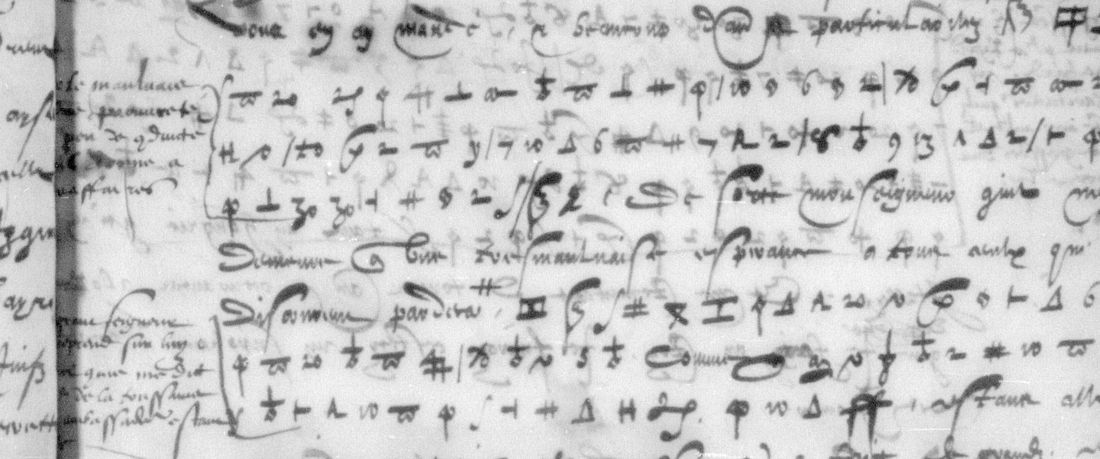
Only part of the glosses is legible, because the start of each line runs into the binding: « … mauluaise … gouvernement … affaires », « … grand seigneur … ne luy … de la fortune … ». The letter was deciphered when it arrived. A complete text would need the volume opened flat.
05 Seure, 1558: open
Seure’s six letters mix clear French (the Indies fleet, twenty-two ships at Havana, the queen of Portugal’s confessor) with long blocks in about sixty invented symbols and numerical groups such as 12, 23 and 100: a homophonic nomenclator. None has a decipherment. There are roughly 2,000 symbols under what looks like one key, enough for a ciphertext-only attack, but the transcription alone would take several sessions. The letters stay in the catalogue as their own item.
06 What remains uncertain
- La Guiche: the name « sieur +arna+e » (symbols t r t d r t 3; the barred-cross symbol, r elsewhere, may stand for a second letter here); two rare symbols (1–2 occurrences) unassigned; the struck-through first two lines deciphered only in fragments; the Ⅲ symbol is l everywhere but gives g in « Diego ». Key grade C; the text is grade M where marked.
- Noailles: the margin decipherment is incomplete; the cipher was not attacked.
- Seure: not transcribed.
07 Sources
- BnF français 3138, Gallica btv1b90601662, view 65 (La Guiche); view 70 has Morvilliers’ 1549 letter with its decipherment.
- BnF français 3151, Gallica btv1b9059865k, view 61 (Noailles); views 72–88 (Seure).
Transcription, solver scripts and notes: guiche1551/.