- Nos. 41 and 42 were already read. George Lasry broke them in 2023 as a “poly-homophonic” letter cipher. They were read again here, from a fresh transcription of the Gallica images with his key, and the reading adds three small corrections to his text.
- No. 43 is not the same cipher. It is a number code of letters and syllables, with a contemporary decipherment between the lines. That decipherment starts only at the thirteenth line. The opening — the address to Laigue and the purpose of the whole mémoire, 264 groups — had never been read.
- No. 43 read in full. The key was rebuilt from about 3,300 glossed groups and used to read the opening. The whole mémoire was then edited: Conti to Laigue, 5 March 1649, the day after the Rueil conference opened, explaining the conference away to the Archduke.
01 The documents
BnF Français 3854 (Gallica btv1b52520094g) is a recueil of Fronde papers from the prince de Conti’s side, January to April 1649. It holds his instructions to his envoys, the marquis de Noirmoutier and Geoffroy de Laigue, the Archduke’s Spanish answers, and three pieces in cipher that Omont describes as follows:
- No. 41 (f. 113r–v): “Mémoire, avec chiffre, du prince de Conti. A Paris, ce 26 mars 1649”.
- No. 42 (f. 115r): the same, “ce 27 mars 1649”, signed Armand de Bourbon.
- No. 43 (ff. 117r–120r): “Mémoire, avec chiffre et déchiffrement, du prince de Conti, pour un de ses envoyés auprès de l’archiduc”, undated.
The catalogue’s “verify first” was to confirm that the three share one cipher. They do not. Nos. 41 and 42 are written in lower-case letters mixed with clear words. No. 43 is written in numbers, with a clerk’s letters and syllables above most of them.
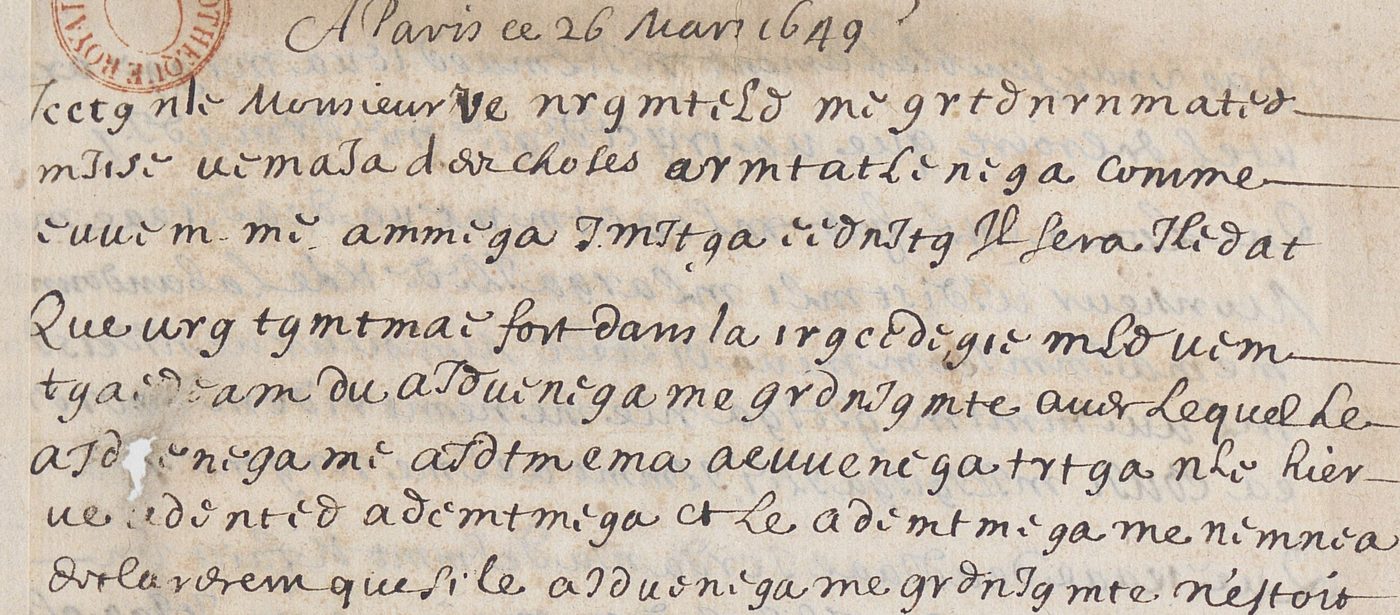
02 Nos. 41 and 42: found already read, and read again
Prior art. A web search before any work found George Lasry, “Armand de Bourbon’s Poly-Homophonic Cipher – 1649”, HistoCrypt 2023. Lasry deciphered both letters, printed their text with a translation, and described the system.
- How it works. Each plaintext letter is written as a cipher letter. A, L and R each have two signs. Five signs each stand for two to four letters: a = t/p/a/b, e = e/g, i = c/z, m = s/d/x, n = m/q.
- The key. There is no nomenclator. The key’s second row spells J’aime c’est un grand mal, a Boesset air of 1642.
- The catalogue entry. His paper cites the volume as “fr. 3584”, a typo, which is why the catalogue harvest did not match it.
Read again here. All three pages were transcribed sign by sign from the full-resolution images. A beam search over each sign’s possible letters, scored with a French quadgram model and then a period word list, picked the readings. The text agrees with Lasry’s throughout, with three additions:
- f. 113r: dans lequel temps les choses ne pouvant pas. The cipher has
ge= NE, which the printed text drops. - No. 42: ordonne à ses députez de se joindre à ceux de son Altesse le prince de Conti pour insister à demander l’éloignement du cardinal Mazarin. The words are in the cipher (
arldtgmtmaed) and in Lasry’s own figure, but not in his clean text. - f. 113v: Bretaigne is enciphered with the L-sign in second place, a slip of the encipherer’s.
“Monsieur de Tenerande”, with whom Longueville is to treat, reads the same under the key; the person is unidentified. “Dix” or “six mil hommes” cannot be settled, because one sign serves both d and s.
Depuis la lettre que je vous escrivi hier j’ay cru vous debvoir advertir qu’on a donné aujourd’huy arrest au parlement qui ordonne à ses députez de se joindre à ceux de son Altesse le prince de Conti pour insister à demander l’éloignement du cardinal Mazarin. On ne doute plus après cela de la rupture … Ne concluez rien pourtant que vous n’ayez le dernier advis, mais si elle arrive, mettez-vous en estat d’en faciliter les suittes. No. 42, 27 March 1649
03 No. 43: a number code, and twelve lines nobody read
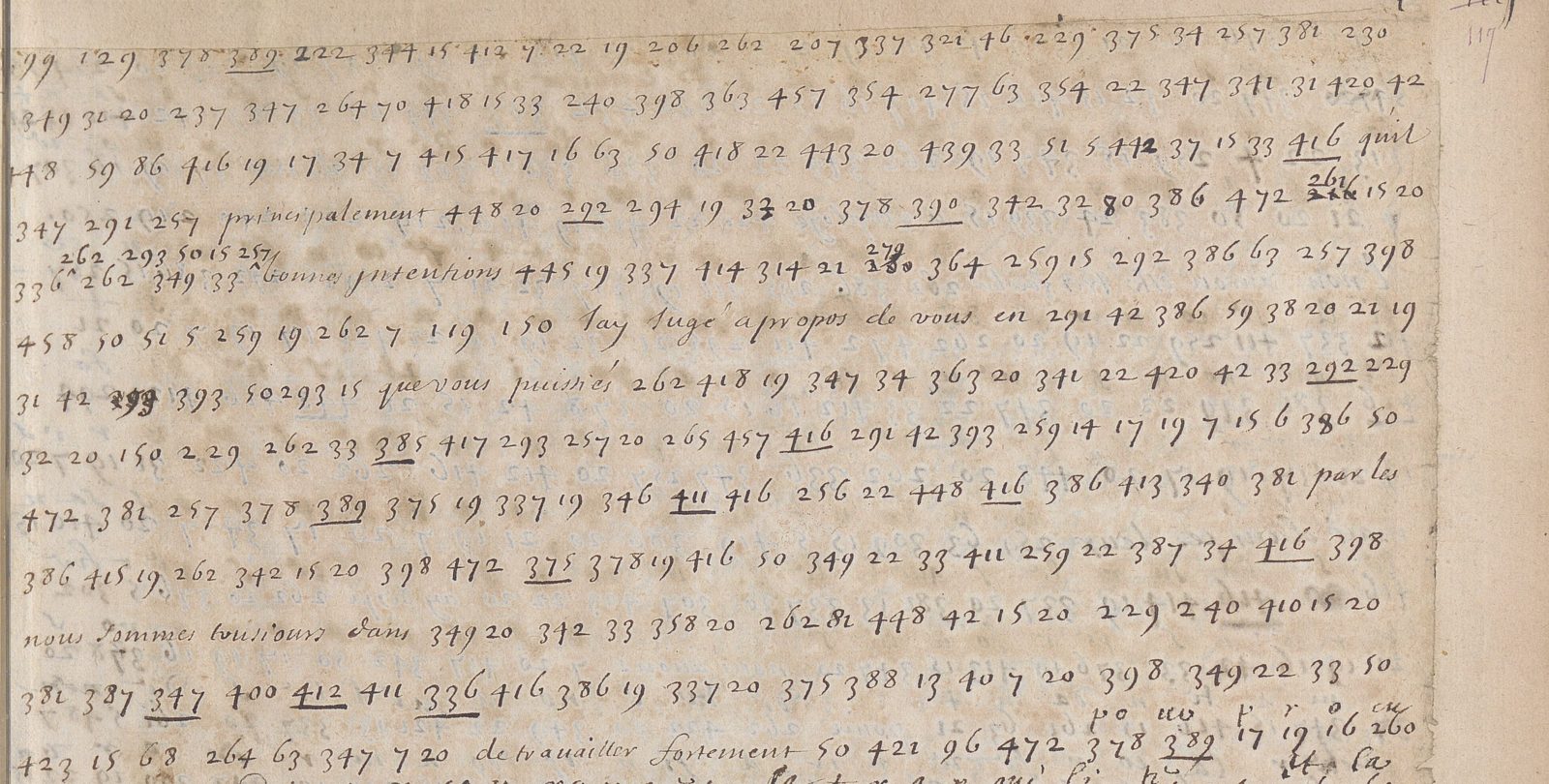
The clerk who deciphered no. 43 wrote a letter or syllable above almost every number from f. 117r line 13 to the end of f. 120r. He wrote nothing over the first twelve lines. Those 264 groups carry the address and the purpose of the mémoire.
The key, rebuilt from his glosses. Agents transcribed number/gloss pairs page by page, and the tallies (key43.txt) show a regular design:
- Four interleaved single-letter alphabets: 3–25 run a→z, 28–50 run z→a, 51–73 run a→z again, and about 80–98 run down.
- Syllables in blocks of five, in vowel order: ca ce ci co cu = 256–260, and so on through the consonants, with a second, homophonic series in the gaps.
- Underlining a number reverses its syllable: 385 = ra, underlined 385 = ar.
- Code words: 451 la Reyne, 457 le cardinal, 458 le parlement, 472 l’archiduc, 482 France. The 500s are dates.
- Nulls: the numbers from about 99 to 250, which are never glossed.
The opening, decoded. Of the 264 groups:
- 220 take the value the same number has in the glosses.
- 24 follow from the alphabets or are nulls.
- 20 are syllables of the second series, fixed from context.
The first draft was checked against the rest of the mémoire. Nine of the context and structural values were later found glossed on ff. 117r–120r, all as predicted: 279 de, 364 la, 354 ne (underlined, en), 443 te, 445 su, 37 o, 43 h, 86 n, and 36 p. None was contradicted.
Pour Monsieur de Legue. Parce que nous ne doutons que le cardinal ne donne une mauvaise interprétation à toutes ses actions, et qu’il ne face principalement ses efforts pour mettre l’archiduc dans la défiance de nos bonnes intentions sur le sujet de la conférence que [le] parlement a accordée, j’ay jugé à propos de vous en faire instruire, afin que vous puissiés destourner les mauvais effets des artifices du cardinal, et faire comprendre à l’archiduc que ce pourparler n’a esté causé et résolu que par les retardemens que l’archiduc apporte à nous secourir, et que nous sommes tousiours dans nos mesmes desseins … No. 43, f. 117r, lines 1–12, read here for the first time
04 What no. 43 says
The last line of f. 120r is glossed à Paris le 5me mars 1649. That is the day after the Rueil conference opened between the court and the parlement. Conti writes to Laigue, who is with Archduke Leopold Wilhelm, to keep the Spanish alliance alive while the Frondeurs negotiate with Mazarin’s side.
- Why the conference happened. The parlement laid the Archduke’s envoy’s proposals (dom Joseph) before the Queen. Mazarin, who saw that real peace would ruin him, proposed a conference to drag things out and to make the Archduke believe the Frondeurs were giving way. “À quoy l’on a employé Vautorte.” Conti would have refused it if the Archduke’s help had been ready and Paris not starving.
- What it bought. No suspension of arms. Saint-Germain lets in a hundred muids of corn a day from Corbeil for as long as the conference lasts, which buys time, “mais fort peu, en vous attendant”.
- Why it cannot succeed. The deputies are “tous gens de bien, dans le zèle de la paix générale et dans une haine irréconciliable pour le ministériat du cardinal”. They cannot give way on Mazarin, whom the parlement has condemned. The generals stayed away on purpose, so as to be free to break the talks at will.
- The promise. “Dès le moment qu’il entrera en France, cette conférence se rompra”, and a truer one will be opened with the Archduke’s own deputies.
- The plea. “Il n’y a plus un seul moment à perdre pour nous secourir.” Laigue is to press for help with all the Archduke’s forces. Even if the Archduke will not march without a treaty, nothing is to stand in the way of relief.
The complete edited text of the mémoire is in conti1649/READING43.md.
Where it fits. The three mémoires frame the Frondeurs’ double game. On 5 March, Conti promises the Archduke that the conference is only a way to buy time. On 26–27 March, he tells Noirmoutier that the talks are about to break on Normandy and Mazarin, and that he should be ready. The Peace of Rueil was signed on 11 March, in between. The parlement’s arrest of 27 March shows the generals still pressing the Mazarin article after the peace.
05 What remains uncertain
- The opening of no. 43. Ten of the opening’s context values (277, 314, 321, 358, 390, 398, 400, 407, 439, 442) never occur in the glossed text, so they rest on sense alone. None of them changes a sentence.
- Four short places in no. 43’s glosses are faint, blotted or struck, and are left as gaps in the edition: f. 117v l. 18, f. 118v ll. 5–8, f. 119v l. 14 and f. 120r l. 0. The clerk wrote something at f. 119v l. 14 and struck it through, apparently “duc de Lorraine”.
- No. 41: Tenerande is unidentified, and “dix” or “six mil hommes” is open.
06 Sources
- BnF Français 3854, nos. 41–43, ff. 113–120. Gallica btv1b52520094g, canvases 237–251; description in BnF Archives et manuscrits.
- George Lasry, “Armand de Bourbon’s Poly-Homophonic Cipher – 1649”, Proceedings of HistoCrypt 2023, Linköping Electronic Conference Proceedings. ecp.ep.liu.se.
- Code and data:
conti1649/.- Nos. 41–42: transcription (
transcription.txt), decoder (decode2.py) and reading (READING.md). - No. 43: pairs and key in
n43/; edition inREADING43.md.
- Nos. 41–42: transcription (