01 The records and the key
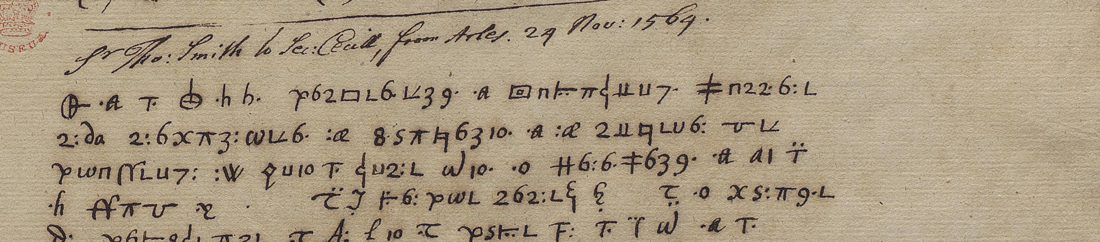
Add MS 4136 is Forbes’s deciphering file for his Full View. For each despatch he copied only what was in cipher, numbered the stretches (1), (2), … in the order they come in the letter, and headed the group with writer, recipient and date. The clear English place names scattered through the copies (London, Dover, Hastings, Lyn, Boston, Poole, Dunkirk…) and the words and, bycause, don, yf are Smith’s nulls: the key lists them under “Nothings”.
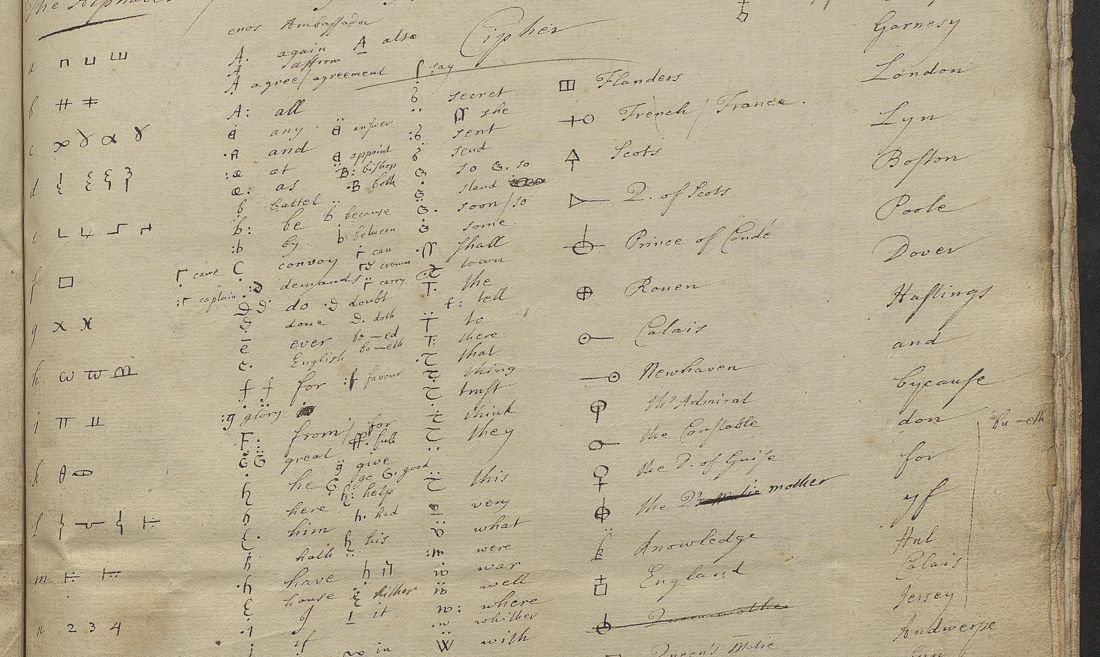
The alphabet gives each letter from a to m one to four invented signs, and n, o and p the figures 2–4, 5–7 and 8–10. The same figures with a dot are r and s, and with a colon t, u/v and y, so 6 is o, 6. r and 6: u. Common words are Latin letters marked with dots, colons or bars on different sides (·A and, A: all, :a at, b: be, :b by, F: from, :W which, Ẅ with), and da and ba are the endings -ing and -ed. About thirty signs stand for names: the Admiral, the Constable, the Duke of Guise, the Queen Mother, the Prince of Condé, the Cardinal of Lorraine, the Queen’s Majesty, England, Scotland, France, Spain, the Pope.
| Record | Folio | Letter | Read here | Printed or calendared |
|---|---|---|---|---|
| R9248 | 157 | to the Queen, Chartres, 17 Jan 1562/3 | tested on two passages | Forbes ii 287–9; CSP F. vi 109 |
| R9249 | 158 | to Cecil, 27 Jan 1562/3 | all 32 passages | Forbes ii 315–18 |
| R9252 | 163–4 | to Cecil, Blois, 7 Mar 1562/3 | about half | Forbes ii 350–51 |
| R9254 | 167–8 | to the Queen, Blois, 12 Mar 1562/3 | not transcribed | Forbes ii c. 354–59 |
| R9250 | 159 | to Cecil, 13 Apr 1563 | all 12 | Forbes ii 384–86 |
| R9250 | 159 | to the Queen, 27 July 1563 | in part | CSP F. vi 1078 |
| R9250 | 159 | to Cecil, 25 Jan 1563/4 | large part | CSP F. vii 103 |
| R9252 | 164 | to Cecil, Valence, 1 Sep 1564 | 28 of 31 | CSP F. vii 642 |
| R9252 | 164 | to Cecil, Valence, 3 Sep 1564 | both | CSP F. vii 650 |
| R9252 | 164–5 | to Cecil, Avignon, 4 Oct 1564 | about 50 of 62 | CSP F. vii 714 |
| R9253 | 166 | to Cecil, Marseilles, 13 Nov 1564 | in part | CSP F. vii 793 |
| R9253 | 166 | to Cecil, Arles, 20 Nov 1564 | large part | CSP F. vii 806 |
| R9253 | 166 | to Cecil, Arles, 22 Nov 1564 | in part (two signs) | CSP F. vii 808 |
| R9253 | 166 | to Cecil, Arles, 24 Nov 1564 | all but a few signs | CSP F. vii 815 |
| R9254 | 167 | to Cecil, Narbonne, 7 Jan 1564/5 | large part | CSP F. vii 916 |
| R9254 | 167 | to Cecil, Toulouse, 9 Feb 1564/5 | all 10 | CSP F. vii 979 |
| R9250 | 159–60 | to Cecil, Bourbon-l’Archambault, 22 Mar 1565/6 | about 12 of 27 | CSP F. viii 208 |
| R9250 | 160 | to Cecil, 29 Apr 1566 | all 5 | CSP F. viii 327 |
02 1563: the passages Forbes printed
The first test passage, in the letter to the Queen of 17 January 1563, came out as chief … on the other side, and Forbes (ii 287) prints: “I do take yt marvelous necessary, that some man were sent to be with the admirall who now is chief on the other side.” In the letter to Cecil of 27 January all 32 stretches run with Forbes’s text in order: the rendering of Tankervill; that is to have one on the other side with the admiral, and I have named him who, for th’acquaintance with the admiral and all of that faction, the knowledge of the countrey and all other respectes, is most fit. But you must dispach him streight; you must not stic for honest allowance in tyme of service; Monsieur Danville is to come over into England shortly; such noblemen of Scotland as favoreth the religion and wold contynew the amytie between Scotland and us. The letter of 13 April is decrypted in full, the Blois letter of 7 March about half.
03 1563–1566: the passages the calendar only summarises
Arles, 24 November 1564 (“chiefly in cipher, deciphered”, CSP no. 815): “[The Cardinal of Lorraine] and the [Prince of Condé] have had conferens and familiar banketting togither at Soissons and at Nanteuil chasteau, which was the late [Cardinal] of Burbons’ … They of Guyse … complaine that all letters that come from the Cardinal … be opened, principally at Paris and Lyons … Madame de Guise … daily in great dispatches to and from Scotland … This bearer Hume is altogether a Lidington, whom you shall find double, I am afraid, or rather triple, having … pencions of all three princes.”
Avignon, 4 October 1564 (CSP no. 714; Forbes’s heading had been taken as 27 October): the two designs of the French court, one of them of the papists, to bring “all again to the olde state” and “break the amity” of England and Scotland; “the Bishop of Glasgow is here greater, no embassador”; “the marriage of the Queen of Scots”, the Earl of Warwick, Lord Robert and the Prince of Spain, “two marriages for her”; “the house of Guise stronger, which is too stronge”; the Earl of Lennox’s practice “to marry his sonne”, and “they feare that she is enclined to this last offer of Lenox”.
Valence, 1 September 1564 (CSP no. 642): the amity between England and Scotland, the Earl of Murray, “such lords and great men … be the great favourers of religion … to do some great enterprise”, Huntly “died and his sonnes were taken”, Lethington, the Bishop of Glasgow’s pension, and “to marry Lord Robert”. On 3 September the two ciphered words are names: Nanion Cocborne and Villeroy.
25 January 1564 (CSP no. 103): the Spanish ambassador reports the French making ladders at Étaples and Boulogne, to surprise a town in England or fall on the Low Countries; the King of Spain has made no league with the Pope and means nothing against the Queen of Navarre, but wants “to make himself rich”.
The other letters are shorter. Arles, 20 November, on the bearer Adam Hume, runs almost word for word with the calendar up to “glad to be rid of him”. Narbonne, 7 January 1565, covers the posts out of Scotland, Beton and Hume going by land, and “the marriage between the Duke of Guise and the Queen of Scots”. From Bourbon-l’Archambault, 22 March 1566, come the ambassadors of Spain and Scotland with the Cardinal of Lorraine, the Bishop of Glasgow looking to be a cardinal, and a Scottish woman who is “the conveyor of [letters] out of Scotland to the [Lady] Lennox”. And 29 April 1566 names “Peter Clare … Almain captain … Albert de Rosemberg”, and the “continuation with the princes of Almain for the recovery of Metz and Calais”.
04 Folio 140: five earlier letters (DECODE R9236)
A seventh record, R9236 (Add MS 4136 f. 140, catalogue 94), is another of Forbes’s leaves: the ciphered passages of Smith to Cecil of 15 October, 20 October and 15/17 December 1562, to the Queen of 4 November 1563, and of “Sir Thomas Smith’s advertisements from France, 31 Jan. 1562[/3]”. The clear words scattered through them (London, Lyn, Poole, Boston, Dover, Hastings, Garnesey) are the nulls of the same key, R9261; DECODE names R9262 as the nearest key, which is Throckmorton’s. Decryptions, added 21 September 2026:
- 15 October 1562, all six passages: the Scots, the Queen of Scots, “break with you and to make war”, “that the hostages which you have shall be convoyed”, Flanders, Rollet and Monsieur Vyllemort. These agree with Forbes, Full View ii 119.
- 15/17 December 1562, all six: “I see, you must hold ferme and fast: Frenchmen will come to reason but compellid … to trust no Frenchman of what religion soever he be … the Prince of Condé, which I do not believe … as soon as ever they be able, they will thither [bend] all their force”. These agree with Forbes ii 238.
- 4 November 1563, to the Queen, decrypted in full and confirmed by the calendar (CSP Foreign vi no. 1366): “…de Montaigne … whose carte of La Rochelle … under another pretence. I have given letters to my Lord Robert and Mr Secretarie … from Rouen … wrote of that same matter … I thinke he can do. But this at this tyme is most necessarie.”
- 20 October 1562, all four passages, with Forbes ii 122 as the check: [Newhaven] is not so strong as supposed; if it were summer they would attempt to afray our men thence “with a garden of chamillion upon the hill on this side”; things begun there by [France] be not perfit.
- 31 January 1562/3, the advertisements: only passage (2), “the queen of Navarre”, is decrypted; (1), (3) and the last line remain fragments, and no printed text was found to check them against.
One variant appears on this leaf only: a double bar stands for i. Passage-by-passage decryptions are in smith1562/decipher_E.md.
05 Method
The six records and the Smith-series key records were fetched from DECODE. The first key record DECODE names, R9262, is Throckmorton’s third cipher. The record listing around it gave R9261, whose first page is Smith’s cipher and whose second is Sir James Croft’s. The passages were transcribed from the images and the key applied sign by sign. Forbes’s printed letters (vol. ii, from the archive.org text) and the calendar summaries were used only to confirm decryptions; where they did not fit the signs the passage was left open. Values added to the key:
- enos, listed at the top of the key among the nulls, is “Ambassador”; a marginal gloss on the 20 November letter spells it out.
- M̅ and M̈ are marriage and marry, B: is Bishop, C̄ is Congregation, J̣ is is or are, ! is in or into.
- The doubled long-s signs are st, the small open v is l, and a looped kite with a stem is w.
- A variant of the England sign stands for Earl (before Murray, Lennox and Warwick). The flag sign, the key’s “Germany” or “the Emperor”, stands where the calendar names Archduke Charles.
- Forbes’s copying slips: a single dot for a colon, 4 for e, ⊔ for π.
06 What remains uncertain
- The hooked-T family of word signs (here, his, they, this, thing) is interpreted from context; Forbes’s dots on it are inconsistent (C).
- Undecrypted word signs: ẓ, ï, C·, F̄ and the ḧ-like sign in 1 September passage 2.
- Letters decrypted only in part: 7 March 1563 (passages 2, 9, 10, 13, 14), 27 July 1563, Marseilles 13 November 1564 (3, 10), Arles 22 November 1564, 22 March 1566 (1, 2, 4, 10, 11, 15, 20, 25, 26). The 12 March 1563 letter is in Forbes and was not transcribed.
- Marseilles (5): the key’s sign for Calais where the calendar has Dieppe.
- Avignon passages 22–23 (“by litle and litle and by … great”) and 8–11 have no counterpart in the calendar summary (M).
07 Sources
- British Library, Add MS 4136 ff. 157–168 and 179, via DECODE R9248, R9249, R9250, R9252, R9253, R9254 and R9261 (images not republished beyond the two details above).
- Patrick Forbes, A Full View of the Public Transactions in the Reign of Q. Elizabeth, vol. II (London, 1741), pp. 287–89, 315–18, 350–59, 384–86 (Internet Archive, bim_eighteenth-century_a-full-view-of-the-publi_1740_2).
- Calendar of State Papers, Foreign, Elizabeth, vols. vi (1563), vii (1564–65), viii (1566–68), British History Online.
- Satoshi Tomokiyo, “Ciphers in the Elizabethan era”, Cryptiana (elizabeth.htm): Smith’s cipher, its sample in Rees’s Cyclopaedia, and the key at Add MS 4136 f. 179 (note of November 2024).
Notes, the key summary, the passage-by-passage decryptions and the profile are in the repository folder smith1562/. The sibling pages Throckmorton and Percy 1559 use the same volume.