01 A key test on the first leaf
R9220, f.110, begins in the middle of a letter. Its first complete numbered extract, (6), decrypts to:
all be it i be revoked or the warr breake
In modern English: “albeit I be recalled, or war break out.” Throckmorton is asking Cecil to obtain permission for Mr Jones to remain abroad and gain experience, even if the ambassador is recalled or war begins. Forbes prints the phrase in volume I (1740), p.355, within the 7 March 1559/60 despatch. The same leaf includes the 8 March continuation and the separate letter to the Queen of 9 March.
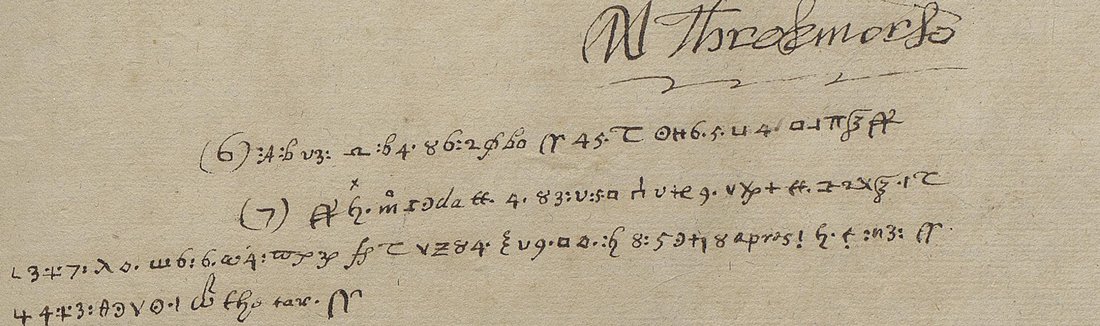
The 27 transcribed cipher tokens include two nulls. The alphabet on R9262 image P1 supplies the letters: dotted 4, 5 and 6 all represent r; plain 4 represents o; colon-marked 6 represents u/v. P3 gives the marked A for all and marked b for be. P4 gives the suffix -ed, and P9 gives the curved T for the/to. The check therefore covers the alphabet, the word symbols, the suffixes and the nulls together. The word before breake is warr, written with two different r homophones; it is not wars.
R9230, f.133, offers a second check at the opening of extract (1):
orleans or burges
These fifteen alphabet tokens agree with Forbes II (1741), p.12. CSP Foreign V, no.425, paragraph 11 summarizes the surrounding warning: the apparent preparations against Orleans or Bourges may conceal an attack on Rouen, Newhaven (Le Havre), and Dieppe. No.426 describes a separate decipher of the ciphered passages. The rest of that sentence has not been transcribed token by token here.
Both checks have grade H: values taken from the archived key. Spacing and capitalization are editorial. The printed texts were at hand during the check, so these are known-plaintext checks rather than blind decryptions. The token labels and values are preserved in control.json and control_9230.json, with a replay script. The script checks the substitution of those labels; the identification of each glyph rests on inspection of the images.
02 Four nearby key records
| Record | Leaf and contents | Use here |
|---|---|---|
| R9257 | f.172; Percy extracts above a separate alphabet and nomenclator | Not established as a Throckmorton key |
| R9260 | ff.177–178; a preceding fragment and Throckmorton's first/second keys | Earlier systems, not the key tested here |
| R9261 | f.179; heading “Sr Thomas Smith's Cipher” | A different alphabet, relevant to distinguishing Smith material |
| R9262 | ff.180–185; “Sr Nicholas Throckmorton's Third Cipher,” eleven photographs | Matches both sampled passages |
The third cipher is a nomenclator: homophonic letters, code symbols (marked initial letters) for words, names and places, symbols for word endings, and nulls. Dots distinguish values; these samples do not use two-digit superscripts. The key sheets in the volume are reconstructions, and their catalogue date does not show that they are the keys used at the time.
03 Record-to-edition concordance
Each row gives the printed counterpart; passages were checked against the cipher only where stated. CSP often abridges the full letters. Dates use January-start years: March 1559 becomes March 1560, and January 1562 becomes January 1563, without changing the day. R9234 remains 1 November 1563. Shared leaves must be separated at the letter headings before assigning their passages.
| DECODE | Folios | Date | To | Published source | Evidence and limits |
|---|---|---|---|---|---|
| R9220 | 110 | 7–8 March 1560 | Cecil | CSP 2, 837; Forbes I, pp.352–356; control on p.355 | Key control verified; shared leaf also contains R9221. |
| R9221 | 110 | 9 March 1560 | Queen | CSP 2, 844; Forbes I, p.356 | Date/addressee match; same image as R9220. |
| R9222 | 111–112 | 9 March 1560 | Cecil | CSP 2, 845; Forbes I, p.358 | Date/addressee match. |
| R9223 | 112–116 | 15 March 1560 | Queen | CSP 2, 859; Forbes I, p.360 | Date/addressee match. |
| R9224 | 116–118 | 15 March 1560 | Council | CSP 2, 860; Forbes I, p.369 | Date/addressee match. |
| R9225 | 118–120 | 21 March 1560 | Queen | CSP 2, footnote 1; Forbes I, p.376 | CSP prints this in a footnote because the State Paper Office original could not then be located. |
| R9226 | 120–122 | 21 March 1560 | Cecil | CSP 2, 882; Forbes I, p.384 | Date/addressee match. |
| R9227 | 122–123 | 21 March 1560 | Council | CSP 2, 881; Forbes I, p.382 | Date/addressee match. |
| R9228 | 123–129 | 24 September 1562 | Queen | CSP 5, 690; Forbes II, p.61 | Date/addressee match. |
| R9229 | 129–133 | 15 October 1562 | Queen | CSP 5, 848; Forbes II, p.111 | Date/addressee match. |
| R9230 | 133 | 5 August 1562 | Queen | CSP 5, 425; Forbes II, p.12 (sampled passage); CSP no.426 is the separate decipher | Orleans/Burges passage matched to CSP paragraph 11 and the corresponding Forbes letter. |
| R9231 | 134 | 9 September 1562 | Queen | CSP 5, 596; CSP V, no.596 | Date/addressee match. |
| R9232 | 134–135 | 9 September 1562 | Cecil | CSP 5, 597; CSP V, nos.597–600 (two same-day letters and copies) | Opening refers to dispatching Francisco on the ninth. No.597 is the principal candidate; keep no.599 for comparison. |
| R9233 | 135–136 | 30 October 1562 | Cecil | CSP 5, 935; Forbes II, p.156 | Date/addressee match. |
| R9234 | 136–138 | 1 November 1563 | Queen | CSP 6, 1356; CSP VI, no.1356 | Manuscript date agrees with 1563; do not change to 1562 just because preceding letters are earlier. |
| R9242 | 149–150 | 3 January 1563 | Queen | CSP 6, 12; Forbes II, p.251 | DECODE uses old-style 1562. |
| R9243 | 150–151 | 6 January 1563 | Queen | CSP 6, 35; Forbes II, p.270 | DECODE uses old-style 1562. |
| R9244 | 151–153 | 13 January 1563 | Queen | CSP 6, 83; Forbes II, p.275 | DECODE uses old-style 1562. |
| R9245 | 153–155 | 20 September 1563 | Cecil | CSP 6, 1233; CSP VI, no.1233 | Date/addressee match; CSP explicitly says cipher deciphered. |
| R9255 | 169–171 | 22 November 1562 (Throckmorton portion) | Queen | CSP 5, 1099; Forbes II, p.208; CSP no.1100 is the deciphered copy | Composite record: Smith, Throckmorton, Somer and Randolph. Throckmorton is on ff.169–170. The catalogue author Lomer is apparently Somer. Other writers require separate keys. |
R9232 is a provisional match to CSP V no.597: the opening mentions dispatching Francisco on the ninth. Nos.599–600 are other same-day Cecil material and remain comparison candidates. R9255 is composite: the Throckmorton portion matches 22 November 1562, CSP V nos.1099–1100, but the Smith, Somer and Randolph material requires separate identification and keys.
04 Prior work and the target description
Satoshi Tomokiyo's Elizabethan cipher study already identifies the Add MS 4136 ciphertexts as largely extracts, cites Forbes, reconstructs three Throckmorton ciphers, and records the archive keys in a November 2024 note. Neither the key nor the plaintext is new here. DECODE's status for these records means only that no decipherment is attached to the record; the plaintext has been in print since the 1740s.
The remark about meaningful two-digit superscripts comes from the neighbouring Serno Gilino/Bishop of Worcester entry on Tomokiyo's Unsolved Historical Ciphers page. It was misattributed to Throckmorton in the target description. Tomokiyo's two specifically unresolved cases are the marginal ciphertext on R2988 and John Wod's 1568 material on R2989. Both lie outside these twenty records and remain unresolved here.
05 What is established, and what is not
All 71 referenced image files passed JPEG signature checks and have SHA-256 hashes in the research inventory. The 54 target references contain 39 distinct images, including a byte-identical R9220/R9221 pair. Two short passages, totalling 42 tokens, were checked against the third cipher. Their published counterparts agree.
No token count or percentage is claimed for the whole corpus. Most record-to-edition matches have not been checked glyph by glyph. A diplomatic edition would require transcribing the 39 unique leaves, separating all letter boundaries and other writers, and aligning every numbered extract with the printed text. The result answers the target's premise that the key was unknown. It is not a complete edition of the twenty records.
06 Sources
- British Library, Add MS 4136, via the DECODE records linked above. Manuscript photographs remain in the private research cache; only the credited crop of f. 110 is shown on this page.
- Patrick Forbes, A Full View of the Public Transactions in the Reign of Q. Elizabeth, I (1740), especially p.355; II (1741), especially p.12. Cached OCR is a finding aid, not a facsimile transcription.
- Calendar of State Papers, Foreign, Elizabeth, II, V and VI, British History Online; individual entries linked in the concordance.
- Satoshi Tomokiyo, English Ciphers during the Reign of Elizabeth I, Throckmorton sections, and Unsolved Historical Ciphers.
Research files, exact token labels, source inventory and published-text dossier: throckmorton/.