
01The letter and its ciphered passage
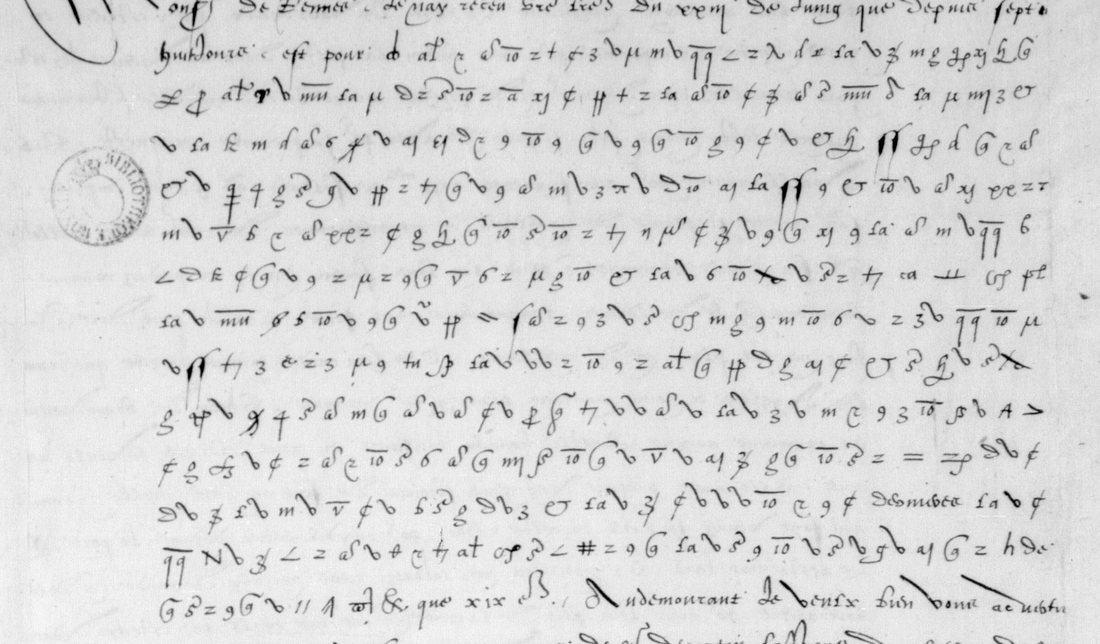
Bochetel had written on 18 June. Catherine, at the camp before Le Havre while the English garrison embarked, replied on the last day of July. La Ferrière prints her text from this very folio (« Orig. Bibl. nat. fonds français, n° 3181, f° 55 r° et v° »), and it runs:
Monsieur de Rennes, je n’ay receu vostre lettre du xviiie de juing que depuis sept ou huit jours, c’est pour [ ]
— footnote: Partie chiffrée.Au demeurant, je veulx bien vous advertir que, après avoir essayé tous moyens de faire départir la royne d’Angleterre de la place du Havre-de-Grâce qu’elle avoit occupée durant ces troubles…
That bracket is the thirteen lines. Everything after it (the siege, the plague among the English, the artillery and ships left behind, the hope that the French and the English « n’auront plus que faire ensemble ») Catherine sent in clear.
02The cipher and its clear-word nulls
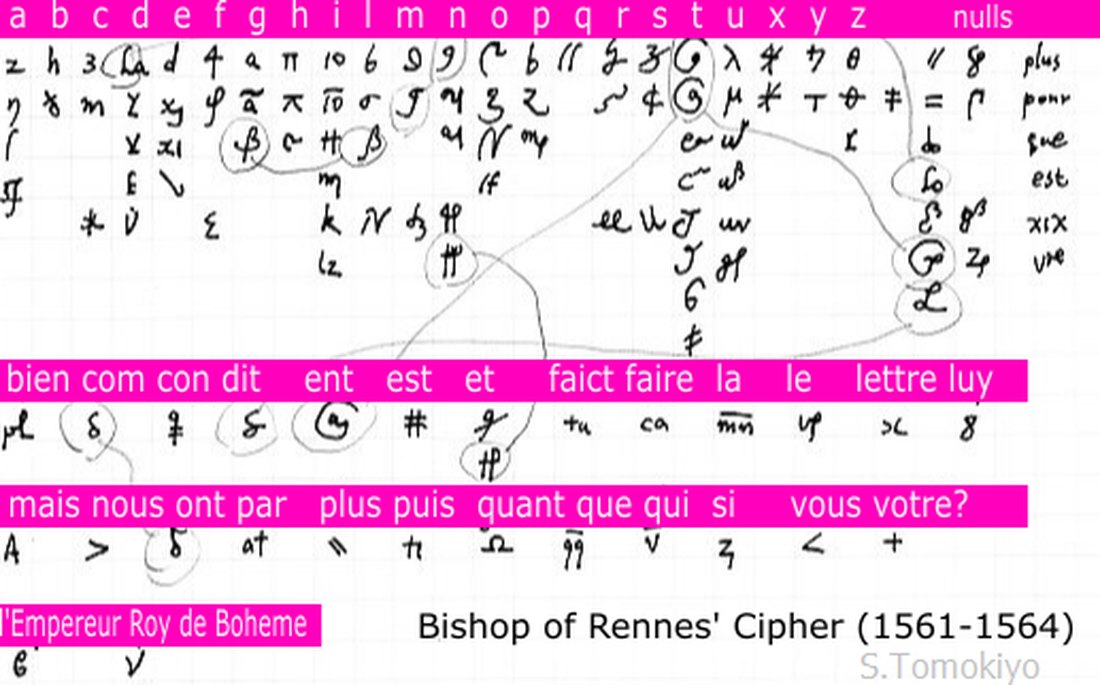
This is the Bishop of Rennes’ cipher, in use between 1561 and 1564 for the embassy to the Emperor. It is homophonic: two to eight invented signs for each letter, an overbar to tell close shapes apart, about thirty word-signs (que, vous, nous, vostre, qui, mais, par, la, le, lettre, bien, faire, faict, and signs of their own for l’Empereur and Roy de Boheme), and a set of nulls.
Besides meaningless squiggles, the key allows ordinary French words written out in clear as nulls: que, est, pour, plus, xix, vre, do, fo. They are scattered through the cipher so that a reader glancing at the page sees what looks like ordinary writing interrupted by symbols, and a codebreaker who takes them for cleartext is misled. On f. 55 the last line ends with a run of five of them before the clear text resumes.
03A crib from a glossed letter in the same hand
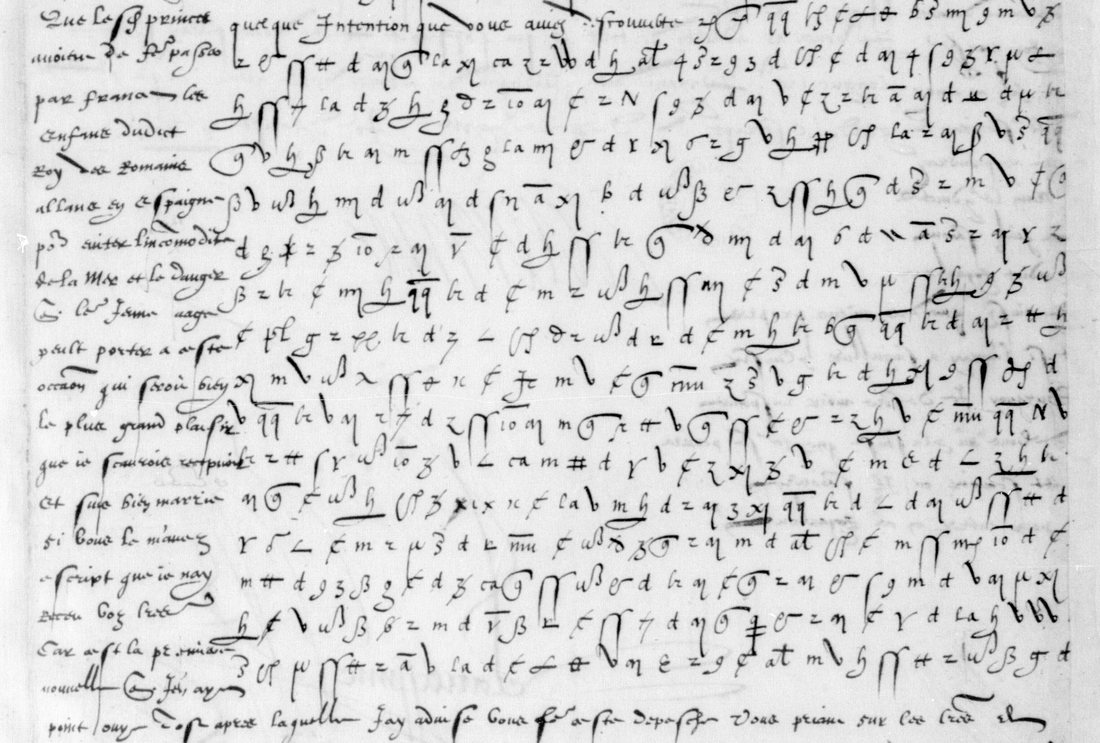
A key drawn as a table of shapes does not settle how a given scribe forms each sign. Several of this scribe’s forms are near-identical (the s-shapes that serve r and s, the c-shapes that serve o, h and t, the loops that serve e and l), and the table does not say which is which in his hand. This was settled by f. 57, the letter of 13 August 1563, thirty-eight views on in the same volume. Its ciphered passage carries a decipherment written down the left margin, phrase by phrase, line for line.
Aligning the margin with the cipher gives an exact crib. The first ciphered line of f. 57 glosses as que les princes, and the signs are q̄q̄ · l · e · s · p · r · i · n · c · e · s: seven signs for « princes », which fix p, r, i, n, c, e and s. The margin runs on: moien de se passer par Ferrare les enfans dudict Roy des Romains allans en Espaigne, pour eviter l’incomodité de la mer et le dangier que les temps aigres peult porter a ceste occasion… Every phrase of it is another handful of confirmed shapes.
04The decipherment of f. 55
The first decryption, made from a single transcription and a direct table lookup, secured about three fifths of the passage. A second transcription from native-resolution crops, decrypted with a language model (section 09), and a full alignment of the margin decipherments of f. 57 and f. 58 (same scribe, same cipher) now put about 91% of the signs into French: some 80% secure and 11% probable. The glosses settled the looped d-like sign that had been taken as e, s or u: in all of its twenty-odd glossed occurrences it is e. They also gave ʃʃ = le, an underlined dagger = con, an underlined u = pour. One correction to the record: the f. 57 margin reads « par France », not « par Ferrare ».
[c’est pour] … vous avez descouvert. … vous par … la [matière] du mariage, et vostre advis sur la conduicte d’iceulx en … mon intention se trouve toute conforme, et ayt tenu ce chemin, dont … ce qui pourra sortir. J’ay aussi entendu ce que l[e …] vous mist en avant, qui l’avoit délibéré faire pour le bien de la Chrestienté et avancer le concile, à ce que je veoy chacun faict … par[t], et monstrer b[onne et] fructueuse … de ce concile. Mais nous sommes à voir l’utilité qui en sortira, mesmes ce qui se promect des sessions de Decembre, desquelz vous avez oy parler, vous estant dernierement à … Trante.
In English: … you have discovered … about the marriage, and your opinion on how to handle them … my intention is entirely in accord, and [I hope] he has kept to this course … what may come of it. I have also heard what [someone] put to you, who had resolved to do it for the good of Christendom and to advance the council, so that, as I see, everyone does his part and shows a good and fruitful [outcome] of this council. But we have yet to see what good will come of it, and what is promised from the December sessions, of which you have heard, having lately been at … Trent.

05Why it was in cipher
The subject is the Council of Trent and the marriage negotiation with the house of Austria: the two things Catherine had reason not to send in clear through the empire in the summer of 1563, and the two things she left out of the open part of the letter. The Havre had just fallen and Charles IX’s majority was about to be declared: those were things to be published. What went under the cipher was the ecclesiastical and dynastic bargaining the crown was conducting at Trent and Vienna at the same moment. The council closed on 4 December 1563, the « sessions de Decembre » of the last line.
06Colbert 390 pp. 357–358: leaving the precedence quarrel (1564)
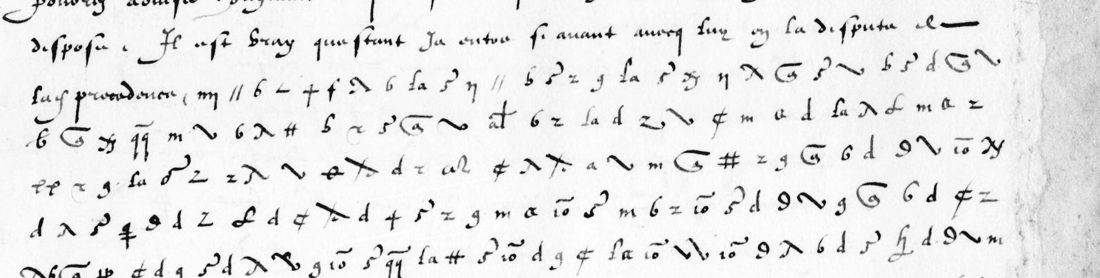
An undated letter to Rennes in Cinq cents Colbert 390, pp. 357–358 (views 180–181), signed by Catherine and countersigned by de l’Aubespine. The upper third of p. 357 is clear: the secretary Charron has arrived, and with him the Emperor’s reply on the dispute over la précédence. Fifteen lines of cipher follow, and ten more at the head of p. 358 before the clear « Le Sr de Lanssac n’est point encore arrivé ». Tomokiyo lists the page as having no contemporary decipherment, and La Ferrière does not print it. The printed letters on the same quarrel (27 June and 18 August 1564, the latter ordering Rennes to attend Ferdinand I’s obsequies and « n’y rien cedder ») place it in the late summer of 1564. About 99% of its 753 signs are decrypted (88% secure, 11% probable):
il fauldra prandre autre pretexte que celuy porté par la depesche du s[ieu]r Charon, dont vous avez beau subject, estant l’ennuieux, ce me plest de franchir clairement les a[utres] …, et s’en revenir, que de riens dissimuler, [re]mectant l’amendement de cela au temps et aux ocasions qui se pourront offrir cy après, et sans avoir [à] opérer l’effect de[s] deffiés, que ny autres d’en aucun maniement ny ouverte negociation de vostre part. Bien pourrez, ainsi que porte ma dernière depesche, laisser là quelque secretaire ou aucun des vostres, advisés soubz couleur d’aucuns voz affaires particuliers, de deniers qu’avez envoyé querir ou autres choses que vous attendez, qui puisse faire sçavoir toutes nouvelles de ce qui s’o[ffr]ira, principalement de ce qui se peult esperer de l’[ajour]nement de la diète et de ce qui se preparera à y decider, de quoy vous pourrez paraventure [avoir] toute lumière avant vostre dit partement; que je remects à vous de disposer, à propos, mouvement, avancement ou retardation d’iceluy ne face prejudice à la reputation du Roy ny à l’amitié que je desire estre conservée entre ces deux princes.
The order of 18 August is reversed. Rennes is to find another pretext than the one Charron carried and withdraw without conceding anything: no open negotiation, the remedy left to time. He is to leave a secretary or one of his own people at the imperial court under cover of private business (money he has sent for, things he is waiting on) to report all news, above all on the Diet; and the timing of his own departure is left to him, so long as neither haste nor delay harms the King’s reputation or the friendship between the two princes. Not decrypted: six signs on p. 358 before toute lumière ([avoir] is restored from the sense), and whether the Diet’s word is ajournement or gouvernement.
07Colbert 392 p. 231: Bourdin on the secret overture (December 1562)
A letter of about twenty-five cipher lines under the salutation « Monsieur », in Cinq cents Colbert 392, p. 231 (view 112). Its clear ending is on the next page (view 113): « De Paris le …e jour de decembre 1562 », signed by the secretary of state Jacques Bourdin. The letter Bourdin encloses is Catherine’s to Rennes of 15 December 1562 (La Ferrière I, 448–451), whose marriage paragraphs La Ferrière printed from the decipherment joined to it: the overture for one of the Emperor’s daughters made through the archbishop of Trier. The cipher is in a third secretary’s hand, with its own forms (a tailed 2 for p, a looped ʒ for r, + for f, a double dagger for et, ‖ for the word plus). About 85% is decrypted:
Monsieur, je vous envoye la lettre que [Madame] la Royne escript [à vous] sur le faict dont vous m’avez donné advis. Dernierement pour advise[r] que l’en ne luy parle de la secrete, qu’elle a en vous, en moindres paroles et termes que de luy dire, ne l’asseurer, qu’elle la trouve telle que de sa propre personne; de sorte que si le[dit] … Roy n’y est retenu en ce que l’on desire d’aultre occasion que celle-là, il n’y [a] plus … devera plus faire de difficulté. Au demeurant [je] vous advise que ce que je vous mande, que … sçavoit incontinant en Espaigne. Tous les pro… que [luy?] teniez secret … ne fut pas s[a]ns occasion, [et] nous eusmes advis que [s]a femme nous [a]voit [fait?] triumphe de la premiere ouverture que vous luy feistes de [ce] mariage. Je croy bien que de nous il y aura à peu changer d’advis [et] conseil, me semble, que … en donne assez, com[me] en grande occasion. Dieu veuille que toutes [choses] se conduise[nt] et succede[nt] au commun desir et contentement de [leurs] Majestés, et avec un tel et si ferme establissement d’amitié et alliance que … nous tous en ressentions, tant d’une part que d’aultre, le bien et l’utilité, à l’honneur de Dieu et [au] repos de la chrestienté.
The secret of the overture has leaked: what Rennes reports was « known at once in Spain », and « his wife » (most likely Maria, Queen of the Romans and Philip II’s sister) made a triumph of the first opening Rennes made of the marriage. Bourdin’s own clear continuation on p. 232 (« faire changer d’opinion ») echoes the cipher’s « changer d’advis et conseil ».
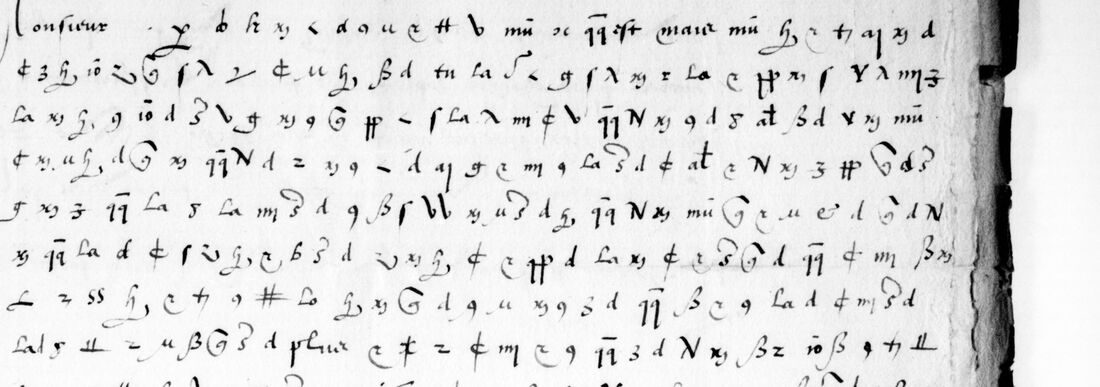
08Colbert 390 p. 139: « Deschiffrez vous mesmes »
A small sheet bound as p. 139 of Cinq cents Colbert 390 (view 70), fourteen faint lines of cipher under three clear-looking words, and beneath them a clear instruction: « Deschiffrez vous mesmes ceste cy et ne vous en fiez en clerc ny secretaire que vous ayez, et la mettez au feu si tost que vous l’aurez veue. » Tomokiyo noted that it uses nulls not only at the ends but between words and inside them. The facing p. 138, in the same secretary’s hand, carries a ciphered paragraph with its decipherment in the margin (« Et pource qu’il m’a semblé que je ne sçaurois trouver ung plus digne et suffisant personnage pour faire parler à mons[ieu]r mon [beau] frere du mariage… »), which gave this hand’s forms; other glossed pages in the volume (pp. 189/199, 221–231) added more. Two first attempts that let the language model choose nulls freely produced fluent nonsense and were discarded. A fresh transcription from contrast-enhanced crops now gives about 37% secure and 28% probable decryption:
[Envoyez que par] … que je vous tienne pour trop advisé et affectionné et loyal serviteur du roy mon fils pour vous en … bien … chose qui est … et en son service … vous dire qu’il vault bien que vous [ayez] les yeux ouverts pour observer … ce de mon cousin …, que les … [CODE] ses actions, encores que je … aucune … doubte, afin … advis, et tout ce que vous congnoistrez … le mér[i]ter, [CODE] … l’envoyez … beau frère … [se] sépare des [CODE] … bien.
The three [CODE] places are signs of the form ẟ with a small letter above it. The full decipherment of p. 117 on pp. 120–121 shows this form is a code word: ẟ with a raised a stands for Allemaigne, and on p. 347 ∂ with a raised l stands for Metz. The one before « ses actions » names a person Rennes is to watch (the Emperor fits), and the one after « des » is a plural. Neither occurs in any decipherment found, so both stay undecrypted.
Catherine (the « roy mon fils » fixes the writer) tells Rennes she holds him too wise and loyal a servant to need telling, but that he must keep his eyes open and watch the doings of « mon cousin » and send her everything he learns. The decrypted text does not name the cousin. The sheet sits among the copies of her 1562 letters to Condé that she sent to Rennes; the Cardinal of Lorraine, whom she calls « mon cousin » in the letters of 1563, is the other candidate. A control re-run with the values from the glossed pages withdrew four earlier decryptions of this sheet (among them passeront and fault) and added four; the text above is the result after that check.
09Method
Images by IIIF region request from Gallica at native resolution (8720 px for français 3181, about 6300–7600 px for the Colbert volumes); in français 3181 the folio number is the Gallica view plus nineteen. Each cipher line was transcribed glyph by glyph from crops at native or double resolution, with contrast enhancement for the faint p. 139. Every sign was then given its candidate values (usually one; two where the hand leaves a homophone ambiguous; a null option only for known null shapes), and for each line a French n-gram language model of sixteenth-century despatches chose the most probable combination of those candidates (rennes1563/lattice.py, the shared lang/ model fr-1530-despatches). Letting the model choose among many nulls produced fluent nonsense on p. 139; with the candidates held narrow it cannot invent text.
The calibration also used every full decipherment found in Colbert 390 (p. 317 against p. 313, p. 117 against pp. 120–121, p. 189 against the slip on p. 199) and the margin-glossed letters of 1561 (pp. 49–69) and 1564 (pp. 339–349). The sister volumes Colbert 391, 394 and 395 contain no deciphered passage in this cipher. The key is Tomokiyo’s, but each of the four letters is in a different secretary’s hand, and the hands form the same signs differently. The values for each hand were fixed on letters in that hand carrying contemporary decipherments: f. 57 and f. 58 for f. 55; p. 138 and the glossed pages 189/199 and 221–231 of Colbert 390 for p. 139 and the Bourdin letter. The glossed pages 241–305 of Colbert 390 are in the hand of français 3181 f. 52, not of f. 55, and added little. La Ferrière’s two volumes were searched for parallels; none of the four passages is printed there.
10What remains uncertain
- f. 55, about 9% of the signs: the opening, two signs on line 2, one on line 3, the runs « 10 ᑲ ɗ xy ee z r » (line 4), « ß La ᑲ ᑲ z 10 9 z » (line 8) and « ‡ G̃ ꜧ ᑲ ᑲ ɗ ᑲ ᑲ » (line 9), one sign on line 11 and two before Trante. None of these signs appears in a glossed passage in this hand.
- Colbert 390 pp. 357–358, about 1%: six signs on p. 358 (line 4–5) and the head of [ajour/gouver]nement. Probable (grade C): estant l’ennuieux, ce me plest (p. 357 line 3–4), vostre part, s’offrira, diète.
- Colbert 392 p. 231, about 20%: short runs in lines 4, 5, 7, 8–9, 11–17 and 22, built on signs (W, ss, tt, πꝫ, t7, a sign read « maue ») that occur once or twice and in no glossed passage found. Madame, à vous and [s]a femme rest on context and the crib (grade C).
- Colbert 390 p. 139, about 37%: most of lines 3–4, 7, 8–10 and 12–14. Faint ink, heavy nulls, and eight signs (ẟ, ẟao, ẟar, ℛ, ℞, aʓ, Ꝫ, ſſʓ) that occur in no glossed passage. The probable readings (27%) each force one value (grade C).
The rest needs more text in the same hands with its decipherment beside it (another glossed letter from the secretary of f. 55, or from the secretary of p. 139), or the decipherments that were once joined to these letters. The key itself is not the limit.
11Sources
- BnF, français 3181, f. 55 (Catherine de Médicis to the bishop of Rennes, 31 July 1563), Gallica ark btv1b9059845t, view 36.
- BnF, français 3181, f. 57–58 (13 August 1563), the glossed sibling in the same hand, views 38–39; f. 52 (another hand), view 33.
- BnF, Cinq cents Colbert 390, view 70 (pp. 138–139), view 180 (p. 357); glossed pages at views 95/100, 111–116, 121.
- BnF, Cinq cents Colbert 392, views 112–113 (pp. 231–232).
- Hector de La Ferrière, Lettres de Catherine de Médicis, I (1880), pp. 448–451 (15 December 1562), and II (1885), pp. 79–81 (« Partie chiffrée »), 199–201, 216–217, Internet Archive.
- S. Tomokiyo, “French Ciphers during the Reigns of Charles IX and Henry III”, cryptiana.web.fc2.com: the reconstruction of the Bishop of Rennes’ cipher, and the list of these four items as undeciphered (no contemporary decipherment known).
Working files: rennes1563/: the sign transcriptions (f55_v2.txt, c390_p357.txt, c392_p231n.txt, c390_p139_v3.txt), one decryption file per letter, the glossed-sibling tables (fr3181_glossed.md, colbert390_glossed.md), the crib notes (cribs.md) and the decoder. Page images are not committed.