At a glanceCiphertext-only break · partial (96% of the cipher)
- The letters
- Louis XIII to Melchior de Sabran, French resident at Genoa, Dijon, 28 March 1631; and 17 letters of Sabran to Bouthillier, secretary of state, copied in his letter-books of 1633 and 1635. All in French.
- Where
- Bibliothèque nationale de France: Baluze 155 f. 79 (DECODE R2748); Français 4134 ff. 46v–73v; Français 4135 ff. 132–252. All on Gallica.
- The cipher
- 22 letters with up to four signs each (letters, digits and invented shapes), 41 two-digit codes for common words, ten signs for names, and signs that double the letter before them.
- How it was solved
- George Lasry recovered the key in 2022 with the built-in cryptanalysis of CTTS (CrypTool Transcriber and Solver), from the King’s letter. In October 2026 he transcribed all 43 images and completed the code list with Claude Opus 5.5 and OpenAI Codex. Re-checked here mechanically, statistically and against an earlier independent reading.
- What it says
- The King keeps the Prince of Monaco in play without a treaty (1631); a sergeant-major offers Sabran the castles of Savona, a plot Savoy is running, and it is discovered (1633); Genoa helps the Spanish fleet while France fights for Valenza (1635).
- Credit
- Key, transcription, edition and translation by George Lasry (pull request 84). An earlier AI reading of nine 1633 leaves by Harumi-Matsuba (issue 56) agrees with his on 88% of the letters.
- Still open
- One code (46); 212 name signs read from context only; a few runs that do not read; a 1636 copy in another key, too short to break alone. With the context-only name signs and these runs counted as holes, the written-out reading builds coherent sentences but reads at 92.9% of its words (measured 24 October 2026), under the 95% a complete reading needs. The other seven leaves listed beside the 43 images carry no further cipher, except a short margin note on f. 218r, read here.
This page joins two earlier entries: Louis XIII’s letter of 1631, which had its own page, and a partial reading of the 1633 letter-book sent in as issue 56. They are one cipher, so they are one entry.
01The letters
Melchior de Sabran was the King’s resident at Genoa from the end of 1629 to about 1638. Français 4134 and 4135 are his own letter-books: copies of his despatches to “Monsieur Bouthillier”, with the secret passages copied in cipher. Claude Bouthillier countersigned the King’s letter of 1631; his son Léon, comte de Chavigny, held the office from March 1632, and which of the two received each later letter is not settled. Most photographs show only part of a letter.
| Source | Images | Cipher signs | Letters |
|---|---|---|---|
| Baluze 155 f. 79r–v: Louis XIII to Sabran, Dijon, 28 March 1631 | 2 | 528 | 1 |
| Français 4134 ff. 46v–73v: Sabran to Bouthillier, June–October 1633 | 14 | 1,061 | 8 |
| Français 4135 ff. 132–252: Sabran to Bouthillier, May–December 1635 | 27 | 1,764 | 9 |
02The key
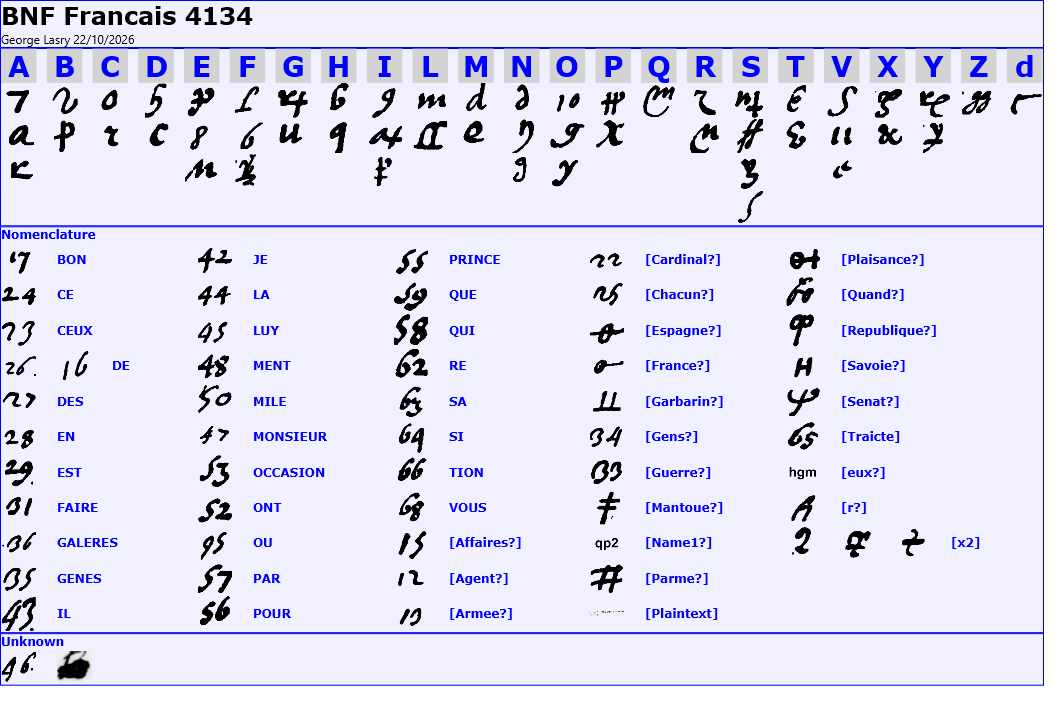
- Letters. 22 letters, each with one to four signs: lower-case letters used for other letters, digits (7 = A, 8 = E, 9 = I, 10 = O, 11 = V) and invented shapes. There are 51 letter signs in all; S has four.
- Word codes. 41 two-digit numbers for common words and syllables, numbered in the order of their first letter: 17 bon, 24 ce, 26 de, 35 Genes, 47 monsieur, 55 prince, 59 que, 66 tion, 68 vous.
- Names. Ten signs for names, identified from their context: France, Spain, the Republic (of Genoa), Savoy, the Senate, Parma, Mantua, Piacenza, an agent, and Garbarino.
- Doubling. Three signs repeat the letter before them.
The clerks’ hands differ from leaf to leaf, so the same sign can look different. The clerk of ff. 57 and 242v–245v, for example, writes H with a straight stem and F as a script L, where the others use a “6” and a straight b.
03The King’s letter of 1631
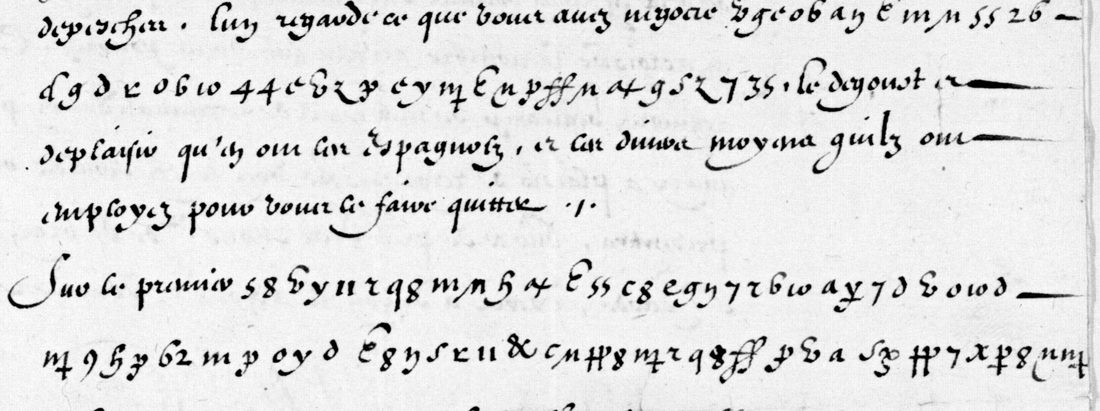
The King thanks Sabran for his despatches and answers two points. The cipher carries the first, the Prince of Monaco, who had offered through his agent Orazio Rossi to come over to France. In George Lasry’s reading the King declines the conditions, and keeps the door open:
je n’ai pas ivge a propos d’y entendre pour plvsievrs bonnes raisons, n’y de faire venir ici le sievr Rossy … sans entrer pour le present en avcvn avtre traicte avec luy, ny avssi faire avcvne rvptvre de la negociation
Richelieu broke off the Monaco talks after the peace of Cherasco so as not to offend Savoy; Monaco came under French protection only in 1641.
04The Savona plot, 1633
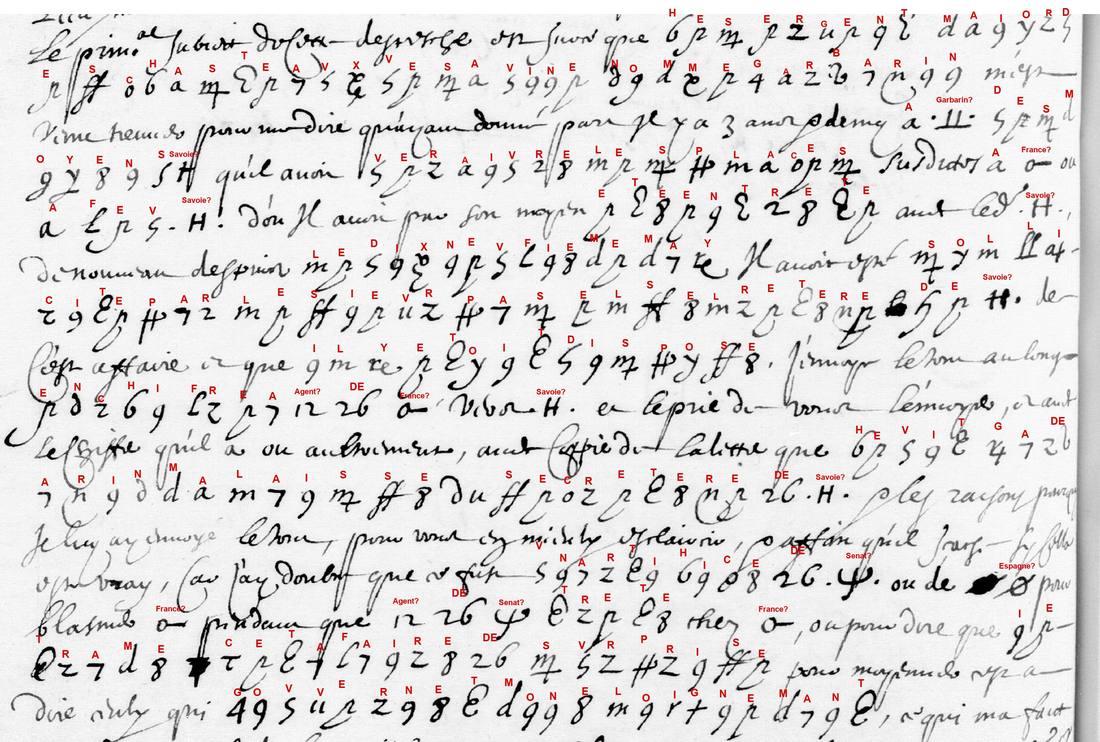
In June 1633 Garbarino, sergeant-major of the castles of Savona, offered to hand them to France or to Savoy. Sabran passed the offer in cipher to the French agent in Savoy and kept out of sight, suspecting a trap. In the summer Garbarino came back dressed as a peasant and set out Savoy’s plan; Sabran sent him away without an answer. In September the plot was discovered and the munitioner of Savona and two others were brought to Genoa. Genoese histories record Giambattista Garbarino of Sassello, executed for treating with Victor Amadeus of Savoy; Sabran’s letters show the affair from the French side.
From the letter on f. 57 (summer 1633), with the enciphered words in bold:
qu’il luy faisoit scavoir le lieu ou seroit les echeles, celluy ou debvoit arriver mile homm[e]s seullement par mer, nomme le fornace, vn mile sur savone a deux mousquettades de l’endroict dv chateav
“He let him know the place where the ladders would be, and the one where a thousand men were to land, by sea only, named Le Fornace, a mile from Savona, two musket shots from the castle.”
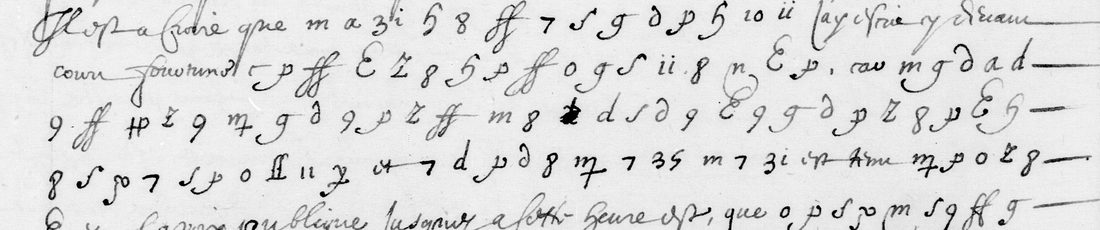
05Genoa in the war of 1635
The nine letters of 1635 (Français 4135) follow the first year of the open war with Spain. France, Savoy, Parma and Mantua besieged Valenza from September to the end of October and failed; on 13 September a Spanish fleet took the Lérins islands off Provence, and Genoa, formally neutral, let it use its ports. Sabran’s ciphered passages propose to reopen the Monaco talks or to surprise Monaco with troops from Pinerolo (“fewer than thirty Spaniards” there), to take Tortona and Serravalle and prefer Novi to Gavi so as not to alarm Genoa, and record that Genoa’s state inquisitors paid his own servants 25 écus a month. The last letter, of 18 December, reports 4,000 Spaniards landed at Vado.
The French text and English translation of all 18 letters, with notes, are in George Lasry’s READING.md.
06The other listed leaves
S. Tomokiyo lists eight more places in the same cipher: Français 4134 f. 51; Français 4135 ff. 217, 226v, 227v, 231v, 239v, 243; and Baluze 156 f. 157. Each was examined on the Gallica image on 22 October 2026. In Français 4135 his folio numbers name two-page openings, so both pages of each opening were examined.
- No further cipher. f. 51 is all clear: it is the start of the letter of 2 July 1633 whose cipher is on f. 52, already deciphered. Ff. 217r, 226v, 228r, 231v, 239v, 240r and 243r are clear. The faint cipher under the letter on f. 227v is ink showing through from f. 227r; in mirror image it matches that page line for line. The other pages of these openings are among George Lasry’s images.
- One image renumbered. Lasry’s image “215v” is f. 216v. Letter 11 runs from f. 216r to f. 216v and ends there, so the passage printed first in his edition is its close.
- A margin note. Beside a “+” on f. 218r are two cipher lines (17 signs) that his transcription lacks. With his key they read [c]a d’avoir / [s]antimant: the cipher of the clear words at that place, “a d’avoir … [res]sentiment”.
- Baluze 156 f. 157 is another cipher. It is a copy of 9 February 1636, written at Genoa after Sabran had left for court. It reports that Duke Doria, at the Lérins islands, was gathering the Spanish galleys of Naples and Sicily for a design on Marseille. Its 136 symbols (15 runs) are lower-case letters, digits and doubled strokes. Neither Lasry’s table nor Tomokiyo’s Servien–Sabran key of 1632 gives French. Two cribs fit: “munitions en galeres de genes”, if code 36 is galeres as in Lasry’s list, and “faire donner audit”. Together they give ten symbol values. An annealing solver run inside the clear context gives no French, with or without them: about five signs per letter type is too little.
07How it was checked
- Mechanically. A short script (
decode.py) applies George Lasry’s key file to his transcription and gives his counts exactly: 3,353 cipher signs, 2,853 letter signs, 287 firm and 212 tentative code readings, and one unknown code. - Statistically (
docs/_validate.py, French letter model, letter signs only). The reading scores −2.13 per letter; random keys of the same shape score −5.73 (7.8 standard deviations lower), and a key fitted to the shuffled signs −3.26 (94 lower). Verdict: pass. - Word cover. 84% of the deciphered text falls in French words of three letters or more. The same measure gives 92% on the King’s letter, which George Lasry deciphered in full in 2022, so that is its ceiling; shuffled keys give 37%.
- Against an independent reading. Harumi-Matsuba’s AI pipeline read nine 1633 leaves with Lasry’s published key (issue 56). 88% of their decoded letters agree with his; on f. 73v all of them, on f. 66v 98%. On f. 50v, where their runs formed no words, his read.
- On the image. One cipher line of the King’s letter was checked sign by sign on the DECODE photograph: 26 of 26 signs agree.
- Earlier readings. George Lasry published the key and the 1631 decipherment on S. Tomokiyo’s Cryptiana in 2022. No edition of the 1633 and 1635 passages was found.
08What remains open
- Code 46, once, in “d’une [46] de l’armée navale” (fr. 4135 f. 219).
- Name signs read from context: 212 occurrences of France, Spain, the Republic, Savoy and the rest. In the hand of ff. 215v–216 the signs for France and Spain may be confused.
- Runs that do not read, probably copyists’ slips: on f. 50v veraivre, fevitga; on f. 215 parico; on f. 228v duc de s / vop.
- Baluze 156 f. 157, a copy of 9 February 1636, written at Genoa after Sabran had left: 136 signs in another letter table (see above). Two cribs give ten values; it is too short to break alone, so it is decoded, not read. On 23 October 2026 its neighbouring leaves (ff. 155–161 opened, ff. 140–190 surveyed on Gallica) were searched for a decipherment, a copy or a sibling in the same key, and none was found; a crib on its repeated run g 7 4 t o does not hold.
- Two signs at the start of the f. 218r margin lines, against the gutter.
- The originals as Bouthillier received them should be in the Archives diplomatiques (Correspondance politique, Gênes); they are not digitised.
Full texts
The transcription and the decryption of every document on this page, so that the reading can be used and checked. Short files are shown here; all are in the repository.
Baluze 155 f. 79, fr. 4134, fr. 4135 (43 images) read in part
The King keeps the Prince of Monaco in play without a treaty (1631); a sergeant-major offers Sabran the castles of Savona, a Savoyard plot that is discovered (1633); Genoa helps the Spanish fleet while France fights for Valenza (1635).
Builds coherent sentences, but under the read bar of 95% of words read as sense (93% here); the holes are marked in the reading.
Transcription: all.txt
Decryption: all.txt
Reading: READING.md
Translation: CONTRIBUTION.md
Baluze 156 f. 157r, copy of 9 Feb 1636 (unread) decoded, not read
Duke Doria, at the Lerins islands, gathers the Spanish galleys for a design on Marseille; a Gascon who knows the plan is sent to the marechal de Vitry. The cipher runs (names and the means) are in a key not yet recovered.
A mechanical decode with holes in most sentences: shown so that the transcription and the key can be checked and improved, not as a reading.
Transcription
# BnF Baluze 156 f. 157r (Gallica btv1b9001409q, view 161, right page): "Coppie du 9e febvrier 1636", to "Monseigneur"
# Transcribed here 22 Oct 2026 from the openapi.bnf.fr IIIF image. One cipher run per line:
# run<TAB>clear text before<TAB>cipher signs (space-separated)<TAB>clear text after
# Sign names are shape names (letters/digits as they look); nn, tt, ll, ff are single doubled-stroke signs.
# Dots around 94 are in the manuscript.
1	francois de bossime en gascogne nomme le sieur	x 12 p f b t r tt u o 7 4 10 g e	que sur lespagne il y a
2	jay enuoye	n z y 10 p ll g 7 4 t o e	a monseigneur le mareschal
3	affin quil	n f 6 h ꝗ 4 p g	amplement
4	amplement	y u nn E tt ll	il espere de pouuoir
5	faire	d o 4 n g ff	audit
6	audit	4 E p C g g u ff ll r m	par
7	par	c o h z p a g g	qui se
8	qui se [?] dans	94	mesmes et dapprendre les noms
9	qui auoit dessaing de	n tt 8 4 z p u nn ll ff g 94 g 6 nn 4 u	sur
10	sur	p g f c c	ce quil auroit execute
11	par ledit	g 7 4 t o p	il me asseure que nice et uillefranche
12	munitions	g n 36 6 g tt g n b u	et quils en sont peu affectionnes
13	a monsieur	x g p u 4 m	et de grandes sollicitations
14	et a monsieur	n z p E p ll g h o g t ꝗ c p E 12 m	auant son depart
15	contraires de leurs	g n ll z g c g c	(continues on f. 157v)
Decryption
# Baluze 156 f. 157r: partial decryption with the two crib values only (see NOTES.md). Not a reading.
# Lower case = crib value, ? = unknown sign, [36] read as GALERES by analogy with Lasry's nomenclator.
1	francois de bossime en gascogne nomme le sieur [?[12]??e??gso?n?e?] que sur lespagne il y a
2	jay enuoye [n?????e?n?o?] a monseigneur le mareschal
3	affin quil [n?d??n?e] amplement
4	amplement [?s??g?] il espere de pouuoir
5	faire [donner] audit
6	audit [n???eesr???] par
7	par [?o????ee] qui se
8	qui se [?] dans [[94]] mesmes et dapprendre les noms
9	qui auoit dessaing de [ng?n??s??re[94]ed?ns] sur
10	sur [?e???] ce quil auroit execute
11	par ledit [e?n?o?] il me asseure que nice et uillefranche
12	munitions [en[GALERES]degenes] et quils en sont peu affectionnes
13	a monsieur [?e?sn?] et de grandes sollicitations
14	et a monsieur [n?????e?oe?????[12]?] auant son depart
15	contraires de leurs [en??e?e?] (continues on f. 157v)
fr. 4135 f. 218r, marginal cipher (17 signs) not prose
Two marginal cipher lines: '[c]a d'avoir / [s]antimant', the words of the clear text at the '+' mark.
Transcription
# BnF fr. 4135 f. 218r, left margin at the "+" after "la raison que le Roy a d'avoir" (Gallica view 226, right page).
# Not in Lasry's CTTS image 218 (his READING.md notes only "[marg.: Cll]", the "ell" written after line 1).
# Signs read on the image and given the values of Lasry's key sheet (lasry2022/cryptiana/images/sabran_key.png):
# line 1:  o  7  h  a  S  y  9  z          -> c a d a v o i r     (o=C 7=A h=D a=A S=V y=O 9=I z=R)
# line 2:  #? a  n  E  9  d  7  ŋ  e       -> s a n t i m a n t   (#=S, n read as N, E=T 9=I d=M 7=A ŋ=N e=T)
# Reading (tentative): "[c]a d'avoir / [s]antimant", i.e. the cipher of "a d'avoir ... [res]sentiment", the words
# the clear text carries at the same place. 17 signs; the first sign of each line and n are doubtful.
Decryption
# BnF fr. 4135 f. 218r, left margin at the "+" after "la raison que le Roy a d'avoir" (Gallica view 226, right page).
# Not in Lasry's CTTS image 218 (his READING.md notes only "[marg.: Cll]", the "ell" written after line 1).
# Signs read on the image and given the values of Lasry's key sheet (lasry2022/cryptiana/images/sabran_key.png):
# line 1:  o  7  h  a  S  y  9  z          -> c a d a v o i r     (o=C 7=A h=D a=A S=V y=O 9=I z=R)
# line 2:  #? a  n  E  9  d  7  ŋ  e       -> s a n t i m a n t   (#=S, n read as N, E=T 9=I d=M 7=A ŋ=N e=T)
# Reading (tentative): "[c]a d'avoir / [s]antimant", i.e. the cipher of "a d'avoir ... [res]sentiment", the words
# the clear text carries at the same place. 17 signs; the first sign of each line and n are doubtful.
Key: key.txt
09Sources
- Bibliothèque nationale de France: Baluze 155 (also DECODE R2748), Français 4134, Français 4135; the catalogue of fr. 4133–4138, which dates the letters by folio.
- George Lasry: the key, transcription, edition and translation, pull request 84, files in targets/sabran1633/lasry2022/.
- S. Tomokiyo, Cryptiana: “Ciphers Solved by George Lasry” (“Melchior de Sabran (1631)”, the 2022 key and overlays) and “French Ciphers during the Reign of Louis XIII” (the list of Sabran cipher passages).
- Harumi-Matsuba, the earlier reading of nine fr. 4134 leaves: issue 56.
- G. Saige, Monaco, ses origines et son histoire (1897), pp. 195–197; F. Donaver, La storia della repubblica di Genova, II (1913), pp. 278–281; D.-L.-M. Avenel, Lettres … du cardinal de Richelieu, III–VI (1858–1867); E. Sue (ed.), Correspondance de Sourdis, I (1839).
Notes, George Lasry’s files and the checks: targets/sabran1633/.