01What the fourteen records are
| Records | What it is | System | Here |
|---|---|---|---|
| R4330, R4331 | Johann Friedrich, archbishop of Bremen, to Salvius at Hamburg, 27 November and 2 December 1631; German | two-digit homophonic figures inside the clear text, and a few one- and two-digit name codes | read |
| R4282 (låda II:113) | Latin letter, about two pages, undated, no names | letter cipher of about 33 signs (Latin letters, 3 4 5 7 8, λ Δ φ ε α and a boxed square), Latin phrases left in clear | attempted, open |
| R4284 (låda II:114) | Latin letter of 1628, docketed with the letters to Ludwig Camerarius | 108 different numbers, comma-separated, Latin words in clear; a leaf of key tests beside it | attempted, open |
| R4306 (låda II:133) | letter to a “Mr …ilick” at Amsterdam, “1632?” | 463 numbers, mostly 30–52; index of coincidence 0.078, so one sign per letter | attempted, open |
| R4333–R4337 | Rusdorff to Oxenstierna, The Hague, 1628 | figures inside clear German and Latin; the archive calls many of them unsolved | not worked |
| R4338–R4341 (E 708) | Swedish letters to Oxenstierna, 8/18 and 27 June 1633 | two-digit letters, four-digit name codes and letter pairs; part deciphered between the lines at the time | not worked |
02The Bremen key
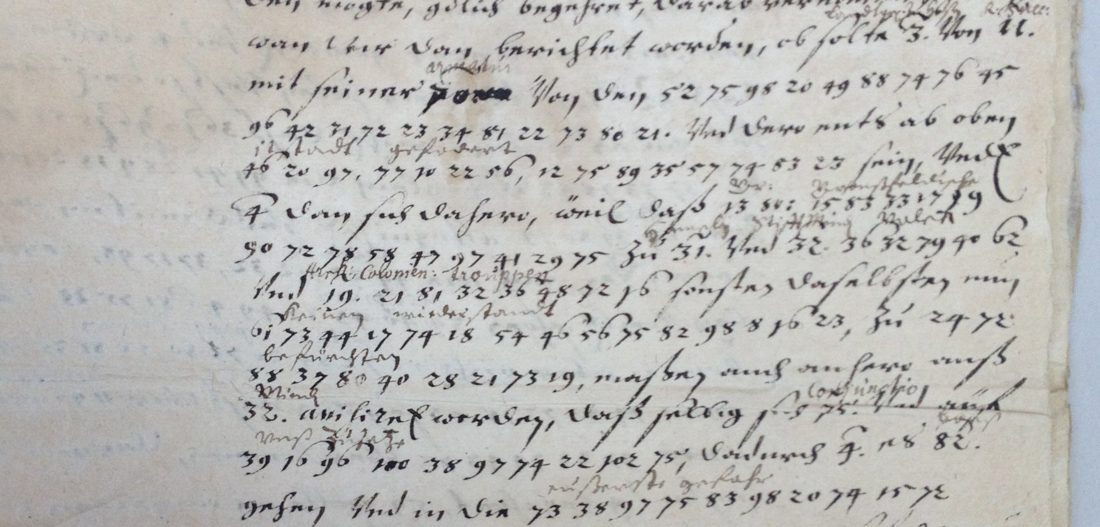
Thirty-five glossed words were set against their numbers one letter to one number. Twenty-three matched in length, and the numbers for each letter came out as runs of four: 8–11 for a, 16–19 for n, 72–75 for e, 96–99 for s. The runs are not in alphabetical order. The alphabet is written in six columns (a b c d e f / g h i k l m / n o p q r s / t u w x y z) and read downwards, so the bands go a g n t, b h o u, c i p w, d k q x, e l r y, f m s z:
8 a · 12 g · 16 n · 20 t · 24 b · 28 h · 32 o · 36 u · 40 c · 44 i · 48 p · 52 w · 56 d · 60 k · 64 q · 68 x · 72 e · 76 l · 80 r · 84 y · 88 f · 92 m · 96 s · 100 z
No gloss covers k, z, m, w or y. The unglossed groups fix them: sincken, schantze, kommen and dem accord mitbegriffen, etwas and wir, weyter and Reuterey. Once they are in place, the grid predicts q and x without a single example. Small numbers stand for words: 4 = wir/uns, 5 = Herzog Christian, 7 = Herzog Georg, 32 = the Stift Minden, 59 = Salvius.
03What the letters say
The archbishop, Johann Friedrich of Holstein-Gottorp, wants Swedish help, and quickly. In the letter of 27 November he fears that the enemy will be in the Stift before relief comes, “und in die euserste gefahr kommen würden”, and asks that “mit schleunigem hulf und succurs ausgeholffen werden möchte”. His people have taken die Burg and are attacking die schantze. They cannot hold without more men.
The letter of 2 December is more urgent. The Reuterey ranges up and down the country, laying waste one place after another, and he fears an einfal by Bönninghausen und Gronsfeldischen troupen from the Westphalian border. He hopes to be “mit etlichen tausend secundiret”, or at least to get etwas fusvolckes und theils dragoner. A postscript asks that, if the garrison of Newenburg marches out on terms, his ertzstift be in dem accord mitbegriffen.
The full decipherment, line by line with the glosses, is in bremen_decoded.txt. The remaining errors are transcription slips from the phone photographs (occupireh, feldlsihen); no group is left undecrypted.
04The three ciphers not solved
R4306, to Amsterdam, has one sign per letter by its statistics, and “34 42” alone occurs 31 times. Simple and homophonic substitution were annealed over quadgram models in Dutch, German, Latin, French, Swedish, English, Italian, Spanish, Portuguese and Danish. None fits. A second transcription kept the scribe’s variant figures apart (34 and 74, 40 and a looped 4o, 30 and 70), on the chance that they are separate signs. That did not help either. It remains open whether the transcription or the model of the cipher is at fault.
R4284 of 1628 uses 108 numbers across 756 groups, with Latin words in clear. A homophonic Latin search produced Latin-sounding nonsense, and so did a search on bands of four. Beside it lies a leaf on which someone tried a letter cipher on four phrases: effusorem sanguinis, pestem patriae, praeter naturalem, disturbatorem religionis. That leaf is unused material.
R4282 is about a thousand signs of Latin letter cipher, with et qualis sit eius futurus status dubitatur, sed tamen ut res and Mittatur nobis responsum in clear. It was annealed as Latin with and without the written word divisions, and no plaintext appeared. Seventy key records from the same boxes were fetched. The two that looked closest, a Transylvanian secretary’s key (R4310) and a 1632 key whose 30 ends every word (R4296), were tested and fit neither of the numerical letters.
05Sources
- DECODE records R4330, R4331 (Bremen), R4282, R4284, R4306, R4333–R4337 (Rusdorff), R4338–R4341 (E 708). Originals in the Riksarkivet, Stockholm.
- Key records of Chifferklaver låda II, DECODE R4259–R4329.
Transcriptions, the decipherment, the solver and notes: riksarkivet1628/.