
At a glanceExternal key matched · none (key obtained, text not read)
- The letter
- Frederick II to his resident in London, Louis Michell, Berlin, 28 December 1751: the ministerial rescript, issued in the King’s name through the foreign department. It opens in clear, Toutes vos dépêches m’ont été bien rendues.
- Where
- Koninklijk Huisarchief, The Hague, archive of Prince William V, inv. 198, the Dutch interceptors’ copy. DECODE R1955, listed as not decrypted.
- The cipher
- A large numerical code: groups from 2 to 5346, half-groups such as 150½, and homophones even for de and que. It is not the King’s cabinet code.
- How it was tried
- WAINUT built a table of 271 code values from the Dutch decipherments written over two of Michell’s own reports (DECODE R1050, R1051) and found that it fits this letter.
- What it says
- Fragments only: an avis, a negotiation with Vienna, the Prince Stadholder, the States, ce projet.
- Still open
- The letter as a text: 265 of the 360 groups have no value, so it is decoded, not read. More decipherments of Michell’s reports are not online. On 23 October 2026 the Hague decipherment registers on the Nationaal Archief IIIF were checked heading by heading: Fagel 5208 holds the Dutch clear decipherments of the ministerial rescripts to Michell in this code, nos. 1–8 (2 November to 7 December 1751), and Fagel 5177 the cabinet-code letters, but the rescript of 28 December is in neither, and the copies carry no figures, so they add no values.
- Credit
- The match and the partial decoding are WAINUT’s (pull request #29, 11 October 2026); checked here.
This letter was written up together with the King’s own letter of the same day until 14 October 2026. That letter, DECODE R1957, is in Frederick’s cabinet code and has its own page, Frederick II to Louis Michell, 28 December 1751: a different cipher, with its own page.
01 The letter
The King wrote to his London resident through two channels: rescripts from the foreign department under Podewils, and his own immediate letters. On 28 December 1751 Michell was sent one of each. Both went by post through the Dutch Republic, where the Stadtholder’s cabinet opened and copied them; the copies are in the papers of William V, inv. 198. The immediate letter tells Michell to report to the King alone, with no copies to the department, which is why the second letter exists.
The copy is headed Lettre du Roi de Prusse au Secrétaire Michell du 28 Decemb. 1751 and signed Féderic. The opening is in clear: Toutes vos dépêches m’ont été bien rendues et la dernière est du 14e de ce mois. Then come the code groups, separated by points, and the date line. The Politische Correspondenz prints only one letter to Michell of that date, the immediate one, so this text is not in print.
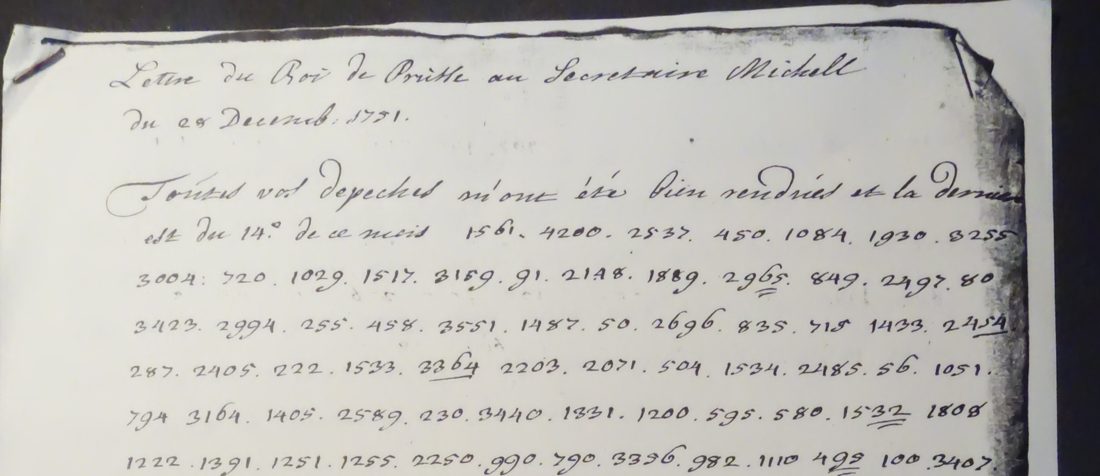
02 The code
The two transcriptions agree on 352 of 360 groups. This project’s of 19 September counts 362, because it splits a run of nine digits written without separators; WAINUT’s of 11 October keeps it as one group. 296 of the 362 groups are distinct and the commonest occurs only five times. That is a large code with several numbers for each common word, and a single letter of it gives nothing to a ciphertext-only attack.
It is not the code of the King’s immediate letters. The cabinet key that WAINUT rebuilt for R1957 gives values to 2.8–5.6% of these groups, against 69.5% of R1957’s. DECODE R1953, von der Hellen’s letter of 4 January 1752 from the same archive, is in a different, smaller code.
03 The partial decoding
DECODE R1050 (London, 5 September 1752) and R1051 (London, 12 November 1751) are Hague copies of Michell’s own reports to the King, with the contemporary Dutch decipherment written over the numbers. WAINUT paired DECODE’s transcriptions of them token by token and got 512 code-word pairs for 271 codes. The code held over the ten months between the two reports: of 40 codes found in both, 32 have the same commonest value.
That table gives a value to 95 of R1955’s 360 groups (26.4%). On R1957 it gives only 5.5%, so R1955 is in Michell’s code. The decoded words also sit together sensibly more often than chance: 19 of 30 adjacent pairs are word pairs found in 18th-century diplomatic French, against 11.1 when the same values are shuffled (p = 0.001).
The fragments include avis … sur … negociation avec … de Vienne … les difficulte(s) … article … du Prince Stadhouder … maison … cet avis et … états … depuis avis est … ce projet … nouvelle … doit etre … des esperance(s) de (spelled as the table gives them). The letter is about Dutch affairs and a negotiation involving Vienna. More than that cannot be said from a quarter of the groups.
WAINUT also tested whether the rescript repeats the wording of a royal letter of the same days printed in the Politische Correspondenz, which would supply its text. The rule was fixed in advance. No letter of 22 December 1751 to 10 January 1752 scores above the controls (best z = 2.69, highest control 4.85), while a 17% sample of a real letter is found at z above 27.
04 What remains uncertain
- 265 of the 360 groups have no value. The table comes from two letters ten months apart, and a changed or homophone value could mislead.
- The table depends on DECODE’s transcriptions of the R1050/R1051 decipherments, which were not checked against the images line by line.
- Further decipherments of Michell’s reports are probably in the Koninklijk Huisarchief (A31-1181), not online. A contemporary decipherment of this letter may be in the Nationaal Archief, 1.01.50 inv. 159, not digitised.
- Uncertain digits: l. 10 194? (9 or 7), l. 21 2?07 (1 or 4), and the nine-digit run on l. 16 (best split 2 2407 2398).
Full texts
The transcription and the decryption of every document on this page, so that the reading can be used and checked. Short files are shown here; all are in the repository.
Frederick II (ministerial rescript) to Louis Michell, Berlin, 28 Dec 1751 (DECODE R1955) decoded, not read
The ministerial rescript in the King's name to his envoy in London, opening in clear 'Toutes vos dépêches m'ont été bien rendues et la dernière est du 14e de ce mois', then 362 code groups. WAINUT decoded 95 of 360 groups (26.4%) with the envoy table rebuilt from the Dutch decipherments of Michell's reports R1050/R1051: fragments only, the subject cannot be stated with confidence.
A mechanical decode with holes in most sentences: shown so that the transcription and the key can be checked and improved, not as a reading.
Transcription
# DECODE R1955 (KHA Prins Willem V inv. 198), Frederick II (ministerial rescript) to Michell, Berlin 28 Dec 1751
# Transcribed 19 Sept 2026 from the DECODE images (P2 = first page, P1 = second page). One line per manuscript line.
# Heading: Lettre du Roi de Prusse au Secretaire Michell du 28 Decemb. 1751.
# Clear opening: Toutes vos depeches m'ont ete bien rendues et la derniere est du 14e de ce mois
# ? = uncertain reading; L16 "22407 2398" is written run together and underlined (read 2240 7 2398?)
1561 4200 2537 450 1084 1930 3255
3004 720 1029 1517 3159 91 2148 1889 2965 849 2497 80
3423 2994 255 458 3551 1487 50 2696 835 715 1433 2454
287 2405 222 1533 3364 2203 2071 504 1534 2485 56 1051
794 3164 1405 2589 230 3440 1831 1200 595 580 1532 1808
1222 1391 1251 1255 2250 990 790 3336 982 1110 495 100 3407
1403 3433 2999 46 455 1820 3120 704 2740 1889 301 800
2237 3340 1376 1478 138 2510 601 892 1873 200 1262 3013
2669 1358 2071 1553 332 1433 1245 198 1110 2328 1060 203
1560 1949 77 2 2274 2828 519 748 2467 3331 227 2016
761 3109 2055 3407 1346 2692 3371 2381 3150 230 326
2080 2122 1404 2050 3082 421 2407 1498 3029 271 2 40½
7 2334 1573 767 99 2175 3551 50 127 1084 2339 1466 1222
2576 3393 1893 275 1487 2313 3131 715 2841 350 248 230
1130 3191 1889 2025 1433 1981 2238 38 1055 932 3411 2071
1820 2856 3297 73 24 2484 2984 96 2240? 7? 2398 1636 3069
10½ 831 790 3312 2405 1229 875 1254 200 2695 2679 1508
3407 1867 474 336 2479 3137 2712 916 1517 1008 1920 300
1131 1110 1744 2539 313 868 2529 2 3600 58 3048 3316 2509
528 3407 376 1534 580 1055 3145 230 1096 3222 450 340
2407 500 2 1034 2165 2999 40½ 2217 2385 5 807 2327 524
2139 1487 1585 4478 1628 2005 3471 10 2312 2071 3171 1403
450 1242 2527 2086 3082 2485 3440 1138 841 1820 1000
357 2831 3577 3072 114 3294 3373 943 2484 297 3084 2351
3015 1889 704 2067 3317 285 707 2385 3019 2403 1278 3138
2 1597 5346 2692 258 2467 140 3167 230 4022 1857 413
3426 165 301 3335 972 761 1918 1110 1½ 553 3193 931 413
2105 728 660½ 2811 2176 3073 820 1076 2138 3475 1821 150½
633 1433 180½ 928 2589 409 3072 326 2417 500 1828 3331
1520 1116 2893 1487 50 3127 660 2381 916 1222 1187 14 1626
4797 5328
# A Berlin ce 28e Decemb. (Signe:) Federic.
Transcription
# WAINUT transcription of DECODE R1955 (KHA The Hague, Prins Willem V inv. 198), made 2026-10-11 from the DECODE images (not included). One line per manuscript line.
# R1955: photographs img/R1955_p1.jpg (p1: heading, clear opening, 25 cipher lines) and img/R1955_p2.jpg (p2: 6 cipher lines, the last one ending in the date line, then the signature; the rest of p2 is blank apart from mirror show-through of p1). On p1 the right edge of the leaf is curled/shadowed: the last group of several lines runs into that dark band (l.1, l.2, l.16, l.19, l.21, l.22, l.25).
# Heading: "Lettre du Roi de Prusse au Secretaire Michell / du 28 Decemb. 1751."
# Clear opening: "Toutes vos depeches m'ont été bien rendües et la derniere est du 14e de ce mois" then cipher. The first manuscript line is entirely clear text ("derniere" runs into the curled edge); data l.1 = 2nd manuscript line, after "est du 14e de ce mois" (14e with superscript e).
# Closing line: p2 l.6 "4797. 5328. à Berlin ce 28e Decemb: (Signé:)"
# Signature: "Federic." (own line, right, below the date line).
# Letter date: Berlin 28 Dec 1751 (heading and date line).
# NOTATION: _ single underline, = double, # triple; ! bar/overline; [del:...] struck; ? uncertain digit; {...} = editorial note on the preceding group (not part of it); "..." clear text; +1/2 = fraction written after the group.
# NOTE hand: one upright copyist's hand throughout (heading, cipher, date line). Groups separated by full stops. 1 = plain stroke (sometimes small top serif); 2 = rounded/looped top and long flat foot; 3 has two forms: round-topped, and FLAT-topped with a closed lower bowl that looks like 'B'/'8' (e.g. 3255, 3159, 3120, 3013, 2313, 3312, 3222, 3294, p2 931/3193) - all read 3: real 8s in this hand are figure-8s, mostly with a hairline flourish rising to the right from the top (868, 1008, 1820, 1828), and 4-digit groups never begin with 7/8/9 in the Michell letters (lead digits 1-6), so 8255/8120/8159 are excluded; 4 = open angular or closed-top 'A'-like (2148, 1245, 247, p2 413); 5 = 's'-shape with a separate flag tick, sometimes the flag fused into a closed top loop (3356, 275, 495); 6 = tall looped ascender; 7 has two forms: 'Z'-like (flat top bar starting with a blob, diagonal, short foot: 715, 77, 707, 2175, 1573, 247) and a small hooked '>' form (720, 2071, 2497, 3317, 224072398) - told from 2 by the flat, unlooped top; 9 = closed bowl with long descender curling left; 0 = small oval. Every 3/8, 2/7, 5/9 and 1/4 decision was checked at 3-7x on contrast-stretched crops; every line was read twice (2-line half-width strips at 0.7 and 3-line third-width strips at 0.8, plus per-line 1.2x crops) and the readings reconciled.
# NOTE separators: the dot is regularly omitted after an underlined group and after a fraction, and also in l.3 '715 1433', l.5 '794 3164', l.6 '1110 495', l.9 '1110 2328', l.17 '2405 1229', l.21 '2165 2999', p2 l.2 '761 1918 1110'. Other separators: l.2 '3004:' and l.8 '200:' colons; l.18 '2712,' and p2 l.1 '1517,', p2 l.2 '3193,' '931,' commas; l.11 '2692' followed by a long horizontal dash instead of a dot. p2 l.4 '1828 3331' written without a separator (the 3 of 3331 touches the flourish of the 8), read as two groups.
# NOTE underlines are mostly drawn under the last two digits only; the mark is recorded on the whole group. Exceptions: l.19 1744= and p2 l.3 1076= have their two strokes under the FIRST digit (just after the preceding dot); p2 l.5 660= under the final 0; l.2 2965= under the 6(5). l.19 2539 and l.17 2695: the descender of the 9 ends on the underline - checked at 7x, only ONE stroke each (single). No triple underlines, overlines or struck-through groups on either page.
# NOTE fractions: written full size as 1 over 2 with a bar, directly after the integer (no dot between): l.12 40+1/2, l.17 10+1/2 (line start), l.21 40+1/2; p2 l.2 1+1/2 (a group of its own after '1110.'), p2 l.3 660+1/2 and 150+1/2, p2 l.4 180+1/2. Only halves occur. p2 l.5 '660=' is an underlined 660 without a fraction.
# NOTE l.16 long run: '224072398' = nine digits 2-2-4-0-7-2-3-9-8 under ONE continuous underline, with no dots, commas or wider spaces inside (inter-digit gaps 14-24 px at native resolution, as inside ordinary groups; gaps between groups are ~50-80 px plus a dot; the first two 2s are joined by a ligature). The 5th digit is the small hooked 7 (as in 720, 2071). It must be several groups run together. Best split: 2 2407 2398 (2 and 2407 occur as groups in this letter, and no group may start with 0); alternatives 2240 7 2398, 22 407 2398, 2240 72 398.
# NOTE l.1 3255: 1st digit is the flat-topped closed 3 (looks like 8; see hand note).
# NOTE l.6 3356: 3rd digit = s-form with a closed top loop, read 5 (no descender, so not 9; not like the two 3s before it).
# NOTE l.10 194?: last digit = flat top bar + short mid stroke closing an angular, open bowl + long descender curling left (as the 9s); 1949 preferred, 1947 possible.
# NOTE l.11 2692: final 2 written with a long horizontal dash through/after its foot (z-like); taken as 2 + separator dash (cf. clean 2692 on p2 l.1); a 7 written over it cannot be excluded.
# NOTE l.11 3371: 2nd digit 'ↄ'-shaped (a 3 without the middle cusp); read 3.
# NOTE l.13 2334: 1st digit faint, an incomplete '∠'-shaped 2 (diagonal + foot, tiny top), with a stray dot after it.
# NOTE l.14 275: 3rd digit s-form with a closed top loop, read 5 (as in 3356).
# NOTE l.21 2?07: 2nd digit is a 'ʌ' (lead-in upstroke from the foot of the 2 + vertical, no crossbar): 1 (2107) or a 4 without its crossbar (2407, cf. 2407 l.12).
# NOTE l.22 3171: a small dot sits low between the 7 and the final 1 (end of the 7's stroke or stray dot); read as one group 3171.
# NOTE edge: l.16 3069 (9 inside the edge shadow, descender visible), l.22 1401 (final 1 partly in shadow), l.21 524 and l.2 80 end at the shadow - a further digit hidden there cannot be excluded for 524/80, though line lengths do not suggest it.
# NOTE p2 l.1 1517: 3rd digit written as a 'V' (the flag of the 5 runs down into an upstroke): read 1 (1517 as on p1 l.2 and l.18); possibly a corrected digit.
# NOTE p2 l.1 '2.' at the line start: 2 with a looped top ('a'-like), followed by a dot; standalone group 2.
# NOTE p2 l.1 and l.2 both end with '413.' (4 closed-top); p2 l.2 931 middle digit is the flat-topped 3.
# UNCERTAIN digits (encoded ?): l.10 194? (9/7), l.21 2?07 (1/4). Read but flagged: l.1 3255 (3/8), l.6 3356 (5/9), l.11 2692 (2/7), l.11 3371, l.13 2334, l.14 275 (5/9), p2 l.1 1517 (3rd digit), l.21 524 and l.2 80 (edge).
# DISAGREE: (no earlier reading of this letter).
1561 4200 2537 450 1084 1930 3255{1st digit flat-topped 3, see NOTE}
3004 720 1029 1517 3159 91 2148 1889 2965= 849 2497 80
3423 2994 255 458 3551 1487 50 2696 835 715 1433 2454_
287 2405 222 1533 3364_ 2203 2071 504 1534 2485 56 1051
794 3164 1405 2589 230 3440 1831 1200 595 580 1532= 1808
1222 1391 1251 1255 2250 990 790 3356{3rd digit 5 with closed top loop} 982 1110 495= 100 3407
1403 3433= 2999 46 455 1820 3120 704 2740 1889 301 800
2237_ 3340 1376 1478 138 2510 601 892 1873 200 1262 3013=
2669 1358 2071 1553 332 1433 1245 198 1110 2328 1060 203
1560 194?{last digit 9 (angular open bowl) or 7; 1949 preferred} 77 2 2274 2828_ 519 748 2467 3331 247 2016
761_ 3109 2055 3407 1346 2692{final 2 with long dash through its foot} 3371{2nd digit open 3} 2381 3150 230 326
2080 2122 1404 2050 3082 421 2407 1498 3029 271 2 40+1/2
7 2334{1st digit faint incomplete 2} 1573 767 99 2175 3551 50 127 1084 2339 1466 1222
2576 3393 1893 275{3rd digit 5 with closed top loop} 1487 2313 3131 715 2841 350 248 230
1130 3191 1889 2025 1433 1981 2238 38_ 1055 932 3411 2071
1820 2856 3297 73 24 2484_ 2984 96 224072398_{9 digits run together under one underline, no separators; best split 2 2407 2398; alt. 2240 7 2398} 1636 3069
10+1/2 831 790 3312 2405 1229 875 1254 200 2695_ 2679 1508
3407 1867 474 336 2479 3137 2712 916 1517 1008 1920 300
1131 1110 1744={2 strokes under the first digit} 2539_ 313 868 2529 2 3600 58 3048 3316_ 2509
528 3407 376 1534 580 1055 3145 230 1096_ 3222 450 340
2?07{2nd digit 1 or crossbarless 4: 2107/2407} 500 2 1034 2165 2999 40+1/2 2217 2385 5 807 2327 524{at edge}
2139 1487 1585 4478 1628 2005 3471 10 2312 2071 3171{dot below between 7 and 1} 1401{last digit partly in edge shadow}
450 1242 2527 2086 3082 2485 3440 1138 841 1820 1000
357 2831 3577 3072 114= 3294 3373 943 2484 297 3084 2351
3015 1889 704 2067 3317 285 707 2385 3019 2403 1278 3138
|| p2
2 1597 5346 2692 258 2467 140 3167 230 4022 1517{3rd digit V-shaped, read 1} 413
3426 165 301 3335 972 761_ 1918_ 1110 1+1/2 553 3193 931 413
2105 728 660+1/2 2811 2176 3073 820 1076={2 strokes under the first digit} 2138 3475 1321= 150+1/2
633 1433 180+1/2 928 2589 409 3072 326 2417 500 1828_ 3331
1520 1116 2893 1487 50 3127 660= 2381 916 1222 1187 14 1626
4797 5328 "à Berlin ce 28e Decemb: (Signé:)"
Decryption
# R1955 (Berlin 28 Dec 1751, to Michell; Michell's envoy code) decoded group by group with the envoy table rebuilt by
# scripts/envoy_key.py from the contemporary decipherments of Michell's reports R1050/R1051 (DECODE transcriptions).
# '·' = group not in that table. 95 of 360 groups (26.4%) have a value. NOT a decipherment: a trial reading of fragments.
# Reproduce: python scripts/decode.py envoy_key_lyonet.tsv R1955_tx.txt
· · · avis · · · · · sur · negociation avec · · accordent ent · · · qui · sont · s de vienne · dernier s · · · · · · · · · · · sans · · · · · · fait · r · · · · · · · · · · de · · · · ant e · · que cela · · · les difficulte · · cette · · · · est · · par · · · · · · · · l'on s · · · d' · · · · · a · · · · · · me · · · · e · l' · · · · · article · · · · · · · · · a la · · · · il · · de · · · · · · · der ne s · · dernier · en · · · · · · s pour · · · · · · · · · · · · · · · · · le · de urgence · · · · · propos · · e · · elle ment · · · · · · du · · princestadhouder · · · · a · · · · maison · e · · · · meme · · cet avis et · · a · · que la · · · oit · · états s · · · comme · au · · · depuis avis est · · · · fait · · · ce projet où si · · re · · · · · · · · les plus · · · · · · moins · a · · l' · · · · · · · nouvelle · · · · · · · · · · · · nouvelle · doit · etre · · · · · · · · · s se · · n' · · · · · · reste des esperance s de · · · · · · · · · ·
05 Sources
- Koninklijk Huisarchief, The Hague, archive of Prince William V, inv. 198: DECODE R1955 (two images, login); key material DECODE R1050 and R1051.
- WAINUT, pull request #29 (11–12 October 2026).
- Politische Correspondenz Friedrich’s des Grossen, vols. 8–9 (Berlin, 1882): Internet Archive.
- K. de Leeuw, Diplomacy & Statecraft 10 (1999), on Pieter Lyonet’s deciphering for the States General.
The two transcriptions, WAINUT’s decoding and the notes are in targets/r1955/; the scripts are shared with targets/michell1751/. The DECODE images are not committed.