01 The documents
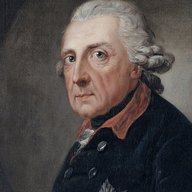
W.B. von der Hellen’s reports from The Hague survive here as intercepted copies. The seven-record catalogue group spans 4 January 1752 to 5 July 1763. The related letter of 15 April 1763, DECODE R1046, was included as supporting material. The recipient is Frederick II of Prussia; “Frederick I” in the imported catalogue metadata was an error.
| DECODE record | Date | Audited segments | Unambiguous numeric groups |
|---|---|---|---|
| R1953 | 4 January 1752 | 846 | 835 |
| R1049 | 7 September 1756 | 516 | 506 |
| R1046 (supporting) | 15 April 1763 | 218 | 206 |
| R1047 | 29 April 1763 | 199 | 192 |
| R1060 | 6 May 1763 | 136 | 134 |
| R1061 | 13 May 1763 | 162 | 150 |
| R1048 | 20 May 1763 | 191 | 188 |
| R1045 | 5 July 1763 | 383 | 364 |
A segment is a nonempty portion of the transcription between separators. An unresolved segment can contain two groups whose separator is missing. Numeric counts ignore underlining for this comparison only; their digits are unambiguous in the transcription, not necessarily correct on the manuscript. The six 1763 letters contain 1,234 such numeric groups, with 634 distinct values.
02 What the audit corrected
The previous parser removed question marks before recognizing numbers: 2 1 ? ?, for example, became the definite value 21. It also counted empty newline fragments as unreadable groups, included the heading year 1752 as ciphertext, and discarded cipher before a cleartext tag on the same line. The revised parser retains uncertainty, source line and page references, underlining and carets, and ciphertext on both sides of cleartext tags.
On R1953, image 13448, the three-line passage beginning 1426 825 963 occurs twice on the manuscript. It must not be deleted as a DECODE transcription duplication. The two versions are not identical, and neither has been established as the correct transcription.
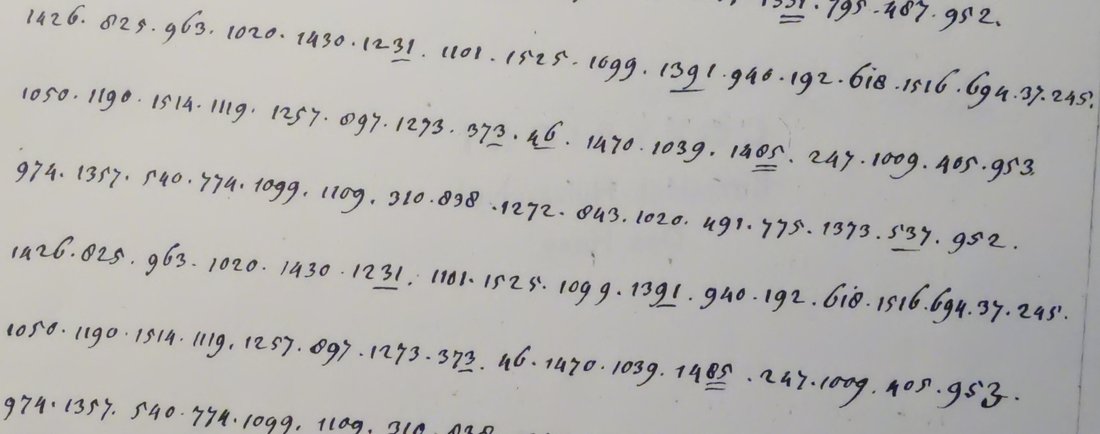
1426 825 963 and, directly below, its second copy. The two copies are not identical, and the code has not been decoded. Image: Koninklijk Huisarchief, Prins Willem V, inv. 196, via DECODE R1953.The letters are provisionally grouped into 1752, 1756 and 1763 code families. Earlier frequency-density tests did not produce readable text, but that failure does not establish random codebook ordering, prove the proposed homophone clusters, or rule out a future ciphertext-only solution. Those stronger conclusions have been withdrawn.
03 The archival lead
The Nationaal Archief catalogue lists collection 1.10.29, Familie Fagel, inventory 5206 as digitized copies of deciphered Hellen letters from 1752–1753. A matching text for 4 January 1752 could provide known plaintext for reconstructing and checking that letter’s code. The date range alone does not establish that this particular letter is included.
During the 20 September 2026 access check, the old scan link returned 404, the catalogue service timed out, and the current viewer displayed an empty content area with a maintenance notice. This was an access failure on that date; it does not show that the documents are permanently unavailable. Open the current archive viewer.
De Leeuw’s study points to Fagel 5177 for British decipherments with Lyonet’s additions, and Boerhaave Museum Arch 162-r for Lyonet and Croiset’s account. He reports no Prussian codes broken between April 1757 and October 1763. That makes a surviving Dutch decipherment a less secure expectation for the 1763 letters than for the earlier material; it does not prove that no parallel text survives elsewhere.
04 What remains open
None of the enciphered passages was decoded. No plaintext value has been verified. The clear passages give context; they are not decipherments. A search of the printed Politische Correspondenz found replies and contextual references, but no matching plaintext for these targets.
The next steps are to retrieve Fagel 5206, check the 4 January date and opening against R1953, and use any genuine parallel text to derive mappings that can be tested on further passages. The source images also need a fuller collation of doubtful digits, missing separators and marks. A key catalogued as “Prussia 1746” in DECODE R2824 proved to be for a Dutch envoy going to Prussia, so it was rejected as a Prussian chancery-key lead.
05 Sources and working record
- DECODE records linked in the document table: KHA, Prins Willem V, inventory 196. Manuscript images and DECODE transcriptions were available locally; the complete image set is not reproduced on this page; one crop of R1953 is shown above.
- Nationaal Archief, Familie Fagel, 1.10.29, inventory 5206: catalogue evidence for the deciphered-letter collection.
- Karl de Leeuw, Cryptology and statecraft in the Dutch Republic (2000), chapter reprinting “The Black Chamber in the Dutch Republic and the Seven Years’ War, 1751–63”, Diplomacy & Statecraft 10(1), 1999, pp. 1–30; especially notes 45–46, 72 and 76.
- DECODE R2824, Additional Information: the rejected Dutch-key lead.
The working record contains the audit, parser, measured transcription projections and research profile. Status: in progress.