

01 The documents and the key
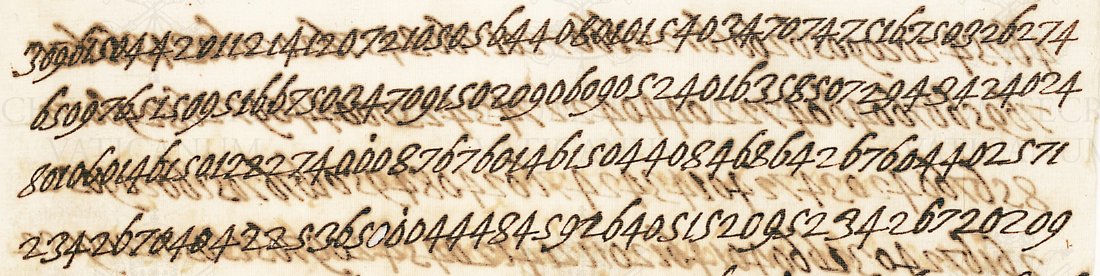
DECODE lists the six as “ASV i. 1025, Segretario di Stato, doss. I”, records ASV_i1025_SdS_Spain_I-1 to I-6, with the archive’s list of the volume’s units in the comments. Their folios are 165r (R85), 236r (R86), 249r–250r (R87), 301r–v (R88), 314r–v (R89) and 324r (R90): 7,817 digits in all, transcribed for DECODE by RebAn in 2016. Each cipher is the enciphered part of a letter that opens in clear: f. 163r, before R85, is about hurrying the archbishop of Toledo, Bartolomé Carranza, to Rome; f. 299r, before R88, is about “il negotio di Milano”. No decipherment is written on those pages.
Lasry’s key “ASV – S6” (24 October 2020), on every record: 1 u|t · 2 i|m · 3 f|g · 4 a|l · 5 o|s · 6 e|n · 7 d|r · 8 b|c · 9 p|z · 0 null, with a nomenclator of four-digit groups X0Y0 (1010 Nostro Signore, 2090 che, 3010 Re, 4030 S. M.tà, 8010 Re di Francia …) and dotted pairs. The full table is on the 1568 page.
02 “Put the Constable in a secure prison”
R88 and R89 are two copies of one cipher; where one copy’s transcription is damaged the other fills it. Words divided from the decoder’s output (R89, f. 314r–v, with R88 where R89 is damaged):
… il [Re di Francia] … da credere tanto al cancelliere, la Mortiglier[i], … l’Albaspi[na], suoi {consi}glieri, che non si sa risolvere a far cosa buona, sempre medicando il male col peggio … tanta ambitione di dominare … credo bene che sia una mala cristiana … In tanto vi dirò [quel] solo, [che] se [S. M.] facesse [me]tter[e] in una prigione sicura il conestabile Memoransi [e] suo figliolo, protestandoli [che] se in termine di tre giorni [non] facessero deponere le armi al Amiraglio al Principe, … tagliare il capo, vedereste [che] si … fine a tanti tumulti … presto, [per]ché si crede [che quel] tratta[to] sia fatta tuta con saputa del [con]estabile e del figliolo … si trova da un giorno ingannata, si pentirà tardi di [non] … voluto credere [a]li buoni …
The text is set out from the decoder’s unspaced output with the words divided; letters in square brackets are supplied from the sense, … marks a stretch left out or not clear.
“The King of France is so taken with the Chancellor, Morvilliers and l’Aubespine, his counsellors, that he cannot bring himself to do any good, but always doctors the evil with worse … [the Queen Mother’s] ambition to rule … I truly believe she is a bad Christian … Meanwhile I will tell you only this: if His Majesty had the Constable Montmorency and his son put in a secure prison, warning them that unless within three days they made the Admiral and the Prince lay down their arms he would have their heads cut off, you would see an end to these troubles, and soon, for it is believed the whole plot was laid with the knowledge of the Constable and his son … she will find herself deceived one day, and repent too late of not having believed the good.” The Prince is Condé and the Admiral Coligny, in arms after the Surprise of Meaux (28 September 1567); the Constable died of his wounds at Saint-Denis on 12 November. The letter therefore belongs to October or early November 1567. It goes on that the Catholic King should be “well instructed of that court and of the nature of its principal persons”. R90 (f. 324r) carries that close once more.
03 All six, in brief
- R85, f. 165r. The Pope wants to be sure whether the King’s journey will take place, because if so he wants an abboccamento with him “in quel loco che li sia più comodo”; the nuncio is to find out and tell him. Words alone are no foundation; the King should be urged, since the meeting would bring “gran frutto alla [religione] cattolica”.
- R86, f. 236r. Milan: the authors of the attack on the archbishop’s jurisdiction; the senate “with its arms”, the Pope with “armi spirituali” and a monitory; “the dignity of this Holy See” requires proceeding at least against the Capitano di giustizia and the fiscal, “il peggio di tutti”, and some of the senate; the King should deprive the ministers concerned.
- R87, ff. 249r–250r. The Pope wants the King’s journey to Flanders, for religion there and in Germany. Then: “[N. S.] vuole ancora che [V. S.] faccia intendere al [Re] che l’arcivescovo di Colonia, [el]etto già sono molti anni, [non] li ha mo[sso] … la [con]firmatione da [quella] santa sede”, nor made the profession of faith in the form “che ordina il [concilio] di Trento”; he is treating with the Duke of Cleves; the Pope means to proceed to his deprivation, and the King should see that the chapter of Cologne, “[non] tutto cattolico”, does not designate a suspect person who could attack “lo stato ecclesiastico di [quello] arcivescovado”. Friedrich von Wied resigned in 1567.
- R88, f. 301r–v; R89, f. 314r–v. France, above.
- R90, f. 324r. The close of the France letter again: the King “instructed of the nature of that court”; the Queen Mother trusts men who are unfaithful.
04 Method
The decoder is alessandrino1568/decrypt.py, copied without change: a search that tries, at each digit, both of its
letters, the null, and any nomenclator group starting there, and keeps the best-scoring partial texts under the repository’s shared Italian five-gram language model
(it-cinquecento, no spaces). The six pages decode at −1.7 to −1.9 nats a letter, the level of the 1568 letters, and end in a few
letters of clerk’s padding. The two copies R88 and R89, decoded independently, give the same text wherever their transcriptions are
clean, which is a check on both the key and the letter choices.
05 What remains uncertain
- Letters are the model’s choice (grade M singly); words forced by context are H. Names decrypted: Morvilliers (“mortiglieri”), l’Aubespine (“baspina”), Montmorency (“Memoransi”), Cleves.
- A recurring group decoded as “colospo” (R85, R87: the King is to invite someone “a colospo”) is not resolved.
- In the France passage the nomenclator group decodes as S. S. where the sense needs the King of France (S. M.); taken as S. M., grade C.
- Dotted groups outside Lasry’s list: 02, 05, 30, 50, 60, 70, 80, 85. Not resolved.
- Not compared with Serrano’s edition of the Pius V correspondence, which prints Alessandrino–Castagna letters and may give some of these in clear. The DECODE transcriptions were not re-checked against the images; R88’s second page is the most damaged.
06 Sources
- DECODE records R85, R86, R87, R88, R89, R90 (images and transcriptions; login).
- George Lasry, reconstructed key “ASV – S6”, 24 October 2020, attached to the records.
- Luciano Serrano, Correspondencia diplomática entre España y la Santa Sede durante el pontificado de S. Pío V, Madrid 1914 (not consulted).
Notes, decoder and decoded pages: nuncio1566/. Page images are not reproduced.