
01 The document and the date correction
Paul Destray printed the address as “A monsr du Croq, mon conseiller et me d’hostel ordinaire et mon ambassadeur en Escosse” and catalogued the item as document XLIII, S. l. n. d.: without place or date. He noted that the letter, its addition, and the King’s second signature were in cipher; Pinart countersigned it. The two following facsimile leaves are the same images now served by DECODE.
DECODE’s structured date spans 1550–1574 but supplies day and month as 1 January; the catalogue flattened that into “1 Jan 1550.” That cannot be a document date: Charles IX was born on 27 June 1550. Cryptiana’s cautious “1565–1567 or 1572” follows the periods in which du Croc served in Scotland and is retained here. The contents fit the minority of James VI, but they do not distinguish those missions securely.
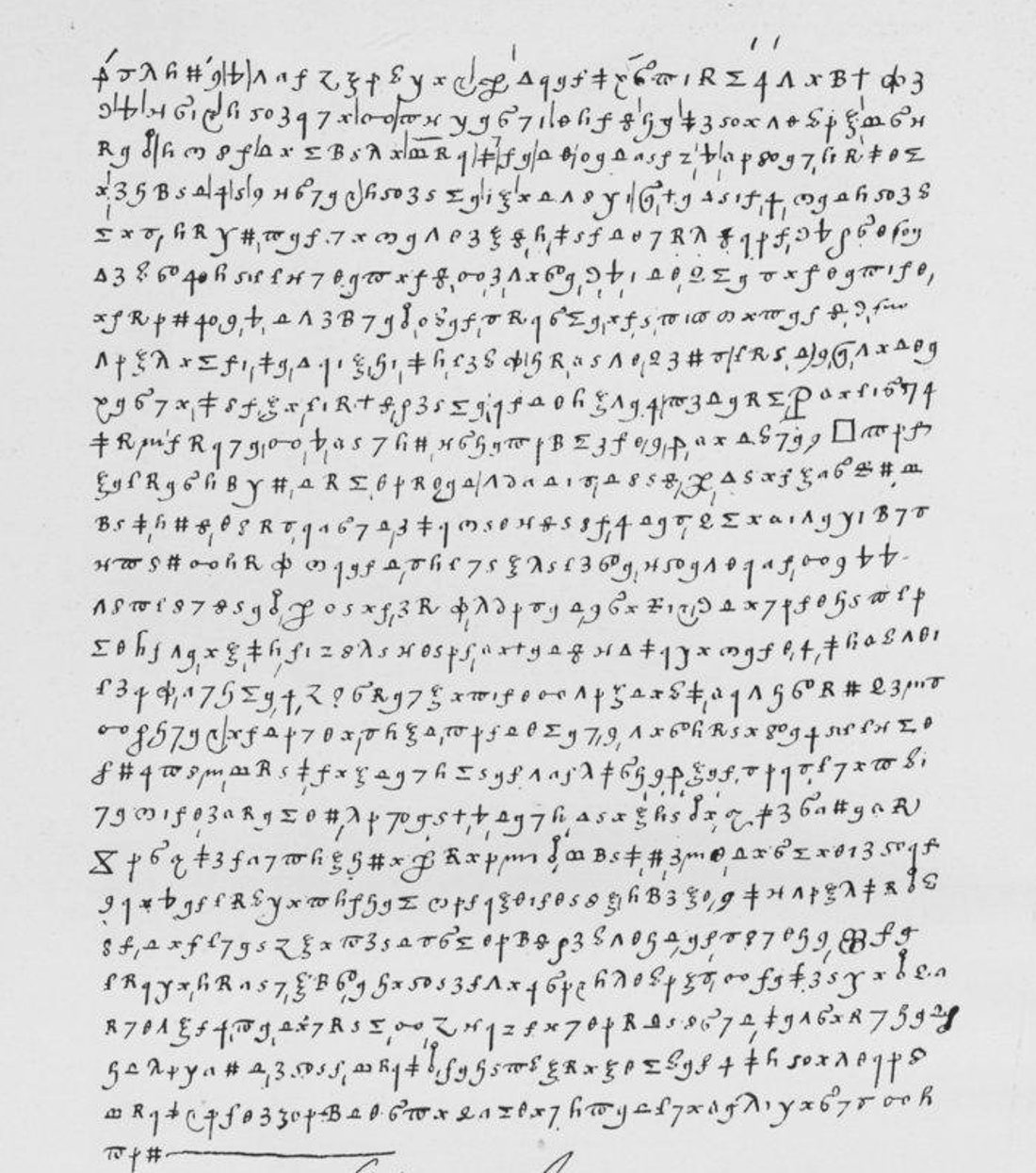
02 George Lasry’s prior solution
Tomokiyo’s page George Lasry’s Solutions of Unsolved Ciphers
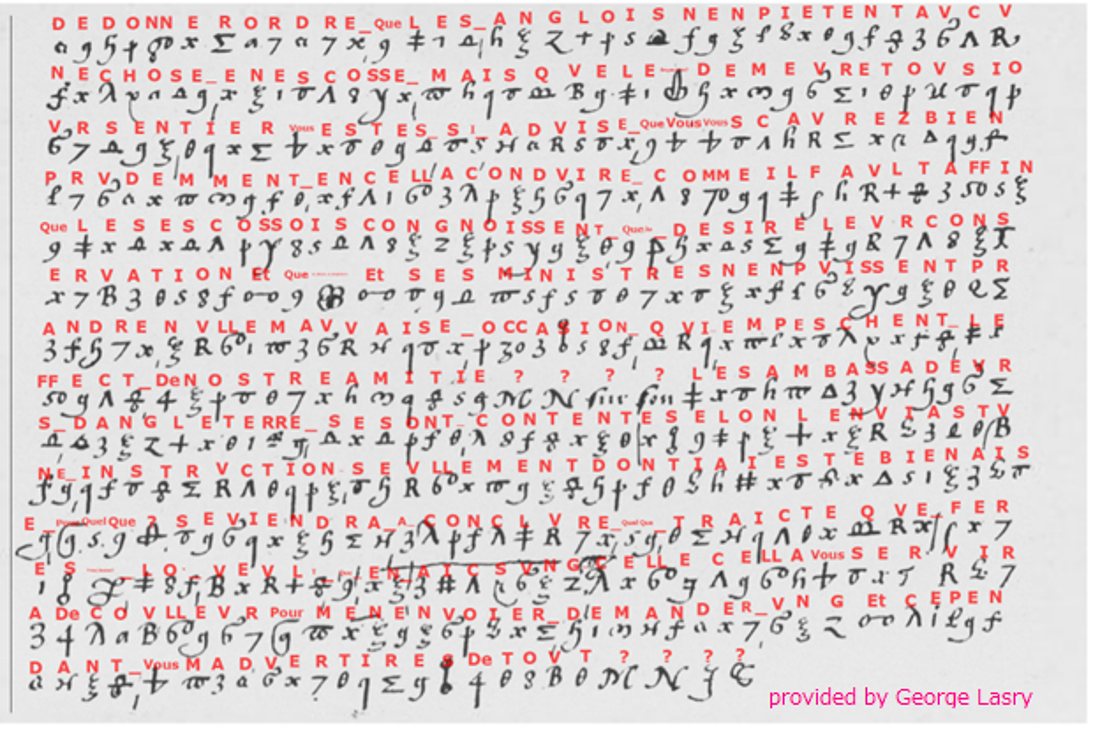
has a section headed “Charles IX to Philibert du Croc (1565–1567 or 1572).” Beneath the manuscript it says “This is solved as follows” and reproduces Lasry’s plaintext in red directly over the signs on both pages. The overlay lies on the same two pages: page geometry, line breaks, signatures and the postscript agree throughout.
The system is a French homophonic nomenclator: several graphic signs can represent letters, while other signs stand for whole words or names. Lasry’s displayed key includes values such as de, et, que, par, pour, je, vous, la Royne d’Angleterre, la Royne d’Escosse, and royaulme. It is not the symbol system used in Catherine de Médicis’s separate letter to du Croc of 27 April 1567.
03 What the cipher says
The opening tells du Croc that he knows both the man and those with whom he must deal, and that his demonstrated devotion makes further advice unnecessary. He is to follow the instructions already given and those now sent, especially “le bien de la paix du dict pais.” Charles then turns from what can presently be done for “ma seur” to the young King:
Je desire que mon nepveu aussy sur toutes choses soit bien nourri, qu’il ait tousjours, à l’imitation de ses predecesseurs, à moi et aux miens sa principalle affection.
Du Croc is to attend closely to the settlement of Scotland’s peace, government, and council. Without revealing that the direction comes from Charles, he must ensure that James neither marries nor concludes a marriage before Charles has been informed and can send his intention. Above all, he is to retain the hearts of the Scots so that their accustomed affection for the French kings does not diminish.
The postscript is blunter:
Ce que vous avez principalement affaire par delà est de donner ordre que les Anglois n’empiètent aucune chose en Escosse…
Du Croc must act prudently, make the Scots recognize that France seeks their preservation, and avoid occasions that could obstruct the friendship. The closing lines mention the English ambassadors and a possible treaty, but the gaps in the overlay are too large for a continuous translation. The repository preserves a line-by-line diplomatic transcription and a normalized summary.
04 What remains uncertain
- The original has no surviving date or place; 1565–67 or 1572 is a range of possible dates.
- Destray names the Nièvre archive and the Bourg de Bozas collection but gives no exact cote.
- Lasry’s overlay has several explicit `????` groups. Other short phrases are partly obscured by the signs at the available resolution.
- No independent symbol-by-symbol transcription was made and no complete key was rebuilt here. The outcome is an existing decipherment, transcribed and checked against the images.
05 Sources
- DECODE R2789, record and authenticated images.
- Paul Destray, Philibert Du Croc : un diplomate français du XVIe siècle (1924), document XLIII, p. 80 and the following facsimile leaves.
- Satoshi Tomokiyo,
George Lasry’s Solutions of Unsolved Ciphers
, with George Lasry’s key and two-page plaintext overlay, 25 May 2022.
Working notes and the transcription of Lasry’s plaintext, with its gaps kept, are in charlesixducroc/.