01The documents
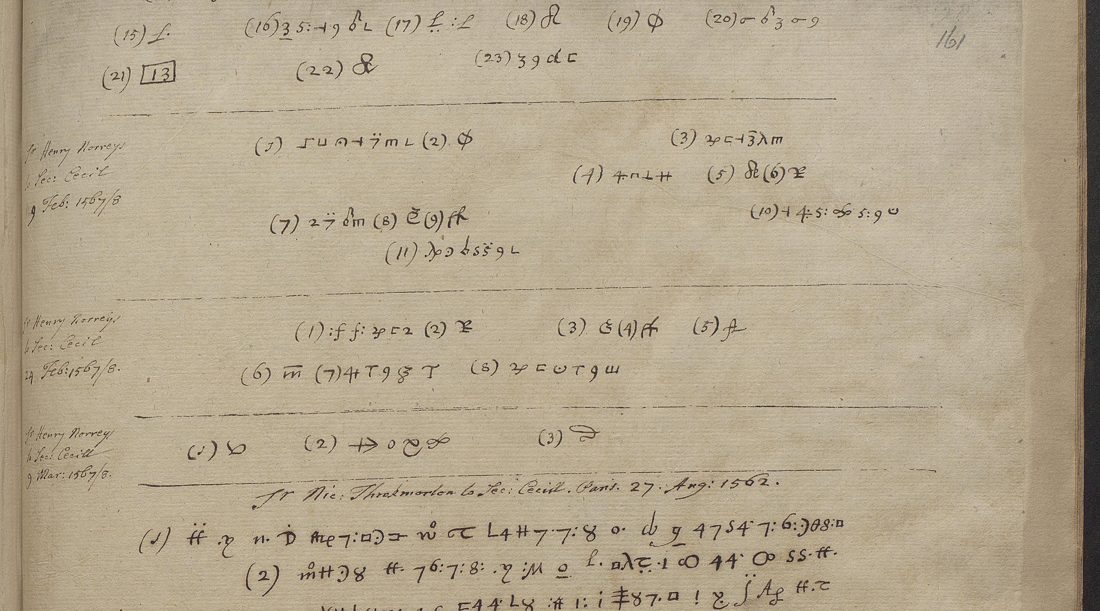
Add MS 4136 is Forbes’s working file for his Full View of the Public Transactions in the Reign of Q. Elizabeth (1740–41). He copied the enciphered stretches of the ambassadors’ letters and filed the keys at ff. 177–190 (see the Smith write-up). The Norreys section is:
| Letter | Folio | Items | CSP Foreign viii |
|---|---|---|---|
| 4 June 1567 | 160 | 7 (two long) | no. 1265 |
| 6 July 1567 | 160 | 1 | no. 1405 |
| 10 July 1567 | 160 | 1 | no. 1427 |
| 6 Feb 1567/8 | 160–161 | 23 | no. 1987 |
| 9 Feb 1567/8 | 161 | 11 | no. 1998 |
| 24 Feb 1567/8 | 161 | 8 | no. 2025 |
| 9 Mar 1567/8 | 161 | 3 | no. 2054 |
The rest of R9251 is Throckmorton (27 Aug 1562), Middlemore (8 Apr 1563) and Smith (7 Mar 1562/3), in other ciphers.
02The key
The key records in the volume (R9257 Percy, R9260 Throckmorton’s first and second ciphers, R9261 Smith and Croft, R9262 Throckmorton’s third) do not match Norreys’s signs. A crib search against the Calendar’s wording was inconclusive: the groups are too short and too many words fit. The name signs did give three identifications, because they recur in the same order in the 9 and 24 February letters, and both Calendar entries run “the Protestants … the Prince [of Condé] … the Admiral”.
The key came from Tomokiyo’s page on Elizabethan ciphers. Cabala (1663) prints Cecil’s cipher letters to Norris, and its “Postscript” to 27 September 1568 is really the decipherment of that letter’s cipher passages. From it Tomokiyo rebuilt a partial table. Signs may be turned in any orientation (⊏ = ⊔ = e, Γ = L = d), and single signs stand for persons. Applied to Norreys’s groups:
| Letter, item | Reading | Calendar |
|---|---|---|
| 6 July 1567 (1) | Master Stewarde | “Signed: Stewart’s name in cipher” |
| 4 June 1567 (6) | #… Savoia … the in[t]e[n]d to ouerthrou # # a[nd] Engla[n]d | “the King of Spain, the Emperor, with the Duke of Savoy intend to overthrow the Protestants of France, Flanders, and England” |
| 10 July 1567 (2) | the lord of Murrei … (rest garbled) | “the Earl of Murray” |
| 6 Feb 1568 (1)–(4), (7), (16) | Leisly; [the] earl; Rothes; papystes; reaums (realms); stayid | “one Lesley, brother to the Earl of Rothes, who came from the Papists of Scotland” |
| 9 Feb 1568 (1), (3), (4) | demaund; reason; peac[e] | “whether now the demand of Calais were not very expedient … a mean to make peace” |
| 9 Feb 1568 (5)–(9) | the French King, the Protestants; ruin; the Prince, the Admiral | “peace betwixt the French King and the Protestants, otherwise Norris much doubts the ruin of the Prince of Condé and the Admiral” |
| 24 Feb 1568 (2)–(4), (6), (8) | the Protestants, the Prince, the Admiral; money; remain | “the Prince and the Admiral … that they may have money to pay the Almains, whom otherwise he much fears will not long remain with them” |
Control. The script work/tomokiyo_apply.py counts dictionary words (the, and, lord, papists, realms, Rothes, earl, stayed, reason, ruin, master, steward…) in the decrypted groups. The real table gives 8 hits. With its letter values shuffled among the same signs (1,000 seeded trials) the mean is 0.22 and the maximum 3, and no shuffle produces a whole cribbed word such as Rothes, papystes, Steuarde, Murrei or Savoia. The table is Norris’s cipher, used from 1567 and not only in 1568.
03The letter of 9 March 1568
The Calendar (no. 2054): “Upon M. Montmorency’s first return from the treaty holden at Longjumeau the King despatched four gentlemen, viz., to the Pope, the Emperor, the King Catholic, and the Swiss … Thinks if peace be concluded some attempt will be made into Scotland for the delivery of the Queen.” Forbes copied three items:
| Item | Signs | Reading | Grade |
|---|---|---|---|
| (1) | ꝺ (turned) | the [French] King | H: the same name sign as in 6 Feb (5), (13) and 9 Feb (5), where it matches the Calendar’s “the French King” |
| (2) | crossed arrowhead, o, loop, ∞ | not read: a t ? l | open. Cabala p. 152 prints the crossed arrowhead inside the “all” before papists, where p is 4 and 4+, so it is not p, and “Pope” is withdrawn. + = a in Norreys’s own “earl” (6 Feb), o = t (papists), ∞ = l; the loop is unmatched. “Catholic”, the first guess, is withdrawn too |
| (3) | ∂ (closed loop) | the Queen [of Scots]? | I: by position against “for the delivery of the Queen”; the sign occurs nowhere else |
04What remains open
- 9 March (2), a t ? l, open; (3) the Queen of Scots only by position (I). The loop sign is not in Tomokiyo’s table.
- 4 June 1567 items 1, 3, 4 and 7, and the rest of 10 July (2): the token transcription of those lines needs redoing.
- 6 Feb 1568 items 9, 12, 17, 20 and 23; 9 Feb 10 and 11; 24 Feb 1 and 7.
- Cabala (1663) pp. 142–173 would give the signs missing from the table (g, k, q, w, the loop) and perhaps the name symbols.
- The originals, TNA SP 70/96–97, probably carry interlinear decipherments by Cecil’s clerks. They were not seen.
05Sources
- British Library, Add MS 4136 ff. 160–161, via DECODE R9251 and R9250 (images login).
- Calendar of State Papers, Foreign, Elizabeth, vol. 8 (1566–68), nos. 1265, 1405, 1427, 1987, 1998, 2025, 2054, British History Online.
- S. Tomokiyo, “Cecil–Norris Ciphers (1567–1570)”, Cryptiana: Ciphers in the Elizabethan era, after Cabala, sive Scrinia Sacra (1663) and Davys.
Transcription, readings and notes: norreys1567/ in the repository.