
01 The documents and the key
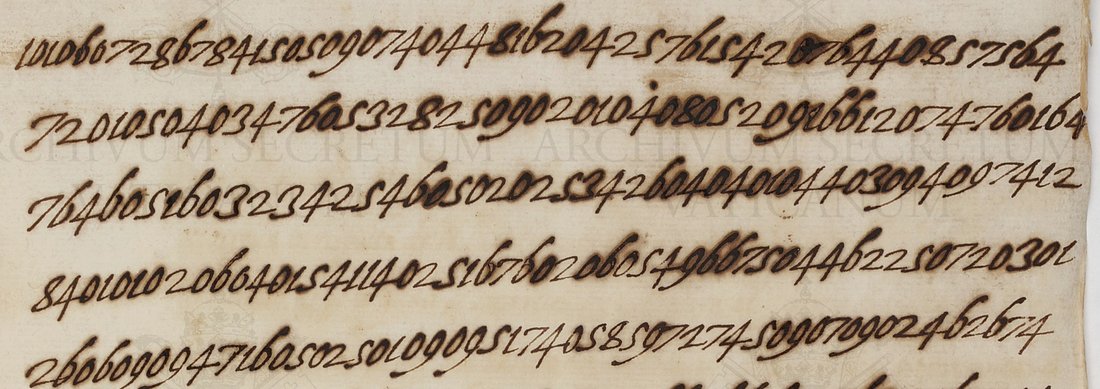
Spagna 6/I is described by the archive as “Lettere orig. e cifre del cardinale Alessandrino dal 16 gennaio 1568”. DECODE has ten ciphertexts from it (items 1–10: ff. 6r, 42r, 55r, 81r, 88r–89v, 136r, 169r–v, 291r–v, 306r; item 8 has no folio on DECODE), 9,842 digits in all, and one from 6/II (item 13, f. 641r, 1569; 769 digits). None is dated on DECODE; the dossier’s folio order places 6/I in 1568. The transcriptions were made for DECODE in 2016–2020 and are used here as they stand.
Lasry’s key, attached to every record:
- Letters: 1 u|t · 2 i|m · 3 f|g · 4 a|l · 5 o|s · 6 e|n · 7 d|r · 8 b|c · 9 p|z · 0 null. There is no sign for h or q.
- Nomenclator: 1010 Nostro Signore · 1020, 4010, 9010 Sua Santità · 1050 Francia · 1090 V. S. · 2060 non · 2090 che · 3010 Re · 4030 S. M.tà · 4060 questo · 4090, 9030 Germania · 5020 per · 5090 qui · 6090 quel · 7090 quello · 8010 Re di Francia · 9020 quelle · 9060 questa; dotted 0̇0 comma, 3 0̇ 9 qua; and a few tentative (1040 Regina di Francia?, 3040 Fiandra?, 8090 sapere?).
02 A French bride for the King
The first cipher (f. 6r), set out from the decoder’s unspaced output with the words divided:
… è ricercato qui da alcuni amorevoli della corona di Francia a fare officio … [che S. M.tà] contenti di ricevere una delle sue figliole per moglie … la pratica N. S. non ha voluto movere non sapendo l’animo di [S. M.tà] in quel particolare … scoprirà qui [V. S.] in quella maniera che le parerà più opportuna e conveniente, assicurandola che [N. S.] non è per farne parola mai se prima non sa [di S. M.tà] l’intentione sua espressa …
“Some well-wishers of the crown of France have asked here that [the Pope] act … that His Majesty be content to take one of [the King of France’s] daughters to wife. Our Lord has not wished to move the matter without knowing His Majesty’s mind … you will discover it in whatever way seems best, assuring him that Our Lord will never speak of it before he knows his intention.” Elisabeth of Valois died on 3 October 1568; Philip’s eventual fourth wife was Anna of Austria, and the French candidate pressed at Rome was Marguerite of Valois. The fourth cipher (f. 81r) is still “waiting for the answer from Your Lordship on the particular of the marriage”, with the argument that the union of “quei tre principi principali della cristianità” would serve the Church.
03 All eleven, in brief
- 6/I/1, f. 6r (R93). The French marriage proposal, above.
- 6/I/2, f. 42r (R94). Jurisdiction: the Pope “non intende di revocare i suoi privilegi … ma sibene di levare li abusi cresciuti” through the ministers’ fault; they have sought to widen the privileges “in detrimento di quella autorità” of the Holy See.
- 6/I/3, f. 55r (R95). Answer to the ministers’ claims; the crusade alms and indulgence; “che il Re si saria alienato da quella santa sede” must not be said; the Pope cares for the King’s soul above any human respect.
- 6/I/4, f. 81r (R96). The marriage again; a man prosecuted as a heretic; an order to be carried out for the Hermits of St Jerome.
- 6/I/5, ff. 88r–89v (R97), four pages. Exiles of the state of Bologna received in the King’s name, the Cavaliere Gualengo; the King, “feudatario” of the Holy See, bound by his investiture to return them; then the Turk: a French embassy “in Andrinopoli”, the Protestant princes promising the Sultan that once all is ruined they will be at one with him — “la povera cristianità”.
- 6/I/6, f. 136r (R98). The King’s orders about the clergy lose their effect while ministers wait for commissions.
- 6/I/7, f. 169r–v (R99). The religion of St John and its Grand Master; Don John of Austria; the senate of Milan, the archbishop’s vicar and the Corpus Domini procession; the Pope “pensa di procedere” with “armi spirituali”.
- 6/I/8 (R100). The King’s ministers’ proceedings in a Church matter; a brief to be executed.
- 6/I/9, f. 291r–v (R101). The St Peter’s-day dues of the Neapolitan fief and the investiture; a schism stirred by the ministers; “alla fine” the King’s subjects will be disobedient if he is disobedient to God’s vicar.
- 6/I/10, f. 306r (R102). A prelate who fails in his office in the kingdom; the Pope “le parerà convenire” to leave it to the King.
- 6/II/13, f. 641r (R115), 1569. Pensions to be transferred on a see; a commission; the Council.
04 Method
Each digit 1–9 gives two letters and 0 nothing, but a group X0Y0 may be a nomenclator word or two letters with their nulls.
The decoder (alessandrino1568/decrypt.py) works through the page keeping the best few partial decryptions at each step; at each digit it tries both letters, the null, and
any nomenclator group that starts there, and scores the resulting Italian with the repository’s shared five-gram model (it-cinquecento,
spaces removed). The same code, with a different key table, decrypted the Morosini ciphers of 1588–89. Every page decodes at about −1.75
nats a letter, the level of ordinary text for this model, and ends in a few letters of clerk’s padding.
05 What remains uncertain
- Letter choice is the model’s (grade M for single letters); words forced by context are H. Proper names are the weakest part.
- Dotted groups not in Lasry’s list: 01, 02, 03, 04, 08, 09, 1, 40, 43, 44, 51, 60, 70, 80, 90. 04 and 60 recur where a comma or et fits. Not resolved.
- Lasry’s tentative glosses (1040, 3040, 8090, 2020) are kept as tentative.
- No comparison yet with the contemporary decifrati or with Serrano’s edition, which prints Alessandrino–Castagna letters; some of these letters may already be in print there in clear.
- Transcriptions are DECODE’s and were not re-checked against the images.
06 Sources
- DECODE records R93–R102 and R115 (images and transcriptions; login).
- George Lasry, reconstructed key “ASV – S6”, 24 October 2020, attached to the records.
- Luciano Serrano, Correspondencia diplomática entre España y la Santa Sede durante el pontificado de S. Pío V, Madrid 1914 (not consulted).
Decoder, notes and decoded pages: alessandrino1568/. Page images are not reproduced.