01 The slip
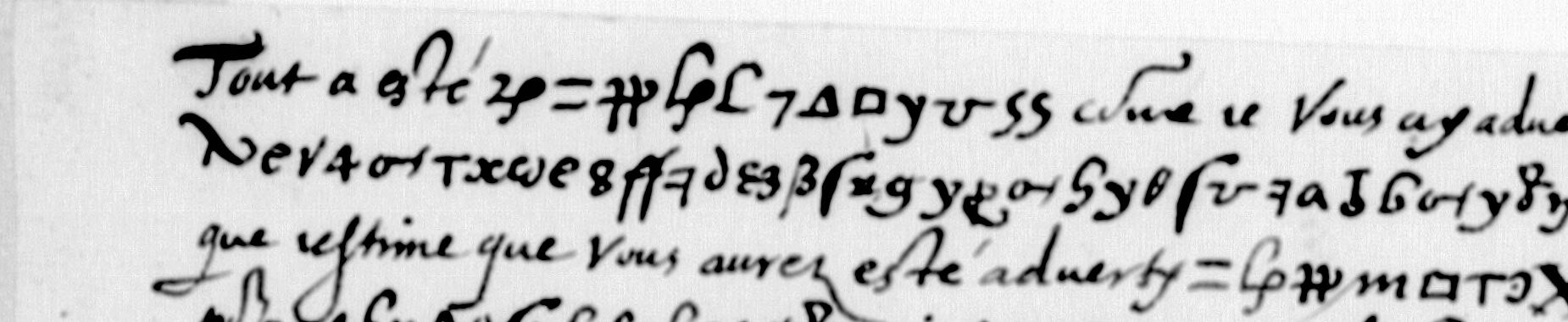
f. 151 is a narrow slip mounted on a guard at the right of Gallica view 164, foliated 151 at the top right with an older number 226 at the foot. It carries eight lines of clear French in a neat secretary hand. The cipher runs are set inside the clear sentences. It is dated “Ce xxvje juin” and signed with a monogram read as MR. The year is not written; the catalogue gives c. 1586.
02 The cleartext
Tout a esté [C1] que je vous ay adverty par ma derniere du ..e de ce mois. Et voy bien que [C2]. Toutes choses y estans disposées et preparées ainsi que j’estime que vous aurez esté adverty [C3] assister … sans vre presence, afin que nous eussions cest heur que desirons (?) tout plus tost … Je regrette infiniment nre malheur si [C4] Je ne faillray de vous tenir adverty de [C5] … Mais nous avons depuis estimé qu’il viendra plus a propos d’attendre encores un peu … le tout ensemble [C6] mais esperons beaucoup par sa valeur. Ce xxvje juin. [monogram] MR
“Everything has been […] as I told you in my last of the … of this month … everything there being arranged and prepared … without your presence, so that we might have the good fortune we desire … I regret our misfortune extremely if […] … but we have since judged it better to wait a little longer … but we hope much from his valour.” Words marked … or (?) are uncertain readings of the hand.
03 What was tried
- Lasry’s fr. 15564/15565 key (cryptiana, GL.htm, table dated 29 May 2022): cursive letter forms, with codes for de, que, pour, leur, au, les, par, son. No symbol of f. 151 is in it.
- Mayenne–Forget Cipher-1 (fr. 15572, 1586; matignon1586): letters with dots, digits and a few geometric forms, including a triangle for a. The overall shapes differ and the symbol inventory does not match.
- Clairambault 357, 1586 (write-up): two-digit figures. Not the same system.
- Ciphertext-only. 217 symbols in six runs, 55 kinds. The commonest are y ×16, σ ×12, 4 ×10, 9 ×10 and † ×9. The solver gave each symbol one letter (4-gram language model of Henri IV’s letters, 8 restarts). It scored −1.87 per symbol on the real text and −1.82 on the same symbols shuffled, so there is no signal. With about four symbols per plaintext letter, 217 symbols are well below what a homophonic key of this size needs.
04 What stays open
None of the six cipher runs is deciphered, and the MR monogram is unidentified. Another letter in the same key would give the material to recover it: the monogrammist’s other letters to Mercœur in fr. 15564–15566 or in the Mercœur papers. The key itself would decipher the runs directly.
05 Sources
- BnF français 15564, Gallica view 164 (f. 151, right).
- S. Tomokiyo, cryptiana: Solutions by George Lasry (GL.htm), “Duke of Guise? in BnF fr.15564 and fr.15565”, and the unsolved list, “Letters from Duke of Guise? (ca. 1581)”.
Transcription, solver and control: mercoeur1586/.