

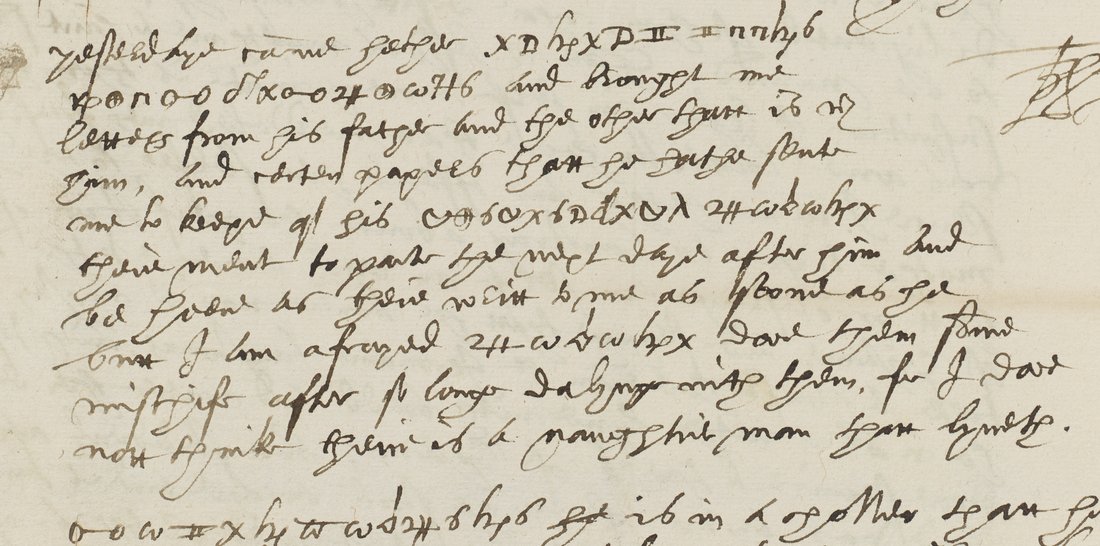
6 is e, not a null as the R8503 runs had suggested. With it the postscript deciphers as follows: Junius’ son came from Cambrai with letters from his father and papers “of his credit with Balagny”; Stafford fears Balagny means them mischief. Four symbol values rest on context; nothing is left open. The letter is not calendared in CSP Foreign.01 The letter and the cipher
Ff. 65r–65v are in Stafford’s own hand. The clear text reports on Captain Blaize, the Neapolitan with Cesar, his fortifications and dealings in Spain and Naples, on Locatello, and on a book lately printed at Rome by Dr Sanders. A note in the margin of f. 65v forwards a request from “one that was Mr Dennys man”. The address leaf, f. 66v, carries the endorsement “20 August 1586. From Sr Edw. Stafford”.
The postscript below the signature holds five cipher runs, written in the same line as the clear words. The signs are a mixture of letter forms and graphic signs (x D h II n oo O+ w 24 H λ), the same inventory as Stafford’s other letters to Walsingham in the volume.
02 Recovering the key
Harley MS 1582 holds four Stafford despatches of August–November 1586 in the same cipher (DECODE R8500–R8504). Two of them carry the plaintext:
- f. 73r (R8502). A second hand glossed the cipher words:
x D h x D IIJunius,d w o o 24 Oo w H 6Cambray,24 w a w B h H 6Balagny,B 6 O+ Oo o w h x 6Germany, and a sum 10000 crownes. - f. 72r (R8501). A whole page of clear text in a small hand, headed a., b. and c. to match the ciphered passages on ff. 71r–71v: the French ambassador’s wife writing to the Duchess of Nemours that the Queen of Scots “is in very ill state”; Villeroy sending the ambassador’s secretary to “make away Nau”. About 480 cipher signs on f. 71 were aligned against it.
The alignment gives a letter alphabet with homophones, plus single-sign and numeric codes:
| letter | signs | letter | signs |
|---|---|---|---|
| a | w | n | h |
| b | 24 | o | n |
| c, l | d | p | E |
| e | 6 | q | Δ |
| f | ψ | r | O+, Oo |
| g | B | s | II, #, I |
| h | λ | t | u, A |
| i, y | x, H | u, v | D, ρ |
| k | M | w | D d |
| l | a | m | oo |
Codes: B alone Villeroy, O+ alone the Duke or Duchess of Nemours, 120 the French ambassador, 47 the King of Navarre; 20, 22 and 54 recur. The earlier interpretation of 6 as a null (from the four runs of R8503) is wrong: it is the commonest letter, e.
03 The decipherment
| run | ciphertext | reading | in context |
|---|---|---|---|
| 1 | x D h x D II · II n n h 6 | Junius sonne | “yesterday came hither Junius’ son” |
| 2 | f O+ n oo · d x oo 24 O+ w 7 H 6 | from Cambraye | “from Cambray, and brought me letters from his father and the other that is with him” |
| 3 | d O+ 6 w x A · D d x u λ · 24 w a w h H x | credit with Balagny | “and other papers that he hath sent me to keep of his credit with Balagny” |
| 4 | 24 w a w h H x | Balagny | “but I am afraid Balagny dare them some mischief after so long dealing with them” |
| 5 | oo w H x h u w σ H δ h 6 | mayntayne | “[I] maintain he is in another than he hath heard often from your honour of long time” |
Balagny is Jean de Monluc, seigneur de Balagny, who held Cambrai; the Junius whose son came from Cambrai is not identified further here.
04 What remains uncertain
- Run 3:
Aas t and the fourth sign as d in “credit” (C: context, one other occurrence ofA= t on f. 71r). - Run 5:
σandδhave no sibling occurrence; “mayntayne” is inferred from the ten confirmed signs around them (C). - All other signs are confirmed by the sibling key (H). 61 tokens, all giving sense.
05 Sources
- British Library, Harley MS 1582 ff. 65–66 (DECODE R8500); siblings ff. 71–72 (R8501), f. 73 (R8502), ff. 74–75 (R8503, see Stafford 1586), ff. 76–77 (R8504). Images on DECODE, not reproduced.
- Calendar of State Papers Foreign, Elizabeth, vol. 21 pt 1, August 1586 (British History Online): a different Stafford letter of 20 August; this one is not calendared.
Notes, the transcriptions, the f. 72r decipherment, the alignment and the key are in harley1582r8500/.