At a glanceExisting decipherment · complete
- The letter
- Robert R. Livingston, the new Secretary for Foreign Affairs, to John Jay at Madrid, Philadelphia, 28 November 1781, carried by Lafayette. The body is printed in full; the open item was its last line, an instruction to add six groups to the cipher.
- Where
- Sent original (ALS), New-York Historical Society, Jay Papers (EJ 598); draft, NHi, R. R. Livingston Papers (EJ 1537). Both are imaged as photostats in Columbia University’s Jay Papers (ldpd:6328, ldpd:11572), with Jay’s copy of the Thomson code (ldpd:50144). Unsolved Catalogue no. 636. Not on DECODE.
- The cipher
- Charles Thomson’s printed list of about 600 words and syllables, with numbers written in by hand. The sent original uses a copy numbered differently from Jay’s: the copy that was lost at sea with William Palfrey.
- How it was deciphered
- Livingston’s draft writes a syllable under each pair. Jay’s copy of the code lists the same six syllables against 600–605. Each pair spells its syllable letter by letter, with 226 as e every time.
- What it says
- “Make this addition to your cypher: be, 600; ce, 601; de, 602; fe, 603; ge, 604; he, 605.”
- Still open
- Nothing in the line. How the three groups of “cypher” (23.473.370) divide into syllables is not settled.
01 The letter and the line
Livingston took office as Secretary for Foreign Affairs on 20 October 1781. This was his first official letter to Jay, then minister at Madrid. It reports the winter after Yorktown, Congress’s anger at the Spanish court, and whether Jay would rather go to Paris. It ends with one line:
Make this addition to your cypher: 69. 226–600; 538. 226–601; 346. 226–602; 216. 226–603; 209. 226–604; 259. 226–605.
The Selected Papers of John Jay (vol. 2, 2012, pp. 644–46; Founders Online) decode the cipher passages of the body from the draft. They print this line as figures, and note 7 explains it as “an attempt to simplify the Thomson code … adding six symbols for syllables ending in r”, calling the passage undecipherable on the authority of Richard B. Morris’s John Jay: The Making of a Revolutionary (1975), p. 664.

02 Two copies of one code
Charles Thomson, secretary of Congress, made nomenclators on a printed form: about 600 words and syllables in alphabetical order, with the numbers written in by hand (Weber’s WE007). Each copy could be numbered differently. Major Franks carried one copy to Jay, and it survives at Columbia. Thomson gave Livingston a second copy, numbered differently, which was meant to go to Jay with the consul William Palfrey. Palfrey was lost at sea.
Livingston explained the muddle to Jay on 9 May 1782 (Founders). His letter of 28 November went by Lafayette “in a cypher delivered to me by mistake, by Mr. Thompson, and lost with Colonel Palfrey”. The original is endorsed “Recd. 24 Feb. 1782 … not decd.”. The duplicate and triplicate were re-encoded in Jay’s copy, and they stop at the signature, without the line. In the same letter Livingston says his letters “only notes a slight alteration in Mr. Thompson’s cypher”. That is this line.
Looking up the six pairs in Jay’s copy gives nonsense (69 twelve, 538 into, 346 el, 216 en, 209 sha, 259 their; 226 edge). The figures are in the lost copy. A nineteenth-century copy of the coded passage of Livingston’s 20 October letter, with the figures written under the words (Columbia ldpd:32488), confirms that the lost copy is the same form renumbered: there not is 203, his 139 and will 175, where Jay’s copy has 281, 88 and 279.
03 The reading
Two witnesses give the line’s meaning, and they agree pair by pair.
- Livingston’s draft writes “Make this addition to your cypher” in clear, then the six pairs in a column, with a syllable written under each: Be, Ce, De, Fe, Ge, he. The first two are clear; the lower four are smudged in the photostat but can be read in that order.
- Jay’s copy of the Thomson code, headed “Thomson cypher, 11 July 81, as modified by Livingston 6 July 1782”, has a handwritten list at the foot of its second page: be 600, ce 601, de 602, fe 603, ge 604, he 605. A first “he 604” is written over. Later additions follow: le 608, me 652, ne 656, pe 651, and Washington 640, Greene 641, Morris 642.
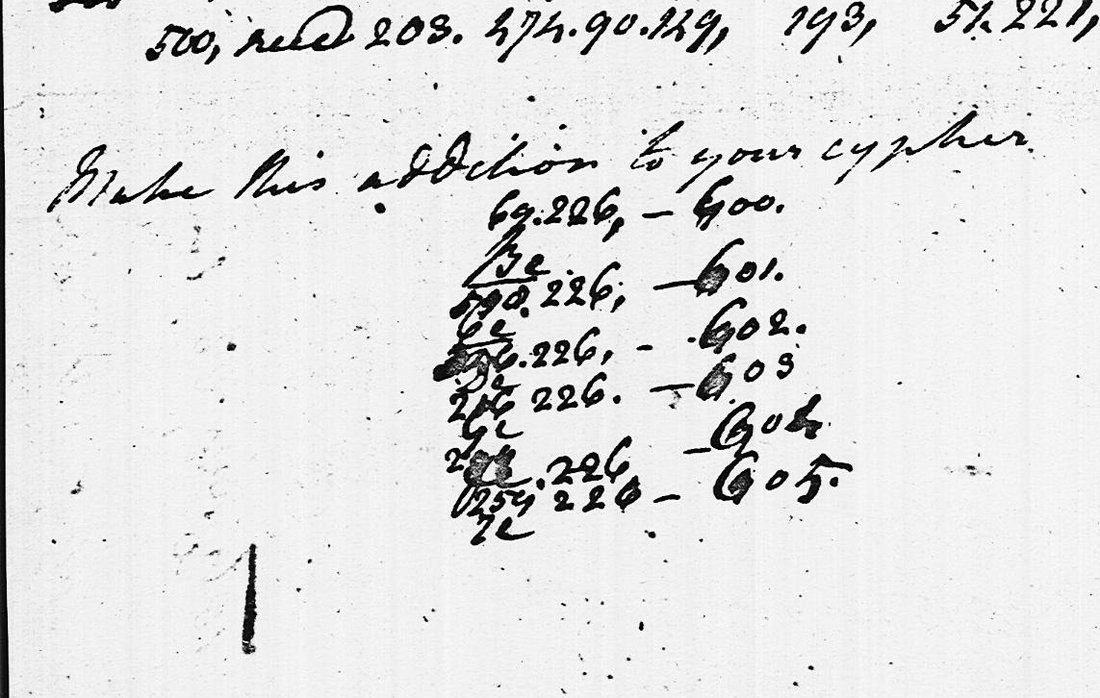
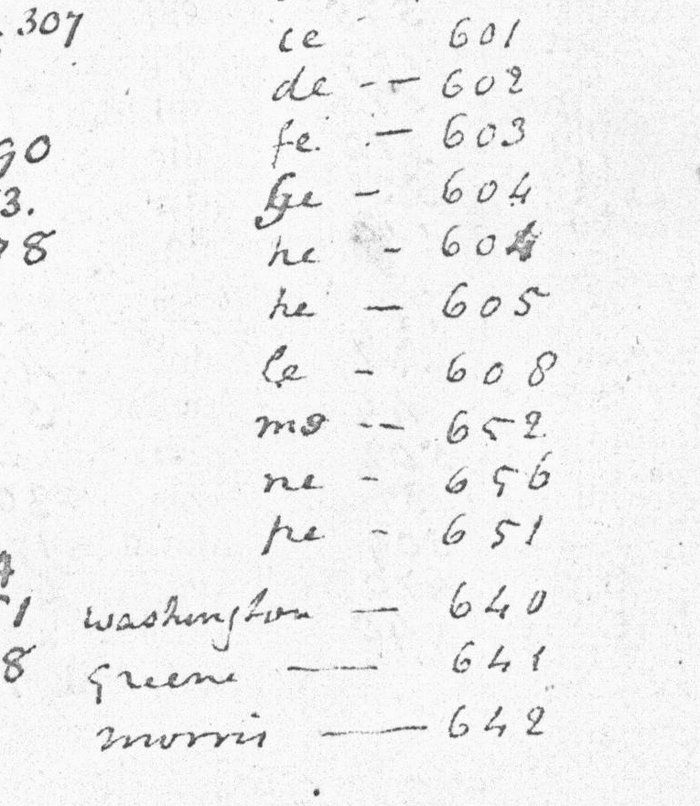
Read against them, the line on the sent original is:
| Cipher | Reading |
|---|---|
| 398 · 264 · 23.473.370 | to your cypher |
| 69.226 — 600 | be — 600 |
| 538.226 — 601 | ce — 601 |
| 346.226 — 602 | de — 602 |
| 216.226 — 603 | fe — 603 |
| 209.226 — 604 | ge — 604 |
| 259.226 — 605 | he — 605 |
Each new group is defined by spelling its syllable in two existing groups, the consonant and then e. In the lost copy, b is 69, c 538, d 346, f 216, g 209, h 259 and e 226. Jay’s printed form has no entry for any of these six bare syllables: it has bea, been, bes, ca, ch, den, dent, fel, fen, fer, ger, head, hear, her, but no be, ce, de, fe, ge or he. The addition fills that gap.
The edition’s “syllables ending in r” came from reading 226 as r. It is e. The form already has the r-syllables (in Jay’s copy ar 76, er 86, ir 150, or 382, ur 331), so there was nothing to add there.
04 Method
The Founders text located the line. All six imaged copies of the letter in Columbia’s Jay Papers were then stitched from their full-resolution IIIF tiles, with Jay’s copy of the Thomson code and the 20 October copy. Two leads failed first. Jay’s own numbering does not fit the line. A four-page word code catalogued at Columbia as the key to this letter (ldpd:50124) gives 69 = apparent and 226 = destroy, so it is a different code. The draft’s glosses and Jay’s list then gave the reading, and the printed form was checked for the gap it fills.
05 What remains uncertain
- All 17 code groups of the line are deciphered, and every reading is graded H: two independent witnesses agree.
- “Cypher” is three groups, 23.473.370. The obvious division is cy·ph·er, but 473 also stands under thing in the nineteenth-century copy of 20 October. Either that copyist’s figures drift against the words, or the division differs. The word itself is certain.
- Where Jay got the addition is not proved. The duplicate he could read does not carry it, and his key sheet is headed with Livingston’s changes of 6 July 1782, so that letter (Columbia, EJ 90354) is the likely source. It was not checked.
- Morris’s explanation in John Jay: The Making of a Revolutionary, p. 664, was not consulted.
Full texts
The transcription and the decryption of every document on this page, so that the reading can be used and checked. Short files are shown here; all are in the repository.
Livingston to Jay, Philadelphia, 28 Nov 1781, last line (NHi Jay Papers EJ 598)
Livingston tells Jay to add six groups to his cipher: be 600, ce 601, de 602, fe 603, ge 604, he 605. Each is defined by spelling the syllable in two existing groups, the second always e (226).
Transcription
# Livingston to Jay, Philadelphia 28 Nov 1781: the "addition to your cypher" line.
# Cipher tokens only, one code group per token, as on the sent original (ALS, NHi Jay Papers EJ 598),
# Columbia Jay Papers record ldpd:6328, scan page 7 (image ldpd:6321), foot of the page, two lines.
# Clear words, punctuation and the six new numbers 600-605 (which are key labels, not ciphertext) are left out.
# Full line as written (clear words in brackets, ^ = interlined):
#   [Make this addition] 398, 264, 23.473.370; 69.226. [600.] 538.
#   226, [601,] 346.226, [602.] 216, 226. [603.] 209.^226 [604..] 259.226. [605.]
# A later hand has interlined "to your cypher" over 398, 264, 23.473.370.
# The second 226 of the fifth pair is interlined over 209 (written in after the fact).
# Read against the draft (NHi R. R. Livingston Papers, EJ 1537; Columbia ldpd:11572, scan page 3, image
# ldpd:11561), where the same pairs stand one to a line with a gloss written under each.
398 264 23 473 370
69 226
538 226
346 226
216 226
209 226
259 226
Decryption
# Reading: Livingston to Jay, 28 Nov 1781, the addition to the cypher

Sent original (ALS), foot of the last page, against the draft's glosses and Jay's key sheet.
Grades as in README Conventions: H = confirmed by two independent witnesses.

| Cipher (ALS) | Reading | Witness | Grade |
|---|---|---|---|
| 398 | to | interlined "to your cypher" on the ALS; clear "to your cypher" in the draft | H |
| 264 | your | same | H |
| 23.473.370 | cypher | same (the three groups together; how they divide into syllables is not settled) | H |
| 69.226 – 600 | be – 600 | draft gloss "Be"; Jay's key sheet "be — 600" | H |
| 538.226 – 601 | ce – 601 | draft gloss "Ce"; Jay's key sheet "ce 601" | H |
| 346.226 – 602 | de – 602 | draft gloss (smudged) "De"; Jay's key sheet "de — 602" | H |
| 216.226 – 603 | fe – 603 | draft gloss (smudged) "Fe"; Jay's key sheet "fe — 603" | H |
| 209.226 – 604 | ge – 604 | draft gloss "Ge"; Jay's key sheet "ge — 604" | H |
| 259.226 – 605 | he – 605 | draft gloss "he"; Jay's key sheet "he — 605" | H |

Cipher tokens: 17 (measured, `transcription.txt`). Read: 17 of 17.

## The line in clear

> Make this addition to your cypher: be, 600; ce, 601; de, 602; fe, 603; ge, 604; he, 605.

Each pair is spelled in the code letter by letter: b, c, d, f, g, h followed by e (226). It gives each
consonant + e syllable a single new group. The printed Thomson form has no entry for any of these six syllables
(it has *bea, been, bes, ca, ch, ci, den, dent, fel, fen, fer, ger, head, hear, hence, her*, but no bare *be, ce,
de, fe, ge, he*). The addition fills that gap.

So the edition's note 7, "six symbols for syllables ending in r", is wrong. The syllables end in *e*. The
r-syllables *ar, er, ir, or, ur* already have their own entries in the printed form (76, 86, 150, 382, 331 in
Jay's copy).

## Values of the lost code these give

The ALS of 28 Nov is in the copy of the Thomson form that Thomson gave Livingston by mistake. The copy meant for
Jay was lost at sea with William Palfrey. It is the same printed word list with different numbers. This line
gives ten of its values:

| Value | Lost code | Jay's copy (WE007) |
|---|---|---|
| b | 69 | 441 |
| c | 538 | 240 |
| d | 346 | 118 |
| e | 226 | 458 |
| f | 216 | 5 |
| g | 209 | 520 |
| h | 259 | 446 |
| to | 398 | 456 |
| your | 264 | 245 |
| cypher | 23.473.370 | (spelled; ci/cy 223, ph 243, er 86) |
Key: key.tsv
06 Sources
- Livingston to Jay, 28 November 1781, The Selected Papers of John Jay, ed. Elizabeth M. Nuxoll, vol. 2 (2012), pp. 644–46, Founders Online; “John Jay’s Use of Codes and Ciphers”, ibid. pp. 7–13, Founders Online; Livingston to Jay, 9 May 1782, Founders Online.
- Columbia University Rare Book & Manuscript Library, The Papers of John Jay: ldpd:6328 (ALS and triplicate, p. 7 = the line), ldpd:11572 (draft, p. 3), ldpd:50144 (Jay’s Thomson code, p. 2), ldpd:50588 (duplicate), ldpd:32488 (20 October passage with figures), ldpd:50124 (the word code that does not fit).
- Ralph E. Weber, United States Diplomatic Codes and Ciphers, 1775–1938 (1979), pp. 80, 308–12 (WE007): not consulted.
Files: targets/livingston1781/ (NOTES, transcription, reading, key, decoder, worklog).