340 and 340 underlined are unrelated. DECODE also holds the Croiset codebook of 1765 for the Russia legation with an authenticated partial transcription of its key (R1038). Parsed with the marks kept, that key gives 5,961 entries and decodes 84.2% of the 1782 despatch as it stands. Thirty-four further values, each checked against every occurrence, and 41 entries transcribed directly from the codebook scans bring the decoded share to 1,663 of 1,719 groups (96.7%). The despatch covers three matters: the French and Spanish answers to the Austro-Russian mediation, Catherine II’s “Greek project” for the young Grand Duke Constantine, and Prussia’s accession to the Armed Neutrality. The 1787 letter changes codebook part-way through, as Karl de Leeuw noted in 2000. Its second part decodes with the same 1765 key. The first 1,928 groups use another codebook, which is missing, and remain open.
01 The documents and the key
R1036 has nine scans. Two leaves are duplicate copies of the same passages (images 5419/5421 and 5420/5422). DECODE’s transcriptions of each pair agree at 96.7% and 99.6%, and they were merged, keeping the group that exists in the key where they differ. After merging, the despatch has 1,719 groups and 596 distinct ones.
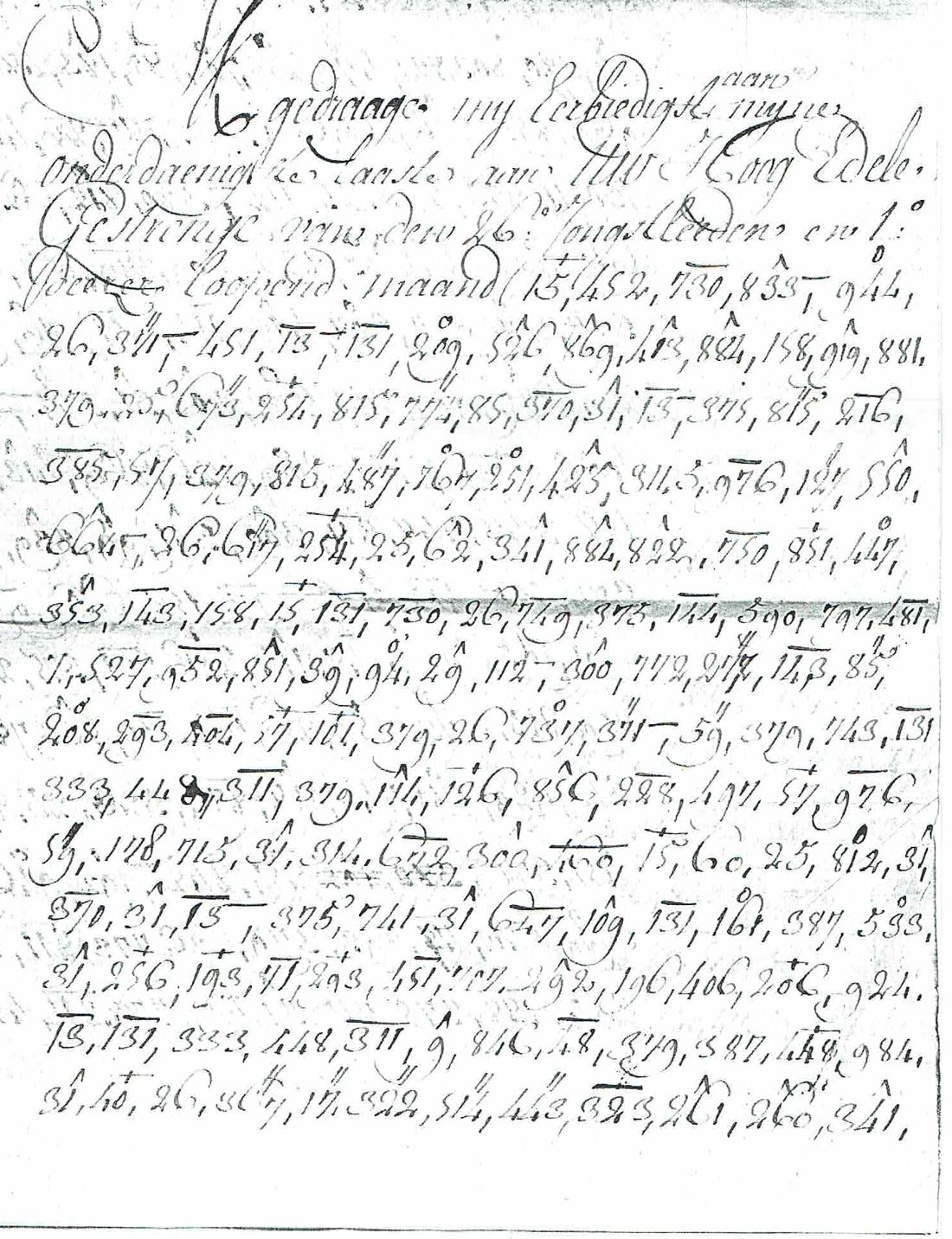
15, 452, 730, 833 = waar bij ingesloten. Image: Nationaal Archief, The Hague, 3.01.25 inv. 610, first page, via DECODE R1036.The key is the codebook that Croiset prepared in 1765 for the Russia legation (DECODE R1038). Its values are words, syllables and single letters, so many words are built from pieces: Spa·nje, Dene·mar·ken, Enge·land. DECODE’s authenticated transcription of the key is partial, which is why about a sixth of the groups have no value on the first pass. The marks are part of each group. If they are dropped and the groups reduced to their three digits, unrelated entries collide and the decoding fails.
02 What the despatch says
The opening, normalised to modern spelling. Brackets mark a group whose value is inferred or open:
Waarbij ingesloten waren de antwoorden van de hoven van Frankrijk en Spanje op de propositie, welke de beide oorlogende hoven dezelve hadden laten volgen op de bewuste preliminaire propositie […], welke de Oostenrijkse minister zondag van zijn hof ontvangen heeft … Betrekkelijk zowel op de bewuste antwoorden als op dat van Engeland … bleef even zo min als tevoren enig middel over, waardoor de voornoemde oorlogende hoven [haar] mediatie van […] enige verdere werkzaamheid zouden kunnen geven.
(“Enclosed were the answers of the courts of France and Spain to the proposal that the two belligerent courts had made in reply to the preliminary proposal, received on Sunday by the Austrian minister from his court … As to those answers and to England’s, there remained no more means than before by which the belligerent courts could give her mediation any further effect.”)
The despatch covers three matters:
- The mediation. The French and Spanish answers are unwelcome to Russia. England insists on keeping the American colonies in some form, and Spain will not negotiate while the question of Gibraltar, or an equivalent for it, is unsettled. There is doubt whether the Emperor is dealing honestly with Russia (of nu den Keizer in dezen met haar oprecht handelt) or only means to amuse her.
- The Greek project. The Empress has not abandoned her project. The young Grand Duke Constantine is being taught Greek and given Greek attendants, and orders have been sent for Greek youths to be brought to him.
- The Armed Neutrality. Prussia is acceding. The Vice-Chancellor has spoken with the Swedish and Danish ministers about the accession act. The Empress wants it signed pure et simpliciter, without the secret articles, and asks for a firm and unalterable law for the rights of neutrals. The despatch also discusses the Prussian minister’s report to Berlin and the King’s reply on the fourth and sixth articles.
The full token-by-token decoding is deswart1782/R1036_machine_decipherment.txt, with every group beside its value in R1036_tokens.tsv. The machine text is the authority. The normalised passages here are editorial.
03 Method: values recovered from context
The key as transcribed decodes 1,448 groups. The rest were filled only where a value fits every occurrence of the group in the letter. Examples:
881= nje, completing Spa·nje each time;340underlined = mar in Dene·mar·ken;311underlined = land in Enge·land.176with a caret = mpli, found twice in pure et si·mpli·citer.741= haar, used twelve times for the Empress: met haar oprecht handelt, om haar te amuseeren, haare mediatie.39= hun, as in hun acte and hun onderdaan.681underlined = mogendheden (de oorlogende mogendheden van Frankrijk, Spanje en Engeland);363with a circle = tusschen in tusschen·komst;3with a circle = stel in veronder·stel·d and vast te stel·len.
Each inferred value is labelled “contextual inference” in R1038_key_parsed.tsv, apart from the entries transcribed from the manuscript key. decode_1765.py regenerates everything.
04 The letter of 1787 (R1040)
Karl de Leeuw noted that the letter of 29 November 1787 is coded, “presumably by accident”, with two codebooks. The change comes at group 180 of image 5459, where the 1765 key begins to give dit alles. From that point to image 5474, the 1765 key decodes 84–90% of each full page. The text reports signs of an alliance between Austria and France, close attention to it from the Prussian and British representatives, news from Berlin, Kaunitz and the Bavarian exchange, and the likely positions of the four powers:
Dit alles, gepaard met vele andere omstandigheden, schijnen als indicien te zijn welke de hiervoor gedetailleerde [berichten] wegens de effectief, zo niet reeds gesloten, ten minste op het tapijt zijnde alliantie tussen de hoven van Frankrijk [en Oostenrijk] zeer waarschijnlijk maken.
The first 1,928 groups are in a different codebook, probably the one used under Rechteren. It does not survive online, though the Rechteren cipher filed as Nationaal Archief inventory 158 may be it. Three plain/cipher pairs from the same legation (R2032, R2051 and R2052, from 1784 and 1786) were aligned against it. Transfers from them cover only 2–3% of the segment and give no connected prose, so no decoding of it is claimed.
05 What remains
- In R1036, 56 groups (51 distinct codes) have no value. A third pass transcribed the entries that DECODE’s transcription of the key left illegible, straight from the codebook scans. The word stands to the left of its code, and the parallel columns of homophones confirm faint words. It kept the 41 values that fit the letter, such as
781= geheel (“het Griekse project geheel stil”),748with two strokes = commercie (“de vrijheid van de commercie der neutralen”),488underlined = Zijne Keizerlijke Majesteit, and515with a circle = twaalf, the twelve Greek boys. The groups still open are entries lost in the binding shadow of the scan, blank in the book, or too faint to use. - Inflections are sometimes uncertain where the key gives a stem only, as in hot for hof/hoven.
- The first 1,928 groups of R1040 are not decoded, pending the Rechteren-family codebook.
06 Sources
- DECODE R1036, NA 3.01.25 P. van Bleiswijk inv. 610, by J. I. de Swart, 1782-03-08: nine scans and the authenticated ciphertext transcription.
- DECODE R1040, NA 1.01.02 SG inv. 7408, by J. I. de Swart, 1787-11-29: 23 scans (images 5453–5475) and transcription.
- DECODE R1038, the Croiset codebook for Russia, 1765, with its authenticated partial key transcription.
- DECODE R2032, R2051, R2052 (1784–86), and R2045 and R2195: plain/cipher pairs from the same legation.
- Karl de Leeuw, Cryptology and Statecraft in the Dutch Republic (PhD thesis, Amsterdam, 2000).
- Bartoloni et al., “The Oterleek Codes”, HistoCrypt 2026: the Croiset codebook family.
No earlier decipherment of either letter was found.
The key parse, the token-level reading, the R1040 segment reading, the crib alignments and the machine-readable profile are in the repository folder deswart1782/. Page images are not committed.