At a glanceExisting decipherment · complete
- The letters
- Lt Col. Nisbet Balfour, commandant at Charleston, to Lord Cornwallis in North Carolina: one dispatch on three numbered sheets and a second letter, both of early March 1781. A third letter, to Lt Col. Alexander Stewart, 12 August 1781, is in clear with cipher runs.
- Where
- National Archives, Washington, RG 360, Papers of the Continental Congress, item 51 (Intercepted Letters) vol. 1, pp. 717–736 (catalog naId 475670722, images 562–579). Listed as no. 630 in the projectUnsolved Catalogue no. 630. Not on DECODE.rsquo;s catalogue of open targets. Not on DECODE.
- The cipher
- The southern British “Common cipher”: 25 numbers in a fixed ring turned against the alphabet. A group of fillers with one real number sets which number stands for A, and the setting changes 35 times. The Stewart letter uses a different, fixed table.
- How it was deciphered
- Every cipher page carries a decipherment between the lines, probably James Lovell’s. The ring order and the setting rule were rebuilt from it; the 6,349 transcribed numbers were then deciphered by program alone, and checked against the interlinear and a control.
- What it says
- Charleston news for Cornwallis: Marion’s and Lee’s raid on Monk’s Corner, Craig’s seizure of Wilmington, Sumter beaten off at the Congarees, Arnold’s plan for the Albemarle Sound, Rodney’s capture of St Eustatius.
- Still open
- Four numbers of the Stewart table (five tokens) and twelve illegible numbers at page edges. The Cornwallis, Wemyss and Craig cipher passages in the same volume, whose translations are on pp. 759–761, were not transcribed.
01 The letters
Volume 1 of the Intercepted Letters in the Papers of the Continental Congress holds British letters taken by the Americans between 1775 and 1781. The National Archives catalogue describes them as including “letters in cipher (some decoded) exchanged between General Charles Cornwallis and Colonel Nisbet Balfour, 1780–1781”. The image descriptions supplied by Fold3 (one per digitised page) were filtered for cipher, Cornwallis and Balfour, which found these items:
- A. Balfour to Cornwallis, Nos. 1–3, pp. 717–725 (images 562–570), wholly in cipher, with a letter-by-letter decipherment written over every line. The docket on p. 728 reads “Letters dated the … March 1781 … in Cypher … supposed Balfour to Cornwallis”. The three sheets are one dispatch: the last words of No. 1 run on into the first word of No. 2 (“their post near Heron’s / bridge”).
- B. Balfour to Cornwallis, pp. 729–732 (images 572–575), wholly in cipher, interlinear decipherment, docketed “Balfour to Cornwallis, about March 1781”.
- C. Balfour at Charleston to Lt Col. Alexander Stewart, 12 August 1781, pp. 733–736 (images 576–579): clear text with runs of cipher, most of them with the decipherment over them; signed N. Balfour.
The dates come from the text. No. 1 reports the Chatham’s arrival on 29 January, the raid on Monk’s Corner on 2 February and Craig’s letter of 28 February; No. 2 reports Sumter’s attack on the Congarees on the “nineteenth ult.” (19 February), so the dispatch is of March. B has Rodney’s capture of St Eustatius (3 February) and news of Arnold at Portsmouth on 10 February.
02 The cipher
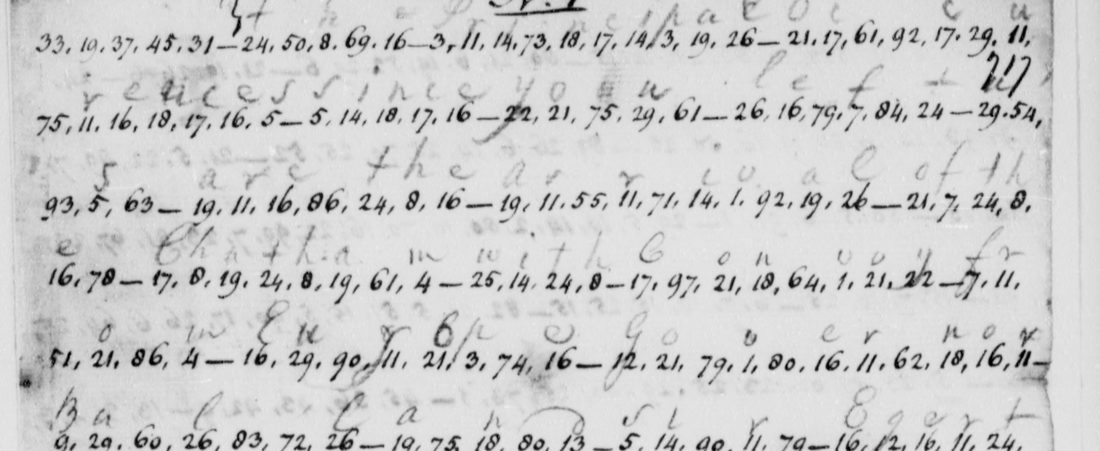
Ian Saberton described this cipher in 2019 from letters in the Cornwallis Papers: an inner ring of numbers turned against an alphabet, the number standing for A given first, and numbers of 30 and over as fillers. The letters here fit that description exactly, and the transcription gives the whole ring:
- The ring. 25 numbers in a fixed cyclic order,
5 24 29 1 25 23 22 6 19 9 17 13 16 7 12 8 14 15 26 4 18 21 3 2 11(1–29 without 10, 20, 27 and 28), against a 25-letter alphabet with i and j as one letter. With A set to 19 the table is a19 b9 c17 d13 e16 f7 g12 h8 i14 k15 l26 m4 n18 o21 p3 q2 r11 s5 t24 u29 v1 w25 x23 y22 z6. - Fillers. Numbers of 30 and over mean nothing and are scattered through the words (24 50 8 69 16 = “the”).
- The setting moves. A group of fillers holding one real number resets A to that number. The decipherer marked each such group with a brace. No. 1 has 13 of them, No. 2 has 15, No. 3 has 3 and B has 4. Nos. 2 and 3 start without one and carry on with the previous sheet’s last setting.
- Numerals in clear. A number standing alone between dashes is a numeral: the 82nd, 84th, 71st and 64th regiments, dates (29 January, 28 February, 26), a French 64-gun ship, 18 men and 40 horses.
On p. 718 the encipherer slipped: the indicator group 47 49 31 25 40 would set A to 25, but the decipherer underlined the 25 and wrote “should be 13”. With 13 the text goes on “two troops under Colonel Fenwick”; with 25 it does not read. This decipherer was working from the numbers, not copying a clear text.

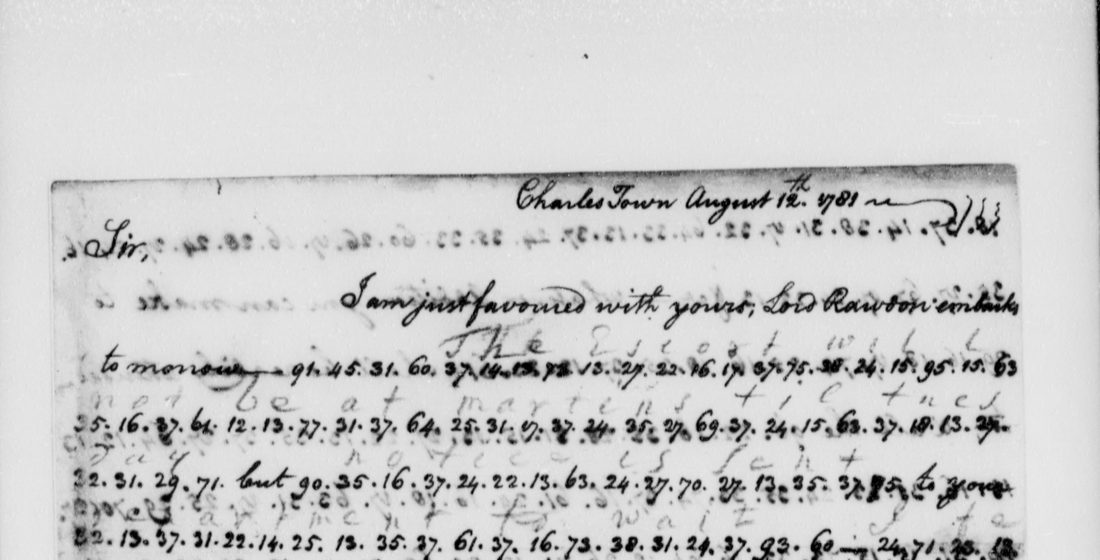
The Stewart letter of August is in another cipher: one fixed table with no settings, the numbers 12–38 for letters and 40 and over as fillers. Over a run the decipherer wrote “day notice is sent”, and the fifteen numbers under it, fillers removed, match the fifteen letters one for one (d32 a31 y29 n35 o16 t37 i24 c22 e13 s27). Its table, rebuilt from the interlinear, is a31 b12 c22 d32 e13 f23 g33 h14 i24 k34 l15 m25 n35 o16 p26 r17 s27 t37 u18 v28 w38 y29, with e also 1.
03 Balfour to Cornwallis, Nos. 1–3
Word division, capitals and punctuation are editorial. Numbers that stand in clear in the cipher are printed as numerals. The cipher’s spellings are kept (“governer”, “offisers”, “cary sfort”).
No. 1. The principal occurrences since you left us are the arrival of the Chatham with convoy from Europe, Governor Bull and Sir Egerton Leigh passengers, both of which are now at the Board of Police. Fifty thousand pounds came in the Chatham; she arrived 29 January. A party of Marion and Lee surprised the sergeant’s party at Monk’s Corner on the 2 February, killed two and made some prisoners, which, with burning three waggons and carrying off some horses, was all they effected. Colonel Small with the 84 and fifty Hessians marched immediately there; the church was fortified and the inhabitants’ horses ordered in to mount the infantry there, as well as at Neilson’s, where fifty men are placed. Two troops under Colonel Fenwick and Lieutenant Campbell, 71 regiment, raising and in forwardness. The light company of the 84 sent to Pocotaligo to cover that country from plunderers. The 82 with convalescents of the army took possession of Wilmington the 28 January without opposition; the enemy were driven from their post at Heron’s Bridge by Major Craig; the marines and seamen landed and a post close to the town taken, which is now in a state of defence not to be forced but by a large corps [with] cannon. Craig is informed of your movements so far as we know them. Tho’ not afraid of the militia now against him, wishes much for a reinforcement; this is not in my power to send. He has all the articles wanted by the army and is perfectly safe. His last letter, 28 February, mentions the enemy being about six hundred and in their post near Heron’s
No. 2. Bridge. If you mean to communicate by Cross Creek the banks of the river must be cleared, as the enemy have posts on it. Georgetown was attacked and Colonel Campbell with some few men taken prisoners as they slept in a house out of the redoubt. Some small parties of men have since been at that post, from the bad conduct of the officers. Fanning’s is now moved from thence and joined Watson’s corps; a detachment of one hundred men are now in Georgetown under Captain Gray of Fanning’s. A fleet from Ireland with provisions and stores under convoy of the Assurance arrived 23 ult., and being in want of water put into this and Beaufort before they proceed to York. A packet from England with duplicates of the dispatches by Ross 20 ult. On the last of February a packet sailed for England with accounts of your being at Salem and the state of affairs here. An express from General Arnold in the Chesapeak 23 ultimo, informing of a French 64 and two frigates having blocked up that place, and desiring assistance. This letter was shewn to Captain Barclay, who altho’ possessed of the Chatham, Carysfort, Assurance, Galatea and Blonde, would not proceed in quest of the enemy. The Chatham with her convoy sailed 26 for New York. Sumpter, having raised at least three hundred men, attacked Congarees nineteenth ult., but by the conduct of Maxwell was beat off; at Thompson’s he had the same fate and was forced to cross the Santee. Lord Rawdon moved with great speed after him to Congarees, Camden and Sumpter’s [?], detaching 64 and York Volunteers in such directions as gave reason to expect the success his movements merited, by misconduct in
No. 3. some of the detachments and other unforeseen events he only got at him as he crossed the river, by Watson’s corps, which acted with […] and drove him with the loss of 18 men and 40 horses; we lost none. Watson is now in pursuit of him, and Marion with the [Hightown?] and Fanning’s. Lord Rawdon is also towards [Pedee?]
No. 3 ends at the foot of its sheet; no further sheet survives in the volume.
04 Balfour to Cornwallis, the second letter
The same ring and the same setting rule decipher it unchanged, with four indicators (A = 23, 18, 6, 5).
In Gen. Arnold’s letter is the following paragraph: “If the cooperation will be of service, I intend to send some boats with four or five hundred men through Currituck Inlet to sweep the Albemarle Sound as high as Edenton, and to go to Newbern and destroy their shipping, stores &c., while a few armed vessels take post at Ocracock Bar and a frigate cruises without.” The General’s intentions to prosecute this plan is corroborated by Capt. Eyons of the Charlestown, who arrived yesterday from Gardner’s Bay; left Arnold at Portsmouth on the tenth of Feb[ruary]. By the progress of Arnold, his operations are mentioned in a newspaper. By the bearer [?]: the removal of the French and intelligence of your movements are both necessary before Arnold proceeds to execute his plan. I have sent him by Evans the cypher, in case he can communicate with you. Evans left this today, being sent to collect the force here, which is now dispersed, to attack the French in the Chesapeak, and proceeds to try to get to Arnold. Having reason to believe the enemy are gone from thence [Savannah?] is well, but seriously alarmed for want of provisions; the river Savannah must shortly be our dependance for supplying that post. The enemy make such serious inroads [and] raise such force that I fear, without an addition soon to our corps on the frontier, we shall be awkwardly situated. A fortunate stroke at Sumpter and Marian will do much. What is to be done with the troops from England, if they come, as is expected, here? What is to become of the post at Wilmington if your movements leave that place uncovered by your army? The bearer, I believe, if he delivers this, he must be well rewarded; he is to proceed to Philadelphia and will be useful there if you wish it. Scott’s letter is a blind. Sir George Rodney has taken possession of St Eustatia, has engaged a Dutch line of battle ship, taken her and a large fleet of merchantmen under convoy for Holland, so that I think there is no kind of doubt a war with the Dutch must take place.
“I have sent him by Evans the cypher”: Balfour sent Arnold a copy of this cipher, which Saberton identifies as the one Arnold and later Leslie used with Cornwallis in Virginia.
05 Balfour to Stewart, 12 August 1781
A clear letter, “Charles Town August 12th 1781”, to the commander of the field army after Rawdon’s departure, with the sensitive parts in cipher. The cipher runs, in order (the clear text between them is in the transcription):
… the escort will not be at Martin’s till Tuesday [?] … day notice is sent … detachment to wait [?] … for the militia will not keep Orangeburgh … possible at present to supply a post there; our present communication assisted by water carriage … keep it … two hundred guineas are rent [?] … spare, or is safe to send at once … not one dragoon is here; employed to the southward getting provisions, rice … your mounted convalescents belonging to your army … by then [the next?] escort … officers when recovered … as to Thomson, I am clear he will be better here; very dangerous; be assured [it] is greatly to be guarded against, as we are vulnerable in so many posts. The depot near Monk’s Corner put in a state of defence … to get possession of the boats upon the Santee by means of the negroes … the garrison [?] … Caldwell near you, but is not to act with the cavalry, by Lord Rawdon’s directions … from your intelligence that the enemy are in force on the other side low down, cross either at Manigault’s or Murray’s ferries, intercept the escort; a small movement of a corps towards Nelson’s would effectually cover them, if convenient.
06 Method
The two volumes of Intercepted Letters (848 images) were listed through the National Archives Catalog’s records API. The pages were fetched as JPEG 2000 and cut into strips, and three transcription agents copied every number, the interlinear letters and the decipherer’s marks: 6,349 cipher tokens on 17 pages.
A single number-to-letter table per sheet, aligned against the interlinear, agreed only 20–27%: the table changes inside a sheet. Saberton’s ring, given a setting for each word, read in long runs. A 25-letter alphabet fixed the remaining i/j and h/i slips, and then one ring order fitted every page. The braced groups proved to be the setting indicators. From then on the decoder (decode.py) works from the numbers alone: it reads an indicator’s number as A, skips fillers and prints lone numbers as numerals. Where an indicator has only two fillers and could also be the word “a” padded with fillers, the next 40 letters are scored both ways with the project’s English model. The only outside correction is the decipherer’s “should be 13”. Two fillers cut off at the page edge on p. 722 were restored as “4x” from the visible first digit, which completed two indicators.
Measured on the decoder’s output, a letter counts as read when a 24-letter window containing it scores at least −3.3 per letter on the en-modern model. No. 1: 1,213 of 1,213; No. 2: 1,292 of 1,292; No. 3: 237 of 237; B: 1,530 of 1,539; Stewart: 850 of 850. The same measure on the same numbers deciphered with a corrupted ring gives 0–2%. The project’s validation test (docs/_validate.py) scores the reading at −2.24 per letter, against −7.26 for random keys of the same shape and −4.16 for a key refitted to shuffled ciphertext: pass.
Against the interlinear as transcribed, the decoder agrees on 62–82% of letters where the interlinear is legible. The differences checked are faint or misread interlinear letters. The one real disagreement is in No. 3, where the cipher has the numeral 18 for the men lost and the decipherer wrote “fifteen”.
07 What remains uncertain
- Stewart letter: the table values 2, 3, 19 and 30 (five tokens). 30 reads as “w” in “will” and as “n” in “present” and may be a misread; the interlinear is illegible there. Grade C for the words around them.
- Twelve numbers in A and B illegible on the microfilm scan (page edges of pp. 718 and 724, blots); each falls inside a word that otherwise reads.
- No. 2, after “Sumpter’s”, and No. 3, after “acted with”: a word the cipher does not give (grade I). “Hightown” and “Pedee” at the end of No. 3 are conjectures for “hitown” and “s?edee” (grade C).
- Stewart letter: “Tuesday”, “rent” and “the next” are grade C; the runs are short, and the clear text between them has not been edited here.
- The cipher passages of Cornwallis to Wemyss and to Balfour (7 October 1780) and Craig to Cornwallis (23 July 1781), in the same volume, were not transcribed; their numbered translations are on pp. 759–761.
- The decipherer’s hand is not signed. James Lovell broke the cipher of Clinton and Cornwallis in 1781, and these pages are probably his work, but the hand has not been compared with his.
Full texts
The transcription and the decryption of every document on this page, so that the reading can be used and checked. Short files are shown here; all are in the repository.
A. Balfour to Cornwallis, Nos. 1-3, March 1781 (pp. 717-725)
Charleston news for Cornwallis after he left: the Chatham convoy with Governor Bull and Sir Egerton Leigh, the raid of Marion and Lee on Monk's Corner, Craig's seizure of Wilmington, Georgetown attacked, a fleet from Ireland, Arnold's express from the Chesapeake, Captain Barclay refusing to sail against the French, and Sumter beaten off at the Congarees and pursued by Rawdon and Watson.
Transcription
H | No. 1 ; page number 717 (top right)
L01 | 33 19 37 45 31 - 24 50 8 69 16 - 3 11 14 73 18 17 14 3 19 26 - 21 17 61 92 17 29 11
I01 | the principal occu
N01 | brace "}" written at the start of the interlinear, over 37/45. "14 3": the comma after 14 is a long slanted stroke; the next number reads 3 (could be taken as 13, but no second 1 is visible)
L02 | 75 11 16 18 17 16 5 - 5 14 18 17 16 - 22 21 75 29 61 - 26 16 79 7 84 24 - 29 54
I02 | re?ces since yo? w left t
L03 | 93 5 63 - 19 11 16 86 24 8 16 - 19 11 55 11 71 14 1 92 19 26 - 21 7 24 8
I03 | s are the arrival of th
L04 | 16 78 - 17 8 19 24 8 19 61 4 - 25 14 24 8 - 17 97 21 18 64 1 21 22 - 7 11
I04 | e Chatham with convoy fr
N04 | 78 could be 70; 22 before the dash is written over/through by the dash stroke
L05 | 51 21 86 4 - 16 29 90 11 21 3 74 16 - 12 21 79 1 80 16 11 62 18 16 11 -
I05 | o w Eng ? b? e Governor
L06 | 9 29 60 26 83 72 26 - 19 75 18 80 13 - 5 14 90 11 79 - 16 12 16 11 24
I06 | Ba l Ca n ? St r Egert
L07 | 21 18 - 26 91 16 74 14 12 62 8 - 3 19 5 81 94 5 16 18 12 16 11 90
I07 | on ?e ig h Pas senger
L08 | 5 - 9 73 21 24 80 8 21 73 7 - 25 8 14 17 99 8 - 19 11 72 16 18 21 88
I08 | s both of which are no
L09 | 25 - 19 76 24 84 82 24 70 8 51 16 - 9 21 80 19 94 11 13 - 73 21 7 3 21
I09 | wat the Board of tho
N09 | a heavy dark-ink "o" is written over 7 (near the end), separate from the lighter interlinear hand
L10 | 60 26 14 70 17 89 16 - 49 32 23 40 36 - 17 7 90 17 2 85 1 - 2 16 99 26
I10 | lice } fifty tho
N10 | brace "}" in the interlinear over 40 36 (nothing written over 49 32 23 40 36)
L11 | 11 81 3 50 23 15 19 80 - 4 26 75 11 54 15 52 19 3 - 6 23 14 9 50 7
I11 | usand pounds came i
L12 | 89 15 83 - 2 16 70 9 70 - 6 16 23 51 2 16 23 95 14 - 3 16 97 9 70
I12 | n the Chatham she
L13 | 23 21 52 58 21 7 84 5 9 89 19 - 29 - 7 23 97 15 11 23 56 21 1 - 47
I13 | arrived th January
N13 | 58 could be 50
L14 | 5 30 31 40 - 5 12 5 90 14 26 83 2 7 23 - 13 5 14 99 50 14 19 81
I14 | } a Part of mari
N14 | brace "}" in the interlinear over the dash / first 5 of the second group
L15 | ? 16 60 - 5 16 1 83 17 89 25 50 25 - 15 4 14 12 59 14 19 15 89 25 1?
I15 | on and Le e surprised
N15 | first number lost in a stain at the left edge; last number at the right edge partly lost, looks like 1
L16 | 74 - 26 6 25 15 25 83 14 90 22 25 5 16 80 26 15 - 91 12 5 14 86
I16 | these rgean ts par
L17 | 51 26 2 - 5 26 99 13 7 16 50 9 15 72 - 29 7 80 14 16 25 14 - 7 16
I17 | ty at monks ?orner on
L18 | 89 26 6 51 25 - 2 - 23 25 89 24 14 4 5 14 2 - 9 19 84 17 53 80 17
I18 | the d February kill
L19 | 25 1 - 26 7 51 21 5 16 60 1 87 - 13 5 1 80 25 - 15 7 91 13 25 93 -
I19 | ed two and made ?? me
N19 | 7 and 21 are underlined; ink blot after 93 at the right edge (final dash under the blot); blot also near 87
Transcription
H | 718 (page number, top left)
L01 | 12 14 70 19 15 7 16 83 25 14 15 - 80 21 6 19 52 29 6 - 21 19 26 6 - 24
I01 | prisoners which with
L02 | 4 93 14 16 80 19 16 50 22 - 89 26 6 14 25 70 25 52 - 21 5 22 89 7
I02 | urning three wag o
N02 | interlinear between "three" and "o" faint/smudged; "o" written above 7 at line end
L03 | 16 15 - 50 5 16 91 1 - 29 5 14 14 2 80 19 70 16 22 99 7 23 81 67 23
I03 | ns and carry ??? off
N03 | "off" written in darker ink over 99 7 23 (a correction or re-writing); interlinear between "carry" and "off" faint
L04 | 90 - 15 7 13 25 - 6 7 14 15 25 15 - 82 21 5 51 15 5 90 17 26 6 64 2?
I04 | some horses was ? h
N04 | caret "^" written between 17 and 26; last number cut off at the right edge (gutter), begins with 2
L05 | 2 - 5 23 84 60 23 25 29 90 25 73 1 - 45 36 43 42 9 - 13 3 4 ?
I05 | y ef fect e d } col
N05 | 5 (after the first dash) underlined; caret "^" under/between 29 and 90; brace "}" in the interlinear over 9 / the dash; a further number after 4 is cut off at the right edge
L06 | 21 7 4 82 - 24 18 9 4 90 4 - 23 15 80 80 29 14 29 14 7 - 84 - 9 2?
I06 | nel Smal l wi th ?ft? th
N06 | interlinear over 29 14 29 14 7 partly crossed/overwritten; last number cut off at the right edge, begins with 2
L07 | 69 16 12 15 14 29 6 - 99 14 7 24 87 52 24 15 9 21 24 - 18 9 5 13 14
I07 | d Fifty Hes s ians marc
N07 | 14 (fifth number) underlined; "Hes" written in darker ink over 99 14 7
L08 | 7 16 - 15 80 90 59 18 7 83 16 15 9 29 7 80 4 6 - 29 14 7 5 7 - 29 80
I08 | ed immediately there f?
L09 | 14 73 7 13 14 1 60 5 13 71 14 - 23 9 24 12 3 5 81 29 15 12 6 7 16 -
I09 | he church was for fifyed
L10 | 9 21 54 16 59 29 65 14 80 7 55 - 15 21 14 9 17 15 29 9 21 29 24 -
I10 | ?nd the ? Inhabitants
N10 | the interlinear "?nd the" is struck through by a horizontal line
L11 | 65 14 3 5 66 24 7 24 - 3 5 91 16 7 5 7 16 - 15 21 60 29 3 54 18
I11 | horses ordered into m
L12 | 1 84 21 29 - 29 14 90 7 71 15 21 12 9 21 29 63 5 6 - 29 14 7 5 ?
I12 | ?unt the Infantry ther
N12 | final number after 5 cut off at the right edge
L13 | 7 9 24 69 23 7 4 86 72 4 9 24 9 29 - 21 7 15 4 24 3 21 24 - 9?
I13 | eas * wel l as at neilsons
N13 | asterisk-like mark "*" in the interlinear before "wel"; last number partly cut at the right edge, looks like 9
L14 | 23 14 62 7 80 5 7 - 12 86 15 12 29 6 80 - 18 90 7 21 9 5 62 7 -
I14 | where fifty men are
N14 | 15 (after 86) has a blot/overstrike
L15 | 2 4 9 13 7 16 89 57 - 47 49 31 25 40 - 25 6 11 25 29 80 11 69 7?
I15 | placed } Two Tro
N15 | 25 (fourth number of second group) underlined with the note "should be 13" written beneath; brace "}" in the interlinear over the dash before the third group; the 25 after that dash looks slightly retouched; last number cut at the edge, looks like 7
L16 | 11 5 1 - 23 2 12 8 29 - 7 11 21 11 2 8 91 21 - 14 8 61 2 6 54 4 7?
I16 | ons under colonel Fenwi
N16 | ditto-like marks "„" before the first number 11; last number cut at the edge, looks like 7
L17 | 18 - 13 2 12 - 21 4 8 80 23 25 55 8 2 13 2 25 - 7 13 3 74 5 16?
I17 | k and Lieutenant Com
N17 | last number cut at the edge, looks like 16
L18 | 8 93 21 - 71 - 29 8 15 4 61 3 8 89 2 25 - 29 13 4 1 80 4 2 12?
I18 | el st Regiment Rals in?
N18 | "st" written over 71; capital "R" in darker ink over 29; last number cut at the edge, a long-tailed figure, perhaps 12
Transcription
H | 719 (page number, top right)
L01 | 13 2 12 - 50 4 67 2 14 11 29 6 13 29 12 2 70 8 1 - 32 40 25 39 41 38 -
I01 | and i nforwardnes s
N01 | brace "}" at the right end of the line, after 38 and the closing dash
L02 | 3 13 19 12 16 82 17 13 3 - 22 15 8 26 25 14 54 29 15 9 62 3 55 13
I02 | The light compan ? of th
N02 | a heavy dark-ink loop (like "Q" / "y" over-written) stands over 29, between "compan" and "of"
L03 | 79 19 - 84 - 21 19 50 14 3 3 15 - 26 15 80 22 53 15 3 25 12 16 17 15 -
I03 | e th se ntle po c otalico
N03 | 53 (after 22) written in heavier ink, possibly retouched
L04 | 3 90 15 22 15 11 19 18 - 96 3 13 72 25 3 22 15 2 80 14 3 18 56 29 -
I04 | to cover th at country
N04 | first number 3 has a blot after it; brace "}" below the end of the line (under 29 -), between this line and the next
L05 | 9 57 18 79 83 15 8 92 - 26 12 2 80 14 6 19 18 59 21 - 47 1 32 30
I05 | from plunder s
N05 | first number 9 partly blotted at the left edge
L06 | 44 - 21 90 17 83 75 6 - 82 - 11 13 21 17 54 70 23 14 8 2 1 50 7 6
I06 | ?hed with convale
L07 | 18 80 6 8 21 18 - 14 19 80 21 17 53 6 1 4 12 79 24 - 21 14 67 52 80
I07 | scents of the army to
N07 | 8 (fourth number) written in heavy ink, possibly retouched
L08 | 14 16 - 15 14 18 90 18 6 18 73 61 18 13 14 8 90 14 85 19 - 11 13 7
I08 | ok possession of wil
L09 | 12 50 13 8 59 9 21 14 8 - 21 60 17 86 91 6 53 - 28 - 13 1 8 3 1 4
I09 | mington the th Januar
N09 | the "J" of "Januar" descends across 13
L10 | 24 - 80 11 13 21 50 17 69 14 3 99 21 - 14 15 61 79 15 14 18 13 60 21
I10 | y without opposit
N10 | first number 24 smudged, with a small mark before it; 21 before the second dash written in heavy ink (retouched)
L11 | 13 14 8 - 49 22 30 40 - 11 7 17 93 17 26 17 15 25 - 29 50 17 3 80
I11 | ion } the enemy wer
N11 | brace "}" in the interlinear over 30 40
L12 | 17 - 9 3 12 60 24 17 60 26 - 13 3 59 4 15 62 11 7 17 12 3 - 18 4 2
I12 | e driven from their pos
L13 | 92 11 61 22 11 93 - 7 17 3 51 4 26 - 6 3 12 9 16 17 - 6 25 80 15
I13 | t at her on bridge by m
N13 | 12 (after 6 3) written in heavier ink
L14 | 22 12 4 60 3 - 19 3 50 22 12 79 16 - 33 25 40 - 3 67 92 13 51 19 52 -
I14 | ajor Craig } the
N14 | 60 (after 4) heavily overwritten/struck, reading uncertain (60?); brace "}" in the interlinear over 40 and the following dash; the "g" of Craig descends across 16
L15 | 90 8 25 18 16 14 51 19 21 - 25 50 14 86 6 72 - 21 19 25 59 8 19 14 -
I15 | marines and seamen
L16 | 12 25 14 6 19 73 6 99 - 65 25 53 14 6 92 25 - 26 15 21 3 - 22 12
I16 | landed and a hostil
L17 | 84 15 21 53 19 - 3 15 80 90 3 90 13 57 19 - 50 3 15 5 86 14 - 3
I17 | ose to the town t
L18 | 25 7 19 14 - 5 13 53 16 22 13 - 16 21 80 14 15 5 71 16 14 25 - 21 3
I18 | aken which is now in a st
L19 | 25 62 3 19 80 - 15 9 74 6 19 9 83 19 14 22 19 - 14 15 3 71 3 15
I19 | ate of defence not to
N19 | blot at the right edge after the last 15
Transcription
H | 720 (page number, top left)
L01 | 84 62 23 19 - 9 15 18 22 19 6 - 23 2 3 89 23 29 54 25 - 12 25 18
I01 | be forced but by a la
N01 | a large loop/circle is drawn in the left margin around the start of the line (84 62 23 19)
L02 | 80 17 19 - 22 50 15 18 26 77 21 22 25 80 14 15 14 - 42 36 11 49
I02 | ge corps canon
N02 | between 21 and 22 a figure (8 or 9?) is struck through, with a dash-like stroke under it; left out of the L line. 19 (third number) retouched
L03 | 30 45 - 24 8 11 6 23 - 70 6 91 14 - 6 13 25 16 8 50 17 83 1 29 -
I03 | Craig is informed
N03 | the dash after 45 has a dot over it; the "g" of Craig descends across 23
L04 | 16 25 90 3 16 77 26 55 8 - 17 16 4 1 17 80 1 13 69 15 14 - 14 16
I04 | of your moovements so
N04 | the first interlinear letter "o" is struck through
L05 | 78 25 11 8 63 52 11 14 89 18 1 92 - 19 13 16 72 18 - 15 22 79 84?
I05 | far as we know th
N05 | last number cut at the right edge, looks like 84
L06 | 1 17 - 39 46 30 4 47 - 16 24 6 85 22 6 16 - 4 11 69 52 11 17 4 81 29 3?
I06 | em } Tho not af tra??
N06 | brace "}" in the interlinear over 47 / the dash; interlinear at the right end smudged; last number cut at the edge, looks like 3
L07 | 6 11 89 70 16 51 24 54 2 - 23 29 57 25 29 69 60 16 29 4 - 22 90
I07 | of the mi li t??
N07 | interlinear over 69 60 16 smudged / blotted
L08 | 6 8 83 - 4 5 4 29 22 13 16 - 53 24 29 65 23 - 8 29 13 24 2 13
I08 | ow against him wishes
L09 | 23 90 7 21 24 - 11 80 6 17 56 4 - 17 2 93 2 22 11 6 70 17 21 2 23
I09 | much for are ento ?rem
L10 | 2 22 16 - 16 70 24 29 54 13 - 29 71 13 62 22 6 97 16 80 - 29 2?
I10 | ent this is not i
N10 | 29 after the second dash smudged; last number cut at the edge, begins with 2
L11 | 75 23 65 15 81 - 19 6 8 50 2 17 - 16 6 73 13 2 54 22 52 3 - 46
I11 | my power to send
N11 | last number at the right edge, 46 (partly cut)
L12 | 12 47 40 33 - 21 26 62 21 12 22 - 12 11 99 11 50 65 6 21 26 -
I12 | } he has all the
N12 | brace "}" in the interlinear over 33 / the dash
L13 | 12 23 6 3 14 11 26 22 - 17 12 52 24 6 26 90 15 - 8 16 93 6 73 2?
I13 | articles wanted by t
N13 | the interlinear "a" at the start is circled; last number cut at the edge, begins with 2
L14 | 26 - 12 23 74 5 16 - 12 24 15 60 3 22 - 1 26 23 4 26 14 6 11 16
I14 | e army and is perfectly
L15 | 22 12 93 4 26 - 33 40 9 31 - 14 15 97 24 - 4 9 24 77 29 - 4 7
I15 | safe } his last le
N15 | brace "}" in the interlinear over 9 31
L16 | 29 69 71 29 7 5 90 - 28 - 12 7 17 5 1 9 5 6 - 18 7 62 21 29
I16 | tter th February ment
N16 | 7 (after 12) written in heavier ink; "th" written over 28 in darker ink
L17 | 15 82 3 62 21 24 - 29 51 14 60 7 - 7 21 86 7 18 6 - 17 7 15 21 8 - 9
I17 | ions the Enemy being a
N17 | 29 (after the first dash) in heavier ink; a dot/semicolon mark after the final 9
L18 | 70 17 3 1 65 29 - 24 15 22 14 99 1 21 16 5 7 16 - 9 21 16 70 15 21 -
I18 | ?bout six hundred and in
N18 | first number faint, read 70; an arc is drawn over "ed" in the interlinear
L19 | 29 14 7 15 5 - 2 77 3 24 61 29 - 21 7 9 97 5 - 14 7 5 3 62 91 21 24
I19 | their post near Hero n?
N19 | "H" of "Hero" written in darker ink, as a correction
Transcription
H | No. 2 ; page number 721 (top right)
L01 | 17 5 15 16 8 7 - 39 26 40 37 - 24 2 73 60 14 22 16 - 25 3 26 71 23
I01 | } If you mea
N01 | brace "}" over 37 and the following dash; "If" written in darker ink beside the "No. 2" heading
L02 | 94 - 69 13 73 80 22 - 18 22 25 25 89 50 16 23 24 18 26 13 3 - 4 14
I02 | to communicate by
N02 | "u" of "communicate" in darker ink; a small mark over the "t"
L03 | 18 9 22 17 81 17 - 18 9 3 72 95 80 3 29 - 13 5 69 3 - 4 26 23 29 73
I03 | cre? s l?c e ek the Bank
N03 | 95 could be 93
L04 | 17 - 22 52 2 61 13 54 5 78 3 69 - 9 24 7 3 9 - 25 62 16 17 13 4 91
I04 | s of the River must b
N04 | the descender of the interlinear "f" runs across 2 (after 52); 78 could be 70
L05 | 3 67 - 18 1 3 26 9 3 21 - 26 72 17 90 13 77 80 81 5 90 3 - 3 50 23
I05 | e cleared as the en
N05 | 17 (after 72) retouched; 80 (after 77) in heavier ink
L06 | 3 54 25 90 14 - 5 26 7 84 3 - 84 6 22 93 17 51 13 17 - 22 23 97
I06 | emy have posts on
L07 | 24 52 13 - 30 47 8 46 30 49 - 21 4 1 22 21 90 4 - 19 1 76 13 54
I07 | it } George Tow
N07 | brace "}" over 49 and the following dash; the "G" flourish runs back across the dash; the "g" descends across 21 (after 22)
L08 | 29 - 13 8 50 6 73 - 8 19 77 91 19 8 15 11 4 70 26 - 8 90 29 52 26 -
I08 | n was attacked and
N08 | 13 (after the first dash) heavily overwritten in darker ink, reading uncertain (13?)
L09 | 15 1 5 53 86 1 29 4 5 - 15 8 24 25 14 4 5 - 13 2 19 3 - 6 1 24 69
I09 | Colonel Campbel with som
L10 | 4 96 - 18 4 61 53 13 52 80 - 24 54 4 61 29 19 8 51 11 4 29 - 25 22
I10 | e few men taken pr
N10 | the first number 4 is circled
L11 | 2 6 1 62 29 4 22 6 - 8 6 71 19 3 55 4 63 7 - 6 79 5 4 25 19 -
I11 | isoners as they u kept
N11 | 6 (after 8) in heavier ink; 5 (after 79) overwritten in heavy ink
L12 | 2 29 60 8 - 3 1 9 52 6 93 4 - 1 9 19 60 1 18 79 19 3 71 4 - 22 4
I12 | in a hous e out of the re
N12 | 4 before the second dash is struck/overwritten
L13 | 26 1 9 14 19 - 39 13 45 31 - 1 11 50 3 8 - 1 3 13 21 62 21 83 -
I13 | Doubt } some small ?
N13 | brace "}" over 31 and the following dash; interlinear over 62 21 83 smudged
L14 | 5 13 29 25 4 8 1 - 11 14 3 8 2 - 26 13 22 90 8 - 1 4 2 7 8 -
I14 | parties of men have since
L15 | 16 93 8 52 71 8 2 - 13 25 59 25 26 13 57 25 - 5 11 61 1 25 -
I15 | been at that post
N15 | a dot before the first number 16
L16 | 14 29 11 3 60 25 26 8 89 - 16 13 12 - 7 11 2 12 23 7 61 25 - 11 14
I16 | from the bad conduc? of
L17 | 53 25 70 26 54 8 - 11 14 67 80 14 4 1 8 29 1 - 43 30 14 40 37 49 -
I17 | the officers }
N17 | brace "}" at the right end over 49 and the final dash
L18 | 21 14 1 69 73 1 11 1 86 3 19 - 11 19 1 25 94 16 82 - 29 25 54 13 18
I18 | Farinings I now move
N18 | the "g" descender runs across 3 (after 86)
L19 | 50 4 - 21 6 25 29 70 9 2 53 18 1 26 18 89 - 14 99 1 54 4 - 11 25 1?
I19 | d from thence and jo
N19 | last number at the right edge partly cut, 1 then an unclear figure (11 or 17?); a flourish line drawn below the start of the line
Transcription
H | "3" at top right (page number); "722" in left margin beside line 2 (folio stamp)
L01 | 1 60 18 77 4 - 62 16 14 9 19 25 1 19 - 26 93 25 6 23 19 - 30 16 33 4x
I01 | ned watsons corps
N01 | last number "4" at the right edge; a trace may follow it in the binding margin
L02 | 37 - 16 8 14 23 16 12 4 52 2 14 11 23 - 99 5 15 72 5 11 14 - 4 22 11
I02 | a detachment of one hun
L03 | 85 8 1 14 76 8 - 2 14 11 62 16 53 1 55 14 - 11 5 19 80 18 63 11 87 -
I03 | dred men are now in
L04 | 26 14 5 1 26 14 - 23 5 19 89 11 - 22 11 8 14 1 - 12 16 72 24 23 16 18 11 -
I04 | george town under captain
L05 | 86 91 26 1 16 17 - 5 93 15 74 15 16 11 18 11 26 25 - 32 40 6 45 30 47 -
I05 | gray of fanings
N05 | a brace/"3"-like mark at the right end of the interlinear, after "fanings", over 32-47 (nothing written over 32 40 6 45 30 47)
L06 | 6 16 15 13 99 50 13 5 - 90 16 2 18 73 80 26 - 8 2 13 15 6 4 17 - 1
I06 | a fleet from ireland w
N06 | last interlinear letter at the edge, read as "w" (continues "ith" on the next line)
L07 | 8 5 67 12 - 21 2 18 29 8 11 8 18 4 11 75 - 6 4 92 17 84 11 5 18 5?
I07 | ith provisions and sto
N07 | "21" written with a smudged 1; last number "5" at the right edge, a second digit may be lost in the margin
L08 | 2 13 11 - 77 24 4 17 13 80 2 55 - 9 18 4 29 18 23 - 18 88 16 5 12
I08 | res under convoy of th
N08 | a curved mark "(" in the left margin; stroke between 29 and 18 is the descender of the interlinear "y"
L09 | 62 13 - 6 11 70 93 11 24 2 6 84 4 9 13 - 6 90 2 83 50 67 2 8 29
I09 | e assurance ar riv
L10 | 13 56 17 - 23 - 24 15 5 70 71 - 6 4 17 19 13 8 4 7 - 8 4 90 1 6
I10 | e d d ult: and being in wa
N10 | the two "d" over 56 and 17/23 are drawn with curved strokes, as if bracketed; colon after "ult"
L11 | 53 5 - 18 72 16 51 1 6 5 74 13 2 - 21 24 5 8 90 4 5 18 - 76 5 12
I11 | t of water putinto th
N11 | the "5" before the final 12 is overwritten/inked heavily (possible correction)
L12 | 8 11 6 50 4 17 - 19 13 6 24 16 18 2 84 5 - 19 80 13 16 18 2 13 -
I12 | is and beaufort before
L13 | 50 5 12 79 13 23 - 21 2 18 9 13 56 13 17 - 5 18 23 18 2 14 - 4x
I13 | they proce ed to york
L14 | 2 49 30 42 - 2 16 2 5 6 29 14 - 57 1 12 13 82 9 - 29 17 25 19
I14 | a packet from engl
N14 | a brace "{" written before "a packet" in the interlinear
L15 | 17 24 - 4 22 14 23 - 24 15 16 19 22 5 2 14 29 8 - 13 1 14 23 29 - 24
I15 | nd with duplicates of the d
N15 | last interlinear letter at the edge, looks like "i" with a cap; read "d" (continues "ispatches")
L16 | 22 8 16 2 14 5 23 29 8 - 11 21 12 13 8 99 76 8 - 20 - 15 19 14 -
I16 | ispatches by ros s ????
N16 | after "by" the decipherer wrote "Ros" with a heavy capital, then "s" over 8, then 3-4 unclear letters (like "Hul" plus a mark) over 20 - 15 19 14
L17 | 36 39 30 41 22 39 - 4 26 11 7 17 - 14 22 2 11 4 13 - 13 17 6 3 5
I17 | on the ?ast of febr
N17 | a "?"-like mark above 22 39 at the start of the interlinear; first letter of "?ast" smudged (probably "l")
L18 | 22 3 25 - 22 18 22 90 19 8 17 86 11 - 2 22 12 14 17 9 - 13 50 4 3 9
I18 | ary a packet sailed for
N18 | "for" has its last letters written over/corrected; a faint "2" in the margin after the final 9
L19 | - 17 26 16 14 22 26 9 - 29 12 11 7 22 19 70 19 4 5 26 11 2 - 4 60
I19 | england with ac counts o
N19 | rest of the page blank below line 19
Transcription
H | "723" at top right (folio stamp)
L01 | 13 25 4 5 79 2 - 6 17 12 26 16 22 94 11 - 2 22 63 14 17 15 - 22
I01 | f your being at sa le m a
N01 | the stroke through 25 and 16 is the descender of interlinear letters; "m" over 17 written heavily
L02 | 26 9 11 52 7 17 - 2 11 22 11 17 90 4 59 65 13 - 22 13 84 13 22
I02 | nd the state of af fa
L03 | 61 12 3 2 - 7 17 69 3 17 - 49 18 37 41 35 - 18 6 11 15 61 9 13 11 16
I03 | ?irs here are xpres
N03 | first interlinear letter over 61 is a crossed capital (looks like "F"/"I"); nothing over 49 18 37 41 35; a brace "}" before "are" over the dash after 35
L04 | - 5 13 19 82 22 86 - 24 11 6 89 11 13 18 23 - 18 13 6 19 23 2 -
I04 | from general arnold
L05 | 1 52 6 7 60 29 11 - 3 29 11 16 18 9 11 18 25 - 23 - 12 23 7 1 22
I05 | int he chesapeak e ultim
N05 | interlinear over 7 60 29 11 reads "T wo"/"the" with overwriting; letters over 23 - 12 23 7 1 22 partly overwritten ("ð Ultim"); the 18 after 16 is inked over
L06 | 19 - 1 6 80 5 19 13 22 1 50 6 24 - 19 5 72 18 83 - 5 13 11 6 3 29 -
I06 | o informing of a french
N06 | a curved bracket ")" around the leading 19 in the left margin
L07 | 64 - 18 90 6 53 2 62 7 19 50 14 - 5 13 1 24 18 7 16 - 29 18 8 1
I07 | sixtyfour and two frigats hadi
N07 | "Sixtyfour" written small in the left margin over 64; "two" written small above, over the underlined 19 and 14 (19 and 14 underlined in the cipher line)
L08 | 56 6 29 - 21 23 19 3 25 11 2 12 9 - 7 29 18 7 9 23 18 3 11 -
I08 | ng blocked up that place
L09 | 18 90 6 53 2 84 - 2 11 16 1 13 1 50 6 24 - 18 16 56 71 16 1 16
I09 | and des?ring as sis
N09 | letter over 1 in "des?ring" looks like "t" (probably "i")
L10 | 7 18 6 3 11 - 41 16 30 - 23 4 18? 90 25 - 3 14 23 99 81 23 14 1 -
I10 | tance this ?et ter
N10 | small mark before the leading 7; ink blot over the "18" after 4 (reading 18 not certain); brace "}" over 41 16 30 (nothing written over them); first letter of "?et" looks like "b" (probably "l")
L11 | 19 16 25 25 4 14 19 11 - 23 5 12 16 24 23 16 18 11 - 7 16 1 12 80
I11 | was shewn to captain bar c
L12 | 3 16 17 - 19 4 87 51 5 - 16 3 23 4 5 - 24 5 25 55 78 25 14 25
I12 | lay who altho posses
L13 | 14 81 8 - 5 53 15 23 4 60 14 - 12 4 16 23 61 4 16 2 - 12 16 1 17
I13 | ed of the chatham cary
N13 | "4,60" - the 60 written heavily, possibly over an earlier figure
L14 | 62 25 15 5 89 1 23 - 16 25 25 22 1 16 11 12 14 - 26 16 50 3 16
I14 | sfort assurance bala
N14 | interlinear "fo" overwritten in dark ink and "t" written darker with a cross stroke (decipherer's corrections); a stroke through the 14 before the dash
L15 | 23 14 16 - 70 16 11 92 8 - 7 3 50 5 11 8 14 - 19 5 22 3 69 8 11
I15 | tea and pl onde would
L16 | 5 52 23 - 24 1 5 12 14 56 94? 14 8 - 18 11 80 29 22 14 25 23 89
I16 | ot proce ed in quest
N16 | "94?" written like "9h"
L17 | 5 15 - 23 4 14 56 70 14 11 14 2 17 - 33 35 29 46 31 - 18 9 22 -
I17 | of the enemy the
N17 | brace "}" before "The" over the dash after 31; nothing over 33 35 29 46 31; 29 underlined
L18 | 25 9 29 61 18 9 29 7 - 2 17 18 52 9 59 72 9 22 26 - 25 8 12
I18 | chatham with her con
L19 | 3 8 64? 5 - 4 29 17 16 22 23 - 26 - 6 70 8 91 26 - 12 22 2 5 8 86
I19 | o o y failed ?? for newpo
N19 | "64?" written "6" followed by a cramped/overwritten "4"; over 26 the decipherer wrote a crossed "tt"/"th" sign; rest of page blank, a small caret mark below the text block
Transcription
H | "724" at top left (folio stamp), written above line 1 next to the interlinear "rk"
N00 | On this page the interlinear is very faint and confused by show-through; many I-letters are uncertain. The photo also cuts the right edge: numbers at line ends marked "?" may be incomplete or followed by lost numbers.
L01 | 26 13 - 40 5 30 40 39 - 15 4 13 12 26 25 14 - 6 97 5 18 19 16 ?
I01 | rk sumpter havin
N01 | first number 26 inked over (26 or 28); brace "}" over the dash after 39, nothing over 40 5 30 40 39; the 5 after 97 is struck through with a horizontal stroke; line cut at right after 16 (a further number, starting "9"?, lost)
L02 | 14 5 19 62 15 25 1 - 5 26 90 51 17 25 5 15 26 - 26 6 14 25 89 7?
I02 | raised at . least thre
N02 | "a" of "least" and "T" of "thre" written heavily over earlier letters (corrections); line cut at right after 7
L03 | 25 6 4 16 1 14 25 1 80 - 13 25 64 16 - 5 26 70 26 5 29 9 25 8?
I03 | ehundred men r?t??e?
N03 | interlinear after "men" faint (letters like r, i, t, t, i, e); final number at the edge, read 8
L04 | 1 97 - 29 7 16 22 5 50 14 25 92 53 25 15 - 16 19 16 25 26 2?
I04 | ?con?????es inet?
N04 | 50 after 5 written heavily (possible correction); interlinear faint; "inet" over 16 19 16 25; line cut at right
L05 | 25 16 26 60 6 - 4 17 26 93 - 24 4 26 82 24 2 87 26 73 6 ?
I05 | ?n ????? th
N05 | interlinear almost entirely illegible (only "n" near start and "t h" at the end over 73 6); line cut at right
L06 | 29 7 16 1 4 83 29 26 7 23 - 13 5 3 99 21 25 17 - 21 93 6?
I06 | conduct of may ?
N06 | line cut at right, last number possibly 6 or 8
L07 | 54 15 - 24 25 5 26 7 23 60 23 - 5 79 26 52 - 26 6 7 13 12
I07 | ?s?eatof fat t?
N07 | interlinear faint; letters over 24-23 read "v ? e a t o f", "f a t" over 23 - 5 79, "t" over 26
L08 | 15 7 16 15 - 6 25 91 6 5 1 84 26 6 51 25 - 15 5 13 25 - 23 ?
I08 | shos he had the same ?
N08 | line cut at right after 23 (one number lost, starting "3"/"5"?)
L09 | 69 26 25 - 5 16 81 1 21 5 15 - 23 7 14 56 29 25 1 92 - 26 ?
I09 | and was ? ? ? ? ed
N09 | interlinear faint after "was"; line cut at right after 26
L10 | 7 29 14 7 15 84 59 15 26 6 73 25 - 15 5 16 26 25 50 72 25
I10 | ? ? r ? s t ? ? s ? ? c
N10 | interlinear very faint; ink blot on 73
L11 | 49 33 17 40 49 - 18 2 24 7 - 24 17 22 7 2 3 92 - 21 2 60 23 12 ?
I11 | lord rawdon mo???
N11 | brace "}" over the dash after 49; nothing over 49 33 17 40 49; line cut at right after 12
L12 | 22 26 50 1 15 14 24 12 17 1 - 29 11 66 12 83 52 12 7 - 17 8 1 12 24
I12 | ?????? ???? c?da??
N12 | interlinear illegible except "c d a" near the end
L13 | 70 15 26 21 - 90 1 63 2 - 16 2 93 3 14 17 24 12 66 12 29 - 16 17
I13 | ????o bo??r?ce? ?a
N13 | interlinear faint; "o b o" around 90 1 63, "r ? c e" around 24-66, "a" at the end
L14 | 7 12 3 17 3 54 7 91 - 29 25 21 11 1 12 24 80 29 - 18 30 49 41 ?
I14 | ?nnand sumpter
N14 | nothing legible over 18 30 49 41; line cut at right after 41
L15 | 2 11 7 18 3 54 29 1 93 6 24 - 64 - 18 91 6 53 2 - 26 19 13 25
I15 | ?????f?? th ??nd ?or
N15 | interlinear very faint; a crossed "th" sign written over 64 with a horizontal stroke; "n d" near 6 53; "o r" over 13 25 (probably "your")
L16 | 8 19 23 60 12 6 7 11 55 11 13 16 - 99 1 70 6 16 12 3 29 - 2 7?
I16 | ??be?an? ?? nsuch ?
N16 | line cut at right after 7
L17 | 1 13 11 3 7 1 19 6 16 - 18 16 24 18 8 11 - 93 13 11 18 72 16 ?
I17 | ?ction again rea
N17 | line cut at right after 16
L18 | 6 - 7 19 11 15 9 11 3 7 - 7 91 29 52 11 71 - 16 12 3 97 3 11 1?
I18 | nto expect ??? es?c
N18 | interlinear faint after "expect"; last number at edge, "1" possibly part of a longer number
L19 | 89 51 16 29 57 1 16 - 22 19 8 11 22 11 6 7 16 - 22 60 11 13 1 7 1?
I19 | ?shis??o ????
N19 | interlinear very faint: "s h i s" over 51-57, rest illegible; last number at edge
L20 | - 37 40 14 35 36 - 15 12? 29 11 19 26 25 1 4 17 26 9 - 11 1
I20 | by mis??????
N20 | brace "}" over the dash after 36; nothing over 37 40 14 35 36; the 12 after 15 is struck through (or overwritten); both 26 written heavily; rest of interlinear faint; bottom of page reached, no blank area
Transcription
H | "No 3" (centred, underlined) at the top, above line 1; "725" at top right (folio stamp)
L01 | - 19 25 29 18 - 25 21 80 9 63 2 51 18 - 4 18 9 14 26 2 29 18
I01 | some of the detachme
N01 | at the left margin before 19 a short double stroke with a mark under it (like "=" over "s"); not certain it is a cipher dash. The "t" of "the" is written under the "No 3" underline
L02 | 1 9 19 - 14 1 60 4 73 25 9 2 18 6 - 17 1 21 25 6 18 93 19 18
I02 | nts and other unforese
L03 | 86 53 18 1 - 18 13 54 18 1 9 19 - 2 18 99 25 1 24 12 8? 25 9
I03 | en events he only got
N03 | "8?" after 12 is crossed by the descender of the interlinear "g"
L04 | 56 14 9 2 61 11 29 - 14 19 63 50 2 73 18 - 26 6 25 19 99 81
I04 | ath imas he cros
L05 | 19 18 50 4 - 9 2 18 51 - 6 11 13 13 6 - 15 12 16 14 9 19 25
I05 | sed the river by watso
N05 | the second 13 is underlined; "so" of "watso" written heavily over earlier letters
L06 | 1 19 - 26 25 6 23 19 - 41 30 16 33 44 - 19 4 18 60 12 4 -
I06 | ns corps which
N06 | the 26 after the dash is written heavily (possibly corrected); a brace "3"/"}" before "which"; no letters over 41 30 16 33 44
L07 | 16 12 23 14 8 19 18 23 4 - 16 11 50 8 61 - 8 1 5 6 14 - 4 18
I07 | actedwith aad dro??ki
N07 | after "with": "a a d" (probably "and"), then "d r o ? e" and "ki" at the edge; the final 18 is written heavily
L08 | 95 2 52 61 - 19 60 18 53 23 74 4 - 23 4 14 3 5 25 73 25 5
I08 | m with ?e?i?
N08 | interlinear faint after "with"
L09 | 15 - 18 - 2 14 11 16 11 63 8 - 40 - 4 5 1 76 25 14 25 - 19 14 3
I09 | fifteen men and forty ??????? wel
N09 | in the left margin "4" and "fifteen" (small, partly struck through) over 15 - 18; "men and forty" written over 2-40 with overwriting; nothing legible over 4 5 1 76 25 14 25
L10 | 5 25 23 - 11 5 50 11 14 - 36 11? 39 41 - 18 11 15 14 16 13 6 14 -
I10 | ost ho?e watsonis
N10 | "11?" after 36 faint/smudged; brace "}" over the dash after 41, nothing over 36 11 39 41; letter between "ho" and "e" unclear (n/r)
L11 | 13 16 18 6 75 13 - 7 26 70 8 14 26 6 15 - 16 25 22 6 17 11 13
I11 | nowi npu rsuit of himan
N11 | first 6 written heavily; a stroke through 25 (descender of interlinear "f")
L12 | 60 29 - 17 11 51 8 73 8 6 16 13 - 18 6 15 22 15 79 22 82 1 -
I12 | d marrion with the
L13 | 84 64 - 22 6 79 15 16 18 13 - 11 13 75 29 - 25 11 73 62 54
I13 | h? town ??d? ?
N13 | interlinear faint after "town"
L14 | 13? 52 6 13 23? 14 - 33 4 47 - 25 6 17 3 61 - 17 4 8 3
I14 | n???? lord rawd
N14 | first number smudged (13?); "23?" could be 28; brace "}" over the dash after 47, nothing over 33 4 47
L15 | 62 6 22 - 29 13 4 25 13 6 - 16 6 83 8 4 17 79 3 13 -
I15 | on isalso towards
L16 | 13? 76 2 59 3 65 52 90 2 97 50 83 2 -
I16 | ned ? e ? e
N16 | first number faint (13?); interlinear faint: "n e d" at the start, "e" over 52, "e" over 50; line ends with a long dash; rest of page blank (no signature; one ink spot in the lower left margin)
Decipherment of the time: decoded.txt
Decryption
# A: decode.py output, line by line (| = setting indicator, <n> = numeral in clear, [n] = number with no value, ? = illegible)
p717 L01  | the principal occur
p717 L02  rences since you left u
p717 L03  s arethe arrival ofth
p717 L04  e chatham with convoy fr
p717 L05  om europe governer
p717 L06  bull and sir egert
p717 L07  on leigh passenger
p717 L08  s bothof which areno
p717 L09  w atthe board ofpo
p717 L10  lice | fifty tho
p717 L11  usand pounds camei
p717 L12  n the chatham she
p717 L13  arrived <29> ianuary
p717 L14  | apartyof marri
p717 L15  ?n andlee surprised?
p717 L16  thesergeants par
p717 L17  ty atmonks corner on
p717 L18  the <2> february kill
p717 L19  ed towand made some
p718 L01  prisoners which with b
p718 L02  urning three wago
p718 L03  ns and carryingoff
p718 L04  some horses wasalthy?
p718 L05  y affeced | col?
p718 L06  nel small withthe <84> ap?
p718 L07  dfihty hessians march
p718 L08  ed imediately there t
p718 L09  hechurch wasfortifyed
p718 L10  andthe inhabitants
p718 L11  horses ordered intom
p718 L12  unt theinfantry ther?
p718 L13  easwellasat neilsons a?
p718 L14  where fifty menare
p718 L15  placed | twotroc?
p718 L16  ops under colonel fenwic?
p718 L17  k and lieutenant campb?
p718 L18  el <71> regiment raisind?
p719 L01  and inforwardnes |
p719 L02  thelight companyofth
p719 L03  e <84> sentto pocotaligo
p719 L04  tocover thatcountry
p719 L05  from plunders |
p719 L06  the <82> withconvale
p719 L07  sents ofthearmy to
p719 L08  ok possessionof wil
p719 L09  mington the <28> ianuar
p719 L10  y without opposit
p719 L11  ion | theenemy wer
p719 L12  e driven fromtheir pos
p719 L13  tat heron bridge bym
p719 L14  aior craig | the
p719 L15  marines and seamen
p719 L16  landed anda post cl
p719 L17  ose tothe town t
p719 L18  aken which isnowina st
p719 L19  ate ofdefence notto
p720 L01  be forced butbya lar
p720 L02  ge corpscanon |
p720 L03  craig is informed
p720 L04  ofyour movements so
p720 L05  faraswe know th
p720 L06  em | thonot affraid?
p720 L07  ofthe militia n
p720 L08  ow against him wishes
p720 L09  much fora reenforcem
p720 L10  ent this isnot ie?
p720 L11  my power tosend
p720 L12  | hehas allthe
p720 L13  articles wanted bytk?
p720 L14  e army andis perfectly
p720 L15  safe | his last le
p720 L16  tter <28> february ment
p720 L17  ions the enemy being a
p720 L18  bout sixhundred andin
p720 L19  their post near herons
p721 L01  bridge | ifyou mean
p721 L02  to communicate by
p721 L03  cross creek the bank
p721 L04  s ofthe river mustb
p721 L05  e cleared asthe en
p721 L06  emy have posts on
p721 L07  it | george tow
p721 L08  n was attacked and
p721 L09  colonel campbel with som
p721 L10  e few mentaken pr
p721 L11  isoners asthey slept
p721 L12  ina house outofthe re
p721 L13  doubt | some small
p721 L14  parties ofmen have since
p721 L15  been atthat post
p721 L16  fromthe bad conduct of
p721 L17  the offisers |
p721 L18  fannings isnow move
p721 L19  d fromthence and ion?
p722 L01  ned watsons corps |
p722 L02  adetachment ofone hun
p722 L03  dred menare nowin
p722 L04  george town under captain
p722 L05  gray offanings |
p722 L06  afleet from ireland w
p722 L07  ith provisions andstot?
p722 L08  res under convoy ofth
p722 L09  e assurance arriv
p722 L10  ed <23> ult andbeing inwa
p722 L11  t ofwater putinto th
p722 L12  isand beaufort before
p722 L13  they proceed toyork
p722 L14  | apacket from engl
p722 L15  nd with duplicates ofthe d
p722 L16  ispatches byross <20> ult
p722 L17  | onthe lastof febru
p722 L18  ary apacket sailed ford
p722 L19  england withaccounts o
p723 L01  fyous beingat salem a
p723 L02  ndthe stateof affa
p723 L03  irs here | anexpres
p723 L04  from general arnold
p723 L05  inthe chesapeak <23> ultim
p723 L06  o informing ofa french
p723 L07  <64> andtow frigats havi
p723 L08  nh blockedup thatplace
p723 L09  and desiring assis
p723 L10  tance | thi?s letter
p723 L11  wasshewn tocaptain barc
p723 L12  lay who altho posses
p723 L13  ed ofthe chatham cary
p723 L14  sfort assurance gala
p723 L15  tea and blonde wouldn
p723 L16  ot proceed inquest
p723 L17  of theenemy | the
p723 L18  chatham withher con
p723 L19  voy sailed <26> for newyo
p724 L00
p724 L01  rk | sumpter havin?
p724 L02  raised atleast threo?
p724 L03  ehundred men attackeq?
p724 L04  d congarees ninety?
p724 L05  enth ult butbyth?
p724 L06  conductof maxwel wh?
p724 L07  s beatoff at thomp
p724 L08  sons hehadthe same f?
p724 L09  te andwas forced t?
p724 L10  ocrossthe santee
p724 L11  | lord rawdon move?
p724 L12  withgreat speed after
p724 L13  him to congarees ca
p724 L14  denand sumpters |
p724 L15  detaching <64> and york
p724 L16  volunteers insuch dt?
p724 L17  irections asgave reas?
p724 L18  n toexpect the succei?
p724 L19  shis movements meriti?
p724 L20  | by?misconduct in
p725 L01  some ofthe detachme
p725 L02  nts andother unforese
p725 L03  en events heonlyz?ot
p725 L04  athim ashe cros
p725 L05  sed the rivvr bywatso
p725 L06  ns corps | which
p725 L07  actedwith and drove hi
p725 L08  m with thelosso
p725 L09  f <18> menand <40> horses wel
p725 L10  ost none | watsonis
p725 L11  nowin pursuit ofhiman
p725 L12  d marrion withthe
p725 L13  hitown and fa
p725 L14  n?ing?s | lord rawd
p725 L15  on isalso towards
p725 L16  s?edee
Reading
# A. Balfour to Cornwallis, Charleston, early March 1781, Nos. 1-3 (pp. 717-725)

**No. 1.** The principal occurrences since you left us are the arrival of the Chatham with convoy from
Europe, Governor Bull and Sir Egerton Leigh passengers, both of which are now at the Board of Police. Fifty
thousand pounds came in the Chatham; she arrived 29 January. A party of Marion and Lee surprised the
sergeant's party at Monk's Corner on the 2 February, killed two and made some prisoners, which, with burning
three waggons and carrying off some horses, was all they effected. Colonel Small with the 84 and fifty
Hessians marched immediately there; the church was fortified and the inhabitants' horses ordered in to mount
the infantry there, as well as at Neilson's, where fifty men are placed. Two troops under Colonel Fenwick and
Lieutenant Campbell, 71 regiment, raising and in forwardness. The light company of the 84 sent to Pocotaligo
to cover that country from plunderers. The 82 with convalescents of the army took possession of Wilmington
the 28 January without opposition; the enemy were driven from their post at Heron's Bridge by Major Craig;
the marines and seamen landed and a post close to the town taken, which is now in a state of defence not to
be forced but by a large corps [with] cannon. Craig is informed of your movements so far as we know them.
Tho' not afraid of the militia now against him, wishes much for a reinforcement; this is not in my power to
send. He has all the articles wanted by the army and is perfectly safe. His last letter, 28 February,
mentions the enemy being about six hundred and in their post near Heron's

**No. 2.** Bridge. If you mean to communicate by Cross Creek the banks of the river must be cleared, as the
enemy have posts on it. Georgetown was attacked and Colonel Campbell with some few men taken prisoners as
they slept in a house out of the redoubt. Some small parties of men have since been at that post, from the
bad conduct of the officers. Fanning's is now moved from thence and joined Watson's corps; a detachment of
one hundred men are now in Georgetown under Captain Gray of Fanning's. A fleet from Ireland with provisions
and stores under convoy of the Assurance arrived 23 ult., and being in want of water put into this and
Beaufort before they proceed to York. A packet from England with duplicates of the dispatches by Ross 20 ult.
On the last of February a packet sailed for England with accounts of your being at Salem and the state of
affairs here. An express from General Arnold in the Chesapeak 23 ultimo, informing of a French 64 and two
frigates having blocked up that place, and desiring assistance. This letter was shewn to Captain Barclay,
who altho' possessed of the Chatham, Carysfort, Assurance, Galatea and Blonde, would not proceed in quest of
the enemy. The Chatham with her convoy sailed 26 for New York. Sumpter, having raised at least three hundred
men, attacked Congarees nineteenth ult., but by the conduct of Maxwell was beat off; at Thompson's he had the
same fate and was forced to cross the Santee. Lord Rawdon moved with great speed after him to Congarees,
Camden and Sumpter's [?], detaching 64 and York Volunteers in such directions as gave reason to expect the
success his movements merited, by misconduct in

**No. 3.** some of the detachments and other unforeseen events he only got at him as he crossed the river,
by Watson's corps, which acted with [...] and drove him with the loss of 18 men and 40 horses; we lost none.
Watson is now in pursuit of him, and Marion with the [Hightown?] and Fanning's. Lord Rawdon is also towards
[Pedee?]

Notes. "Sumpter's [?]" is "sumpters" followed by a setting change; a word may be lost there. In No. 3 the
cipher has the numeral 18 for the men lost; the decipherer wrote "fifteen" (and "4 fifteen" in the margin).
"[Hightown?]" is "hitown"; "[Pedee?]" is "s?edee" at the foot of the sheet, where the letter breaks off.
B. Balfour to Cornwallis, about March 1781 (pp. 729-732)
Arnold's plan to raid the Albemarle Sound and Newbern; Balfour has sent Arnold the cipher by Evans; Savannah short of provisions, the frontier under pressure; what to do with the troops from England and the Wilmington post; Rodney's capture of St Eustatius and a Dutch war certain.
Transcription
H | large "3" at top left (letter number?) ; page number 729 (top right). Most cipher lines begin with an inverted-comma mark ("), as if quoting
L01 | 80 76 23 54 - 7 65 15 - 13 9 15 - 23 21 15 26 8 19 3 - 8 9 2 9 21 -
I01 | In gen arnolds leter
N01 | the large "3" and the "I" of "In" stand over 80 76 23 54; "In" over 7 65 15 is not clear, the interlinear starts "3 I n gen"
L02 | 7 3 2 16 9 - 17 26 8 26 24 7 15 13 - 14 23 21 23 13 21 23 4 16 - 7 17
I02 | is the folowing paragraph It
N02 | a long stroke/brace before 14 and before the second 13; the 4 in "23 4 16" has an extra stroke; inverted comma before "7 17"
L03 | 2 16 9 - 6 26 26 4 9 21 23 2 7 26 15 - 24 7 8 22 9 - 26 17 3 9 21 5 7 6 9 -
I03 | the cooperation wilbe of service
N03 | the 23 in "21 23 2" is in heavier ink (overwritten); no dash between "of" and "service": "26 17 3 9 21 5 7 6 9" is one run
L04 | 7 7 15 2 9 15 19 - 2 26 3 9 15 19 - 3 26 14 9 22 26 23 2 3 - 24 7 2 53 16 -
I04 | I intend to send some boats with
N04 | the 3 after "2 26" is overwritten/heavy (3 over 8?); no dash between "2 26" and "3 9 15 19" (only a dot); no dash inside "3 26 14 9 22 26 23 2 3"
L05 | 17 26 11 21 26 21 17 7? 5 9 - 16 11 15 19 21 9 19 - 77 14 65 9 54 15 -
I05 | four or five hundred Mien
N05 | after "21 17" an ink blot covers a figure (struck/blotted out), then a faint 7; read "17 [blot] 7 5 9". 77 could be 72
L06 | 2 16 21 26 11 13 16 - 6 11 21 92 66 21 23 2 11 6 12 - 7 15 8 9 2 - 2 26 3
I06 | through cur ratuck Inlet to s
N06 | "92" could be read "9 2" (small gap, no dot visible); 15 in "7 15 8" written heavily over another figure; final 3 heavy (over 8?)
L07 | 24 9 72 9 4 - 2 16 9 - 23 8 22 9 14 23 21 8 9 - 3 26 11 15 19 - 23 3
I07 | we ep the albemarle sound as
N07 | no dot between 11 and 15 ("26,11 15,19")
L08 | 16 7 13 16 23 3 - 9 19 9 15 2 26 24 15 - 23 96 15 94 19 - 2 26 13 26 -
I08 | high as edentown and to go
N08 | "13 16 23" heavy ink; "94" could be "9 4"; long stroke through 13 in "2 26 13 26"
L09 | 2 26 15 9 24 22 9 21 15 - 70 23 84 15 76 19 - 19 9 3 2 21 26 1? - 2 16 9 7
I09 | to newbern and destroy thi
N09 | first 2 blotted; the figure after "21 26" is a single stroke with a curl, read 1 (doubtful); 70 could be 76
L10 | 21 - 3 16 7 4 7 15 13 - 3 2 26 21 9 3 - 46? 23 - 24 16 7 8 9 - 23 17 9 24 -
I10 | r shiping stores while a few
N10 | "46": first figure looks like a cross, 4 or +; no interlinear over it
L11 | 23 21 14 9 19 5 9 3 80 3 9 8 3 - 2 23? 12 9 - 4 26 3 2 23 2 - 26 6 21 26
I11 | armedvessels take post at ocro
N11 | "2 23? 12": second number overwritten in heavy ink, reads 28 or 23; "3 2 23 2" heavy; no dash between "post" and "at"
L12 | 6 26 6 12 - 22 23 21 - 23? 15 19 23 - 17 21 7 13 23 2 9 - 6 21 11 7 3 9 3 -
I12 | cock bar and a frigate cruises
N12 | first figure of "23? 15 19 23" overwritten in heavy ink (28 or 23); no dash between "and" and "a"
L13 | 24 7 2 16 26 11 2 - 2 16 9 13 9 15 9 21 23 8 3 - 7 15 2 9 15 2 7 26
I13 | without the generals intentio
N13 | an inked-out figure (blot, struck, not transcribed) before "2 16 9"; no dash between "the" and "generals"; diaeresis-like dots over the dash after 2
L14 | 15 3 - 2 26 4 21 26 3 9 6 11 2 9 - 2 16 7 3 4 8 23 15 - 78? 7 95 3 51 -
I14 | ns to prosecute this plan is
N14 | "78" first figure faint (7 or 2); interlinear "i s" stands over 7 and 3 only; no dash between "to" and "prosecute", nor "this" and "plan"
L15 | 6 26 21 26 22 26 21 23 2 3 19 - 22 1 - 6 23 4 2 - 9 1 26 15 3 - 26 17 2 16 9
I15 | corroborated by capt byons of the
N15 | the 3 before 19 is underlined; "9 1 26 15 3": first figure 9 (interlinear "b")
L16 | - 6 16 23 21 8 9 3 2? 26 24 15 - 24 16 26 23 21 7 5? 9 19 - 1 9 3 2 9 21 19
I16 | charlestown who arived yesterd
N16 | figure after "9 3" blotted, reads 2; figure after "21 7" heavily inked, reads 5; no dash between "who" and "arived"
L17 | 23 1 - 17 21 26 14 - 13 23 21 19 15 9 21 5 22 23 1 - 4? 8 9 17 2 23 21 15 26 8 19
I17 | ay from gardners bay left arnold
N17 | colon-like mark before 23; long strokes before 17 and 13; the 5 is underlined; no dash between "gardners" and "bay", nor between "left" and "arnold"; "4?" before 8 looks like a cross (4, + or the &-sign seen on p. 731 L05), no interlinear over it
L18 | - 23 2 4 26 21 2 3 14 26 11 2 16 - 26 15 2 16 9 - 2 9 15 2 16 26 17 17 9
I18 | (Va) at portsmouth on the tenth of fe
N18 | "Va" written in the margin and circled; 26 after 14 blotted; no dash between "at" and "portsmouth"
L19 | 22 1 - 2 16 9 4 21 26 13 21 9 3 - 26 17 23 21 15 26 8 19 - 16 7 3 98 -
I19 | by the progress of arnold his
N19 | the "-" after 19 is written as an &-like sign; no dash between "the" and "progress" nor "of" and "arnold"; 98 could be 90
L20 | 26 4 9 21 23 2 7 26 15 3 - 23 21 66 9 - 14 9 15 2 7 26 15 9 19 - 7 15 23
I20 | operations are mentioned in a
N20 | the 9 after 66 is struck through with a stroke and a bracket mark below it
Transcription
H | page number 730 (top left); a "{" mark at top centre. The right-hand ends of the lines run into the page edge/gutter and are partly lost
L01 | 15 9 24 3 4 23 4 9 21 - 93 65 39 18 50 - 21 26 7 29 11 - 21 11 18 13 11 13
I01 | newspaper (circled) ... I by the bearer
N01 | "newspaper" and its numbers are enclosed in a loop; no interlinear over 93 65 39 18 50; the "-" before 21 is a stroke with a vertical (a "⊥"-like mark, perhaps the "I" of the interlinear); no dash between "by" (21 26) and "the" (7 29 11)
L02 | 7 29 11 13 11 22 19 8 18 23 - 19 5 7 29 11 - 5 13 11 6 3 29 - 4? 1 6 7 11 23 1 24?
I02 | the removal of the french intellig
N02 | no dash between "of" and "the"; first figure of "5 13 11 6 3 29" hidden under the long f of the interlinear; "4?" before 1 is a cross-like sign (4, + or the &-sign of p. 731 L05); 23 in heavy ink; last number: figure(s) under the descender of interlinear "g", read 24 (could be 4 or 94); line end at the page edge
L03 | 6 3 11 - 19 5 26 19 12 13 - 22 19 8 11 22 11 6 7 16 - 18 13 11 21 19 7 29 - 6
I03 | nce of your movements are both ne
N03 | no dash between "of" and "your", nor "are" and "both"; 16 in heavy ink; anything after the final 6 is lost at the edge
L04 | 3 11 16 18 23 26 - 21 11 5 19 13 11 - 18 13 6 19 23 2 - 9 13 19 3 11 2 16 7 ?
I04 | cessary before arnold proceeds z
N04 | after the final 7 a trace of a further figure at the page edge ("?")
L05 | 11 15 14 3 12 7 11 - 29 1 16 9 23 18 6 - 1 29 18 8 11 - 16 11 6 7 29 1 22 21 2?
I05 | execute his plan i have sent him b
N05 | 14 in heavy ink; no dash between "his" and "plan", "i" and "have", "sent" and "him", "him" and "b"; last number at the page edge reads 2 (a second figure may be lost)
L06 | 11 8 18 6 16 - 7 29 11 96 - 3 26 9 29 11 13 - 1 6 3 18 16 11 - 29 11 3 1?
I06 | evans the cypher incase hec
N06 | 26 in "3 26 9" crossed by the interlinear y; last figures at the page edge (1? doubtful)
L07 | - 3 19 22 12 6 1 3 18 7 11 - 14 1 7 29 26 19 12 - 11 8 18 6 16 - 23 11 5
I07 | comunicat with you evans bef
N07 | no dash between "with" and "you"; "23 11 5": first number reads 23 (interlinear "b")
L08 | 7 29 1 16 - 7 19 2 18 26 - 21 11 1 6 24 16 11 6 7 - 7 19 3 19 23 11 3 7
I08 | this today being sent to colect
N08 | no dash between "being" and "sent", nor "to" and "colect"; 19 in "7 19 3" and the 11 before "3 7" in heavy ink
L09 | 7 29 11 5 19 13 3 11 - 29 11 13 11 - 14 29 1 3 29 1 16 - 6 19 14 2
I09 | the forcee her which is now d
N09 | a "/" stroke before 14; no dash between "which" and "is"; between 19 and 14 a figure is inked out (blot, not transcribed); "the forcee": no dash between "the" and "force"
L10 | 16 9 11 13 16 11 2 - 7 19 18 7 18 3 25 - 7 29 11 5 13 11 6 3 29 -
I10 | ispersed to atack the french
N10 | after 2 a ")" bracket stands where a dash would be (transcribed as "-"); no dash between "to" and "atack"; interlinear "i" faint over 16
L11 | 1 6 7 29 11 - 3 29 11 16 18 9 11 18 25 - 4? 9? 13 19 3 11 2 16 - 7 19 7 13
I11 | inthe chesapeak proceeds for
N11 | "4?" a cross-like sign (4, + or the &-sign of p. 731 L05) before the word; "9?" hidden under the long stroke of interlinear p; small gap but no dot between 19 and 3; interlinear over "7 19 7 13" reads "for" with a t above (doubtful); line end at page edge
L12 | 7 19 24 11 7 7 19 - 18 13 6 19 23 2? - 29 18 8 1 6 24 - 13 11 18 16 19 ?
I12 | togetto arnald having reason
N12 | 24 in heavy ink; the 2 after 23 blotted; final figure(s) after 19 lost at the edge
L13 | 7 19 21 11 23 1 11 8 11 - 7 29 11 11 6 11 22 26 - 18 13 11 24 19 6 11 -
I13 | to beliee the enemy are gone
N13 | no dash between "the" and "enemy"; 6 in "11 6 11" heavy
L14 | 5 13 19 22 7 29 11 6 3 11 - 96 1 16 60? - 14 11 23 - 21 12 7 - 16 14? 1
I14 | from thence is ... But se
N14 | an "x" written before 6 (6 heavy, possibly over another figure); "60?" a blotted, illegible group (6a / 60 / 66); no dash between "from" and "thence"; last figure at edge; "14?" could be 11
L15 | 19 12 16 23 26 - 18 23 18 13 22 11 2 - 5 19 13 14 18 6 7 19 3? - 9 13 19
I15 | ously alarmed forwat to pro
N15 | "3?" written like 5 with a stroke above (3 or 5)
L16 | 8 1 16 1 19 6 16 - 7 29 11 13 1 8 11 13 - 16 18 8 18 6 18 29 - 22 12 16
I16 | visions the river savanah mus
N16 | no dash between "the" and "river"; a "/" stroke before 16 of savanah; 29 heavy
L17 | 16 29 19 13 7 23 26 - 21 11 19 12 13 - 2 11 9 11 6 2 18 6 3 11 - 5 19 13 80?
I17 | shortly be our dependance for
N17 | no dash between "be" and "our"; the first 2 of "2 11 9" has a blot under it; final "80?" could be 60 or 00
L18 | 16 12 9 22? 26 1 6 24 - 7 29 18 7 9 19 16 7 - 7 29 11 11 6 11 22 26 -
I18 | supplying that post the enemy
N18 | "22?" could be 23; no dash between "that" and "post", nor "the" and "enemy"
L19 | 22 18 25 11 16 12 3 29 - 16 11 13 1 19 12 16 - 1 6 13 19 18 2 16 -
I19 | make such serious inroads
N19 | no dash between "make" and "such"
Transcription
H | page number 731 (top right)
L01 | 13 18 1 16 11 16 12 3 29 - 5 19 13 3 11 - 7 29 18 7 - 1 5 11 18 13 - 14 1 7 29 19
I01 | raise such force that i fear with o
N01 | a cross/&-like sign before 13 in the margin (not transcribed); the 16 in "1 16 11" is blotted; no dash between "raise" and "such"
L02 | 12 7 - 18 6 18 2 1 7 1 19 6 - 16 19 87 19 6 - 7 19 19 12 13 - -
I02 | ut an adition so ... on to our
N02 | after 87 a group of about three figures is heavily struck out (looks like "60 ? 6"), not transcribed; after "12 13 -" a whole group (about five figures, "8 ? 6 ? 3 3 ?") is struck through, not transcribed, followed by a dash; no dash between "an" and "adition", nor between "to" and "our"
L03 | 3? 19 13 9 16 - 19 6 7 29 11 - 5 13 19 6 7 1 11 13 - 14 11 16 29 18 23 21 11 -
I03 | corps on the frontier we shal be
N03 | first figure faint, 3 (could be 2); 9 crossed by the long interlinear p; no dash between "on" and "the", nor inside "we shal be"
L04 | 18 12 25 14 18 13 2 23 26 - 16 1 7 12 18 7 11 2 - 18 5 19 13 7 12 6 18 7 11 -
I04 | aukwardly situated afortunate
N04 | 12 in heavy ink
L05 | 16 7 13 19 25 11 - 18 7 16 12 22 9 7 11 13 - 4? 22 18 13 1 18 6 - 14 1 23 2 19 -
I05 | stroki at sumpter & marian wil do
N05 | "4?" is the cross/&-like sign, and the interlinear reads "&" over it; no dash between "at" and "sumpter", nor "wil" and "do"
L06 | 22 12 3 29 - 14 29 18 7 1 16 - 7 19 21 11 2 19 6 11 - 44 37 6 90 60
I06 | much what Is to be done
N06 | a figure inked out after the dash (not transcribed); 44 37 6 90 60 in heavy ink, no interlinear; "90" could be "9 0"; ":" and a dash-like mark follow 60; a large "§"/"8" sign in the right margin; no dash between "what" and "is", nor inside "to be done"
L07 | 1 8 5 12 5 12 13 - 5 2 18 18 21 11 - 16 2 18 26 13 4 7 15 6 4 17 - 8 16 5 12 13
I07 | with the troops from england it the
N07 | "1 8 5 12" and "5 12 13" heavy; a ";" after the first 12; the second 12 written over another figure (perhaps 2 over 1); 16 heavy
L08 | 23 - 9 18 26 13 - 6 11 8 11 - 13 25 21 12? 9 5 13 17 - 12 13 2 13
I08 | y come as is expected here
N08 | "12?" written with a loop below, could be 13; the line ends with a "?" question mark and a long flourish (punctuation, not a doubtful figure)
L09 | 1 12 6 5 8 11 - 5 18 19 13 9 18 26 13 - 18 16 5 12 13 - 21 18 11 5 6 5 -
I09 | what is to become of the post at
N09 | "18 16 5 12 13" and "21 18" heavy
L10 | 1 8 15 26 8 4 7 5 18 4 - 18 16? 23 18 24 2 - 26 18 29 13 26 13 4 5 11 -
I10 | wilmington of your movements
N10 | the "-" after 18 4 is written as ";" ; "16?" sits on the fold line and looks underlined/struck; 26 13 heavy
L11 | 75? 13 6 29 13 - 5 12 6 5 - 21 15 6 9 13 - 24 4 9 18 29 13 2 13? 17 -
I11 | leawe that place uncovered
N11 | first number faint, 75 (could be 15); "13?" small, could be 12
L12 | 19 23 23 18 24 2 - 6 2 26 23 - 5 12 13 19 13 6 2 13 2 - 8 19 13 15 8
I12 | by your army the bearer i beli
N12 | final 8 heavy
L13 | 13 29 13 - 8 16 12 13 - 17 13 15 8 29 13 2 11? - 5 12 8 11 - 12 13 26
I13 | eve if he delivers this hem
N13 | "11?" is followed by a small 2-like stroke before the dash (11 or 112)
L14 | 24 11 5 19 13 - 1 13 15 - 2 13 1 6? 2 17 13 17 - 12 13 8 11 - 5 18 21 2 18
I14 | ustbe wel rewarded he is to pro
N14 | "6?" under the long stroke of interlinear "r"; "13 17" heavy; final 18 heavy
L15 | 9 13 34 75 13 17 - 5 18 - 21 12 8 15 6 17 13 15 21 12 8 6 - 4? 1 8 15
I15 | ceeded to philadelphia wil
N15 | "34" could be 24; "4?" a cross/&-like sign before 1 (interlinear "w" stands over it); final 15 heavy
L16 | 19 13 - 24 11 15 16 24 15 - 5 12 13 2 13 - 8 15 23 18 24 - 1 8 11 12
I16 | be useful there if you wish
N16 | space but no dot between 13 and 2 in "5 12 13 2 13"
L17 | 8 5 - 11 9 18 5 73 64 5 89 11 - 15 13 5 13 2 - 8 11 6 19 15 8 4 17 -
I17 | it, scot t s leter is a blind
N17 | interlinear "t" and "s" stand over 73 / 89 roughly; no dash inside "is a blind"
L18 | 30 46 5 80 - 15 19 14 22 25 7 14 22 25 - 14 7 1 16 25 2
I18 | } sir george rodney
N18 | "=" mark in the left margin; a "}" brace before the interlinear "sir"; no interlinear over 30 46 5 80; no dash between "sir" and "george"
L19 | 6 5 15 26 5 9 25 16 - 12 7 15 25? 15 19 7 16 - 7 13 - 15 26 -
I19 | has taken posession of st
N19 | "25?" could be 95 or 45; no dash between "has" and "taken"
Transcription
H | page number 732 (top left). Below the text, a docket written vertically on the lower half of the page (low-res reading: "Balfour to Cornwallis ... about March 1781", doubtful)
L01 | 25 4 15 26 5 26 19 5 - 6 5 15 25 16 22 5 22 25 1 - 5 -
I01 | eustatia has engaged a
N01 | continues "of st" at the foot of p. 731; no dash between "has" and "engaged"; after "5" a group of about five figures is struck through with a heavy line (looks like "19 26 ? ? 6"), not transcribed; the "-" after 5 stands for that struck group's separator (doubtful)
L02 | 1 4 26 29 6 - 17 19 16 25 7 23 24 5 26 17 25 - 15 6 19 12 - 26 5 9?
I02 | dutch line of batle ship tak
N02 | no dash between "line", "of" and "batle"; last figure faint at the page edge (9?)
L03 | 16 6 25 14 - 4? 5 17 5 14 22 25 - 23 17 25 67 25 26 - 7 23 13 25 14 29
I03 | n her a large fle et of merc
N03 | "4?" is the cross/&-like sign before 5 (no interlinear over it); the dash before 7 is short; no dash between "of" and "merc"; a mark at the edge after 29
L04 | 5 16 26 13 25 16 - 4 16 1 25 14 29 7 16 18 7 2 - 23 7 14 - 6 7 17
I04 | ant men under convoy for hol
N04 | 26 and the last 16 heavy; no dash between "ant" and "men", nor "under" and "convoy"
L05 | 16 1 - 15 7 26 6 5 26 - 19 26 6 19 16 9 - 26 6 25 14 25 19 15 - 16 7
I05 | nd so that i think there is no
N05 | no dash between "so" and "that", "i" and "think", "there" and "is"
L06 | 19 16 1 - 7 23 1 7 4 24 26 - 5 21 5 14 - 21 19 26 6 26 6 25
I06 | ind of doubt a war with the
N06 | no dash between "of" and "doubt", "a" and "war", "with" and "the"
L07 | 1 4 26 29 6 - 13 4 15 26 - 26 5 9 25 12 17 5 29 25 -
I07 | dutch must take place
N07 | no dash between "take" and "place" (space only); the line ends with a long dash and a point
Decipherment of the time: decoded.txt
Decryption
# B: decode.py output, line by line (| = setting indicator, <n> = numeral in clear, [n] = number with no value, ? = illegible)
p729 L01  | in gen arnolds leter
p729 L02  isthe folowing maragraph if
p729 L03  the cooperation wilbe ofservice
p729 L04  iintend tosend someboats with
p729 L05  fourorfi?ve hundred men
p729 L06  through curratuck inlet tos
p729 L07  weep the albemarle sound as
p729 L08  highas edentown and togo
p729 L09  tonewbern and destroy? thei
p729 L10  r shiping stores a while afew
p729 L11  armedvessels ta?ke postat ocro
p729 L12  cock bar a?nda frigate cruises
p729 L13  without thegenerals intentio
p729 L14  ns toprosecute thisplan is
p729 L15  coroboratsd by capt eyons ofthe
p729 L16  charlest?own whoariv?ed yesterd
p729 L17  ay from gardnervbay p?leftarnold
p729 L18  atportsmouth onthe tenthoffe
p729 L19  by theprogres ofarnold his
p729 L20  operations are mentioned ina
p730 L01  newspaper | bythe bearer
p730 L02  theremoval ofthe french z?intelig?
p730 L03  nce ofyour movements areboth n
p730 L04  cesaly before arnold procedst?
p730 L05  exwcute hisplan ihave senthimbd?
p730 L06  evans the cypher incase heci?
p730 L07  comunicate withyou evans lef
p730 L08  this today beingsent tocolect
p730 L09  theforce here whichis nowd
p730 L10  spersed toatack thefrench
p730 L11  inthe chesapeak z?p?roceds totr
p730 L12  togetto arnold? having reaso?
p730 L13  tobelieve theenemy aregone
p730 L14  fromthence is wel but sw?i
p730 L15  ously alarmed forwantoc? pro
p730 L16  visions theriver savanah mus
p730 L17  shortly beour dependance for
p730 L18  supm?ying thatpost theenemy
p730 L19  makesuch serious inroads
p731 L01  raisesuch force that ifear witho
p731 L02  ut anadition soon toour
p731 L03  c?orps onthe frontier weshalbe
p731 L04  aukwardly situated afortunate
p731 L05  stroke atsumpter z?marian wildo
p731 L06  much whatis tobedone |
p731 L07  withthe troops fromengland ifthe
p731 L08  y come asis exph?cted here
p731 L09  whatis tobecome ofthe postat
p731 L10  wilmington of?your movements
p731 L11  eave that place uncovere?d
p731 L12  byyour army thebearer ibeli
p731 L13  eve ifhe delivers? this hem
p731 L14  ustbe wel rewa?rded heis topro
p731 L15  ceed to philadelphia n?wil
p731 L16  be uslful there ilyou wish
p731 L17  it scotts leter isablind
p731 L18  | sirgeorge rodney
p731 L19  hastaken pose?sion om st
p732 L01  eustatia hasengaged a
p732 L02  dutch lineofbatle ship tak?
p732 L03  nher u?alarge fleet ofmerc
p732 L04  antmen underconvoy for hol
p732 L05  nd sothat ithink thereis no
p732 L06  ind ofdoubt awar withthe
p732 L07  dutch must takeplace
Reading
# B. Balfour to Cornwallis, Charleston, about March 1781 (pp. 729-732)

In Gen. Arnold's letter is the following paragraph: "If the cooperation will be of service, I intend to send
some boats with four or five hundred men through Currituck Inlet to sweep the Albemarle Sound as high as
Edenton, and to go to Newbern and destroy their shipping, stores &c., while a few armed vessels take post at
Ocracock Bar and a frigate cruises without." The General's intentions to prosecute this plan is corroborated
by Capt. Eyons of the Charlestown, who arrived yesterday from Gardner's Bay; left Arnold at Portsmouth on the
tenth of Feb[ruary]. By the progress of Arnold, his operations are mentioned in a newspaper.

By the bearer [?]: the removal of the French and intelligence of your movements are both necessary before
Arnold proceeds to execute his plan. I have sent him by Evans the cypher, in case he can communicate with
you. Evans left this today, being sent to collect the force here, which is now dispersed, to attack the
French in the Chesapeak, and proceeds to try to get to Arnold. Having reason to believe the enemy are gone
from thence [Savannah?] is well, but seriously alarmed for want of provisions; the river Savannah must
shortly be our dependance for supplying that post. The enemy make such serious inroads [and] raise such force
that I fear, without an addition soon to our corps on the frontier, we shall be awkwardly situated. A
fortunate stroke at Sumpter and Marian will do much. What is to be done with the troops from England, if they
come, as is expected, here? What is to become of the post at Wilmington if your movements leave that place
uncovered by your army? The bearer, I believe, if he delivers this, he must be well rewarded; he is to
proceed to Philadelphia and will be useful there if you wish it. Scott's letter is a blind. Sir George Rodney
has taken possession of St Eustatia, has engaged a Dutch line of battle ship, taken her and a large fleet of
merchantmen under convoy for Holland, so that I think there is no kind of doubt a war with the Dutch must
take place.

Notes. "By the bearer" is the end of a sentence in the cipher ("...in a newspaper by the bearer"); its
place is uncertain. The "&" before "Marian" and in "French & proceeds" is a cross sign, not a number
(the decipherer wrote "&" over it on p. 731).
C. Balfour to Lt Col. Alexander Stewart, 12 Aug 1781 (pp. 733-736), cipher runs
Arrangements for an escort and supplies to Stewart's army: no dragoons at Charleston, the depot near Monk's Corner put in defence, Caldwell not to act with the cavalry, and a request to cover the escort at Manigault's or Murray's ferries with a move towards Nelson's.
Transcription
H | "Charles Town August 12th 1781" (top), page number 733 top right (partly hidden by a flourish). Mirror-image numbers behind "Sir," and the first lines are show-through from the other side, not text. The interlinear decipherment is very faint and mixed with show-through; only legible parts are given
C01 | Sir,
C02 | I am just favoured with yours; Lord Rawdon embarks
L03 | 91 45 31 60 37 14 13? 72? 13 27 22 16 17 37 75 38 24 15 95 15 63
C03 | [before] to morrow —
I03 | The Escort will
N03 | "14 13? 72?" heavily inked / overwritten, readings of 13 and 72 doubtful; the 13 after 72 is written like "√3"
L04 | 35? 16 37 64? 12 13 77 31 37 64 25 31 17 37 24 35 27 69 37 24 15 63 37 18 13 37?
I04 | not be at martens til tues
N04 | first figure partly at the margin (35, could be 25); first "64?" written "6ı", could be 61; last number heavy/struck, reads 37
L05 | 32 31 29 71 90 35 16 37 24 22 13 63 24 27 70 27 13 35 37 85?
C05 | [after 71] but [after 85] to you
I05 | day notice is sent
N05 | the clear word "but" stands between 71 and 90; "85?" blotted (85 or 35)
L06 | 32 13 37 31 22 14 25 13 35 37 61 37 16 73 38 31 24 37 93 60 - 24 71 35? 13?
I06 | ? artment to wait ? ta
N06 | 93 60 heavy; last two numbers blotted at the edge (35? 13?)
L07 | 31 17 74 37 14 13 69 25 24 15 24 37 24 31 62 30? 24 15 83 15 72 35 16
I07 | ? (illegible)
N07 | "30?" blotted (30 or 38); 15 after 24 heavy
L08 | 37 60 34 13 80 13 26 77 16 17 31 35 33 13 12 18 17 33 14 90
C08 | [after] however
I08 | ? (illegible)
N08 | first figure at the margin (37); 34 could be 24; 80 heavy
L09 | 26 16 27 90 27 24 12 15 13 71 31 37 60 26 17 13 27 13
C09 | [before] was not
I09 | ? (illegible)
L10 | 30 37 65 37 16 73 27 18 26 97 26 15 29 73 31 60 26 16 27 37 70 37 14
I10 | ? (illegible; "...ge" visible)
N10 | 26 after 97 heavy
L11 | 13 17 13 99 - 16 18 17 73 26 17 13 27 13 35 37 71 22 16 25 25 18 35?
I11 | ere ? ? ? (illegible)
N11 | long dash after 99; 16 after the dash heavy (overwritten?); last number blotted (35?)
L12 | 24 22 31 37 24 16 35 73 83 31 27 24 27 37 13 32 61 12
C12 | [after 73] is so much
I12 | ? cation
N12 | ":" after 83; 61 heavy
L13 | 29 73 38 31 37 13 17 64 22 31 17 17 24 31 33 13 74
C13 | [after] that I hope to
I13 | water carriage
N13 | 38 could be 30; "17 17" written with "=" between them; colons after 31, 33, 74
L14 | 83? 95? 87 34 13 80 13 26 61 24 37 74 93
C14 | [after] — I am sure, that if
I14 | keep it
N14 | "83?" could be 03; "95?" could be 90
C15 | your People keep moving only to change ground they will be
C16 | healthy, at this Season, remaining on the same ground never
L17 | 83? 37 38 16 71 14 18? 35 32 17 13 32 64 33
C17 | [before] fails to produce Sickness.
I17 | To ? (illegible)
N17 | "83?" could be 03; "18? 35" blotted: a figure (18?) run into 35, possibly a struck figure; final 33 heavy
L18 | 18? 24 35 13 31 27 63 31 17 13 74 17? 13 35 37
C18 | [after] which is as much
I18 | ? ineas ? (illegible)
N18 | first number 18 or 10; "17?" after 74 is a heavy blot (17 or 27)
L19 | 86? 27 26 31 17 13 71 16 17 63 24 27 66? 27 31 23 13 70
C19 | [before] as we can
I19 | ? (illegible)
N19 | "86?" could be 06; "66?" written "6ℓ" (66, 61 or 6b)
L20 | 37 16 78 27 13 35 32 61 31 37 79 16 35 22 13 80
C20 | [after] — All your
I20 | ? (illegible)
N20 | 78 could be 70
L21 | 35 16 37 60 16 35 13 75 32
C21 | [before] Orders here will be duly Honored —
I21 | ? (illegible)
L22 | 17 31 33 16 16 35 63 24 27 60 14 13 90 17 13
C22 | [after] being most res=
I22 | dragoons h ? (rest illegible)
N22 | colons after 60, 13, 90, 13
L23 | 87 13 25 26 15 16 29 13 32 73 37 16 74 37 14 13 69 27 16
C23 | [before] =fully
I23 | employed ? (rest illegible)
Transcription
H | page number 734, written small at the left margin between lines 1 and 2. Continues the letter of 12 Aug 1781 (p. 733). Show-through (mirror-image figures) between the lines is not text. The interlinear decipherment is faint and only partly legible; the right ends of several lines run to the page edge
L01 | 18 37 14 38 31 17 32 64 33 13 37 24 35 33 60 26 17 16 28 24 27 24
I01 | ukward geting provisi
N01 | first number written "1ϴ", read 18; a comma after 33; 26 heavy
L02 | 35 27 67 17 24 22 13
C02 | [after] &c. — whatever Addition you can make to
I02 | ns rice
L03 | 29 16 18 17 74 25 16 18 35 37 13 32 61
C03 | [after] shall be readily attende
I03 | your mounted
N03 | "18 35": a stroke between 18 and 35 (separating dot or slash)
L04 | 96 22 16 35 28 31 15 13 27 22 13 35 37 17 64 12
C04 | [before] to; & all the
I04 | convalescents ? b
N04 | 64 heavy
L05 | 18 16 35 33? 24 35 33 74 37 16 61 29 16 18 17 63 31 17 25 29 70
I05 | longing for ? your ? ar ma
N05 | first 18 heavy; "33?" blotted
L06 | 74? 31 75? 15 73 33 16 61 18 26 71 12 29 63 37 14 13 90 73 35 1?
I06 | half ? (rest illegible)
N06 | first number a heavy blot (74?); "75?": a stroke then 5, could be 45; last number at the page edge, only "1" visible
L07 | 19 37 77 13 27 22 16 17 37 95 93 76 23 85 90 23
C07 | [after 95] — All the
I07 | ? (illegible)
L08 | 24 80 22 13 17 27 80
C08 | [after] I can muster are sent now, & the
I08 | ? (illegible)
L09 | 38 14 13 35 77 17 13 22 16 28 13 17?
C09 | [before] remainder shall come
I09 | ? h ? w h (rest illegible)
N09 | last figure at the page edge (17?)
L10 | 80? 32 - 94 31 27 70 27 16 64 37 14 16 25 27 16 35 62 24 70
I10 | ? for Thomson ?
N10 | first number a heavy blot (80?); long dash after 32
L11 | 31 25 66 22 15 13 31 17 69 14 13 71 38 24 15 90 15 70? 12 13
I11 | ? he will be
N11 | "70?" could be 72; a mark after the final 13 at the edge
L12 | 12 13 37? 37 13 17 79 14 13 17 90 13 81 28 13
C12 | [after 81] for he can be
I12 | better her ? ve
N12 | "12 13" heavy; "37?" heavy blot; a mark after the final 13 at the edge
L13 | 29 76 32 31 35 33 13 17 16 18 27 69 12 13 75 31 27 27 18 17 73 32
I13 | y dangerous ? be asured
N13 | "76" written "7.6" (could be 7 6)
L14 | 24 27 60 33 17 13 31 37 13 15 29 74 37 16 60 12 13 66 37? 18 3?
I14 | ? great ? to be gu
N14 | the line opens with a heavy "&"-like sign (or 8), not transcribed; long stroke through 33; "37?" with a long descender over it; last figure at the page edge
L15 | 17 32 13 32 61 31 33 31 24 35 27 37 74
C15 | [after] — I beg to have the mo
I15 | ?r ded against ?
N15 | 3 of 32 heavy; long stroke through 33
L16 | 97 31 27 63 38 13 74
C16 | [before] constant knowledge of your movements.
I16 | as we
L17 | 31 17 13 60 28 18 15 35 13 17 31 12 18? 13? 62 24 35 71 27 16 69?
I17 | are ? vulnerable in ?
N17 | "18? 13?" overwritten; last number at the page edge (69?)
L18 | 25 31 35 29? 60 26 16 91 27 37 27 61 83 - 87 37 14 13 65 32 1?
I18 | many ? the d
N18 | "29?" could be 79; long dash after 83; last figure at the edge
L19 | 26 16 37 74 35 13 31 17 61 25 16 35 34 27 69 22 16 17 35 13?
I19 | ? near ? m ? horns corn
N19 | first 26 heavy; last number at the page edge
L20 | 17 67 91 26 18 37 74 24 35 62 31 62 27 37 31 37 1?
C20 | [after 67] shall be
I20 | ? in a ? pat
N20 | last figure at the page edge
L21 | 75? 16 23 62 32 13 23 13 91 35 22 13 95
C21 | [after] as soon as possible
I21 | ? defence
N21 | first number heavy (75 or 73)
L22 | 37 16 79 33 13 37 61 26 16 27 93 27
C22 | [before] — If it was possible
I22 | ? get ? o ? s
N22 | a hyphen-like stroke between 61 and 26
Transcription
H | page number 735 (top right, written over the end of the first interlinear line). Continues the letter of 12 Aug 1781
L01 | 13 27 27 24 16 35 69 16 23 75 57 14 13 69 12 16 37 37 27 74 18
I01 | ession of the boats
N01 | first 13 heavy; "57" has a flat-topped first figure (5; could be 3); 16 after 12 heavy
L02 | 26 16 35 77 57 14 13 64 27 31 35 37 13 70 12 29 74 25 13 31 35
I02 | hon the ?able by mean
N02 | "16 35" heavy (overwritten?); "57" as in line 1; colon after 14
L03 | 27 70 16 23 61 37 14 13 74 35 13 33 17 16 13 27
C03 | [after] It would be
I03 | s of the ? (rest illegible)
L04 | 84 37 14 13 17 17 79 24 27 61 16 35 13 73
C04 | [before] most desirable —
I04 | there ? one
N04 | the second 17 is struck through with a diagonal stroke and a small "13" is written below it (correction 17 -> 13)
L05 | 22 31? 15 32 38 13 15 76 35 13 31 17 60 29 16 18 93
C05 | [after] He is a
I05 | caldwel near you
N05 | "31?" first figure blotted (3 or 8); first 22 partly at the margin
C06 | very sensible Man, & well informed — Major Sheridan
L07 | 12 18 37 73
C07 | [before] of the New York Volunteers comes up to join
I07 | but
L08 | 24 27 63 35 16 37 61 37 16 73 31 22 37 63 38 24 37 14 71
I08 | is not to act with
L09 | 37 14 13 60 22 31? 28 31 15 17 29 60 84 12 29 61 15 16 17 32
I09 | the cavalry by Lord
N09 | "31?" first figure blotted (3 or 8)
L10 | 74 17 31 38 32 16 35 27 60 32 24 17 13 22 37 24 16 37 27
I10 | Rawdons directions
L11 | 91
C11 | [after] the reasons you will easily learn — should you think
N11 | a heavy ink smear across "the reasons"
L12 | 23 17 16 25 74 29 16 18 17 60 24 35 37 13 15 24 33 13 35 22 13 70
I12 | from your inteligence
L13 | 93 37 14 31 37 61 37 14 13 76 13 35 13 25 29 77 31 17 13 63 24
I13 | that the enemy are in
L14 | 35 71 23 16 17 22 13 62 16 35 70 37 14 13 61 16 37 14 13 17
I14 | n force on the other
L15 | 74 27 24 32 13 61 15 16 38 74 32 16 38 35 70
C15 | [after] they may easily
I15 | side low down
L16 | 71 22 17 16 27 94 27 63 13 24 37 14 13 17 71 31 37 62 25 31 35?
I16 | cross either at man
N16 | last number at the page edge (35 or 38)
L17 | 24 33 31 18 15 37 27 60 16 17 83 74 25 18 17 92 17 29 27 64
I17 | gaults ? murrys
N17 | long stroke (interlinear g) through 33; last number heavy at the edge
L18 | 23 13 17 24 13 27 61 24 35 37 13 17 22 13 26 37 74 37 14
C18 | [after 61] &
I18 | feries & intercept th
L19 | 13 90 64 13 27 22 16 17 37 64 90 74 27 25 31
C19 | [after 64] Therefore a.
I19 | e Escort ? sma
L20 | 15 86? 15 73 25 16 28 13 25 13 35 37 69 16 23 61 31 74 22
I20 | l movement of ?
N20 | "86?" heavy (86 or 06)
L21 | 16 17 26 27 73 37 16 38 31 17 32 27 71 35 13 - 24 15 27 16
I21 | orps towards neceso
N21 | first 16 heavy, followed by a short stroke; "-" between 13 and 24 is a short hyphen
Transcription
H | page number 736, written small at the left margin between lines 1 and 2. End of the letter of 12 Aug 1781 (Balfour to Lt. Col. Stewart). The lower half is full of mirror-image figures and words: show-through from the other side of the leaf, not text. A short docket written vertically at the right edge of the lower half (low-res reading: "... Balfour ... Aug. 12 ...", doubtful)
L01 | 35 27 60 38 16 18 15 32 71 13 23 23 13 22 37 18 31 18 29?
I01 | ns would effectual
N01 | 38 heavy; last number at the page edge, underlined with a curl (29?)
L02 | 80 71 22 16 28 13 17 80 62 37 14 13 25 70 24 23 69 2?
I02 | cover them if
N02 | first 80 heavy; last figure at the page edge (only "2" visible)
L03 | 16 35 28 13 35 24 13 35 37 92
C03 | [after] — General Leslie is expected
I03 | onvenient
N03 | colons after 24, 13 and 37; a few faint small letters above 92 (illegible)
C04 | every day from the Chesapeak, to Command to the South
C05 | -ward — No News of any consequence, & no Dispatches
C06 | from York or Virginia.
C07 | I have the honor to be,
C08 | Sir,
C09 | Your obedient
C10 | Humble Servant
C11 | N Balfour
C12 | Lt. Col. Stewart
C13 | &c &c &c
Decipherment of the time: decoded.txt
Decryption
# C: decode.py output, line by line (| = setting indicator, <n> = numeral in clear, [n] = number with no value, ? = illegible)
p733 L03  athe?escortwill
p733 L04  n?otbeatmartinstiltuet?
p733 L05  daynoticeissent
p733 L06  detachmenttowait in?e?
p733 L07  arthemilitia[30]?illno
p733 L08  tkeeporangeburgh
p733 L09  possibleatprese
p733 L10  [30]ttosupplyapostth
p733 L11  ere ourpresentcommun?
p733 L12  icationasistedb
p733 L13  ywatercarriage
p733 L14  keepit
p733 L17  twohu?ndredg
p733 L18  u?ineasarer?ent
p733 L19  spareorissafe
p733 L20  tosendatonce
p733 L21  notoned
p733 L22  ragoonishere
p733 L23  employedtotheso
p734 L01  uthwardgetingprovisi
p734 L02  nsrice
p734 L03  yourmounted
p734 L04  convalescentrb
p734 L05  uong?ingtoyourarmy
p734 L06  algoupbythene?
p734 L07  [19]tescortff
p734 L08  icers
p734 L09  whenrecover?
p734 L10  d assothomsoni
p734 L11  amclearhewillbe
p734 L12  bet?terhereve
p734 L13  ydangerousbeassurd
p734 L14  isgreatelytobet?u[3]?
p734 L15  rdedagainst
p734 L16  aswe
p734 L17  arevulnerabu?e?inso
p734 L18  many?posts thede?
p734 L19  potnearmonkscorne?
p734 L20  rputinastate?
p734 L21  ofdefence
p734 L22  togetposs
p735 L01  essionofhebottsu
p735 L02  ponhesantebymean
p735 L03  softhenegroes
p735 L04  therrisone
p735 L05  ca?ldwelnearyou
p735 L07  but
p735 L08  isnottoactwith
p735 L09  theca?valrybylord
p735 L10  rawdonsdirectiots
p735 L11
p735 L12  fromyourinteligence
p735 L13  thattheenemyarei
p735 L14  nforceontheother
p735 L15  sidelowdown
p735 L16  crosseitheratman?
p735 L17  igaultsormurrys
p735 L18  feriesinterceptth
p735 L19  eescortsma
p735 L20  llmovementofac
p735 L21  orpstowardsne ilso
p736 L01  nswouldeffectuauy?
p736 L02  coverthemif[2]?
p736 L03  onvenient
Reading
# C. Balfour to Lt Col. Alexander Stewart, Charleston, 12 August 1781 (pp. 733-736), cipher runs

The letter is in clear with runs of cipher; only the cipher runs are given here, in order. They join the
clear text recorded on the C lines of `transcription/p733.txt`-`p736.txt`.

... the escort will not be at Martin's till Tuesday[?] ... day notice is sent ... detachment to wait [?] ...
for the militia will not keep Orangeburgh ... possible at present to supply a post there; our present
communication assisted by water carriage ... keep it ... two hundred guineas are rent[?] ... spare, or is
safe to send at once ... not one dragoon is here; employed to the southward getting provisions, rice ...
your mounted convalescents belonging to your army ... by then [the next?] escort ... officers when
recovered ... as to Thomson, I am clear he will be better here; very dangerous; be assured [it] is greatly to
be guarded against, as we are vulnerable in so many posts. The depot near Monk's Corner put in a state of
defence ... to get possession of the boats upon the Santee by means of the negroes ... the garrison [?] ...
Caldwell near you, but is not to act with the cavalry, by Lord Rawdon's directions ... from your intelligence
that the enemy are in force on the other side low down, cross either at Manigault's or Murray's ferries,
intercept the escort; a small movement of a corps towards Nelson's would effectually cover them, if
convenient.
Key: decode.py
08 Sources
- National Archives, RG 360, Papers of the Continental Congress, item 51, Intercepted Letters vol. 1 (naId 475670722), images 562–579 (pp. 717–736) and 582–584 (pp. 759–761); file unit naId 2124620; M247 roll 65.
- Ian Saberton, “Decoding British ciphers used in the South, 1780–81”, Journal of the American Revolution, June 2019. He writes that he found no evidence the revolutionaries broke any of these ciphers; these letters show that they did.
- Ian Saberton (ed.), The Cornwallis Papers (2010), vols. 2–4: not consulted; duplicates of A and B may be printed there.
- Washington to Lovell, 6 October 1781, Founders Online; National Security Agency, The American Revolution (Lovell’s breaking of the British ciphers).
Files: targets/balfour1781/ (transcription per page, ciphertext files, decode.py, decoded.txt line by line, reading.md, NOTES).