01 A gap that was not a gap
Français 3669 is a recueil of originals: the King and Herbault writing to Béthune in Rome through the autumn and winter of 1625–26, most pieces catalogued “avec chiffre et déchiffrement” because the embassy’s clerk wrote the plaintext of each ciphered passage onto the sheet as he read it. One piece breaks the pattern. The volume is digitised from a black-and-white microfilm of double-page openings; canvas equals folio plus five, fixed on the foliation of ff. 70 and 73.
| Piece | Letter | Leaves | Cipher |
|---|---|---|---|
| 24 | Herbault → Béthune, 6 February 1626 | ff. 67–68 | none noted |
| 25 | Herbault → Béthune, 13 February 1626 | ff. 69–71 | cipher, no decipherment |
| 26 | the same letter, 13 February 1626 | ff. 72–74 | cipher with interlinear decipherment |
| 27 | Louis XIII → Béthune | f. 75– | cipher and decipherment |
Both copies are made up for sending, each with its own address leaf, wax seal and docket. Both open on the same words under the same marginal note, “Le roy fera responce”. And their clear text runs word for word: the same paragraphs on Rambouillet’s delayed departure for Spain, the promotion of cardinals and Marquemont’s hat, the courier sent on the 6th through the Venetian ambassador Contarini, the peace with the Huguenots, the prince of Piedmont’s arrival — down to the King’s sore toe, “quelque douleur à cause d’ung ongle qui luy entre dans la chair”, which kept him in bed and delayed Herbault’s report.
02 Why the identification is safe
Three things establish that no. 26 reads no. 25 rather than merely resembling it.
- The clear text is identical, paragraph by paragraph, including incidental matter no second letter would repeat verbatim: the memoir of Cardinal Bevilacqua for Horatio Giraldi, the naturalisation letters obtained through Cardinal de la Valette, the sore toe.
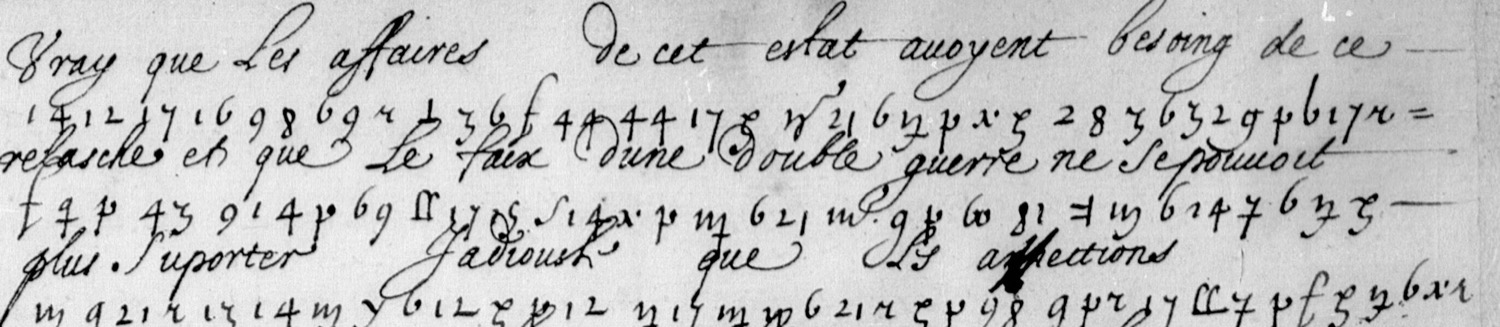
- The cipher runs fall at the same points, after the same clear words — “en laquelle il aura laissé”, “dont nous esperons estre bientost esclaircis”, “au nom de ce prétendu comte de”, “besoing de ce”, “Vous scaurez maintenant que”, “Toutes ces propositions”, “il nous faut continuer ceste mesme routte jusques”.
- The groups match where checked. No. 25’s first run opens
to 92 … 17 … 43and no. 26’s opensto 92 g 17 … 43 …; the third run ends… 68 93 …in both, with the same short group after it. The two clerks’ hands differ enough that individual figures read differently at this resolution, so no group-for-group identity is claimed here — only that the runs correspond.
The cipher itself is a nomenclator of one- to three-character groups mixing Arabic figures with letter-forms. The opening run, to 92 g 17 ẓ 43 x cu 4 7 ẓ p x 3 3 6 x, stands for
“le Pape pour l’acheminement de ces troupes in la Valt(eline)” — about eighteen groups for some forty-eight letters, so most groups carry a syllable or a whole word. The table is not
reconstructed here because the reading does not need it, and roughly thirty further glossed letters of 1625–26 in the same cipher sit in the same volume for anyone who wants it.
03 What the letter says
A secretary of state writing to his ambassador in Rome on the eve of the Treaty of Monzón, and enciphering exactly the three things that mattered.
The Valtelline. Herbault waits on news of the papal Legate’s departure for Spain and of the last resolution in which he will have left “le Pape pour l’acheminement de ces troupes in la Valt(eline)” — an affair which deserves “l’envoy d’un courrier exprez” — and above all “principallement sy le Pape entroit dans la partialité”, the fear that Urban VIII would cease to mediate and take a side.
Why the crown had just made peace with its Protestants. The peace “s’affermit de jour en jour” and is welcome even to those “qui ont tousjours le plus hautement conseillé le chastiment et la guerre contre les huguenots” — because, in cipher, “les affaires de cet estat avoyent besoing de ce relasche, et que le faix d’une double guerre ne se pouvoit plus supporter”, while “les affections de noz voysins qui font profession de ceste religion pretendue refformée estoyent grandement alterés”. That is the candid version: France made peace at home because it could not afford two wars, and because the Protestant powers abroad were turning.
The ships. Béthune has already been told of “la conduitte des Anglois envers nous, et comme une partye des vaisseaux hollandois s’estoyent retirez”. Now he is to know that the Huguenot admiral — read as Soubise — “a suivy depuis sept ou huict jours avec le reste de sa flotte; la route des premiers par l’ordre des estatz et sans permission de Sa Ma(jes)té ny de Mons(ieu)r l’Admiral, et dans la conioncture de la conclusion de la paix”. The Dutch squadron lent to the King against La Rochelle had sailed home on its own States’ orders, at the precise moment France needed it least to be noticed.
And Savoy’s push for war. The prince of Piedmont reached Paris on Monday the 9th, surprising Longueville and the maréchal de Créquy who were to have met him, and saluted the King out hunting in the warren at Saint-Germain. Once the King is back he will begin to treat, and all his propositions “tendent à engager le Roy à la guerre avec l’Espagne, (et que) la Seig(neu)rie de Venize contribue comme faict l’Angleterre et Holande”. Herbault’s answer is the whole French position in one clause: Sa Majesté “escoutera tout ce qu’il luy sera representé, et scaura bien prendre la resolution convenable au bien de ses affaires”. Six weeks later she did, settling with Spain separately at Monzón and leaving Venice and Savoy out of it.
A closing practical passage, also part-ciphered, weighs keeping the ordinary courier route against going by the Grisons, rejected for “d’autres longueurs et incommoditez, outre la despense”.
04 What remains
- The key is not tabulated. It would need the groups aligned to the glossed words, which the decipherer’s placement only loosely indicates, and the volume’s thirty other glossed letters would do it better.
- Two proper names are read only from the gloss and are uncertain in the palaeography: the “S(ieu)r de Santriny” who made a proposition to Béthune, and the “prétendu comte de Montembelans” in whose name it was made.
- “L’admiral Soubise” is an identification from context — a Huguenot admiral with a fleet in February 1626 — rather than a confident reading of the gloss.
- Whether this letter or the series is in print was not checked.
Unvalidated. Checked: the folio-to-canvas mapping on two foliated leaves, the piece list against the leaves, the word-for-word identity of the two copies’ clear text, the correspondence of the cipher runs and the matching of groups at two places, and the reading of every glossed passage quoted. Not checked: a group-by-group identity of the two ciphertexts, the key table, any printed edition. This is a reading of a contemporary decipherment, not an independent decryption.