At a glanceNot a cipher · explained by the source
- The document
- Seven lines of signs that a conjurer’s pen, “lifted into the air”, wrote by itself in answer to a question about a missing inheritance in Piacenza. Ambrogio printed them from the original sheet.
- Where
- Teseo Ambrogio degli Albonesi, Introductio in Chaldaicam linguam, Syriacam, atque Armenicam, & decem alias linguas (Pavia, 1539), f. 212v; the account runs from f. 212r to f. 213r.
- The question
- “Has Cavaliero Marchantonio, son of a rich woman from Piacenza, found all the money that Antonio Maria left, and if not, where is it?”
- What the signs are
- Ambrogio says the peasants who later killed the conjurer struck him “with as many iron tridents as the invoked Amon had drawn in his characters”. The commonest sign, a reversed E with a long bar, is a trident on its side.
- How it was tested
- Three transcriptions, a homophonic solver that recovered all 12 matched Latin and Italian controls, 17 cribs from the question, a syllabic model and Amadi’s 1580s names for the signs: no text in any of them.
- Credit
- David Scheers identified the image and sent his transcription and Amadi’s table. Stephen Houston and Felipe Rojas had printed and translated the trident passage in 2024 without drawing this conclusion.
- Still open
- Whether whoever cut the woodcut meant anything beyond the tridents cannot be shown; a code of whole words is not excluded in principle.
01 The conjuration
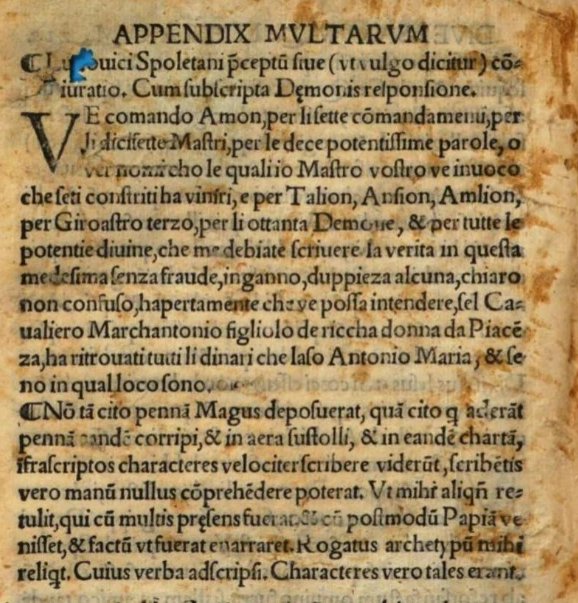
Ambrogio’s appendix of alphabets ends with Arabic punctuation. He then turns to the “characters of the magicians” that Honorius of Thebes and Pietro d’Abano left and Cornelius Agrippa printed, “which need not concern us”, and adds the conjuration of Ludovico of Spoleto “to satisfy a friend and the curious”. A noble woman of holy life, often filled with a prophetic spirit, had once written in unknown letters and foretold that people would come who used such characters; some years after her death, these were written (f. 212r).
The conjuration is in Italian (f. 212v): “Ve comando Amon, per li sette commandamenti, per li dicisette Mastri, per le dece potentissime parole … per Talion, Ansion, Amlion, per Giroastro terzo, per li ottanta Demone … che me debiate scrivere la verita in questa medesima … sel Cavaliero Marchantonio figliolo de riccha donna da Piacenza ha ritrovati tutti li dinari che laso Antonio Maria, & se no in qual loco sono.” No sooner had the magus put down his pen than the bystanders saw it seized and lifted into the air and write the characters below on the same sheet, though no one could see the hand that held it. A witness told Ambrogio the story when he came to Pavia, and at his request left him the original sheet (“rogatus archetypum mihi reliquit”). The woodcut copies it.
02 What Ambrogio says the characters meant
The next page (f. 213r) opens with the sentence usually quoted: “Quid vero characteres illi insinuarent, quamve responsionem ad quaesita redderent, scire omnino non curavi” (what those characters meant, or what answer they gave to the questions, I did not care at all to know). He hates the superstitions of magicians: such spirits always lay snares for those who worship them. His example is Simon Magus, and then the conjurer himself. The man had since given himself wholly to soldiering and led three or four hundred armed foot soldiers under his banner, when he fell into the hands of peasants:
“Qui tot illum ferris tridentibus (quot invocatus Amon, in suis characteribus effinxerat) appetentes, percusserunt, vulneraverunt, transfixerunt. Et tricipiti apud inferos Cerbero consignandum, multis undique laetalibus cribratum vulneribus, exanime tandem corpus illius reliquerunt.”
“They went at him with as many iron tridents as the invoked Amon had drawn in his characters, and struck him, wounded him and ran him through; and they left his body lifeless at last, riddled on every side with deadly wounds, to be handed over to three-headed Cerberus below.”
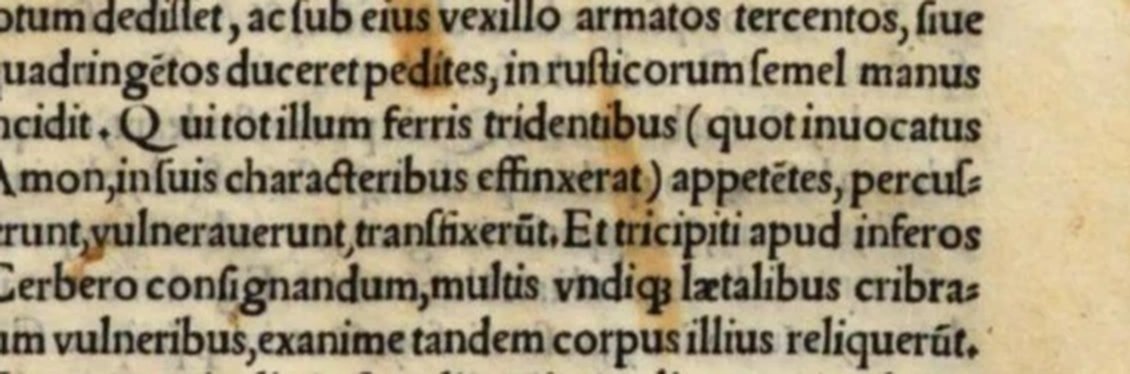
So the one meaning the source gives the characters is pictorial. The demon drew tridents, and the number of tridents was the number of pitchforks that would kill the man who had summoned him. On this account the Devil answered a question about money with an omen of the questioner’s death. Ambrogio then says he printed “this kind of writing” because the shapes of letters always interested him, and at the request of Guillaume Postel.
03 The signs are tridents
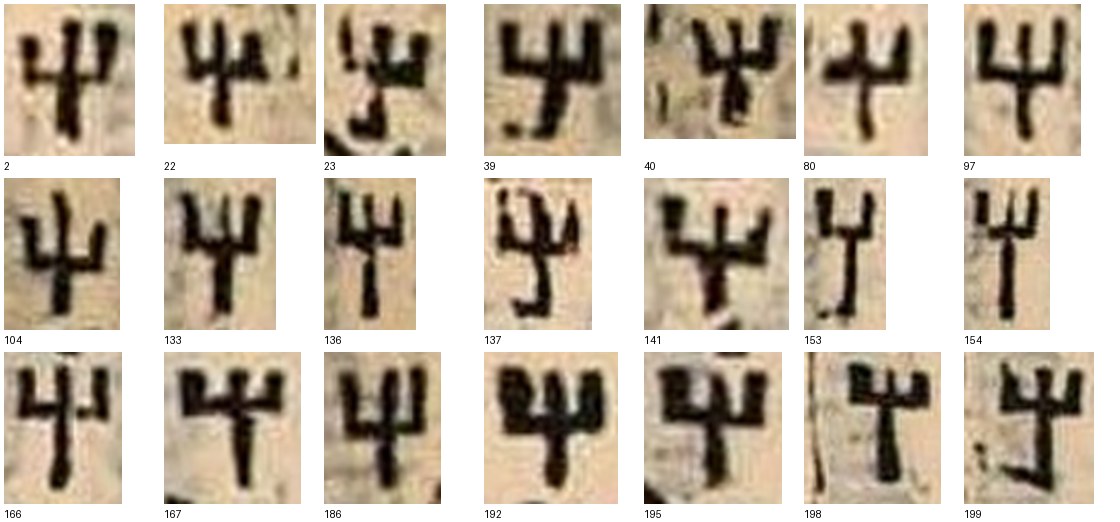
The woodcut bears this out. Its commonest sign, a reversed E whose middle bar runs on past the upright (26 of 161 signs in the transcription made here), is a trident lying on its side. The three bars are the prongs and the long bar is the shaft. Turned upright it is an unmistakable Ψ. The fork signs, a U or Ψ on a stem with or without a crossbar, are tridents and bidents standing up. Houston and Rojas (2024) called the whole set a “pitchfork script”, orientated up, down, left and right.
Agostino Amadi’s Venetian cipher manuscript (about 1588) has a “diabolic alphabet” of 31 signs, each named after a demon. They are the woodcut’s own signs (Acheron is the reversed E, Lybicon, Zael and Lucifer the three arch variants, Aletho and Nayn the forks, Demon the looped sign with a long tail). So a reader of the 1580s already took the woodcut for an alphabet. Read as the first letter of each demon’s name, the signs give no words, and the result scores no better than 2,000 random reassignments (z = 1.35 against Italian, 0.63 against Latin). The names are labels, not sound values.
04 No letter cipher
Before Ambrogio’s sentence came to light here, the characters were treated as a cipher and tested hard. There are three transcriptions: David Scheers’s (153 signs, 31 symbols), one made here before the image was identified (174 signs), and a third made by cutting the image into glyphs, clustering them by shape and checking every glyph by eye (161 signs, 38 classes). The second and third agree closely. A homophonic solver was built and first run on matched controls: 153 letters of real Latin and Italian, enciphered in 31 signs with extra signs for the common letters.
| Test | Result |
|---|---|
| Latin controls (Caesar, Sallust), 6 | 6 of 6 recovered, 99–100% of letters; scores −1.62 to −1.86 per letter |
| Italian controls (held-out Bible text), 6 | 6 of 6 recovered, 88–100%; scores −1.64 to −2.12 |
| The Devil’s text, Latin and Italian, both reading directions, three transcriptions | −2.31 to −2.50, no words; shuffled copies −2.34 to −2.52 |
| Hebrew, Spanish, French, German, Greek, Arabic, Amharic (consonant rows); Italian and Latin with vowels dropped or merged | all at the level of shuffled copies |
| Cribs from the question (antoniomaria, marchantonio, dinari, denari, danari, piacenza, caualiero, trouati, qualloco, tesoro, figliolo; Latin pecunia, thesaurus, placentia and the names) at every position: 15,970 placements | best −2.50, worse than no crib; on a control the true crib recovers the whole text |
| Syllabic model (Ethiopic-style: one consonant per sign family, one vowel per mark) | 3 of 4 syllabary controls recovered; the Devil’s text −2.51 to −2.55, the same as shuffled |
| Amadi’s demon names as values | no words; z = 1.35 (Italian), 0.63 (Latin) |
Both Scheers’s transcription and the one made here read a run of three identical signs in line 2. Any letter cipher of Latin or Italian would make that a tripled letter. The characters are not a letter cipher of the language of the question, nor of any language tried, under any transcription.
05 What stays open
- Whoever made the sheet (or the woodcut) could in principle have hidden a code of whole words or names among the tridents; 150 signs give too little to test that.
- Ambrogio does not give the number of tridents, so the count cannot be checked against the story; about 26 sideways tridents and a dozen upright forks are visible.
- Ambrogio’s alphabet plates elsewhere in the book were not compared sign by sign. Amadi’s Ethiopian and Armenian tables (sent privately) share only generic shapes with the woodcut.
06 Sources
- Teseo Ambrogio degli Albonesi, Introductio in Chaldaicam linguam, Syriacam, atque Armenicam, & decem alias linguas (Pavia: Giovanni Maria Simonetta, 1539), ff. 212r–213r; Google-digitised copy, Internet Archive bub_gb_yUkKq_QnrnwC, n428.
- Stephen Houston and Felipe Rojas, “The Devil’s Writing”, Maya Decipherment, 6 April 2024: transcription and translation of the account, including the trident sentence.
- David Scheers, notes on the Devil’s Handwriting and a transcription (16 Oct 2026), and his redrawing of Agostino Amadi’s Letere diaboliche (21 Oct 2026); Scheers, The Complete Manuscript: The Venetian Ciphers of Agostino Amadi.
- Nick Pelling, “The Devil’s Handwriting”, Cipher Mysteries, 2013; Klaus Schmeh, “Top 25 der ungelösten Verschlüsselungen”, no. 12 (2013).
- Andrew Clark, The Life and Times of Anthony Wood I (1891), pp. 497–99 (the Queen’s College copy shown to Charles II in 1663); J. Yeowell, Notes and Queries 11 (1855), p. 146 (the 1746 verses).
Notes, transcriptions, solvers and controls are in the repository folder targets/devil1539/.