
01 The letter and the key
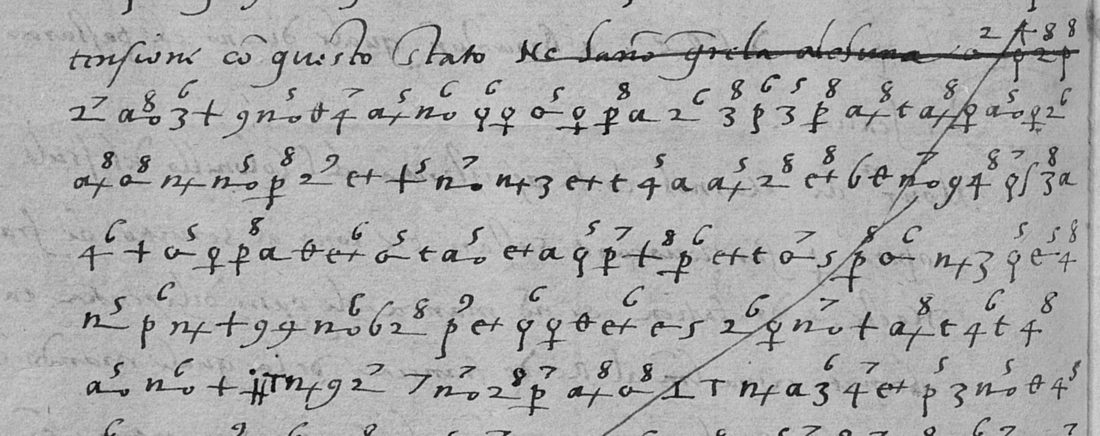
The four DECODE images are out of archive order. P4 is f. 110r (scan 0408) and opens “Sacra Cat.ca & Ces.a M.ta”. It is in clear, on the Dauphin and the Grand Master crossing with munitions, the King at Briançon, and “Mons.or di Marnol” with the Colonel of the Isola working to recall the Swiss in French service. P1 is f. 110v (scan 0409), with clear text on the Grisons and then the eleven cipher lines. P3 is f. 111r (scan 0410). It has one cipher line struck through, then the clear close, dated “In M.lo ali xiiij de Nov.e M. D. xxxvij” and signed “il Car.l Caracciolo”. P2 is the address leaf, with the docket “del Cardenal Caracciolo xiiij de Nov.e 1537”.
Cifrario 38 (Luo 2021, p. 657, from AGS Estado leg. 38 doc. 190) has three parts.
- An alphabet of invented signs with homophones. a has six signs, and e, i, l, n, o, p and u have two to four each.
- A syllabary. A consonant’s base sign takes a superscript digit for the vowel: 5 = a, 6 = e, 7 = i, 8 = o, 9 = u. For example, 2 is the base for s, so 2⁷ = si.
- Nulls, marked by the superscripts 2, 3 and 4, and a few code words.
The first cipher line shows the system at work: 2⁷ a̱o⁸ 3⁶ + 9 ṉo⁵ θ 4⁷ a+⁵ ṉo⁶ = si do ve a p ra c ti ca re.
02 The decipherment
Line by line, as the cipher spells it. [..] marks signs not resolved, and square brackets around words mark a doubtful decryption.
 1  solo si dovea practicare per Marno a se volevano concordarse
 2  como erano Suizari, et in tal caso ho scripto piu vol-
 3  te a Marno a che manda il Panizone in mio nome et pagato
 4  quale a fe? resolui, perche io serria? contento
 5  dare a epsi Grisoni como a[..] Elvetii la tracta
 6  del frumento gratis, facendo capituli convenienti.
 7  Fin qui a epso Marno a non e parso [..] dicti Griso-
 8  ni; harriano 'l facto como [..] Suizari. Epso Marno a
 9  se accorge hora de la malignita et perfidia de
10  Suizari et [..] et soi ministri. Se deve ne recor-
11  dare, e quante volte io ha dicto che epsi Suizari far-
    (f. 111r, cancelled) riano quello hora fan po[..]
In substance, Caracciolo reports on Marnol’s work with the Grisons. Marnol was to find out whether they would come to terms as the Swiss had. Caracciolo had written to him several times to send Panizone in Caracciolo’s name and to pay him. The Grisons were to be given, as the Swiss had been, the tratta of grain free of duty, on suitable articles. So far it had not seemed good to them, and they would have done as the Swiss did. Marnol now saw the malice and bad faith of the Swiss and their ministers. Caracciolo reminds the Emperor how often he had said what the Swiss would do “hora”. The last words are in the line the writer cancelled.
03 Prior work and method
Tomokiyo’s page on the Spanish ciphers of Charles V, in its section on Luo’s thesis, names the key and gives a rough decipherment of lines 1–4 (“… pagabo quale e a e f ressolvi perche io se r ri a conbento”). That note was found before the work and led to the key. Here the letter was deciphered line by line from the DECODE images, and the key needed no change. Line 3 gives pagato and line 4 contento, where Tomokiyo had pagabo and conbento. Luo’s thesis does not edit this letter.
04 The second pass, and what remains uncertain
The first pass left about fifteen percent open. A second pass at 4× with contrast on every line settled most of it with four rules:
- A superscript belongs to the sign before it. In line 5, 3⁶ 4⁷ et decrypts as ve ti i, so the word is “Elvetii”.
- A bare ♀ is the letter r, and ♀ with a superscript is the p-syllable. This gives “harriano” in line 8 and “parso” in line 7.
- The g-shaped sign with a bar is an f homophone, which gives “frumento” in line 6.
- Dotted signs are nulls.
About ten of roughly 330 signs (an estimate, not a sign-by-sign count) stay doubtful:
- Line 4: “a fe”, decrypted letter by letter, and “serria”, where the sign taken as n stands where an a is expected.
- Line 5: two a-homophones after “como a”.
- Lines 7 and 8: one sign each.
- Line 10: “2 a” after “et”.
- The cancelled line: one syllable after “po”.
05 Sources
- Archivo General de Simancas, Estado leg. 1184 fol. 110, scans 0408–0411: DECODE R9966 (login).
- Wanruo Luo, El lenguaje cifrado de Isabel de Portugal (1530–1539), doctoral thesis, Universitat de València, 2021 (RODERIC), Cifrario 38, p. 657.
- Satoshi Tomokiyo, cryptiana.web.fc2.com, “Spanish ciphers during the reign of Charles V”, section on Luo (2021).
Notes, reading and profile: caracciolo1537/ in the repository.