01 The documents
Philippe de Béthune, younger brother of Rosny (the future Sully), left for Rome with his instruction of 23 August 1601 (no. 2 of the volume) and served as ordinary ambassador until 1605. The letters of the King to him in fr. 3484 run from October 1601 to October 1602. They are the sent originals, signed Henry and countersigned de Neufville, that is Villeroy’s office, and the cipher is that office’s. Where the office in Rome deciphered a letter it wrote the reading in the margin, in a smaller hand, numbered 1, 2, 3 to the passages, or as a footnote keyed with a sign; the volume keeps those readings. Three letters have none.
| Letter | Folio | Cipher | Plaintext available |
|---|---|---|---|
| Paris, 8 Nov 1601 (no. 6) | 30v–31v | six passages, one to five lines | numbered marginal glosses, near-verbatim |
| Paris, 9 Nov 1601 (no. 7) | 33r | 22 lines, the whole body after “il me mande qu’il est certain que” | none |
| Paris, 10 Nov 1601 (no. 8) | 34r–v | four passages, 17 lines | the minute, f. 36r–v, in clear (the notice’s “copie du n° précédent”) |
| Saint-Germain, 22 Nov 1601 (no. 12) | 46r–47v | c. 40 lines in blocks | none; ff. 45 and 48 are address leaves |
| Paris, 10 Dec 1601 (no. 13) | 49v–50r | 5 + 9 lines | verbatim footnote on 49v, marginal glosses on 50r |
| 24 Dec 1601, Jan 1602 (nos. 14–17) | 53, 56–57 | blocks of 9–11 lines | marginal glosses |

02 The design
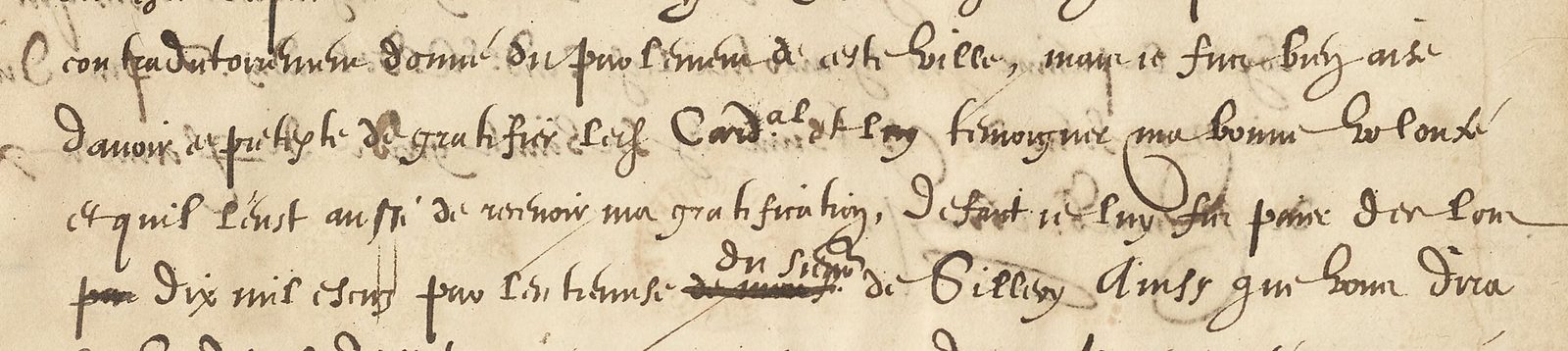
Bazeries (Les chiffres secrets dévoilés, 1901, pp. 28–29) prints the “chiffre baillé à M. de Béthune” of 1599, given to Maximilien for his mission to England. Each letter has a figure (A = 3, B = 10, C = 8 …) and two or three arbitrary symbols; thirty names are figures with two dots (Le Roy 4̈, Le Roy d’Espagne 2̈); some eighty common words are letters with a comma (a, ayant … y, et, z, nous), with one dot (entre … mons) or with two dots (nostre … selon), each series alphabetical; the figures 2 to 11 with a comma are tout, tant, toutesfois … vivs; a Δ doubles the preceding letter and y and $ cancel it. The 1601 cipher of the younger brother is the same office’s design two years on, with new values: f, = le, g, = la, x, = que, r, = par, q, = pour, d, = je in the comma series (the initials run l, l, q, p, p, j: alphabetical by groups, as in 1599); f: = au, s: = dit, x: = et, y: = ent in the two-dot series; t. = de, p. = ce with one dot; 61 = qui, 63 = re, 65 = si as syllable groups; 48 = Cardinal, 17 = Aldobrandin, 7 = le Roy d’Espagne as names; 68 = tout and 71 = tion are further syllable groups (toutes = 68 ȥ g, affectionne ends 71 g ȥ). The letters: e = ȥ ‡ ε 0; a = 4 6 u; i = hooked m, v, a, 1; o = f + t; t = q 7; u/v = ꝑ, y, c; s = g, 2-shaped r, n; r = r ∂; l = h B S; m = x; g = plain m, hooked u; c = b e; p = o T; b = n; y = a. And φ is not a letter but the doubling sign Bazeries describes in the 1599 key (“Δ doublera son prochain précédent”): somme is written s-o-m-φ-e, l’année l-a-n-φ-e-φ, Sillery has h-φ for ll, occasions o-c-φ, retrouve u-φ (u and v one letter), mienne mie-n-φ-e. The “gratification” of f. 34 is written x 6 ꞔu ∂ u p ꞔm m v b 6 7 1 f: m-a-g-r-a-t-i-f-i-c-a-t-i-o(n), with the figures 6 7 1 for a t i; the design’s figure-letters in the flesh.
03 The 10 November letter
The minute gives the enciphered passages word for word (differences: one word-sign where the minute has “de sorte”, “faites semblant” for the minute’s
“taschez qu’il n’en soit rien dit”). In the King’s voice: after the Parlement of Paris had given judgment in the Este–Aldobrandini debt, he “fus bien aise
d’avoir ce pretexte de gratifier led. Cardinal et luy tesmoigner ma bonne volonté … de sorte je luy fis payer des lors dix mil escuz par l’entremise du
sieur de Sillery”; he has now ordered “qu’il face payer aud. Cardinal dedans les premiers quatre mois de l’année prochaine la somme de dix mil escuz par les
mesmes mains … sans avoir esgard à l’arrest obtenu par lad. duchesse de Nemours, ny au besoing d’argent auquel je me retrouve. Car j’affectionne led.
Cardinal et desire m’acquitter de lad. promesse que je luy ay faicte”; Béthune, after conferring with Cardinal d’Ossat, is to let Cardinal Aldobrandini
know “de facon qu’il recoive et estime ceste grace comme elle merite”, to pretend “que vous n’aiez receu la presente”, and to be “le premier qui en avertira
led. Cardinal Aldobrandin”. Pietro Aldobrandini, the Pope’s nephew, had made the Peace of Lyon in January 1601; here is the King paying for it, and
managing how the gift is announced. The full text is in the repository (bethune/reading_10nov.md).
04 The 22 November letter
This letter was expected to be the harder of the two open ones: forty lines of cipher in blocks, the notice said, with no clear copy anywhere in the
volume. Reading the four leaves at full resolution showed the description to be wrong in the way that mattered. The cipher is not in blocks. It is broken
into eighty short runs set inside lines of ordinary clear French, so that the King’s secretary enciphered only the names, the sums and the
sharpest judgements and left the grammar around them open. The clear text therefore carries most of the sense, and the letter can be read without
breaking the runs at all. All four pages are transcribed in bethune/reading_22nov.md; this is the first reading of any part of it.
It answers Béthune’s despatch of 29 October, received on the 18th, and is signed Henry and countersigned de Neufville. Its core is a rebuke, in clear, of two persons the cipher names only by code group: “Il me semble que [20] [S 12], qui sont douez de toute prudence, ont faict faulte de n’avoir rompu ce coup, car ilz l’eussent faict facilement s’ilz y eussent pensé et operé d’heure, ainsi qu’ilz devoient. Mais ilz se sont contentez de … meuz d’autres considerations …” On money and discipline the King will “donner ordre que la pension que j’ay accordée au s.r Camaiano sera bien payée”, all to “relever le party françois a Rome”; but Béthune is to give no “esperances ou [fermes] des promesses a d’autres” without express command, “afin de n’abuser personne ne moy le premier”, and to act always “après toutesfois en avoir conferé avec le Card.al d’Ossat”. He acknowledges the Pope’s “bon accueil … aux deux audiences quelle vous a données”; he will receive Maffeo Barberini — the future Urban VIII, then on his way to France — “le plus favorablement que je pourray po[ur] le respect de sa S.té”; on the Jesuits he refers back to an earlier letter and will await the Pope’s answer; and he complains of an agent “qui reside en Suisse, accompagné d’un certain Julio de la Torre y Travers[i]”, whom Cardinal Aldobrandini had already reprimanded. The third leaf ends in clear on the household news that dates the whole file: “J’attends en bonne devotion le retour du courrier que je vous ay envoié pour convier sa S.té au baptesme de mon filz, lequel se faict tres bien nourrir et se fortifie a veue d’oeil” — the dauphin, born on 27 September. The letter is dated “Escrit a St Germain en Laye le xxij.e jour de 9bre 1601”, and a postscript, signed again, countermands part of what precedes it.
The eighty ciphered runs are in bethune/ct_22nov.txt. Decoded with the key they give fragments only — le cardinal aldobrandin,
attenter a este toute, suisses, octobre, saincteté au — which is the same ceiling the 9 November letter meets, and for
the same reason. Two values are confirmed by their clear frames, 73 = vostre and the pair 48 17 = Cardinal Aldobrandin. Fifteen groups
remain open; three of them have frames that constrain them, and one, 72, has a proposal against it as well as for it (see below).
05 The 9 November letter, and the ceiling on it
The corpus of known plaintext — the 10 November pair, the six glossed passages of 8 November, the footnote passage of 10 December, about 1,650 letters — was aligned by an EM procedure in which each symbol may stand for zero to twelve letters under a proper prior over strings, seeded with the values fixed by hand and allowing nulls only on the signs Bazeries’ design uses for them. The resulting P(letter | symbol) feeds the decoders. A second pass re-read the leaf symbol by symbol at four times magnification, fixed the doubling sign, the syllable groups, ꝑ = u/v and a dozen letters on words of the minute, and lifted the reading to about six words in ten: …sera la promotion au cardinalat … Alexandre … ensemble ce que vous aurez … jamais il m’avoit dit … propos de rechercher le cardinal … de vous dire la res[olution] … de telles pratiques … des advis desdits car[dinaux]. A third pass added a bigram language model built from Xivrey’s 1.43 million words, which brought in sur le revenu de Naples, le nunce resident, les cardinaux … enclins a la [26] and aux prudens advis desdits card[inaux]. The letter is about the Spanish pressure over Don Alexandre’s cardinalate and the cardinals’ advice, not the military news its clear opening suggests.
What that third pass added that matters more is a way of telling when to stop. An oracle bound lets every transcribed symbol emit any value in its model’s support and asks how many of the true letters it could then possibly produce. On the known-plaintext blocks that ceiling is 71.0 %, while the decoder scores 74.5 % — it is already above its own emission bound, getting a few letters right by accident. No further work on the search or the language model can help: roughly 29 % of the true letters cannot be produced by the glyphs as transcribed at all.
- Widening each symbol’s emissions to those of its visually confusable partners raises the ceiling to 80.6 % but lowers the real decode from 74.5 % to 71.9 %: more ambiguity than the language model can resolve.
- Three segmentation architectures. Connected components give 1.13–1.38 components per glyph and both over- and under-cut. A forced alignment that never cuts — a dynamic program giving each token of a known sequence a variable-width slice, with templates re-estimated from the alignment — collapses to the average glyph from a uniform start. Restricting the cuts to component boundaries with a per-class width model leaves the program no freedom to recover where the components are wrong.
- More resolution. The second pass read from Gallica’s 2,000-pixel image; the 3,926-pixel original gives about 30 % more linear resolution, and the glyphs are visibly crisper. It does not settle them.
- Letting the language model re-split the figures. The re-reading did localise the disagreement — it clusters in the figure runs, not the letters, because the cipher writes figures without separators and one- and two-figure groups coexist, so “6165” reads as 61|65, 6|1|65 or 61|6|5. Offering every legal split to the decoder scores 70.8 %, and turns partant into “par [70] le roy d’Espaigne [2]”.
- Two independent readings, unioned. The one widening that does help, and the measurement that ends the argument. A block of 102 letters of known plaintext was read again from scratch off the full-resolution leaf without consulting the first transcription. Reader A (the second pass) scores 75.5 %, reader B (the third) 57.8 %; they agree on 50 of 72 aligned positions, and their union reaches 78.4 %. Nearly three points — and the second reading is worse than the first, despite the extra resolution.
Two careful readers of the same ink agreeing on 69 % of its tokens is not carelessness. It is the statement that this hand does not carry enough information at roughly 450 dpi to fix its glyphs, which is what the 71 % bound says in another form.
The confusions are sub-glyph, and one example fixes the point. In conduitte, whose reading is verified against the minute, the same m-shaped glyph stands for d in one position and i in the next, the two differing only by a hook. The three families recorded earlier — an open-tailed and a looped g (n and s), three m-shapes (g, d, f), r against the 2-shaped r (r and s) — are real, and no magnification separates them. The note in the repository that called the remainder “a day’s work, mechanical” is now corrected there, with the numbers: it was not the two-digit names that stood in the way.
06 The code groups, and one proposal with evidence both ways
The groups that carry the substance of both open letters — 2, 5, 6, 8, 9, 12, 20, 28, 31, 44, 66, 67, 69, 72, 80 — occur only where there is no decipherment. Three have clear frames that constrain them: S 12 and 20 are the two persons “douez de toute prudence”; 28 is a place, from “ce[luy] m’a escrit de [28]”; 44 follows “et par consequent”.
One has a proposal, recorded here the way this project records unconfirmed things. 72 = vous: the collocation “x , 72” —
que followed by 72 — occurs four times across ff. 46r, 46v, 47r and 33; 72 opens a line three times; and on f. 53r, whose marginal decipherment is
verbatim rather than a paraphrase, the gloss reads “…je ne suis pas d’auis que vous pressiez sa Sain.té…” exactly where the cipher runs
x , 72 , T 63 , r S Z, which with the established T = p, 63 = re, r = s, Z = e gives que · vous · p-re-s-s-e. Against it: the block on
f. 49v ends … 63 72 while its footnote gloss ends “il sera meilleur de differer a luy en parler”, where a final vous is hard to place.
Either the ciphered block runs on past the passage the footnote glosses, or 72 is something else. It stays unconfirmed, and is used in no
reading on this page.
The glossed leaves are the way to settle them, and examining ff. 53r and 56r at full resolution showed why they are tractable: their decipherments are verbatim, and whole clear phrases sit inside the ciphered blocks — “discours d’aultruy. Il fault” on f. 53r, “Mais je ne croy pas quil le face” and “si ce n’est pour” on f. 56r — each also in the gloss, in the gloss’s own order. Those are free anchors for an alignment. f. 53r contains 66 and 72; f. 56r’s margins name the King of Spain and Archduke Albert in clear. Neither block is transcribed.
07 What would finish the 9 November letter
Not more computation. The clear text of both open letters should exist in a copy, and the search for it turned up the right volume. BnF, Cinq cents de Colbert 346 is “Copies des despesches concernans l’ambassade de Messire Philippe de Bethune, conseiller du Roy en son Conseil d’Estat, à Rome, en 1601-[1605]”, whose first volume runs 23 August 1601 to 22 November 1602 and holds letters of Henri IV, Marie de Médicis, Villeroy and Béthune. That range covers both the 9 and the 22 November letters, and a copy register of this kind is made from the minutes — that is, in clear, which is exactly how the 10 November letter came to be readable here. It is not digitised: Gallica’s SRU returns no record for it. Reading it in the Salle des manuscrits, or ordering reproductions, is the single most valuable thing anyone can do to this target.
Second, and independent: Eugène Halphen edited Lettres inédites du roi Henri IV à monsieur de Béthune, ambassadeur de France à Rome, du 18 octobre au 24 décembre 1601, an edition covering precisely this stretch. It is in the HathiTrust catalogue (record 100644113) and not in Gallica, the Internet Archive or Open Library. Whether Halphen printed the ciphered passages in clear — which would have required the minutes — decides whether these letters count as already in print, as fr. 3077/3078 did for Du Bellay.
Checked and excluded as sources of a clear text: Berger de Xivrey’s Recueil, vols. I–V, which prints a Béthune letter of 10 October 1601 but nothing for November; Mélanges de Colbert 17, whose first part is still running instructions at p. 179 and whose second is 1602–05; and BnF fr. 3677 and 3678, the “Registre des lettres que monseigneur de Bethune a escrites en France durant son ambassade de Rome”, which belong to the second embassy of 1624–30.
08 Sources
- BnF, Département des Manuscrits, Français 3484, Recueil de lettres et de pièces originales (Henri IV to Béthune, 1599–1602), Gallica ark:/12148/btv1b52523722c; canvas = 2 × folio + 7 for a recto.
- É. Bazeries, Les chiffres secrets dévoilés (Paris, 1901), pp. 28–29, “Chiffre baillé à M. de Béthune, 1599”, Gallica bpt6k325768q.
- Berger de Xivrey and Guadet, Recueil des lettres missives de Henri IV, vols. III–V (1846–50), archive.org, as language model; vol. V has no Béthune letter for November 1601.
- S. Tomokiyo, “Ciphers during the reign of Henri IV”: Béthune’s ciphers of fr. 15975 (1602–05) and fr. 15972 (1606–08) are other keys.
- BnF, Département des Manuscrits, Cinq cents de Colbert 346–350, « Copies des despesches concernans l’ambassade de Messire Philippe de Bethune », vol. I: 23 August 1601 – 22 November 1602. Not digitised; the route to a clear text of the 9 and 22 November letters.
- E. Halphen (ed.), Lettres inédites du roi Henri IV à monsieur de Béthune, ambassadeur de France à Rome, du 18 octobre au 24 décembre 1601. HathiTrust catalogue record 100644113; not in Gallica, the Internet Archive or Open Library.
- Working files in
bethune/:NOTES.md,reading_10nov.md,reading_22nov.md,corpus_v2.txt,key.tsv,ct_f33_v2.txt,ct_22nov.txt,em_align.py,lm.py(period language model),decode2.py(bigram word-lattice decoder),eval.py(control harness),oracle.py(the ceiling),union.py(two readings unioned),seg.py/align.py/align2.py(the segmentation attempts, negative), andcrop.py/lines2.py/cut.py/sheet.py(the image pipeline).