01 The seven letters
| Item | Date and place | To | Where on the image | Cipher |
|---|---|---|---|---|
| fr. 3985 no. 66 | Nevers, 27 Aug 1593 | Revol | ff. 113–114v (canvases 226–230) | copy in clear; the recurring sign is the copyist’s que |
| fr. 3985 no. 88 (dupl. no. 94) | Nevers, 2 Sept 1593 | Revol | after f. 156; not reached | no. 60 (Tomokiyo) |
| fr. 3985 no. 116 | Nevers, 8 Sept 1593 | Pisany | f. 209 (canvas 419) | no. 46, read |
| fr. 3986 no. 68 | Vese, 7 Oct 1593 | Revol | ff. 144–150 region; not identified | no. 60 (Tomokiyo) |
| fr. 3986 no. 75 | Coire, 9 Oct 1593 | Revol | ff. 156–157v (canvases 306–309) | clear with c. 90 symbols of no. 60 on f. 157v |
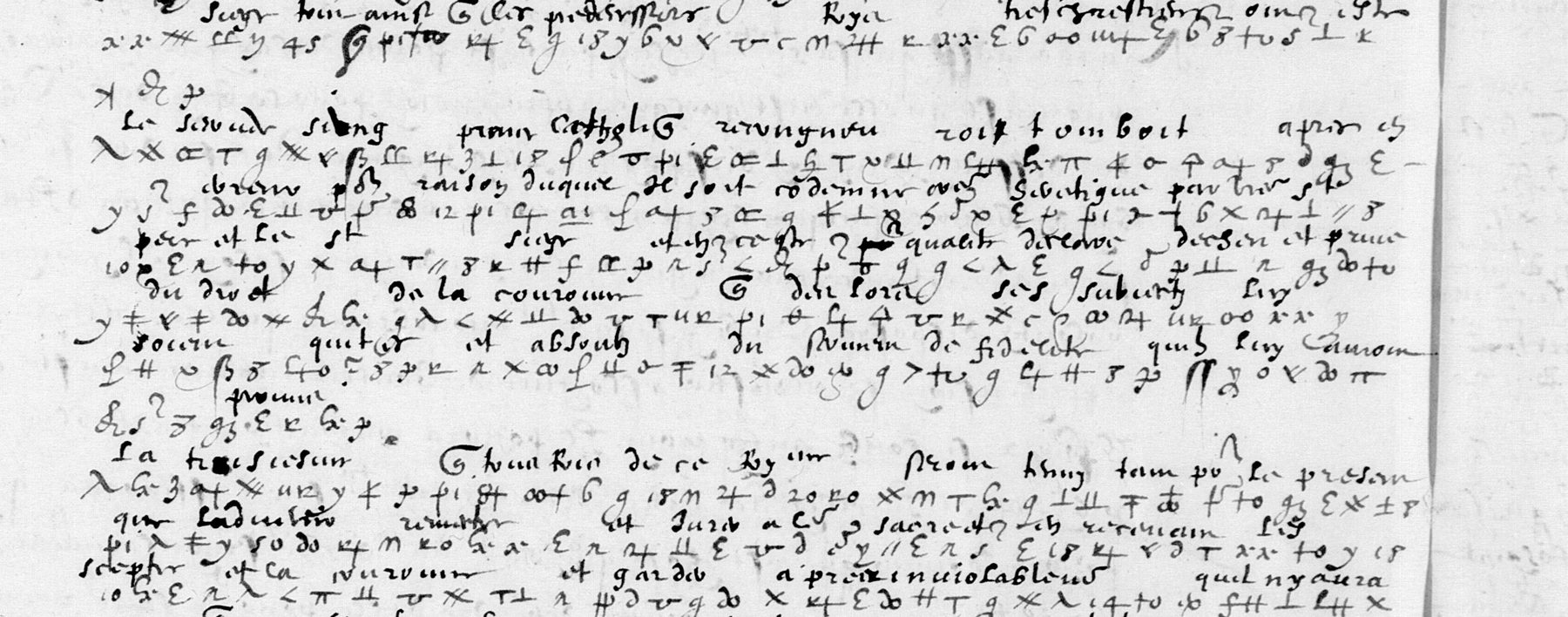
| fr. 3986 no. 81 | “Ville” [Edolo], 14 Oct 1593 | Pisany | f. 168 (canvas 332) | no. 46, read in stretches |
| fr. 3986 no. 101 | Desenzano, 23 Oct 1593 | Revol | after f. 190; not reached | no. 60 (Tomokiyo) |
Both volumes are microfilm digitisations on Gallica with every canvas labelled NP; the folio is close to half the canvas number, and the 1400 px canvases do not resolve two-digit figures, so the pages were fetched at full IIIF resolution (about 4,900 px wide). Tomokiyo’s Henri IV article states the division of keys: Gondi and Nevers used the symbol cipher no. 60 with the King and Revol from July 1593, and the numerical no. 46 with Vivonne (Pisany). The catalogue entry had not taken that in.
02 The key
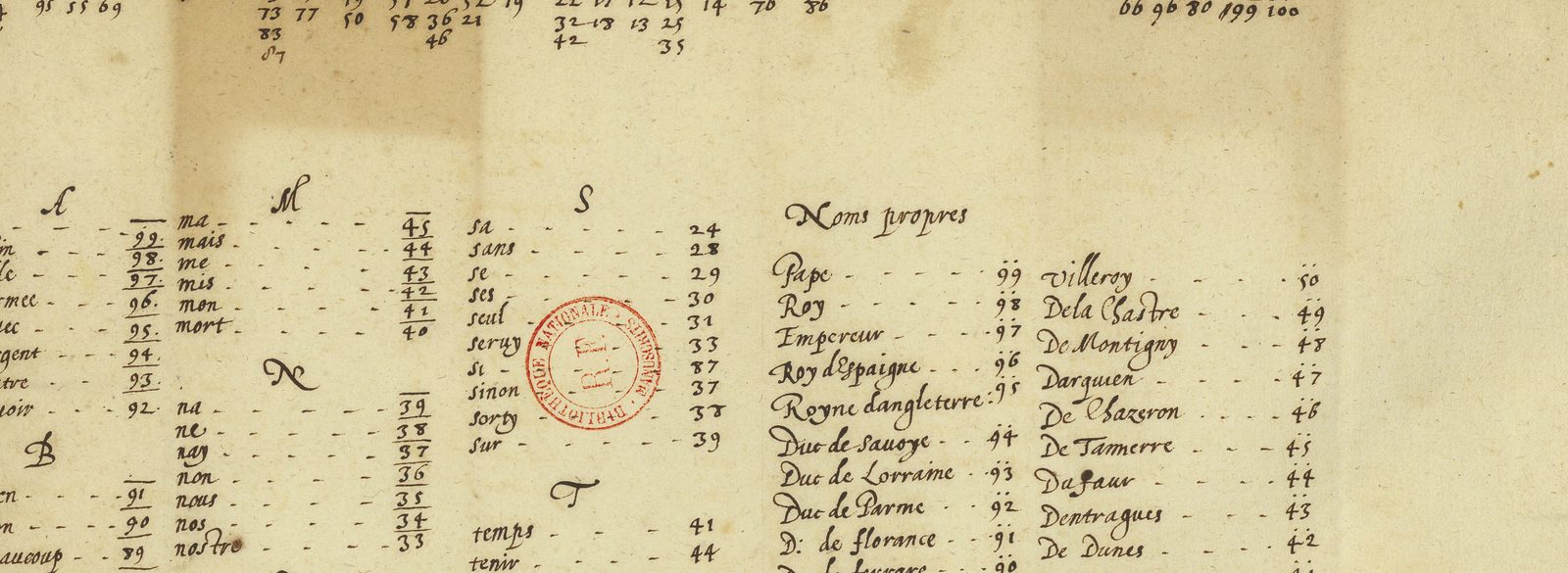
Tomokiyo’s published image of the key is 225 pixels wide; the Gallica image of the sheet is 7,677. The table has a barred series from 99 down to 2 for common words (80̄ de, 56̄ je, 51̄ luy, 53̄ la, 11̄ que, 9̄ quil, 38̄ ne, 73̄ est, 5̄ recherche), a plain series on the figures the alphabet leaves free (24 sa, 28 sans, 29 se, 87 si, 45 tout, 62 vous, and the provinces), and a double-dotted series of names (99 Pape, 98 Roy, 88 Duc de Nevers, 70 Cardinal Gondi, 89 Duc de Mantoue, 54 Revol, 34 De Pizany, 1 Ambassadeur). In the letters the digit 1, and once 0, is dropped inside a group as a null, the device the sister key no. 45 prescribes in words. The conventions were checked against a letter the office deciphered interlinearly in the same key, Girolamo Gondi to Pisany of 22 September 1593 (fr. 3986 ff. 64–65v): personne, rencontre, congregation, absoudre, sainct, siege, ladicte, Romme all come out figure for figure.
03 8 September 1593, fr. 3985 f. 209

Three passages, 122 figure groups, all in the key.
- “Car j’estois sur ce mesme faict” l’on dissuadoit [99̈] de rechercher [99̈] luy don[n]es[t] l’absolutio[n]. The copy has the Pope’s sign twice; one of them is the King’s (98̈) in sense. Tomokiyo read this passage with the figure 14 for 74 and the name as Beaulieu; the figures are 74 and, in the next passage, 54 Revol.
- “Car” [le duc de Nevers] alléguoit qu’il n’estoyt besoin qu’il a[l]la[s]t sans cela, parce qu’il ne feroit rien, then in clear “Je suys attendant des nouvelles de” [Revol] “à qui j’ay escript”. Nevers is named by his sign in his own letter; the 61 in allast is a slip for 65.
- “Je suys d’opinion que” l’on n’a volonté de contanter le Pape, que l’on n’y aille poynt, and in clear “Et suys bien ayse que soyez de mesme volonté”. Three figures in this passage are the copyist’s (11 for the u of volonté, 14 inside de, 84 for 34).

04 14 October 1593, fr. 3986 f. 168
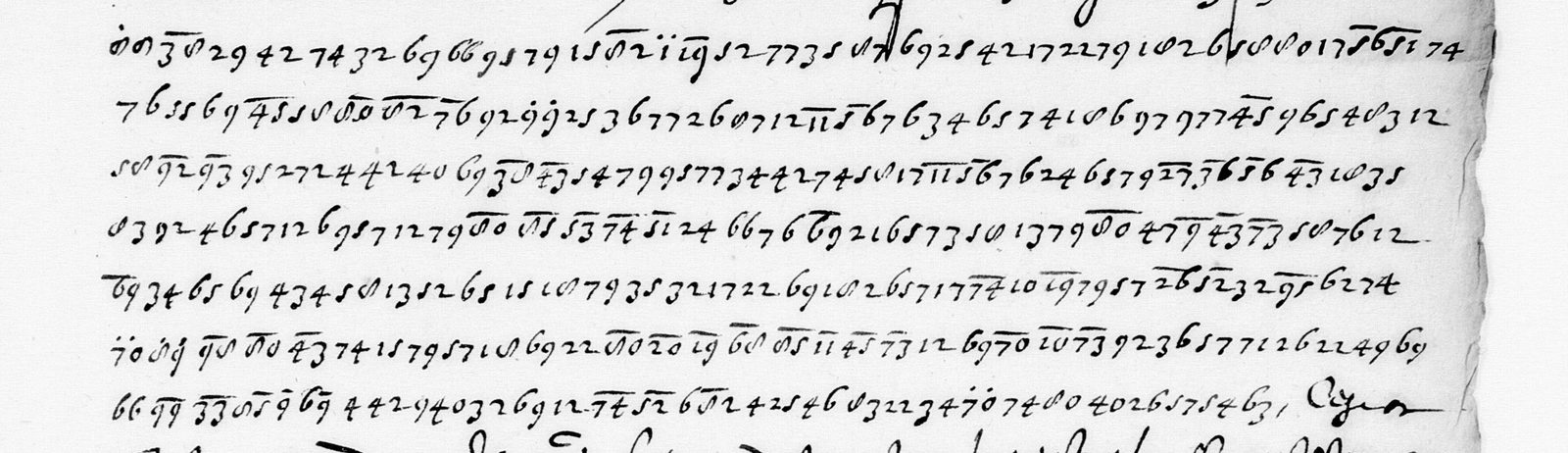
Seven full lines of figures, a short run and one more line: 269 groups, 268 in the key. The copyist’s hand makes 1 and 7, 0 and 8, 3 and 5 close, and the transcription still has garbled stretches. What reads continuously: [le duc de Nevers] ne sera receu come [ambassadeur] pour pluseurs resons. Je luy ay demandé … se [le Pape] voloit que … e[ll]e m’a dit n’avoir autre charge, ne me declarans que … je me … conten[t] … qu’il de cela et luy … [p]l[a]inte de lettre m’est … faict aller … pluseurs resons … pour en par… [le cardinal Gondi] [le duc de Mantoue] avec de m’avancer de plus pour faire ce que m’a esté escrit, qui est conforme au nostre. Ce qu’il faict tenir secret, et le … dans sa … [le cardinal Gondi] a … s’est nostre [q]uestion, est bruit … secrete, tout yra … Tomokiyo’s fragment stopped at “Je luy ay demandé”. The doubtful groups are listed in the transcription file; a lexicon scorer over the alternative null placements did not settle them, and the next pass is a re-reading of those spots with the Gondi decipherment as the guide to this copyist.
05 The letters to Revol and key no. 60
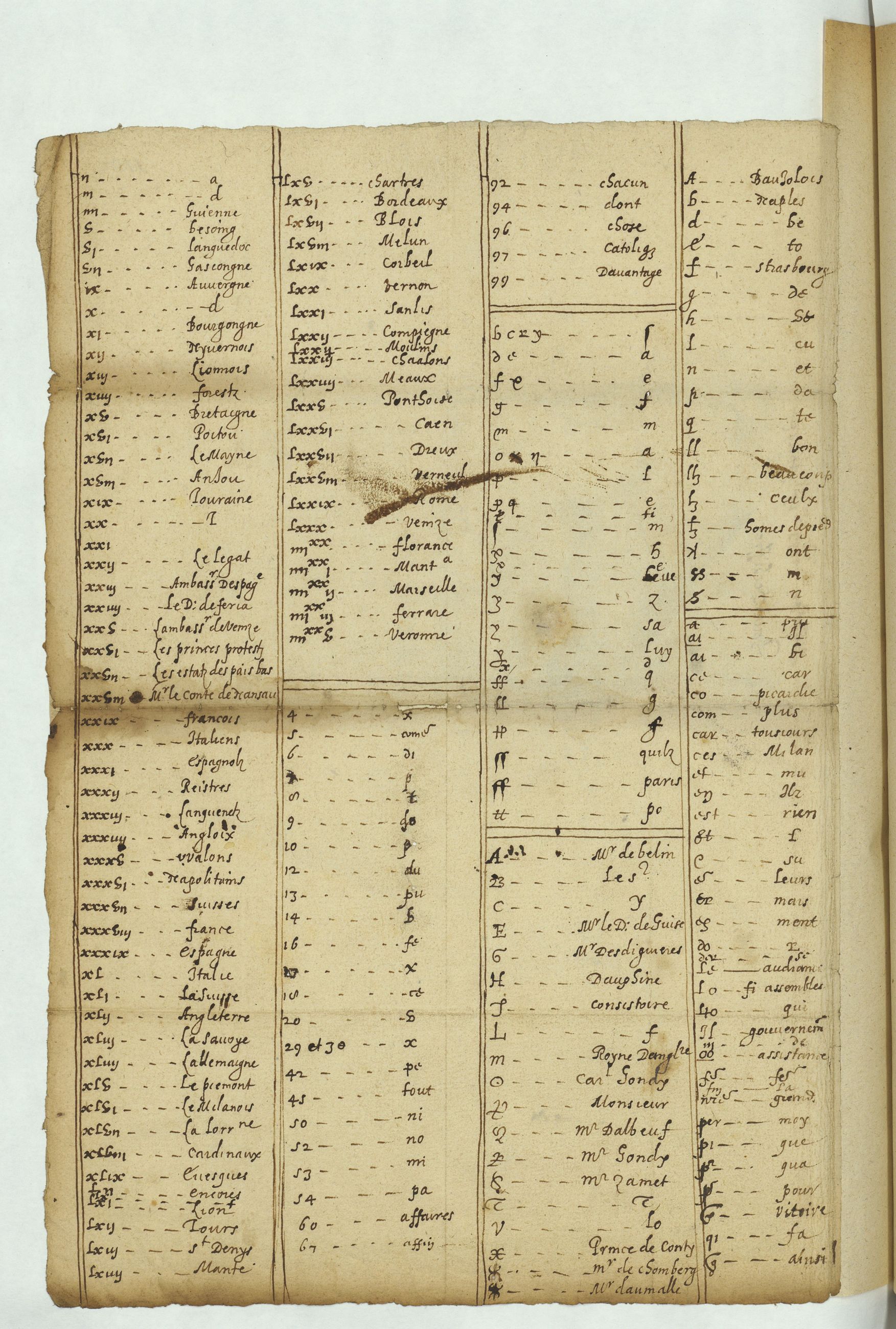
The five letters to Revol are in the Court’s symbol cipher, Tomokiyo’s no. 60, endorsed “Chiffre baillé à Monsieur de Nevers, Montereau, aoust 1593”. Its
enciphering sheet (fr. 3995 f. 109) gives four or five symbols for each letter, a syllabary ba … vu, word signs, Roman numerals for provinces, towns and
persons (iiijxx for 80), and a row of nulls; Nevers’s secretary added a deciphering table sorted by the shape of the symbols (ff. 110v–111). Both
tables were read from the full-resolution images on 17 September 2026 and are transcribed in key60.txt; the deciphering table is complete and legible,
and it settles the values Tomokiyo found doubtful (the y-shaped sign is s, the 4-shaped sign is x, the crossed η is the doubling sign).
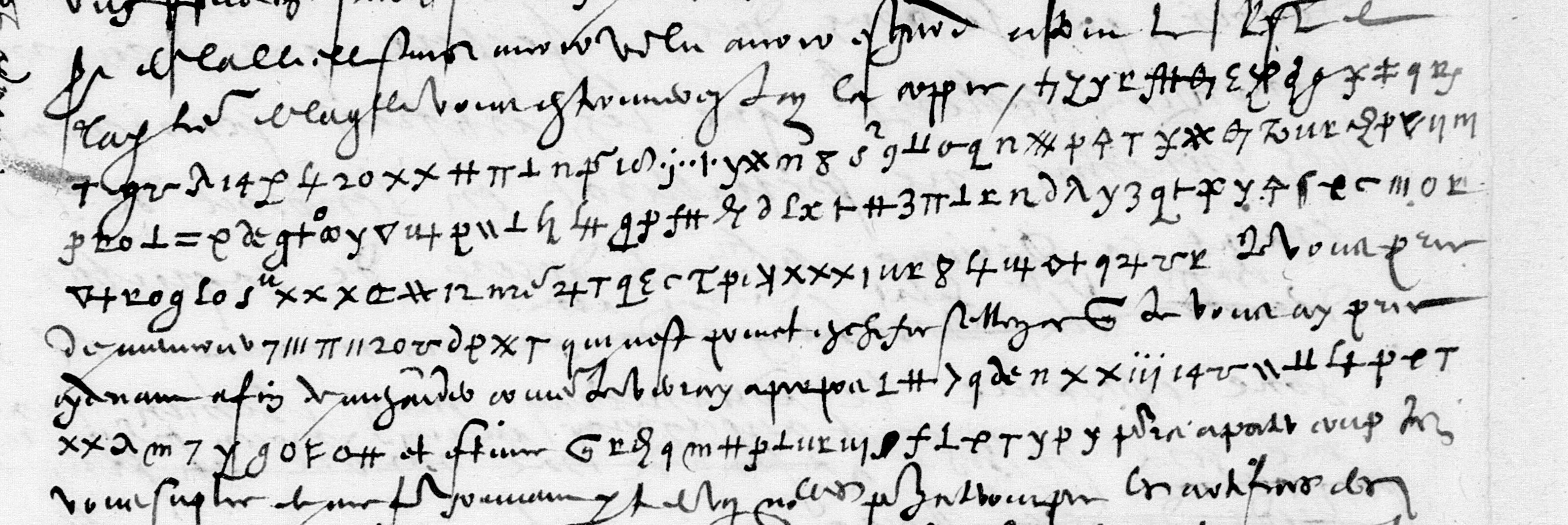
The cursive forms the copyist uses in the letters differ from the Court hand of the table, so the values were checked on Henri IV’s letter to Nevers of 7 October 1593 (fr. 3986 f. 151), a page in the same cipher with the office’s interlinear decipherment: plusieurs, contre, de la, promesse, respondre, Bellièvre, Villeroy, Zamet pin down thirty of the commonest signs. The Instruction of 31 August turned out to be the richer crib: part 2 of the Mémoires de Nevers is on Gallica after all (ark bpt6k64451005, reached through the catalogue notice rather than search), and its pp. 492–499 print the Instruction in clear; better, the cipher pages of the manuscript Instruction itself (fr. 3985, canvases 264–268) carry the office’s interlinear decipherment in the same copyist’s hand as the Revol letters, matching the print word for word. That gives three full pages of symbol–plaintext pairs in the target hand, on top of the King’s letter of 7 October.
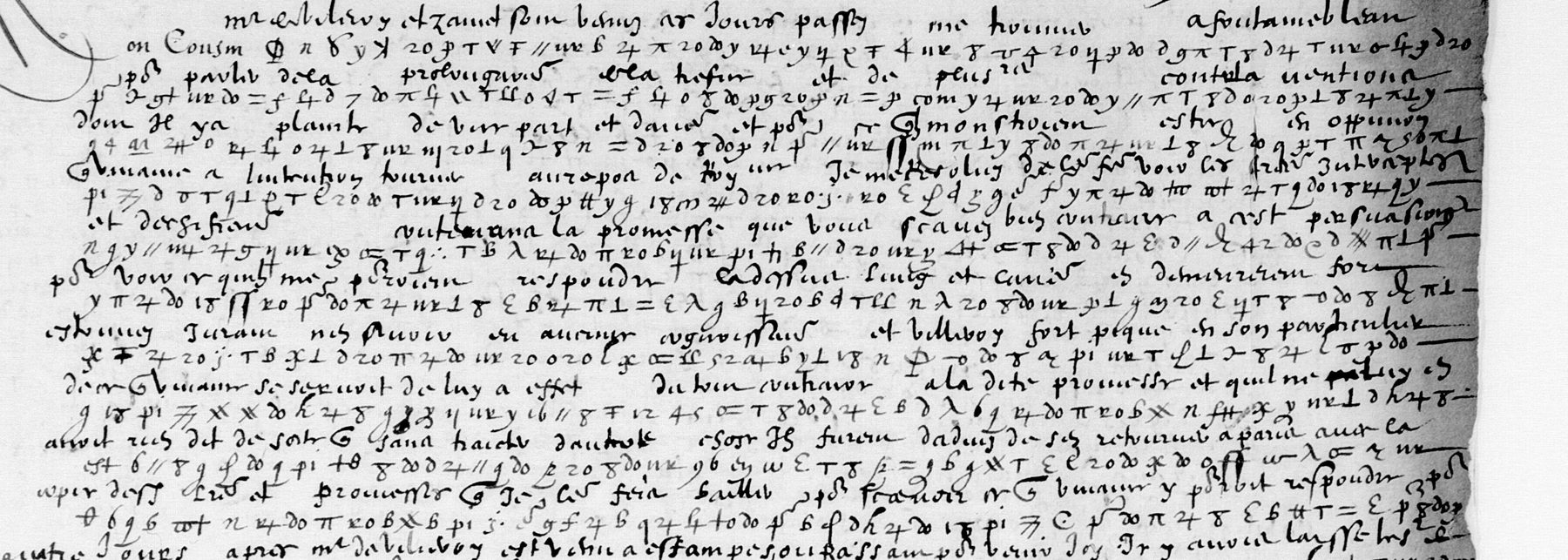
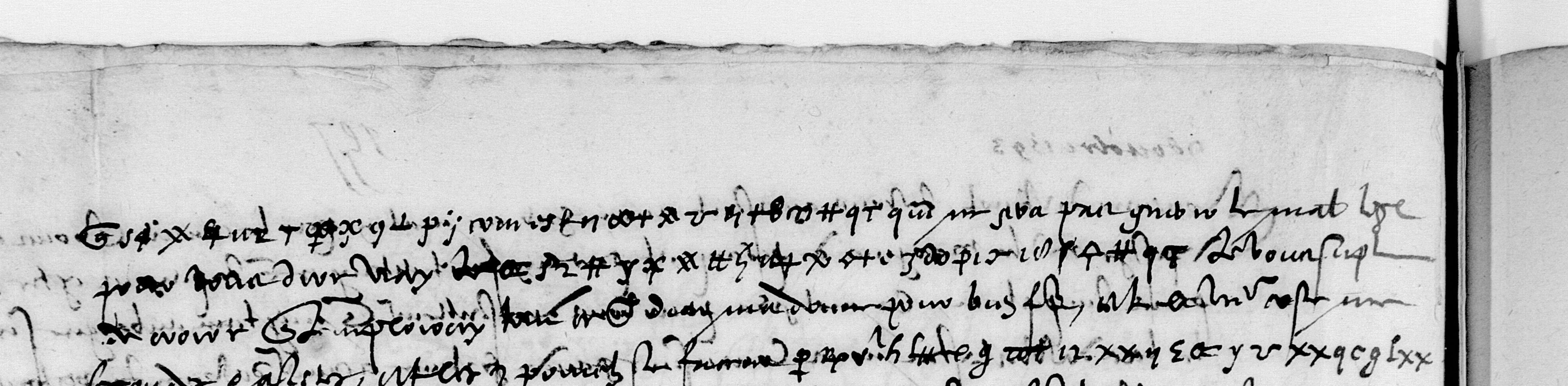
Where the cipher sits in the copies, from the full-resolution pages: 21 August, fr. 3985 f. 88–88v, six lines; 27 August, f. 115, one line (the earlier pages of
that letter are in clear); 2 September, f. 176, about ten lines with the sign lxxix for Rome; 7 October, fr. 3986 f. 146v, nine lines; 9 October, f. 157v, four
lines; 23 October, f. 198, five lines. The f. 146v and f. 157v passages are transcribed symbol by symbol (ct_3986_f146v.txt, ct_3986_f157v.txt)
and run through the decoder; a second pass at higher magnification then showed that both pages, like the interlined Instruction, mix short cipher stretches into
faded clear cursive, so those transcriptions over-read cipher and carry a revision note. Tomokiyo’s three anchors on f. 146v fall out of the table at once, l’absolution (λ 14 ꝑ 4 20 xx ‡ π ⊥ = la·b·so·l·u·t·i·o·n),
à la vérité and intérêt, with qu’il, bien, et, que, nous, si around them; but between the anchors
the output is still letter salad, because the copyist runs the small symbols together (ue, ur, ıı, v) and the same stroke stands for
two or three table entries. The next pass is a glyph-level alignment of the copyist’s forms against the crib page in the same hand, then the other four letters.
06 Sources
- BnF, Département des Manuscrits, Français 3985 (Gallica ark:/12148/btv1b90606498) and Français 3986 (ark:/12148/btv1b9060631k), Mémoires de la Ligue; Français 3995 f. 86–87 and ff. 109–111 (ark:/12148/btv1b525085665), the two keys.
- S. Tomokiyo, Catalogue of Ciphers (Mainly Related to Duke of Nevers) in BnF fr. 3995, no. 46 and no. 60; French Ciphers during the Reign of Henry IV, on the Gondi–Nevers correspondence of 1593–94.
- Working files in
nevers1593/: the two key tables (key46.txt,key60.txt), the decoders, the four transcriptions, the segmentation scorer, and the notes.