01 The letters
The Earl of Manchester’s papers at the Beinecke (OSB MSS fc37) include a run of letters from Robert Yard at Whitehall in September and October 1699, while Manchester was ambassador in Paris. Yard writes most of each letter in clear and puts names, places and the matter of each sentence in numbers, from a single group to runs of twenty, in the middle of the English. Two letters of the run carry a decipherment written between the lines at the time they were received: 28 September/9 October (box 2, folder 39) and 5 October (folder 45). The next two, 12 October (folder 49, two pages with an endorsement “Mr Yard 12/24” on the third) and 16 October (folder 51, two pages), have no decipherment on them. The Beinecke catalogue describes both as “almost entirely in cipher, undeciphered”. The Historical Manuscripts Commission’s 8th Report, Appendix II, p. 74, calendars them in the same terms and adds that “No key to the ciphers of the period is known to exist among the State Papers”.
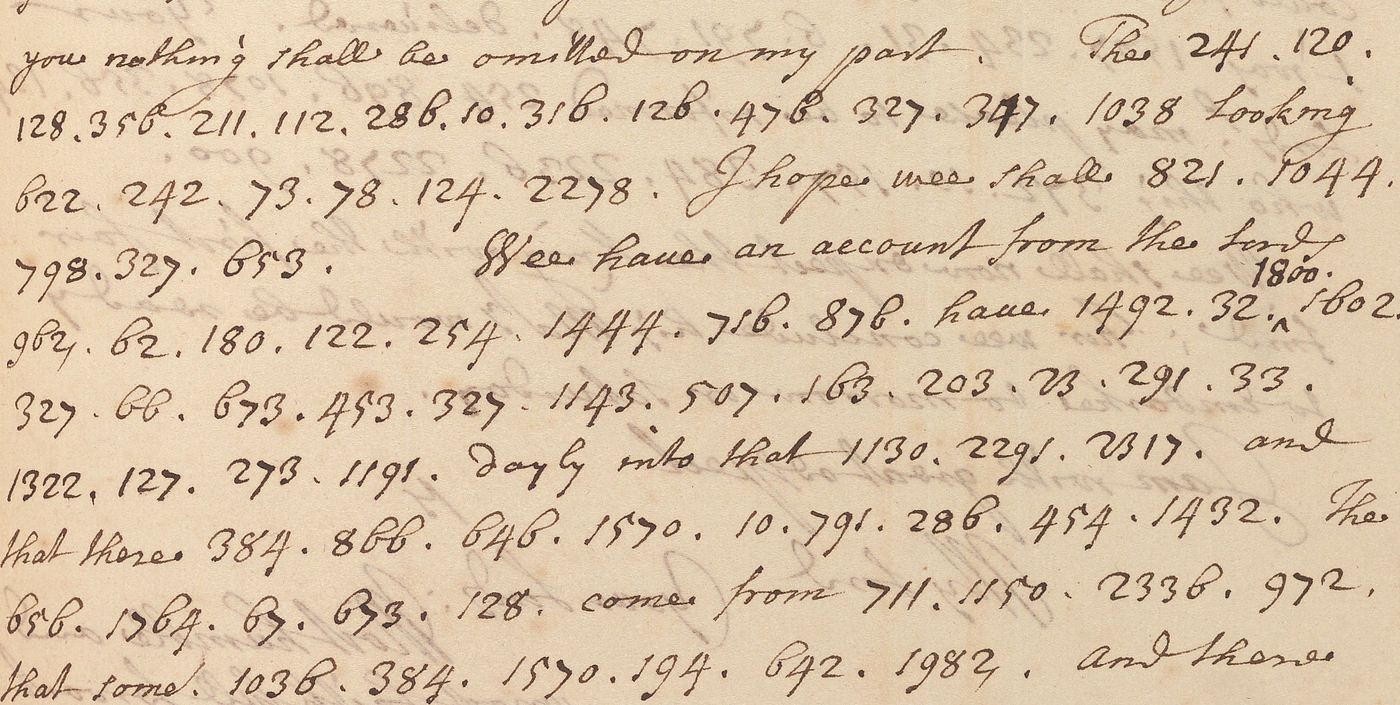
Satoshi Tomokiyo had already identified the code. His cryptiana page on the ciphers of the period lists the Yard letters from the DECODE database (R2858–R2860), says that the two undeciphered ones (R2859, R2860) “can be deciphered with THE=454”, and decodes the first few groups of each. No full reading had been published.
02 The key at Yale
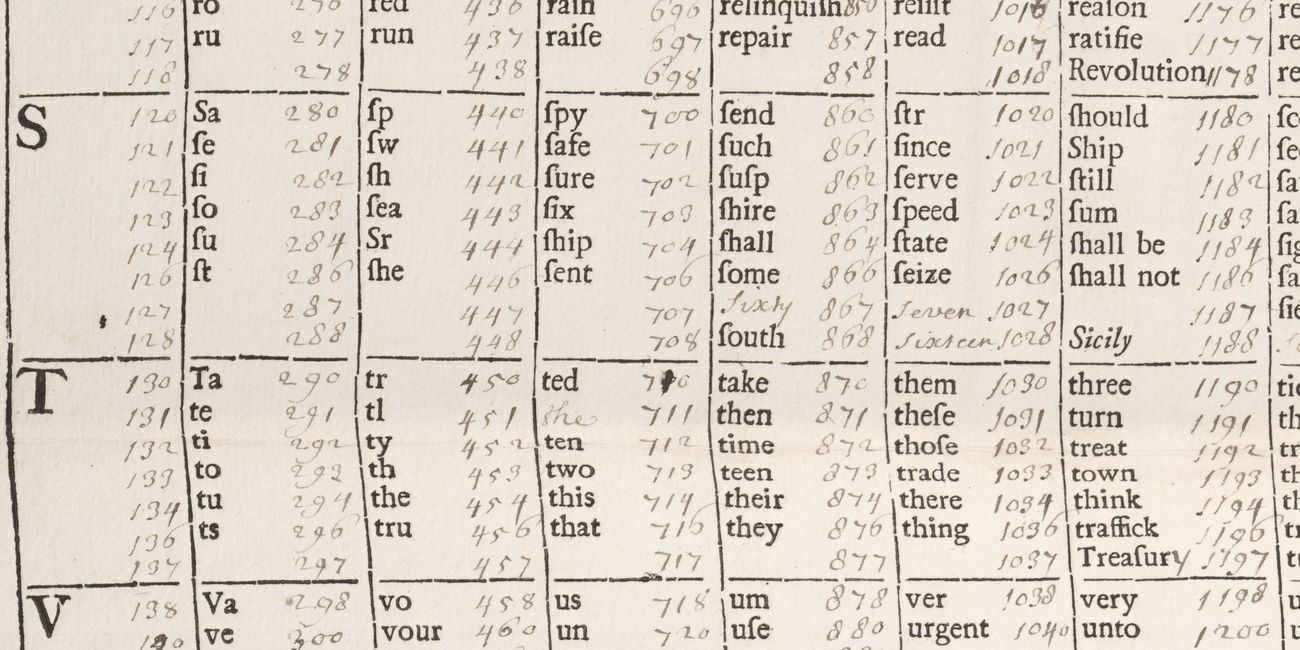
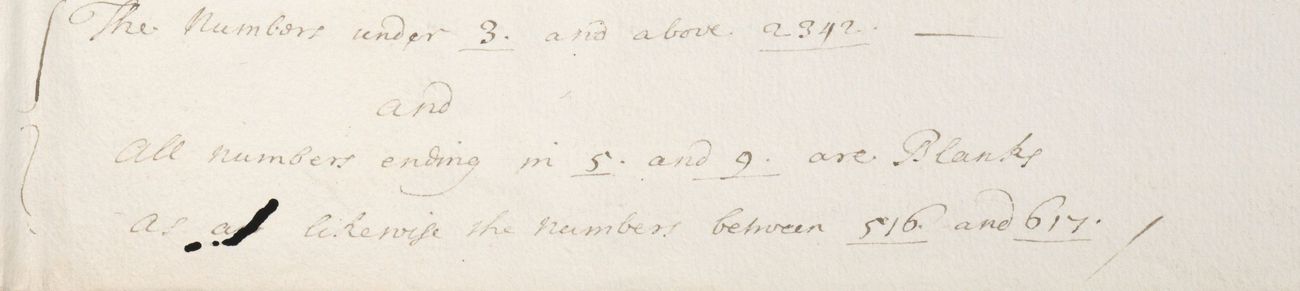
Box 18, folder 47 of the same collection is a large printed sheet endorsed “Copy of the E. of Manchester’s Cypher”. It is a one-part code template of fourteen columns, each running A to Z: first the single letters, then two columns of syllables, then words and names in alphabetical order. The printer set only the plaintext; the numbers were written in by hand, one to a slot, from 3 up to 2342. The hand skips every number ending in 5 or 9, and jumps from 516 to 617. In the T block the second syllable column reads tr 450, tl 451, ty 452, th 453, the 454, tru 456.
A note at the foot of the sheet gives the rule for the nulls:
All 1,456 numbered slots on the recto were transcribed, in 25 tiles from the full-resolution image. Three entries sit in a fold and cannot be read (1584, 1744, 1904). In practice Yard also uses the slots that are numbered but carry no word as nulls: 322, 482, 740, 742, 900, 902, 972, 1060, 1062, 1854, 2190, 2236, 2258, 2278, 2291, 2317, 2336, 2342. The decipherer of the 5 October letter passes over 740, 900, 2172 and 2278 in the same way.
Yard’s key was not numbered exactly like the copy at Yale, because the numbers on each copy were written in by hand. Three differences show in the letters:
- 42 and 48 are e, not f as on Manchester’s sheet: sent three is 281.667.453.117.42.48, se-nt-th-r-e-e.
- 21 is d, not c: Drummond’s ends 87.21.123, n-d-s. Both values agree with the reconstruction in HMC’s Addendum 141a (48 = E, 21 = D), which Tomokiyo had flagged as not matching the printed sheet.
- 483 is and though the sheet prints ard. Tomokiyo notes that Vernon used it the same way.
Yard writes the figure 2 in two ways, one of them shaped like a V, so V3 is 23, V17 is 2317, V34 is 234, V36 is 236.
03 The control: 5 October
Before the target letters were touched, the transcribed sheet was applied to the letter of 5 October 1699 (folder 45), which carries a decipherment between the lines in a contemporary hand. The groups and the decipherer’s words agree:
| Groups on the leaf | Decoded with the Yale sheet | Interlined at the time |
|---|---|---|
| 454 1322 120 306 | the person s we | the Persons we |
| 622 [740 900 2172] 327 347 1038 | for [nulls] at do ver | for at Dover |
| 328 261 323 [2278] | ap pe ar [null] | appear |
| 241 120 128 356 211 112 | me s s en ge r | messenger |
| 293 304 130 340 [438] 502 804 | to wa t ch [null] come ing | to watch … coming |
Nothing else was needed. The two target letters were then transcribed from the Yale images and decoded group by group (dec.py). Two readings that looked doubtful, the 12 October
group 656 (like) and the V-shaped 2s, were checked on enlarged crops of the leaves.
04 The readings
Clear text roman; deciphered words in italics; spelling of the leaf kept; […] editorial notes on Yard’s slips. Nulls are omitted. The clear closing paragraphs are abbreviated (…).
Whitehall, 12 October 1699
I have the favor of your Lordp’s letter of the 7/17 of this month, and am sorry I could not effect what your Lordp desired in your letter of the 3d Oct. I hope at an other time your Lordp will be able to give me earlier notice, and I assure you nothing shall be omitted on my part. The messengers stay yet at Dover looking for Mills. I hope wee shall meet with him at last. Wee have an account from the Lords Justices of Ireland that they have received private information that many disaffected persons return dayly into that Kingdom, and that there is some ill design against the Government. The like intimations come from the north that something is designed in Scotland, and there the same intimations likewise with relation to England. And all is said to be carryed on very privately at Saint Germains, which I take the liberty to mention that your Lordp may endeavour all you can to get light into what they are doing at Saint Germains.
By the last post from France wee found at the post house a letter from one Lebrun at Paris to Dunster at the three Lyons in Bedford Court, with an enclosed for Mr. Gray; but upon reading it could find nothing therein but private concerns, and so sealed again and delivered. Your Lordp may please to be informed of your correspondent who this Gray is.
Wee shall now expect the King with the first fair wind; for wee conclude his Majesty would be ready to embarke to morrow or Saturday. …
Whitehall, 16 October 1699
I received by the post yesterday the favor of your Lordp’s letter of the 11/21 instant, and as soon as I understood the contents of it, and that Mills [1276 = have not, sic; a slip] was gone by the way of Rouen, I gott warrants prepared, and sent three severall messengers to watch his landing all along the coast [266 for 286 st] where it may be thought he may land; and at London too he is watched where he lives; and besides wee still keep a messen[ge]r at Dover to watch him and Lord Drummond’s priest [enciphered pre-su-t] these, for I think nothing would be more usefull then to take them and their letters.
I have given directions likewise concerning Fowles, and will endeavor to have him met with. Tho I must acquaint your Lordp that there is no goldsmith [20, c, for the s] lives in Round Court, nor any body named Cockburne; but there is one of that name, a thread man in Bedford Court, whom I have ordered enquiry to be made.
I suppose your Lordp has heard of Clance the periwig maker; he is gone lately to France. Your Lordp will please to have him observed and to give notice of his return.
Wee are now looking out very impatiently for an Easterly wind to bring the King over. …
The five slips are Yard’s, not the key’s: 1276 have not after Mills, where the sense wants nothing; 266, an unassigned slot, for
286 st in coast; pre-su-t for priest; 20 (c) for an s in goldsmith; and messen[ge]r, a syllable left out.
The raw group-by-group decode, with the syllable joins, is in yard1699/oct12_decoded.txt and oct16_decoded.txt.
05 What they are about
Both letters answer letters from Manchester (of 7/17 and 11/21 October, the double dates being English Old Style and French New Style) and both are about watching people who cross between France and England. On the 12th messengers were already waiting at Dover for a man named Mills; on the 16th, having learned from Manchester’s letter that Mills had gone by the way of Rouen, Yard had warrants made out and three more messengers watching the coast where he might land, and his lodging in London watched as well. The Dover messenger was also to watch for Lord Drummond’s priest, and Yard wanted them and their letters taken. Enquiries after a Fowles, a Cockburne said to be a goldsmith in Round Court (there was none; there was a threadman of that name in Bedford Court) and a periwig maker called Clance, gone to France, follow the same pattern: names apparently sent from Paris, checked in London, and movements to be reported back.
The larger news is in the 12 October letter. The Lords Justices of Ireland reported that many disaffected persons return dayly into that Kingdom and that there was some ill design against the Government; similar reports came from the north about Scotland and about England; and all is said to be carryed on very privately at Saint Germains, the court of the exiled James II outside Paris. Yard asks Manchester to find out what they are doing there. The same letter shows the post office at work: a letter from one Lebrun in Paris to Dunster at the Three Lions in Bedford Court, with an enclosure for a Mr Gray, was taken out of the French post, read, found to hold nothing therein but private concerns, sealed again and delivered, and Manchester is asked who Gray is. The clear passages expect the King, William III, from Holland with the first fair wind.
The Beinecke summaries of the neighbouring letters speak of “Mills and Lord Drummond’s priest” and “persons expected at Dover”, so the names read here agree with what the deciphered siblings say.
06 What remains uncertain
- Three slots of the Yale sheet are hidden in a fold and unread (1584, 1744, 1904, the third F-row entry of columns 10–12). None of them occurs in these two letters, but a letter that uses them would need a better image of the fold or the original.
- Yard’s own copy of the key differed from Manchester’s in at least the letter column and in 483. Three differences show in these letters; others may exist where the letters use a slot only once and the context carries the reading.
- The unassigned slots are read as nulls because the note calls the unnumbered ranges blanks and the 5 October decipherer skips four of them; that the numbered-but-empty slots are blanks too is an inference from their use, not stated on the sheet.
- Cole’s Memoirs of Affairs of State (1733) prints letters from Manchester’s embassy. It was not re-checked for these two letters, so a text of them in print, deciphered at the time, cannot yet be ruled out.
- Mills, Lebrun, Dunster, Gray, Fowles, Cockburne, Clance and Lord Drummond’s priest are not identified here.
07 Sources
- Robert Yard to the Earl of Manchester, Whitehall, 12 October 1699: Beinecke Rare Book and Manuscript Library, OSB MSS fc37, box 2, folder 49 (Yale Digital Collections 16601173; IIIF 16601219–16601222).
- The same, 16 October 1699: box 2, folder 51 (16601175; IIIF 16601223–16601226).
- The deciphered siblings, 28 September/9 October and 5 October 1699: box 2, folders 39 and 45 (16601171, 16601172).
- The key: “Diplomatic cipher, contemporary copy”, endorsed “Copy of the E. of Manchester’s Cypher”, box 18, folder 47 (2046948; IIIF 1213691 recto, 1213692 verso).
- Historical Manuscripts Commission, Eighth Report, Appendix, Part II (1881), Manchester papers, p. 74, no. xlix.
- S. Tomokiyo, ciphers of the Glorious Revolution period, cryptiana, glorious.htm: the THE = 454 identification, the first groups of each letter decoded, and the Addendum 141a values.
The key transcription (key_raw.txt, expanded and checked by key.py), the decoder (dec.py), the transcriptions of both letters (oct12_ct.txt,
oct16_ct.txt), the decodes and the crop helpers are in the repository (yard1699/). The Yale images are not committed; they can be fetched from the IIIF ids above.