

01 The documents
| DECODE | ff. | Date, place | In print | What is concealed |
|---|---|---|---|---|
| R4838 | 125–127 | 28 July 1585, Nonsuch | CSP Scot. viii no. 40 | name numbers only, and a slip (f. 126) with 13, 19, 37 |
| R4839 | 140–141 | 7 August 1585, the Court | CSP Scot. viii no. 65 | name numbers only |
| R4840 | 163–164 | 21 August 1585, the Court | not calendared | name numbers only |
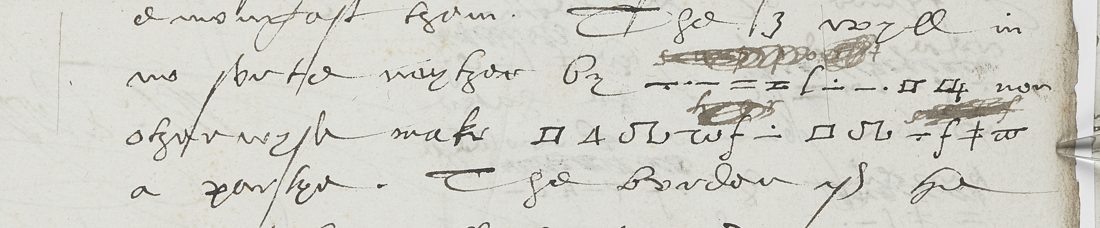
| R4844 | 194–195 | 10 September 1585, the Court | not calendared | name numbers and about fourteen sign words |
These are the letters Wotton received, kept with his papers; each is signed “Your assured friend, Fra. Walsingham”. DECODE’s “graphic signs” on R4838 refers to nothing more than the numbers. Only R4844 has signs.
02 The name code
The same numbers run through Wotton’s replies (R4841–R4843). Grades as in the repository’s conventions: H certain, C probable, M possible, I unidentified.
| No. | Reading | Grade | Ground |
|---|---|---|---|
| 10 | King James VI | H | “the King” in CSP no. 106 for Wotton’s 10; sense in every letter |
| 19 | James Stewart, Earl of Arran | H | CSP no. 41, Arran [“19”] |
| 20 | John, Lord Maxwell, styled Earl of Morton | H | CSP no. 106, “Morton” for 20 |
| 24 | Sir Thomas Kerr of Ferniehirst | H | CSP, Farnyhurst [“24”]; the 21 August letter presses for his imprisonment |
| 39 | Patrick, Master of Gray | H | CSP no. 41, the Master of Gray [“39”] |
| 40 | Sir Lewis Bellenden, Justice Clerk | H | CSP no. 41, Justice Clerk [“40”] |
| 11 | the French party | C | “the party of 11 increaseth”; “devoted unto 11” |
| 36 | England, the Queen’s side | M | “10 will be carried away from 36”; “delivered towards 36” |
| 27 | a councillor coupled with 40 (Secretary Maitland?) | M | “the practice of 27 and 40” |
| 28, 29 | the banished lords (Angus and Mar?) | M | “if 28 and 29 would come down to the Borders to join with 20” |
| 13, 14, 23, 30, 37 | unidentified | I | “13 is affected to 19”; “23 is the principal dealer in 37 between 10 and the Jesuits” |
03 The letters
28 July 1585, Nonsuch (R4838; CSP no. 40)
Walsingham is sorry to hear of a move in Scotland to ask for an English duchy for the King: it would offend the Queen and breed jealousy against the league. Wotton should dissuade it through Gray. On the slip of f. 126: 13 is “affected to 19” and Wotton should deal warily with 13 in anything that concerns Arran.
7 August 1585, the Court (R4839; CSP no. 65)
After the killing of Lord Russell on the Border, the Russells’ friends are incensed against Farnihurst (24) and Arran (19). Wotton is to insist that the King do justice and not set Arran at liberty.
21 August 1585, the Court (R4840)
“39 doth complain in a late letter written to his friend here … of the alteration of your countenance towards him.” Gray offers to prove himself if 28 and 29 come down to the Borders to join with 20 (Maxwell); without that, he fears that “10 will be carried away from 36, the party of 11 increasing”. Walsingham trusts none of them: “The best is to deal warily with them all.” He advises Wotton to tell Gray of the suspicion without naming its author. The Queen wants Farnihurst (24) imprisoned. Wotton’s draft answer of 30 August is on the companion page.
10 September 1585, the Court (R4844)
Wotton’s letters of 1 September have bred “some better liking of the [signs] set down by 39”. This is Gray’s plan to seize the King. The 28 and 29 “will be [signs]”; 13 “will in no sort neither be [signs] nor otherwise make [signs] a party”. Wotton is to confer with the King so as to be “[signs] at the [signs]”, but must “ward your [signs]” and avoid [signs]. In the postscript Walsingham sends on a letter and reports that 23 “is the principal dealer in 37 between 10 and the Jesuits”. Working transcriptions of both uncalendared letters, with gaps, are in the repository folder.
04 The sign words
About fourteen words, some 120 signs in all, are written in an alphabet of geometric and letter-like signs: squares, triangles, =, ≠, ÷, a crossed 4, ω, and borrowed letters f, d, c, k, R. They also carry dots and dashes that look like nulls. The same signs (square, triangle, ≠) open many words, which suggests homophones. Over every sign word Wotton, or his secretary, wrote the decipherment and later scribbled it out in loops. Nothing of it can be read on the scan.
No key was found. DECODE has no key record for Wotton or Walsingham’s Scottish correspondence, and Tomokiyo’s survey of Elizabethan ciphers has none for 1585 (his “Wotton” cipher is Nicholas Wotton’s of 1548). Wotton’s drafts in the same volume use the numbers but no signs, so they give no crib. A homophonic alphabet with nulls cannot be recovered from the ciphertext alone when it has only 120 signs. The words are copied as far as they can be in walsingham1585/NOTES.md.
05 What remains open
- The fourteen sign words of 10 September (R4844), without a key. They would yield to Wotton’s cipher key or to any other letter in this alphabet with its decipherment, most likely among the sent despatches in TNA SP 52/37–38.
- Numbers 13, 14, 23, 30, 37, unidentified; 27, 28, 29, 36 possible only.
- The transcriptions of 21 August and 10 September are working texts with gaps, not editions.
06 Sources
- British Library, Add MS 32657. DECODE records R4838, R4839, R4840, R4844 (images behind login).
- Calendar of State Papers, Scotland, vol. 8 (1585–1586), ed. W. K. Boyd (Edinburgh, 1914), nos. 40, 41, 65, 106; read in the HathiTrust copy.
- S. Tomokiyo, “Ciphers during the Reign of Queen Elizabeth I”, Cryptiana.
Notes, transcriptions and profile in the repository folder walsingham1585/. The page images are British Library copyright and are not in the repository.