01 The document and the key
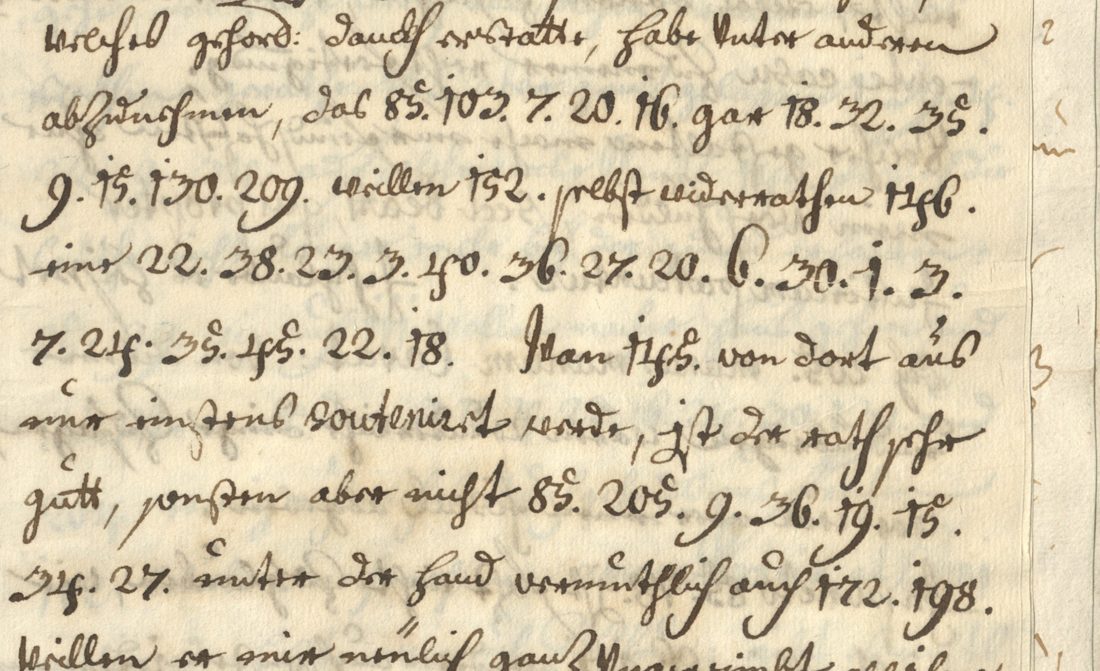
Five DECODE images: the first page (“Brüssel den 18. 9bris 721”, “Hochgebohrner Graf”), two openings, and the last page (seen from both sides). The text is ordinary German and French in clear; the secrets are written as dotted numbers in the line.
Mírka’s key gives each letter two numbers: A = 24 or 36, B = 12 or 48, C = 23 or 35, E = 22 or 34, and so on to Z = 1 or 37; the first column runs 24 to 1 down a fixed order of the alphabet, the second is the first plus 12 or 36. Numbers above 48 are a small nomenclator, of which he identifies 54 Althann, 85 der/dem, 86 die, 135 hat, 145 ich, 152 Kayser, 197 Plan, 198 Prinz, with guesses for 99 [Engländer?], 103 [Emp…?], 151 [K…?], 167 [Micosch?] and others.
02 The decipherment
Cipher in capitals, codes in brackets (open ones by number), cleartext around them in lower case.
- … dass der [103] MIR gar NICHT [130] [209] willen, [der] KAYSER selbst widerrathen [146] eine EXCUSATION ZU MACHEN.
- Wan ICH von dort aus nur einiges souteniert werde, ist der rath sehr gutt, sonsten aber nicht; DER [205] HALTET unter der hand, vermuthlich auch [172] PRINZ.
- [205] sicherlich gegen niemand davon melden wird … auch selbst DEM ALTHANN nicht. … Ich glaube es heisset bey [205]: manus manum lavat.
- In puncto DER [78] ist fast nicht zu glauben, wie nicht allein DIE [151?] sondern auch sonsten jederman DIE LIEBE vor [103] ia selbsten KAYSER täglich [164] VERLIEHRET, in ansehen, dass nach dem der curier endlich nach so langer zeit [172] DES PRINZ PLAN …
- ZU [225] angelanget; [103] selben schon über 2 monathe [182] [101] … KAYSER aber ganz gelassen ZUSEHE; auf solche weise könte ICH …
- DER [99: Engländer?] wie auch [111] wollen nacher haus gehen, und dörften als dan UNSER AN[…] [139] und [204] wenig rühmliches … ICH wirdt succumbiren, DER PRINZ gloriren, KAYSER aber will [168] VERLIEHRE[N] [78] und DIE.
- [181] [206] worden, welches der effect bald weisen solle … dass das [167] versprechen einen guten effect haben, sonsten will der Wartheimber nicht mehr zuhalten.
- … an eine Grentze SUCCESSION [182] zu gedencken ist mir umb so lieber, als ich mir ein principe d’honneur gemacht, solches nebst villen anderen ursachen hauptsächlich derumb NIE[H]EMAHLEN ANZUNEHMEN, damit [182] seine; ICH HAT DER PRINZ [206], umb dessen DIENSTE ZU [131], welches schändlich …
- (last page) … nur ZU [149] KAYSER GETH[A]N [131]. Ich bitte aber …
The writer, waiting for the Congress of Cambrai to open, complains that he gets no support; the Emperor himself advised an excuse; a patron [205] works under hand, perhaps with the Prince (Eugene); love for [103] is being lost daily, even by the Emperor, after the courier finally brought the Prince’s plan; the English [?] want to go home and “I shall succumb, the Prince triumph”. In clear, the Madrid courier has brought Pozobueno orders on the exchange of renunciations. The matter (Cambrai, Pozobueno, Beretti Landi) fits Ernst Friedrich, the imperial plenipotentiary at the Congress, better than Leopold Viktorin; DECODE’s direction is kept here but is worth checking against the hands.
03 What remains uncertain
- Open codes (33 groups): 78 (twice), 101, 102, 111, 130, 131 (twice), 139, 146, 149, 164, 168, 172 (twice), 181, 182 (three times), 204, 205 (three times), 206 (twice), 209, 225; and Mírka’s guesses 99, 103 (four times), 151, 167, not confirmed here. 205 is a person; 182 and 131 recur in the succession passage.
- Slips (grade C): “1.39.4” has a flourish that could be taken as 24 (ZUAEHE); decrypted as ZUSEHE. 45 (H) stands where A is wanted in GETHHN, and NIEHEMAHLEN has an extra H.
- All letter-spelled words are grade H: the key gives them without choice.
04 Sources
- DECODE R5029, record, images and the reconstructed key (xlsx) by Jakub Mírka, 2023.
- J. Mírka, “Raně novověká šifrovaná korespondence ve fondech šlechtických rodinných archivů Státního oblastního archivu v Plzni”, Západočeské archivy 2012, pp. 44–72 (not seen).
- Related here: Charles VI to Windischgrätz, 1720–1722 (a different cipher).
Transcription, key table and decoder: windischgraetz1721/.