01 The document and the key
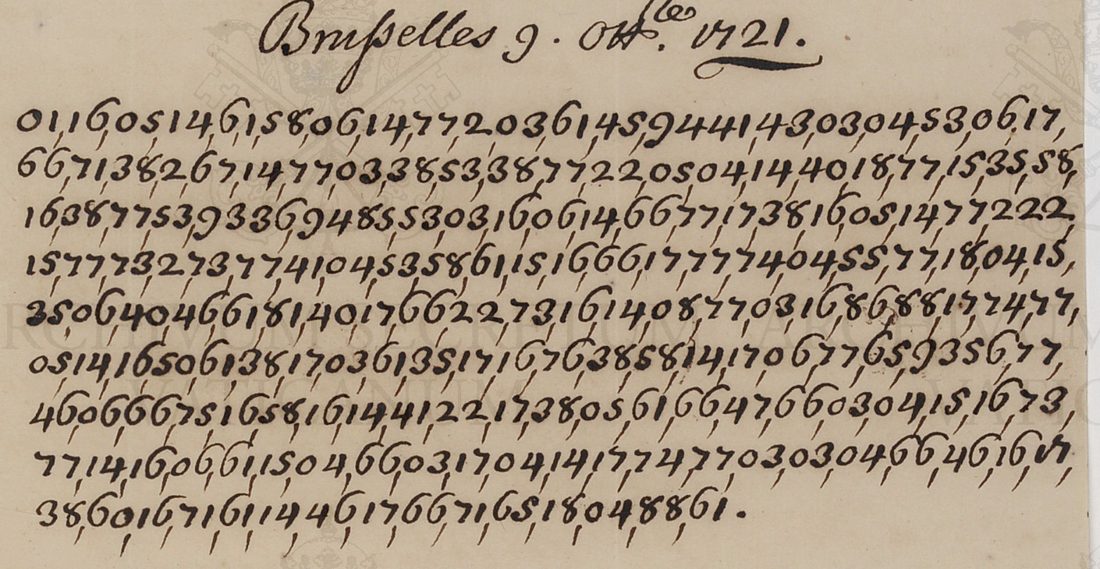
The leaf carries a clear dateline and nine lines of figures, 189 tokens separated by commas, with no address or signature. Brussels was then the capital of the Austrian Netherlands, and ecclesiastical business there went through the nunciatures, so the slip was probably sent by someone at Brussels to the nuncio at Cologne, in whose archive it is kept. Nothing on the leaf proves this.
The key, as Lasry rebuilt it, gives letters and a few syllables fixed homophones of one to three digits (a 6|77, e 04|40, i 17|71, o 16|61, r 14|41, s 01|38, che 35, di 53, ma 74). The nulls 2, 22 and 222 stand between words, and four-digit codes in the 9300s and 9400s stand for words or names. Because the groups are separated by commas, the text divides into units without ambiguity.
02 The decipherment
Brusselles 9 ott.re 1721.
Sopra il curato [45] [9441] [43]te divinis, g(rat)s di sapere qualche cosa di [9336] [9485] di Tournai. Sopra l’affare di Colonia, ma egli, a quel che vedo, ne è informato. Se stima a proposito che io [76] scriva in [9356] ad un suo corrispondente, lo farò volentieri, ma attendo i suoi ordini in questo.
“About the curate […] a divinis [suspended from his office?], [I would be] glad to know something of [9336 9485] of Tournai. About the Cologne affair: he, as far as I see, is informed of it. If you think it right that I write [76] in [9356] to a correspondent of yours, I will gladly do so, but I await your orders on this.”
Bonavoglia’s decipherment is the same, except where the values below change it.
03 Values added
- 18 = qu, not que. It occurs in qu-a-l-che, a qu-e-l che and in qu-e-st-o. With que every one of the three has a doubled e. Grade C.
- 55 = gli: “ma e-55, a quel che vedo, ne è informato”, ma egli. Grade C.
- 67 = g?: “67-r-a-t-s di sapere”, most likely grato with a slip in the last figure. Grade M.
- Lasry’s three queried values, 81 ne, 86 se and 88 st, each fit their context (ne è informato, se stima, questo) and are kept.
04 What remains open
- 45, 9441, 43 in “curato 45 9441 43-te divinis”. The phrase must be a suspension a divinis, perhaps with the curate’s parish, but none of the three occurs again, so no value can be confirmed.
- 9336 9485 in “di [9336] [9485] di Tournai”: probably a title and a name, perhaps the bishop.
- 9356 in “scriva in [9356]”: a place or a word such as cifra.
- 76 in “che io [76] scriva”: ne, le or gli would all fit.
- The sender and recipient are not named on the leaf. The other contents of Colonia 5 might identify them.
05 Sources
- Archivio Apostolico Vaticano, Arch. Nunz. Colonia 5, f. 26r, via DECODE R24 (one image; transcription by Callum, edited by BM, 2015, revised by Lasry, 2020).
- George Lasry, reconstructed key “ASV – C15” and segmented decryption, DECODE, November 2020.
- Paolo Bonavoglia, decipherment and English translation “based on key obtained with simulated annealing”, attached to DECODE R24.
The figures, the decryption script with Lasry’s key and the added values, and the decipherment are in colonia1721/.