

01 The record
Harley MS 260 is a fair-copy letter-book of Walsingham’s embassy in France, 1570–73, the book Digges printed. DECODE R8363 has three images:
- f. 398r, top: the end of a letter signed Frauncis Walsingham, “At Paris the 21th of Januarie 1572”. It covers the Cardinal of Lorraine bringing a dispensation from Rome for Monsieur to marry his niece, and Marshal Tavannes’s hope of recovery. CSP Foreign x calendars it between nos. 726 and 727 as “a copy of Mr. Secretary’s letter”. DECODE’s date and its blank recipient come from this tail.
- f. 398r–399v: “To the right hono[ra]ble and my verie good Lord the Lord Treasurer”, dated 20 January 1572/3 and signed. It concerns the Vidame’s man, who has not delivered two letters and some books; “Steward” (Colonel Stewart), gone to La Rochelle, who sent “a fond cipher” that Walsingham found “not for the purpose”; letters from Davison he cannot forward safely; and Walsingham’s reluctance to carry on as “a distributer of letters” for young and inexperienced parties.
02 The cipher
The whole of the cipher is the last two lines of f. 398r:
The matter of most importance conteyned in the same was touchinge a Gentleman of [9] departed hence to 2 1 ⌘ ε 9 4 wth intention to imbarke there yf the barke were not departed.
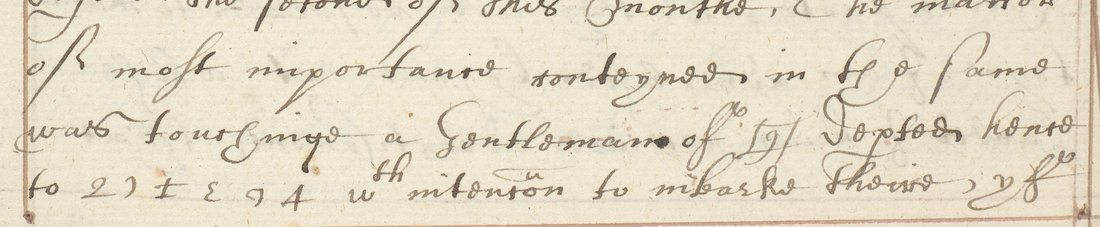
The copyist writes [9], a bracketed flourish, wherever the original had a cipher name he did not copy. It stands for other names in R8362 (“longeth to heare from Lyons [9]”) and R8364, and Digges prints it as “[7]” or “[s]”. The six symbols 2 1 ⌘ ε 9 4 were copied, and Digges set them as “2 ) ⌘ 6·) 4”. Burghley’s answer in the same book (f. 419r, DECODE R8364, February 1572/3) has one group in the same system: “a Shipp sent to 2 0 ⌘ H 6 1 tt ymagined that Ball there had a meaninge to provoke Glasco [9] to come hither”. Both groups start with 2 and have ⌘ third.
03 What was tried
- Print. Digges 1655 pp. 312–313: the cipher printed as cipher. CSP Foreign x, January 1573: no. 725 (Walsingham to Burghley, 20 Jan) opens with the Vidame’s servant but goes on to a book defending the Queen of Scots and to Dr Dale, and does not include the passage. The signed original in SP 70 was not seen.
- Keys. DECODE has no key record from Harley 260 and no Walsingham key before 1577. Tomokiyo’s survey of Elizabethan ciphers has none for Walsingham’s Paris embassy. The Cecil–Norris table of 1567–68 (see norreys1567) turns the group into “r a ? ? i p”.
- Siblings. The nine Harley 260 records on DECODE (R8356–R8364) were fetched. The two from the same weeks were examined: R8362 has placeholders only, and R8364 has the one group above.
- Ciphertext only. Twelve symbols of nine kinds. Under a homophonic alphabet of digits and signs, Dieppe, Calais, Nantes, Brest(e) and Rouen(s) can each be made to fit both groups. A gentleman leaving Paris to catch a ship points to a Channel port, Dieppe likeliest, but that is a guess (grade I).
04 What remains open
- The port “2 1 ⌘ ε 9 4” is not deciphered. It is too short, and no key survives.
- The name behind “[9]” was never copied into the book. Only Walsingham’s signed original in SP 70, if it survives, could show it.
05 Sources
- British Library, Harley MS 260 ff. 398–399, 395, 419: DECODE R8363, R8362, R8364 (images by login; one crop of f. 398r reproduced above).
- Dudley Digges, The Compleat Ambassador (London, 1655), pp. 312–313: archive.org.
- Calendar of State Papers, Foreign, Elizabeth, x (1572–74), January 1573, no. 725: British History Online.
- S. Tomokiyo, “Ciphers in Elizabethan England”, cryptiana (elizabeth.htm).
Notes, the transcription of the two groups and the profile are in walsingham1572/.