01 What the record is
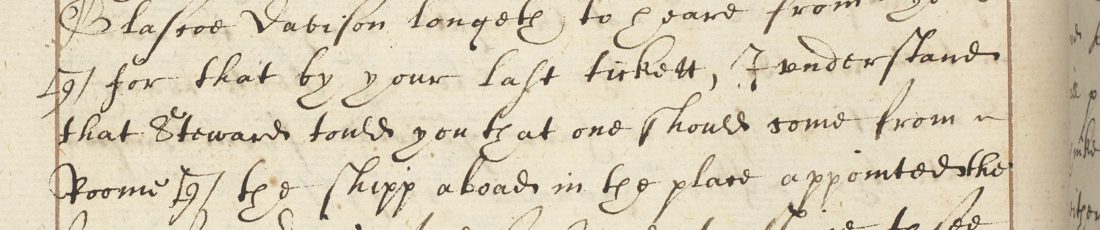
The page carries the running head “Januarie 1572”. The letter is copied in the same hand as the rest of the register, so this is the letter-book copy, not the letter as sent. DECODE made two misreadings. It read the day as 27 when the page has “24th”, and it left the recipient unknown although the register belongs to Walsingham. The address at the foot of the page, “To my verie …”, is cut off at the page end.
02 The letter
Burghley writes that he is “sorie and ashamed” that he cannot yet send anything that settles Walsingham’s own case, his recall from France. He promises to keep working for it. He leaves news of Lord Worcester’s journey to the Secretary. Then he comes to the business of the cover-names:
Glascoe Davison longeth to heare from Lyons [9] for that by your last tickett, I understand that Steward tould you that one should come from Roome [9], the shipp abode in the place appointed the space of 23 daies. And soe I end, trusting to see you here amongst your frinds within this sixe weekes at the leaste to bee revoked by that tyme. From Westm the 24th of Januarie 1572. Your assured frind William Baurleighe.
“Tickett” is the separate slip on which Walsingham sent his secret news. The same plot about a ship, Steward, Glasgow and the Rome/Florence party runs through the letters of November 1572 and February 1573 in this volume (R8361, R8364).
03 Why the boxed 9s are not cipher
In the Harley 260 letters that Digges printed, boxed digits appear directly after a place name: Florence [9], Rome [9], Glasgow [7], and in February 1573 both “Glasco [9]” and “Glasco [g]”. The same cover-word takes different digits, so the digit does not encode a value. The box flags the word before it as a cover-name for a person. In R8362 both boxes follow place names, Lyons and Roome, and the sentence makes sense without them. That accounts for both marks; the page has no others.
04 What remains
- Who is meant by “Lyons” and “Roome”. “Glascoe” is most likely the Archbishop of Glasgow, Mary Queen of Scots’ ambassador in Paris. The other two cover-names are never glossed. This is a question of historical identification, not of cipher.
05 Sources
- British Library, Harley MS 260 f. 395r, via DECODE R8362 (image, login).
- Dudley Digges, The Compleat Ambassador (London 1655), the letter headed “To the Right Honourable Francis Walsingham Esq; Ambassador Resident for her Majestie in France”.
- Sibling records in the same volume: R8361 (November 1572) and R8364 (February 1573).
Notes, transcription and profile: r8362/.