At a glanceNot solved · 0 of 717 code groups
- The letter
- An unsigned letter in German to Prince Carl August Friedrich of Waldeck-Pyrmont. His draft reply on the back answers a letter of 18 January, so it dates from January 1744.
- Where
- Hessisches Staatsarchiv Marburg, HStAM 118 a Nr. 3954, ff. 3r–4r, filed as “Militärische Nachrichten für Fürst Carl August Friedrich (in Chiffre)”; HCPortal record 517, “not solved”.
- The cipher
- 717 dotted groups from 4 to 999, 303 of them different. It is most probably a two-part homophonic nomenclator: a numbered list of letters, syllables and words in no alphabetical order, with several numbers for common entries.
- How it was tried
- The file, the Waldeck papers and the Marburg keys on HCPortal and DECODE were searched for a key. Letter, alphabetical and nomenclator solvers were each tested first on synthetic letters of the same size.
- Why it resists
- On a synthetic two-part nomenclator of this size, wrong keys score better than the true one. One letter does not determine the key.
- Still open
- The whole text. A key or a deciphered copy could be in the undigitised volumes on the 1744 campaign in the same fonds (118 a Nr. 1973–1980).
01 The letter and its reply
The file holds one letter on two leaves. Folio 3r is headed, in a flourished hand, Durchlauchtigster Fürst, then Ew. H. Dl. (Euer Hochfürstlichen Durchlaucht) in clear, then nineteen lines of numbers. A later hand has written “1744” in the corner. Folio 4 is a narrower leaf with twenty-six more lines. Ew. H. Dl. appears once more in clear, in its seventeenth line. There is no signature and no date. The back of folio 3 carries a docket that was never finished: “Schreiben an [blank] in Ziffern”.
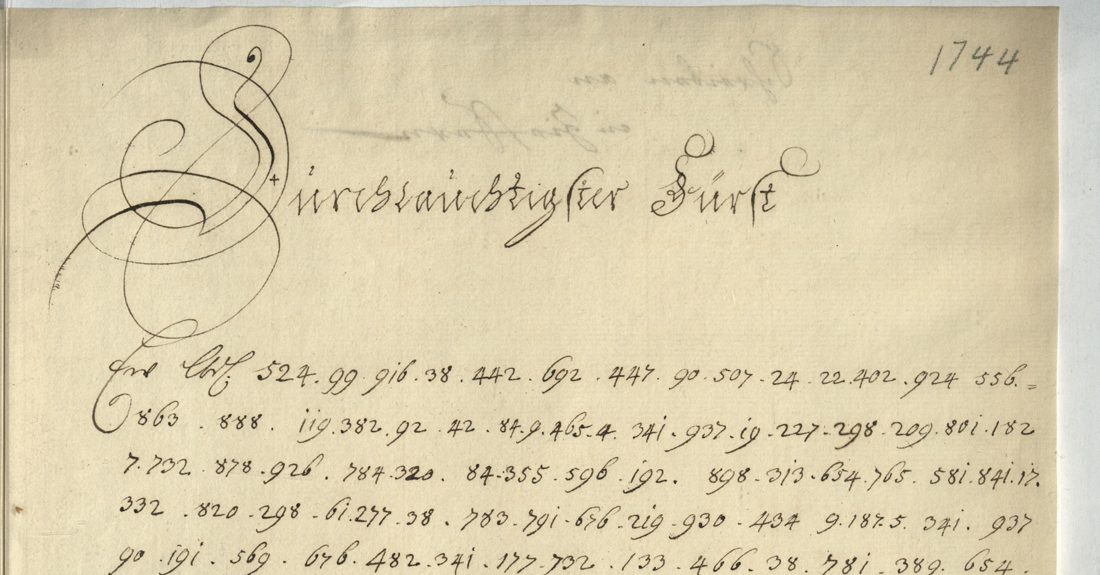
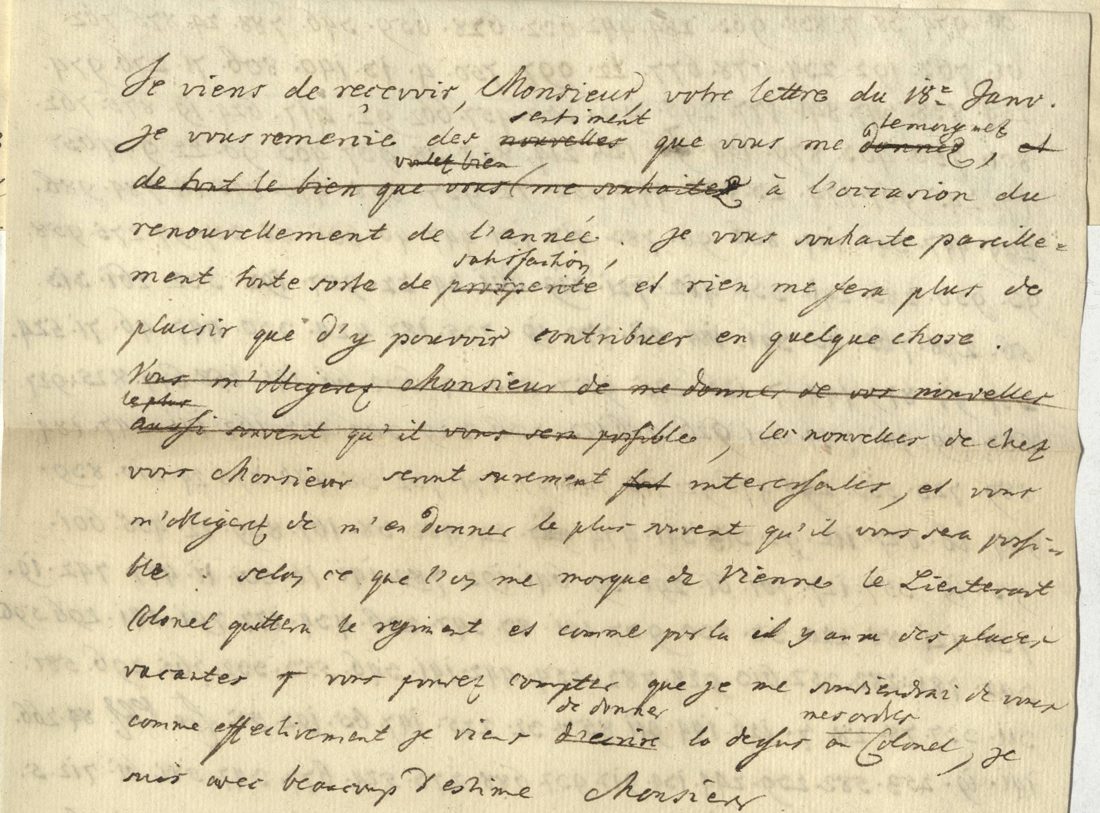
556.= with the German hyphen, so a word runs on to the next line and the code has units smaller than words. Image: Hessisches Staatsarchiv Marburg, HStAM 118 a Nr. 3954 f. 3r, via Arcinsys Hessen (image 0003) and HCPortal record 517.The back of folio 4 was used for the prince’s reply, drafted in French and corrected as it was written. It opens: “Je viens de recevoir, Monsieur, votre lettre du 18e Janv.” He first thanked his correspondent “des nouvelles que vous me donnez et de tout le bien que vous me souhaitez à l’occasion du renouvellement de l’année”, then shortened the thanks to the New Year wishes alone. He asks for news “de chez vous” as often as possible. Vienna reports that the lieutenant-colonel will leave the regiment, and he promises to remember his correspondent when places fall vacant.
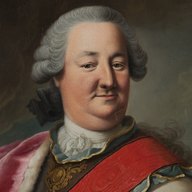
Carl August Friedrich (1704–1763) owned an Imperial infantry regiment from 1739. He was an Imperial Feldzeugmeister and, from 1742, a general of infantry in Dutch service. In 1744 he served with the Austrian army, and in 1745 he commanded the Dutch at Fontenoy. The writer’s place is not named. The prince’s interest in news “de chez vous” suggests a court or army he could not see from his own.
02 The code
The two pages were transcribed here from full-resolution crops of the scans: 45 lines, 717 groups, 303 of them different and 144 used once. The groups run from 4 to 999; 19 have one digit and 133 two. They are separated by dots, dashes or bare spaces with no pattern. The second leaf writes 2 as a z-shaped figure, and its 5 ends in a hook that can look like a colon. The commonest groups are 19 and 141 (14 times each), 38 and 341 (13), 24 (11), and 7 and 937 (10).
Two features fix the kind of system. The sequence 879.144.X.126 occurs four times, with X = 90, 7, 7 and 924. In its second occurrence the writer began a 9, struck it through and wrote 7 above. These are several numbers for one entry, chosen at will: homophones.

879 . 144 . 9 7 . 126. On f. 3r the same phrase has 90 in this place, and on f. 4 l. 20 it has 924. Image: Hessisches Staatsarchiv Marburg, HStAM 118 a Nr. 3954 f. 4r, lines 4–6, via Arcinsys Hessen (image 0004).Second, 303 different groups in 717 are too many for a letter cipher of the period, which gave each letter three to six numbers. A letter alphabet of about 130 numbers could not produce them. The table must also hold syllables and words, as the line-end hyphen already showed.
03 Which kind of table
A one-part code lists its entries alphabetically with the numbers rising, so its usage piles up where frequent German entries fall (die, der, the e- and ge- syllables, und). The share of text carried by each stretch of numbers was compared with that profile, built by encoding 1740s German with a sorted syllabary. Random numberings of the same counts give the baseline.
| Numbering tested | Fit to German (lower is better) | Random numberings | Verdict |
|---|---|---|---|
| alphabetical, 1–999 | 0.192 | 0.077 | rejected |
| letters in 1–99, alphabetical 100–999 | 0.149 | 0.077 | rejected |
| columns by last digit, as in the Hessen-Kassel keys of 1723 and 1720–30 (best of 20 orders) | 0.057 | 0.047 | no support |
| multiplicative scrambling n = a·p mod 1000 (best of 400) | 0.038 | 0.036 | no support |
Nothing in the numbering behaves alphabetically. A two-part design fits: letters with about four scattered numbers each, some six hundred syllables and words with one number each, as in the Hessen-Kassel key of 1730 for Hanoverian correspondence (HStAM 4 d Nr. 1229). A synthetic letter encoded that way gives 310 different groups, 146 used once, a commonest group of 14, and 93 groups used three times or more carrying 429 tokens. The letter to Waldeck has 303, 144, 14, and 85 carrying 425. It departs only in its heavy use of numbers under 100, which fits a clerk who took the first number listed for an entry.
04 What was tried
A language model of 1740s German was built for this letter from 202 texts of 1724–1767 in the Deutsches Textarchiv: Berlin newspapers of 1737–41, the Hamburgischer Correspondent and military manuals, 23.6 million letters. Every solver was run first on synthetic letters of the same size whose key is known.
| Attack | On the synthetic control | On the letter |
|---|---|---|
| Letter-by-letter homophonic annealing (5-gram) | Gibberish scores as well as or better than the true text | Best score in the same range, no two runs agree |
| The same with a dictionary word score added | True key scores highest, but 12 runs of 20 million moves and heat-bath sampling stop short of it | — |
| Alphabetical-table annealers (after the van Swieten solve), with letters free under 100, column orders, heat-bath sampling | True key highest only at a low letter bonus; searches stall below it | Fragments of words, no sense |
| Two-part nomenclator assignment | True key −1284 against wrong keys found at −255 (bonus 1.0), −1934 against −1060 (bonus 0.6) | Not run: the control shows the answer would not be identifiable |
The last row settles it. For a two-part code of this size, the language model rates many wrong keys far above the true one, whatever the allowance for longer units. A search that reached the true key could not recognise it. The probable New Year wish cannot be used as a crib either, because in a two-part code the unit boundaries are unknown.
05 Where a key could be
No other cipher item is catalogued in the Waldeck cabinet papers (118 a) or in any Waldeck fonds after 1646. The two older Waldeck ciphers, of 1638 and 1646, are simple letter substitutions. HCPortal’s Marburg records and its 319 keys have nothing for Waldeck in the 1740s. DECODE lists 112 Hessen-Kassel keys of 1710–1799 from Marburg; the German ones examined (4 d Nr. 1229, 1231 and 1237) do not fit this letter. The volumes where the correspondence of January 1744 would sit are not digitised. These are 118 a Nr. 1973–1980, “Akten betr. den Feldzug von 1744” (volume 1 covers January to May), the prince’s wartime correspondence (Nr. 1969–1972, 2044) and the officers’ applications of 1745–1750 (Nr. 2047). The prince’s reply shows that his chancery could read the letter. A deciphered copy, or the key itself, may survive among them.
06 Sources
- Hessisches Staatsarchiv Marburg, HStAM 118 a Nr. 3954, eight images on Arcinsys Hessen (0003–0004 the cipher, 0005 the draft reply, 0006 the docket).
- HCPortal, cryptogram 517 (Eugen Antal, 2025), crypto.hcportal.eu; API record
api.hcportal.eu/api/cryptograms/517. - Hessen-Kassel keys: HStAM 4 d Nr. 1220 f. 12 (1723) and Nr. 1231 (1720–30) on HCPortal; Nr. 1229 (DECODE R4680) and Nr. 1237 (R4741, R4742) on DECODE.
- C. von Wurzbach, Biographisches Lexikon des Kaiserthums Oesterreich 52 (1885), pp. 174–175, “Waldeck, Karl August Friedrich Fürst” (Wikisource).
- Deutsches Textarchiv, texts of 1724–1767, for the language model
de-1740s.
Everything is in targets/waldeck1744/ in the project repository: the transcription (trans_p1.txt, trans_p2.txt, ct.txt), the statistics and ordering tests (stats.py, cdf_test*.py), the synthetic controls (synth*.py), the solvers (hsolve*.cs, hgibbs.cs, msolve*.cs, gsolve.cs) and NOTES.md, which holds the full record of the attempt.