At a glanceKey recovered from the ciphertext alone · partial · 521 of 529 cipher tokens
- The letter
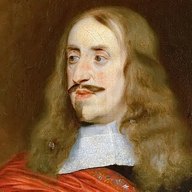
- Archduke Leopold Wilhelm, governor of the Spanish Netherlands, to his chaplain Mercy, from the camp at Barneton, 6 June 1648: whom to see, what to ask the Elector of Brandenburg, and how fast.
- Where
- Bibliothèque nationale de France, Espagnol 144 (formerly Supplément français 1257C, tome III) f. 22r–v, finding-aid item 11, “Autre instruction chiffrée pour l’abbé de Mercy”. Not in the catalogue and not on DECODE; it reached us as GitHub issue 16.
- The cipher
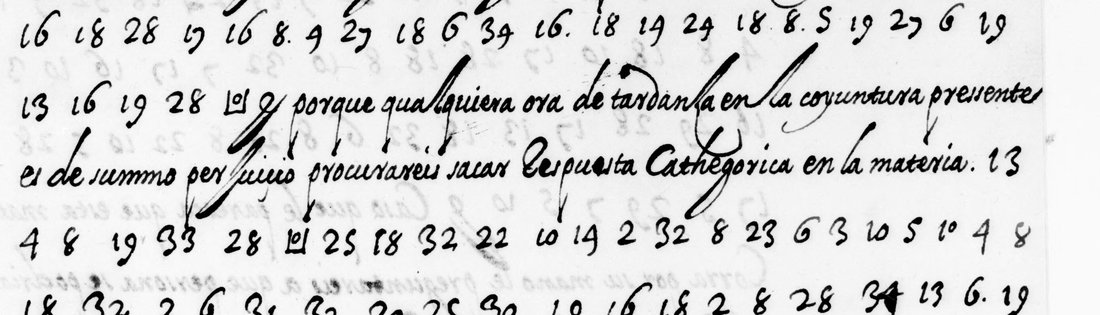
- Letter by letter in the numbers 2–34, one to three numbers for each letter, no word division, in runs inside the clear Spanish; one extra sign (a square with a dot) for a name.
- How it was deciphered
- NoAutopilot (cipher-lab) recovered the key by annealing on Spanish n-grams, with no plaintext. Here the transcription was checked on the images and corrected in eight places, and the name sign and a named official were identified from the clear instructions on the two leaves before.
- What it says
- Get a categorical answer from the duchesse de Chevreuse and have Saint-Ibal come back with Mercy; then go to Cleves and ask the Elector of Brandenburg and his chief chamberlain whether 3,000 infantry can be raised in his lands, in two or three regiments, and by whom.
- Still open
- Eight tokens in the middle of the verso (code 15 twice, “t non”), and the letters lost where the right edge of f. 22v is trimmed.
- Credit
- The transcription, the key and the reading of the cipher runs are NoAutopilot’s (issue 16, cipher-lab); the corrections and the identifications on this page are ours.
01 The leaf and the two before it
Item 11 of Espagnol 144 is the last of a small series for the abbé (baron) de Mercy, the Archduke’s chaplain and agent in the intrigue between the Spanish Netherlands and the French malcontents of the early Fronde. Item 8 is a French memoir of September 1647 on his journey to Holland with the comte de Saint-Ibal and the duchesse de Chevreuse; items 9 and 10 are two instructions in clear Spanish, of 8 February and 13 April 1648, written for him from Brussels. The third, the one in cipher, is dated “Barneton a seis de Junio de 1648”, from the field, the summer the Archduke took the army out.
The two clear instructions matter here, because they name the same people in clear. On f. 20r (8 February, signed “Leopoldo Guillermo” and by his secretary Juan de Galarreta) Mercy is to meet the duc de Longueville on his way home from Münster, where “el Conde de S. Ibal” may come with him. On f. 21r (13 April), for the journey to Kerpen to meet “la Duquessa de Cheurossa y el Conde de Sant Ibal”, the Archduke writes the sentence that settles the first open question of the cipher:

That is the sentence the cipher repeats seven weeks later: “que el [box] uenga con uos para que nos informe della”.
02 The cipher
The numbers run from 2 to 34 and each is a letter; the same letter has up to three numbers, and the vowels a, e, i, o, u have three each:
| a | b | c | d | e | f | g | h | i | l | m | n | o | p | q | r | s | t | u | y |
|---|---|---|---|---|---|---|---|---|---|---|---|---|---|---|---|---|---|---|---|
| 10 17 34 | 12 | 14 | 16 | 18 19 33 | 20 | 22 | 24 | 21 26 31 | 28 | 30 | 32 | 2 23 29 | 3 | 4 9 | 5 | 6 | 7 | 8 25 27 | 13 |
There is no letter for j, k, ñ, v, w, x or z (u is written for v), doubled letters are written twice, and the runs have no word division. One extra sign, a square with a dot, stands for a name. The Spanish clerk, as on the clear leaves, wrote “Cheureuse” for Chevreuse and “Cleues” for Cleves, and spelled them out letter by letter. The table above is NoAutopilot’s, recovered from the numbers alone; every value reads in Spanish in the text below, and the common ones (18, 5, 32, 6, 10) are the commonest numbers in the leaf.
03 The transcription, checked on the images
The 522 tokens of the contributor’s transcription were compared with the full-resolution Gallica images line by line, with crops at native resolution for every doubtful glyph. They agree except in eight places:
| Where | They had | The image | Reading |
|---|---|---|---|
| f. 22r line 24 | 65 | 6 5, touching | tre s regimientos: s, r |
| f. 22r line 17 | 52 | 5 2 | camer o: r, o |
| f. 22r lines 17, 20 | 48 | 4 8 | para quien se os embian; que si se permitira |
| f. 22r line 16 | 72 | 7 2 | burgstorf: t, o |
| f. 22r lines 18, 24 | 26 | 2 6 | se os embian; regimientos y |
| f. 22v line 1 | 19 | an open 14 | y al camarero |
The key has values 2 to 34 only, and 2 to 9 are single digits, so a token above 34 can only be two digits written together. The contributor’s four “uncertain codes” (48, 52, 65, 72) are therefore not codes at all, and with them the number of tokens goes from 522 to 529. 26 stays a letter, i, where it reads (propondreis, pais, permitira, que si se). The contributor had already seen five more places where a 14 with an open 4 looks like 19, and settled them by sense; the image supports each. Two more tokens are re-cut by sense and graded M: in line 10 a tight 25 as 2 5, and a 2 and an 8 that stand apart as one 28, which turn “infume de oulay” into “informe della y”.
Every line of f. 22v is also cut at the right edge, by about four or five digits; the clear lines are cut too (“no con[venga]”, “encargar p[ara]”). Where the loss falls inside a word, the sense restores it (camare[ro], encarga[r s]e, por su [ma]no, pag[an]dola, cons[ig]uiese, tener [tan]ta gente); these 18 letters are marked and not counted as read.
04 The reading
Spanish as the clerk wrote it, the cipher in bold, brackets for letters lost at the edge or supplied:
Baron de Mercy mi Sumiller de Cortina deseo tener Resolucion de la negociacion que fuisteis por lo que conviene saver lo que se puede esperar della Respeto de las operaciones que se deven saver: 24. (H)alandose estas armas en campagna y asi Holgare me digais lo que en esta razon saueis entendido de la duquesa de Cheureuse y del [Santibal], y porque qualquiera ora de tardança en la coyuntura presente es de summo perjuicio procuraveis sacar Respuesta Cathegorica en la materia. Y que el [Santibal] uenga con uos para que nos informe della y sepamos Con fundamento lo que nos podemos prometer y Caso de no estar en estado y que es necesario esperar algun tiempo para poder dezir determinadamente el que tiene esta negociacion y lo que se puede confiar della, pasareis a Cleues a veros con el elector de Brandenburg y con Conrad von Burgstorf su camarero mayor para quien se os embian cartas de creencia que uan con esta y les propondreis que si se permitira se leuanten en aquel pais tres mil hombres de infanteria en dos o tres regimientos y con que condiciones y al camarero mayor si querra encargarse della y que corra por su mano no la dire?t non y si i u? a sera mas conuenient[e …]ar otra tanta gente de […] que a leuantada pag[an]dola y en su lugar leua[nt]ar otra. Y Caso que le paresca que esta materia no convenga Corra por su mano le preguntareis a que persona se podria encargar para que se pudiese caminar en ello sin perder tiempo, y se cons[ig]uiese el fruto de tener [tan]ta gente. En todo os encargo la brevedad porque qualquiera dilacion que aya es summamente danosa y de nuestro zelo fio aten… a ello con el Cuydado que Conviene vos encargo. Barneton a seis Junio de 1648.
In English: Baron de Mercy, my chaplain: I want a decision on the negotiation you went on, because it is important to know what can be expected of it concerning the operations … The armies being in the field, I shall be glad if you tell me what you have understood on this matter of the Duchess of Chevreuse and of Saint-Ibal; and because any hour of delay at this juncture is most harmful, get a categorical answer on the subject, and have Saint-Ibal come with you, so that he may inform us of it and we may know firmly what we can promise ourselves; and if it is not ready and one must wait some time before saying what this negotiation holds and what can be trusted of it, go to Cleves to see the Elector of Brandenburg and Konrad von Burgsdorff, his chief chamberlain, for whom letters of credence go with this, and put to them whether it will be allowed to raise in that country three thousand foot in two or three regiments, and on what conditions, and whether the chief chamberlain will take charge of it and have it run through his hands … [if it is more convenient to … as many people again as he has raised, paying them, and raise others in their place]. And if it seems to him that this matter does not suit, ask him to whom it could be entrusted, so that one can go ahead without losing time, and the fruit of having so many people be got. In everything I charge you with haste, because any delay is most harmful, and I trust in your zeal that you will see to it with the care it needs. Barneton, 6 June 1648.
The substance matches the one printed source that the contributor found: Lonchay, Cuvelier and Lefèvre, Correspondance de la Cour d’Espagne IV no. 183 (1933) calendars the Archduke’s dispatch to Philip IV of June 1648 as reporting that someone had been asked to ask the Elector of Brandenburg whether 3,000 infantry could be raised in his states for a corps to operate in Flanders. The text of the instruction itself is in neither.
05 The two names
The box. A square with a dot occurs twice, both times after “el”, in the sentence that Mercy is to bring “the [box]” back with him; the clear instruction of 13 April asks exactly that of Santibal. The sign is the comte de Saint-Ibal, the duchess’s partner in the plot (item 8 of the volume is the memoir of the journey “entre luy, le comte St Ibal et Madame la duchesse de Chevreuse”). Grade C, adjacent plaintext. The duc de Longueville, the subject of f. 20r, is not named in this instruction.
The chamberlain. After “el elector de Brandenburg y con” the cipher gives copurad lon burgsto rf su cmarero mayor (with 5 2 read as r o). That is Konrad von Burgsdorff (1595–1652), Oberkammerherr, “camarero mayor”, of Elector Friedrich Wilhelm from 1642 and his closest adviser: burgstorf is exact but for d written t, rad and on are exact, the part before is two letters off (copu for con, l for v), and the writer drops an a in cmarero. The same title comes back at the top of the verso, “y al camare[ro] mayor si querra encargarse della”. Grade I.
06 What remains uncertain
- The middle of the verso, “no la dire?t non y si i u?” (line 4, eight tokens): code 15 occurs twice and has no value; a Spanish word model finds “no la direct- … y si una sera mas conveniente” at best, by moving two glyphs, which is not accepted.
- At two line ends on the verso (“conuenient[e ?]ar otra”, “gente de [?] que a leuantada”) two to three letters are lost with the edge and cannot be restored.
- 27 tokens are graded M: the 14 for 19 glyphs, the re-cut tokens, and the first two letters of “co p u r a d” in the chamberlain’s name (copu for con). The name sign is grade C; the other 498 are I, from the ciphertext-only key.
- “Saint-Malo” and “Péronne” for the governors on f. 21r are guesses, and do not touch the reading.
07 Sources
- Bibliothèque nationale de France, Espagnol 144, Gallica btv1b10035717h, f. 22r–v (canvases 58–59), ff. 20r–21v (54–57).
- BnF, Archives et manuscrits, Espagnol 142–144, items 6–11.
- NoAutopilot, espagnol142-mercy-1648 (transcription, key, reading, grades, search log), and GitHub issue 16 (30 September 2026).
- Lonchay, Cuvelier and Lefèvre, Correspondance de la Cour d’Espagne sur les affaires des Pays-Bas au XVIIe siècle IV (1933) no. 183 p. 71 (cited by the contributor); H. Lonchay, La rivalité de la France et de l’Espagne aux Pays-Bas (1896) p. 445 n. 2, Internet Archive.
- Konrad von Burgsdorff: ADB; Wikipedia.
Transcription, key, reading and the scripts: targets/mercy1648/.