At a glanceKey from adjacent plaintext · 169 of 169 signs
- The document
- A copy, made for the Hessian authorities, of a secret message headed “Snell an A?ud”, dated 20 February 1824 on HCPortal. The original was written in sympathetic ink between the lines of a harmless letter.
- Where
- Hessisches Staatsarchiv Marburg, HStAM 9 a Nr. 259, f. 249. HCPortal record 513 lists it as a polyalphabetic cipher, not solved.
- The cipher
- A Vigenère table without j. The key letters b c d e f g are written over the signs again and again, and shift the letter by 2 to 7. Past z the cipher alphabet runs on into the digits 1, 2, 3, 4.
- How it was deciphered
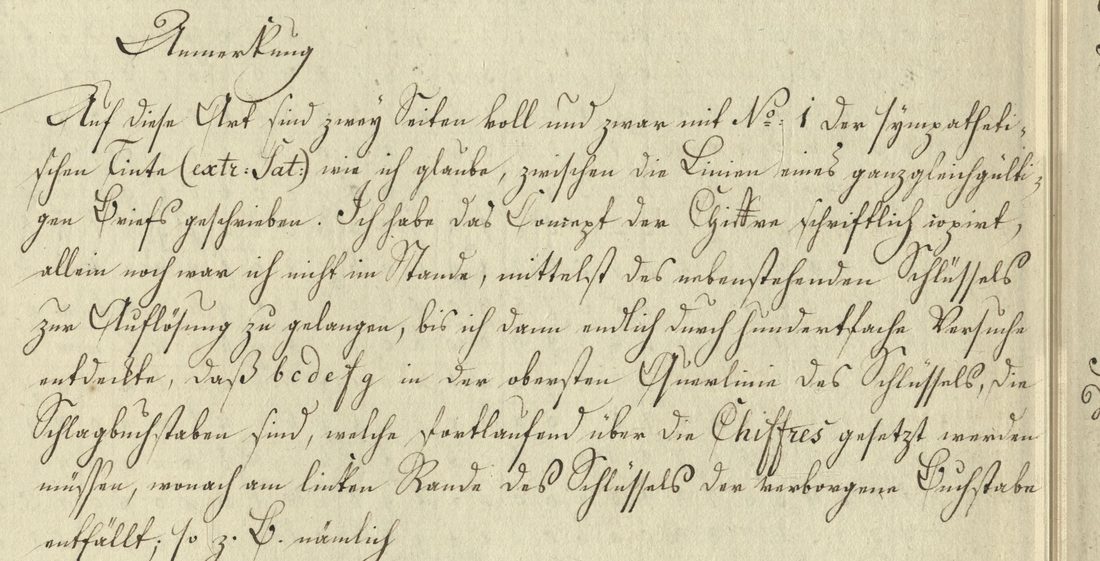
- The decipherer’s note on the same leaf gives the key letters and the first word. The rest of the table, the digit signs and the copyist’s slips were worked out here.
- What it says
- Send Lisching or someone else; if not, answer: what has Paul Follen heard about America from Fries, Oken and de Wette, and did “the discovery of this plan in Wetzlar” have consequences?
- Still open
- Nothing in the cipher. The addressee’s name in the heading is not made out, and Lisching is not identified.
01 The leaf and the decipherer’s note
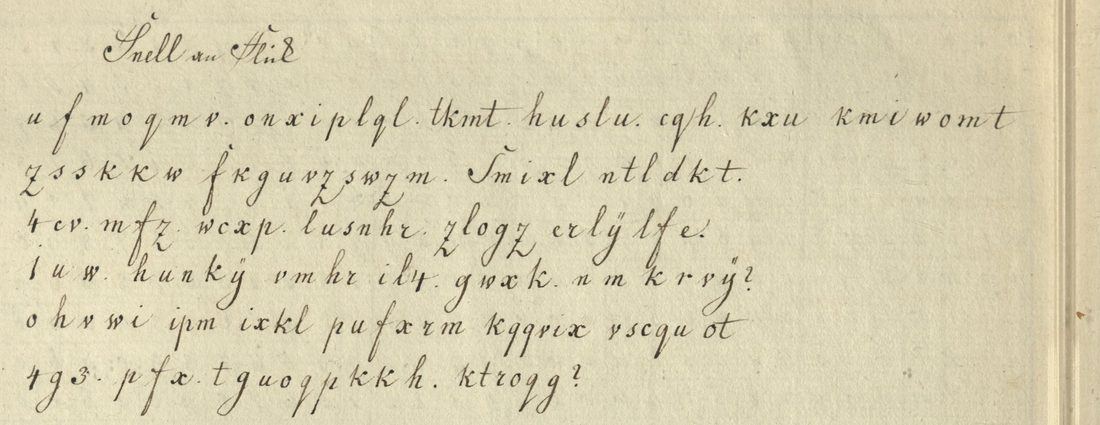
The leaf is not the letter itself. Below the six lines of cipher, the official who copied it wrote an Anmerkung (note) in Kurrent script. He says the message filled two pages, written “with No. 1 of the sympathetic ink (extr. Sat.), I believe” (lead acetate) between the lines of an innocent letter. He had copied the cipher and had a key table beside it, but at first could not use it. After “a hundred attempts” he found that the letters bcdefg along the top of the table are the key letters, written one after another over the cipher. The hidden letter is then read at the table’s left edge.
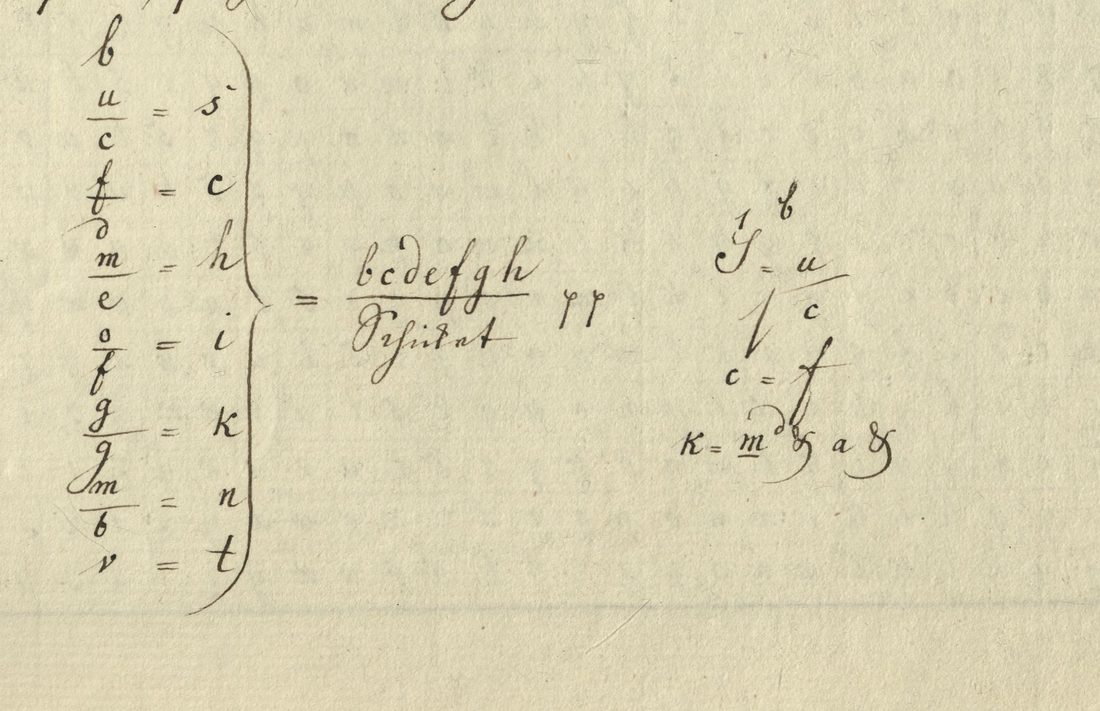
He then works the first word. Key b over cipher u gives s, c over f gives c, d over m gives h, e over o gives i, f over g gives k, g over m gives e (a Kurrent e, which looks like an n), and b again over v gives t: schiket. His table is not on the image, and his decipherment of the rest is not on the leaf.
02 The cipher
The seven pairs fit a Vigenère table on a 25-letter alphabet without j. Key b shifts the letter by +2, c by +3, and so on to g, which shifts by +7. That leaves one puzzle: the pair f over g = k. The shift for f is +6, and k + 6 is q, not g. The copy has two tailed letters, one straight (q) and one looped (g), and the copyist confuses them. The decipherer’s “g” is the straight one, q.
The digits are the second find. The cipher contains 4 three times, 1 once and 3 once. “il4 gwxk” decrypts to “de ?ette”: de Wette. Counting a as 0, w is 21 and z is 24; w under g is 21 + 7 = 28, four places past z. So the table does not wrap round from z back to a; each column runs on into the signs 1, 2, 3, 4. With that rule every digit falls into place: each 4 is w under g, the 3 is z under c (Wezlar), and the 1 is v under e (von). The digits take a key letter like any other sign; the dots between words do not.
| Key | b | c | d | e | f | g |
|---|---|---|---|---|---|---|
| Shift | +2 | +3 | +4 | +5 | +6 | +7 |
| a → | c | d | e | f | g | h |
| w → | y | z | 1 | 2 | 3 | 4 |
| z → | 2 | 3 | 4 | 5 | 6 | 7 |
03 The decrypted text
Cipher and reading, line by line. Letters in braces are copy slips, where the sign as written decrypts to the wrong letter; the note in the Method section lists them.
ufmoqmv.onxiplql.tkmt.huslu.cqh.kxu kmiwomt
schiket  lisching oder e{i}nen andern  hierher

zss·kkw fkguvzswzm.fmixl ntldkt.
wo{n}icht beantworte  diese fra{g}en.

4cv.mfz.wcxp.lusnhr.zlogz erlylfe.
was hat paul follen {w}ege{n} america.

1uw.hunky vmhr il4.gwxk.nm krvy?
vo{n} fries oken de w ette ge hort?

ohvwi ipm ixkl pufxrm kqqrix vscqu ot
hatte die {a}uff indung die{s}{e}s plan{s} in

4g3.pfx.tguoqpkkh.ktroqq?
wez lar  merkliche folg{e}n?
Schicket Lisching oder einen andern hierher; wo nicht, beantworte diese Fragen. Was hat Paul Follen wegen America von Fries, Oken, de Wette gehört? Hatte die Auffindung dieses Plans in Wezlar merkliche Folgen?
In English. Send Lisching or someone else here; if not, answer these questions. What has Paul Follen heard from Fries, Oken and de Wette about America? Did the discovery of this plan in Wetzlar have any noticeable consequences?
The names place the message in the persecution of the “demagogues” after 1819. Jakob Friedrich Fries and Lorenz Oken at Jena and Wilhelm de Wette at Berlin had been removed from their chairs; de Wette taught at Basel from 1822. Paul Follen was the brother of Karl Follen, who taught at Basel with Wilhelm Snell and sailed for America at the end of 1824. Wilhelm Snell had fled to Basel in 1821. His brother Ludwig Snell was suspended as rector of the Wetzlar gymnasium in 1820 and dismissed in 1824. The leaf does not say which Snell wrote; the Wetzlar question points to Ludwig, and Basel to Wilhelm. What “this plan” was is not stated.
04 Method
The HCPortal record gives one image at 2928 × 4416 pixels. I transcribed the cipher line by line from crops: 169 signs, 164 letters and five digits. A plain Vigenère decryption with shifts +2 to +7 read the first line straight away (“schiket lisching oder e?nen andern hierher”) and then drifted. Trying the six key phases on each word brought out “beantworte diese fragen”, “paul follen”, “america”, “fries oken” and “merkliche folgen”. An automatic search that let the key phase slip, scored by how German the result looked, was too noisy to help. The drift went away once the digits were counted as signs (“de Wette”). One real break in the key phase remains, at the start of line 2. There the copyist left out a sign: z s s k k w stands for z s s p k k w, “wo nicht”.
Otherwise the copy has 11 wrong signs in 8 words. Most are look-alike letters in this hand: u for n (einen), d and l swapped (fragen), z for 2 and z for q (wegen), w for u (von), i for c (Auffindung), q for g and r for v (dieses), u for w (Plans), and q for g (folgen). In each case the intended sign is the one the table requires for a German word that fits. Of the 169 signs, 158 decrypt correctly as written.
No reading had been published. HCPortal lists the leaf as not solved. An attempt in the NoAutopilot/cipher-lab repository on GitHub ruled out a periodic Vigenère at periods 2 to 20, because the digits and the slips break a standard solver, and reached no reading.
05 What remains uncertain
- The cipher: nothing unread. All 38 words are H except the 11 corrected signs, which are C (forced by the table and the word).
- “Lisching” decrypts cleanly (H) but the person is not identified.
- The heading’s addressee, in clear Kurrent, “A?ud”, is not made out, and which Snell wrote is not settled.
- The decipherer’s own key table (“the key beside it”) and any other leaves of Nr. 259 are not on HCPortal.
06 Sources
- Hessisches Staatsarchiv Marburg, Best. 9 a Nr. 259, f. 249. HCPortal record 513 (image: api.hcportal.eu media 1439), record created by Eugen Antal.
- NoAutopilot/cipher-lab on GitHub, folder
ciphers/hessen-1824: an attempt without a reading, 2026. - Ludwig Snell: German Wikipedia; Hessische Biografie (LAGIS).
Transcription, decoder, notes and reading: targets/hesse1824/ in the repository.