01 The Vich letters
Jerónimo de Vich, a Valencian noble, was Ferdinand’s ambassador at Rome through the pontificate of Julius II and into that of Leo X. His family’s papers passed to the Archivo Histórico Nacional and are catalogued with the Estado section, legajos 8714 and 8715. A PARES search for Vich cifrada lists the ciphered items. Most of them have a contemporary decipherment on the leaves that follow the cipher, written out in clear by a clerk at Rome; three of 1511–12 do not, and neither does one of 1515.
| Signature | Date | Place | State |
|---|---|---|---|
| 8714 N.12 | 30 Sept 1508 | cipher and decipherment | |
| 8714 N.26 | 28 July 1509 | cipher and decipherment | |
| 8714 N.39 | 13 May 1510 | Monzón | cipher and decipherment |
| 8715 N.41 | 22 May 1510 | cipher and decipherment; same key as below | |
| 8715 N.45 | 4 Apr 1511 | Seville | cipher only — read here |
| 8715 N.46 | 5 July 1511 | cipher and decipherment — key source | |
| 8715 N.52BIS | 1 Mar 1512 | cipher and decipherment — key source | |
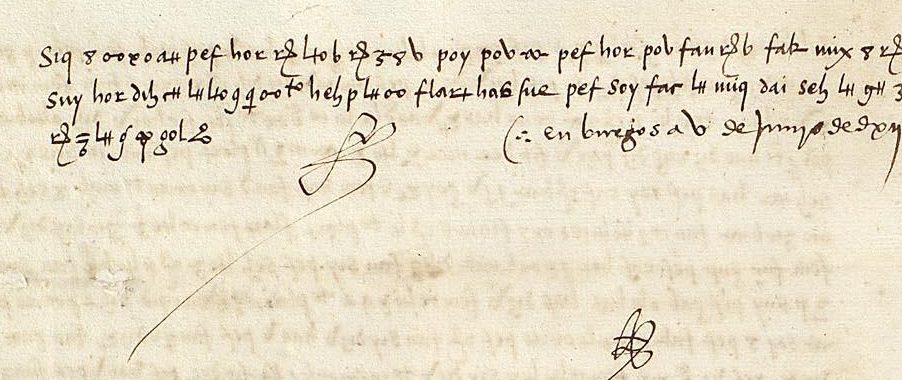
| 8715 N.57 | 5 June 1512 | Burgos | cipher only — read here |
| 8715 N.60 | 1 Sept 1512 | Logroño | cipher only — read here |
| 8715 N.73 | 26 Oct 1515 | Pedrezuela | cipher only; a different system, not read |
| 8715 N.74 | 30 Jan 1519 | Charles I; cipher and decipherment in a third system | |
| 8715 N.79 | “1500” | “Clave de cifra”: a plain letter-to-sign table, not the key to any of these |
The letters are long. N.45 runs to thirteen pages of cipher (378 lines), N.60 to thirteen (432 lines), N.57 to one page and three lines. Apart from the heading date, the closing dateline and the royal signature, everything is in cipher.
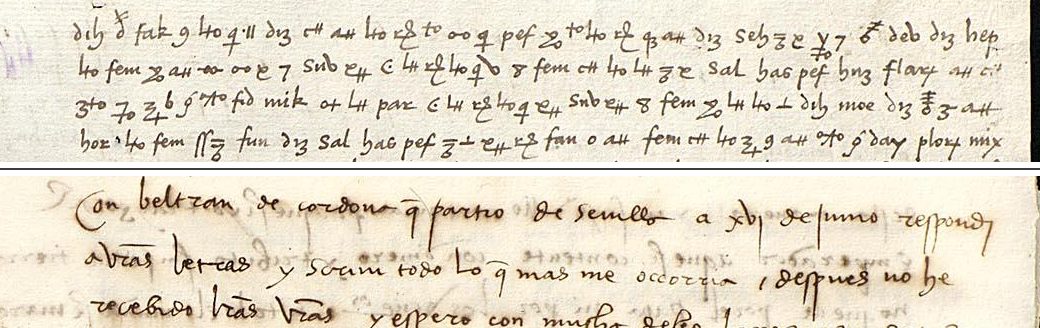
02 The 1511–12 key
One key serves N.41, N.45, N.46, N.52BIS, N.57 and N.60, from May 1510 to September 1512. It has two parts.
A homophonic alphabet. Each letter is written with one to three signs: figures, and letters with bars, loops or dots added. The labels below are the ASCII names used in the transcriptions, not the shapes themselves.
| letter | signs | letter | signs | letter | signs |
|---|---|---|---|---|---|
| a | to 7 b | h | O | p | P SS mt |
| b | B | i | e Z | r | 40 tt E |
| c | ch | l | c | s | d eh |
| d | oo | ll | 7o | t | X g 9 |
| e | 4h 3 | m | q | u | 3t |
| f | gh | n | 11 W | v | V |
| g | o | o | ah T | y / z | 8 / p |
Code groups. Lowercase groups of two to five letters, most of three, stand for words: pef que, diz de,
dih con, fak el, hor la, has lo, raf por,
rif porque, mix and mye papa, fef emperador, sap
venecianos, fio Ferrara, fuq Francia, dur/dox/dux
duque, hib guerra, gup batalla, mak Nápoles, hel
Ingalaterra. Some are syllables used inside words that are otherwise spelt out: pob si in si-t-io, flart
me in pri-me-ras, mik no in me-no-r, plort al in c-al-dero. The groups are not in alphabetical
order of their meanings, but related words often share an initial: f for el, en, es, esta, estado, emperador, Ferrara, Francia, franceses,
m for mucho, muy, mil, manera, Nápoles, no, nos, p and r for que, quiere, quales, por, para,
parte. Several words have two or three groups. In all 153 groups have been recovered; the full list is in vich1511/key.md.
Traps. fug is señor and fuq Francia, and the two differ by a tail. plart mi and plort al differ by one letter, and the transcribers of N.45 and N.60 read the second differently; its value al is supported by c-plort-dero in N.57. The barred q is m in most places and a in a few: on the leaf there seem to be two similar signs, m with two bars and a with one, which the transcription has merged. In N.60 a tailed 8 reads i/j, and P serves for j and y as well as p.
03 How the key was rebuilt
Nothing here was broken cold. N.46 (5 July 1511) and N.52BIS (1 March 1512) are in the same key and each has the clerk’s decipherment on the leaves after the cipher. Both were transcribed sign by sign from the PARES images, and the cipher was lined up with the decipherment word by word, as in the figure above. That gave the alphabet and the commoner code groups.
The three cipher-only letters were then transcribed in the same labels and decoded by script (decode.py). Where the decode left a group unread, its value was fixed from
the sense of the surrounding Spanish and accepted only when it read the same way elsewhere; fio Ferrara, dur duque,
fuq Francia, gib franceses and sum tierra were added this way. The key went from the groups
the two siblings supply to 153.
04 The checks
- Built on two letters, read on three others. The alphabet and the core groups come from N.46 and N.52BIS alone. They read N.45, N.57 and N.60, which contributed nothing to them, as running Spanish.
- The datelines. Each letter’s place and date are written in clear at the foot, and they agree with the catalogue: Seville, Burgos, Logroño.
- The contents fit the dates. N.45 complains of Julius II’s publication of new cardinals, which fits the promotion of 10 March 1511, less than four weeks earlier. N.57 turns on a battle lost after the Pope’s side and Vich pressed the viceroy to fight, which fits Ravenna (11 April 1512). N.60 starts from bulls para lo de Navarra and puts Massimiliano Sforza into Milan, which fits the Navarre campaign of summer 1512 and the Sforza restoration agreed that August. None of this is in the clear text.
- A proverb spelt out. In N.57, echar la soga tras el caldero (to throw the rope after the bucket) is spelt out sign by sign except for el, and for al in c-al-dero, which are code groups. A spelt-out proverb that comes out right is hard to get by accident.

05 N.45 — Seville, 4 April 1511
Quotations are the decode with word division and spelling normalised lightly; […] marks groups not read
A long complaint against Julius II, then instructions. It opens with the news Vich had sent: the publication of the new cardinals, la publicacion de los nueve cardenales que crio el papa, which Ferdinand takes as proof that the Pope will not follow his counsel. The Pope has absolved the Venetians and treated with them sin dezirme ni comunicarme; he has not kept his promise over the priory of San Juan; and because he would not follow Ferdinand’s advice to keep his army out of danger, there followed la rota que dezis.
The business is the Emperor and Venice. Ferdinand gives draft terms for their concord: Padua and Treviso to stay with Venice in fief against a tribute, Verona, Vicenza, Riva, Rovereto and Peschiera to go to the Emperor; yo estoy muy determinado de ser perpetuamente unido con el emperador. France is offering him a separate perpetual alliance without the Emperor, which he will not take, and a rupture would wreck his war against the Moors. Orders go to Fabrizio Colonna under an enclosed letter of credence. Near the end he sums up the three points Vich is to press:
la primera, que la gente del papa este en lugar seguro y donde no se aventure … la segunda, que apreteys muy vivamente la conclusion de la concordia del emperador y de los venecianos; y la tercera, la concordia de Ferrara, todo esto de la manera que de suso [es] dicho.
“First, that the Pope’s troops stay in a safe place where they are not put at risk; second, that you press very hard for the conclusion of the concord between the Emperor and the Venetians; and third, the settlement of Ferrara, all in the way set out above.”
06 N.57 — Burgos, 5 June 1512
The aftermath of Ravenna, where on 11 April 1512 the French destroyed the army of the Holy League under Ferdinand’s viceroy of Naples, Ramón de Cardona. Ferdinand reconstructs how his army came to fight. Vich’s letters, and the papal side, pressed the viceroy, saying que si no la hazian, el papa no compliria la paga y que se concertaria con Francia, if they did not fight the Pope would not meet the pay and would come to terms with France; and this against Ferdinand’s repeated written orders not to risk a battle.
por cierto que las cosas de guerra es muy peligroso […] los que estan absentes della; que siempre se ha de remitir a los que las tienen presentes.
“Truly, in matters of war it is very dangerous for those who are absent from it [to decide]; they must always be left to those who have them in front of them.” Do not do it again, he says, for it would be echar la soga tras el caldero, to lose the rope after the bucket. What is left to Vich is to procurar que el papa y venecianos cumplan their share of the pay, to bring the Emperor’s business to a conclusion, and to treat the Ferrara business secretly, sin que la sienta el papa, and report back, que yo dare orden como se efectue.
07 N.60 — Logroño, 1 September 1512
Written from the Navarre campaign, the longest and least complete of the three. Its parts, in order:
- Reproach to Julius II (pp. 3–5). Vich had sent the bulls para lo de Navarra, and word that the Pope was acting against what had been agreed. Ferdinand recites what he has spent por tierra y por mar to rescue the Pope, the Church and Italy, and the Pope’s ingratitude in not paying his troops as the League requires. He traces it to the Pope’s suspicion que el Emperador y yo nos […] de Italia, no siendo assi la verdad (the notes supply hemos de apoderar, “mean to seize Italy”), and tells Vich to remove it.
- Milan (pp. 6–8). The Emperor and Ferdinand agree that Massimiliano, fijo del duque Ludovico, be put into the duchy by the Emperor’s hand, so that Pope and Venice lose the suspicion that Milan is being taken for the Emperor; possession of the state and its fortresses is to be taken at once in Massimiliano’s name. A marriage is in view for el infante don Fernando, Ferdinand’s grandson, with la fija de la duquesa de Milan.
- Venice and the papal claims (p. 9). Venice should not be stopped from recovering the towns it held before the war, or it will not pay. The Pope is trying to take Parma, Piacenza, Modena and Reggio, against the capitulation of the League, under which no member is to act en perjuizio de otra; that is to wait until Milan is secured.
- Spiritual war on Louis XII (pp. 10–11). Ferdinand wants the Pope to use las armas espirituales: to deprive the King of France of his crown and of Guyenne and Normandy, as principal fautor i receptador […] cysmaticos i heretycos, to absolve his subjects of obedience and grant a crusade against him, as was done against the Emperor Frederick and King Pedro.
- Money, and Milan before Ferrara (pp. 12–15). Pensions of cinquenta mil ducados de pension cada año, shared among the members of the League, to hold an Italian power to it, que es muy sustancial; if the Pope insists on beginning with Ferrara, Vich is to insist on finishing the French in the state of Milan first, and on a mutual guarantee of each member’s state in Italy.
08 N.73 (1515) is not read
N.73, from Pedrezuela on 26 October 1515, is in another system. It is 124 lines, 3,177 tokens of 197 kinds, mostly three-letter code groups (sin 151 times, sud 97, no 93, zre 89) with a smaller set of signs. None of the 1511–12 values carries over. No deciphered sibling is known: the nearest, N.74 of 1519, is Charles I’s and in a third system (sex papa, sin de), and N.79, filed as a clave de cifra, is a simple letter table that fits none of these letters.
Annealing against a Spanish five-gram model, with the code groups treated as runs of letters, as whole units, and as breaks between runs of signs, gave nothing: scores well below Spanish and seeds that disagreed. The sign runs are short (median three), so a letter model has little to hold on to. This letter needs a crib or a deciphered sibling. Its clear text is the docket a 26 de octubre 1515, the opening videlicet iterum, and the dateline en Pedrezuela a xxvj de otubre de dxv.
09 Has this been printed?
Possibly. The Barón de Terrateig, Política en Italia del Rey Católico 1507–1516. Correspondencia inédita con el embajador Vich (CSIC, Madrid 1963, 2 vols.), edits this correspondence, and it was not seen for this reading. What could be found out about it without the book (web searches and Google Books snippets, 18 September 2026):
- Volume II prints Ferdinand’s letters to Vich as numbered documents with AHN Estado references; a snippet shows a letter dated Logroño a XXVI días de octubre 1512 followed by Documento n.° 89, A.H.N. Estado, and later historians cite 1512 letters in vol. II from p. 206 on.
- The book has plates of ciphered letters and prints Descifrado de la carta que figura en la lámina … beside them, and its index has many entries under Rávena, batalla de.
- No snippet, review or citation was found that quotes or cites the letters of 4 April 1511, 5 June 1512 or 1 September 1512, or says whether Terrateig printed cipher-only letters in clear.
So it is open whether Terrateig printed N.45, N.57 and N.60, and if so whether he printed a decipherment of them. Given that his volume II prints Ferdinand’s 1512 letters from this legajo, it should be assumed until checked that he may have. PARES itself records no decipherment for these three items.
10 What remains uncertain
- Unread text. Of the tokens transcribed, about 2.6 % in N.45, 3.5 % in N.57 and 7.5 % in N.60 are groups the key does not yet have. The notes put the share of text still unread or doubtful higher, about 5, 7 and 14 %, because some stretches decode letter by letter without yet making sense. The four other deciphered letters in the same or the earlier key (N.41 and the three in 8714) were not used and would close many of the gaps.
- Look-alike signs. The q sign for m and a, and the group pairs plart/plort and flart/flort, need one careful pass against the images before they are trusted.
- Single-context values. Some groups were fixed from one or two contexts in the three letters. fer, for instance, is keyed as dio(s), but it also stands where Fer- of Fernando is wanted; it may be a syllable group, not a word.
- Readings the notes supply. In N.60, the words after que el Emperador y yo nos are unread, and hemos de apoderar is the sense, not the decode. Guyenne and Normandy are in the decode, but whom they are to go to sits in unread groups; the notes’ “assigned to England” is an inference. The duquesa de Milan whose daughter is proposed for the infante is presumably Isabella of Aragon, widow of Gian Galeazzo Sforza, and the daughter Bona; the letter as read does not name them. A nearby line reads el fijo del duque Ludovico que mato a su padre, whose sense in context is not settled.
- Prior publication. See section 09. The three letters may already be in print in Terrateig 1963, which was not consulted.
- N.73 is unread, and nothing here bears on its content.
11 Sources
- Archivo Histórico Nacional, Estado, leg. 8715: N.45, PARES 12751390; N.46, 12751391; N.52BIS, 12760824; N.57, 12751402; N.60, 12751405; N.73, 12751418; also N.41 (12751386), N.74 (12751419), N.79 (12751424), and leg. 8714 N.12, N.26, N.39 (12751356, 12751370, 12751383).
- Barón de Terrateig (J. Manglano y Cucaló de Montull), Política en Italia del Rey Católico 1507–1516. Correspondencia inédita con el embajador Vich, 2 vols., CSIC, Madrid 1963. Not consulted; see section 09.
- Context: the Holy League of 1511, the battle of Ravenna (11 April 1512), the conquest of Navarre (July 1512) and the restoration of Massimiliano Sforza (1512), in the standard accounts.
The sign-by-sign transcriptions (n45_pp03-09.txt, n45_pp10-15.txt, n57_transcription.txt, n60_pp03-09.txt,
n60_pp10-15.txt), the decodes (*_decoded.txt, n57_decode_v3.txt), the key (key.md, decode.py), the N.73 transcription
and solver attempts, and the notes are in the repository (vich1511/). The PARES images are not committed; pares.py re-fetches them.