01 The letter
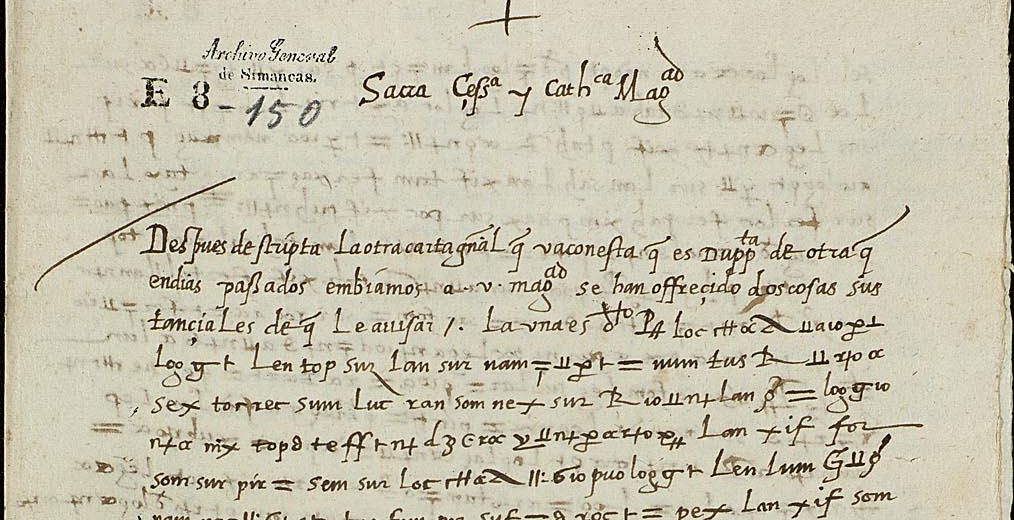
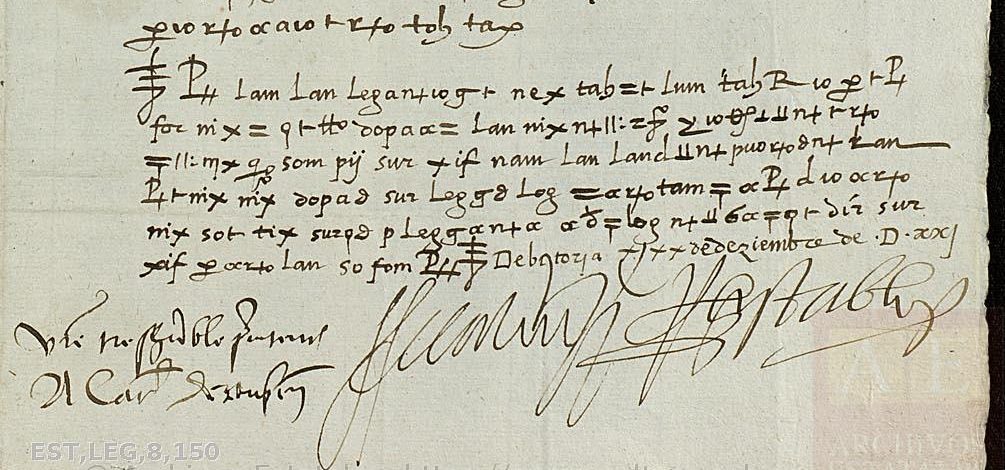
In 1521 Castile was governed for the absent Charles V by three men: Adrian of Utrecht, cardinal of Tortosa and Charles’s old tutor, whom he had left as regent in 1520, and the two great nobles added to him during the revolt of the Comunidades, Fadrique Enríquez, Admiral of Castile, and Íñigo de Velasco, Constable of Castile. The letter is signed by all three: Adrian in French, Votre treshumble serviteur, el Cardenal dertusense, then the Admiral and the Constable. It is dated Vitoria, 30 December 1521. On 9 January 1522 the conclave in Rome elected Adrian pope; Danvila calls this the last letter the three governors signed together.
It covers two sheets, of which three sides are cipher. Only the address and the first two and a half lines are in clear; after La una es the scribe goes into the code and stays there until the dateline, De bitoria a xxx de deziembre de D.xxj.
02 Found in print
PARES gave the date and the place. An OCR search of the Internet Archive scan of Memorial Histórico Español 38 (memorialhistri38realuoft) for that date at Vitoria found the letter on p. 703, under the heading Carta cifrada de los Gobernadores de Castilla al Emperador, fecha en Vitoria á 30 de Diciembre de 1521. Danvila’s note (3) gives the credit: Esta traducción se debe á D. Claudio Pérez Gredilla, Jefe del Archivo general de Simancas, sin que á pesar de su especial competencia haya podido descifrar algunas palabras, que se trasladan tal como resultan en el original. Note (4) gives the reference as Arch. gen. de Sim., Estado, leg. 8.°, fol. 150, the number stamped on the leaf. Neither PARES nor the lists of unread ciphers mention the edition.
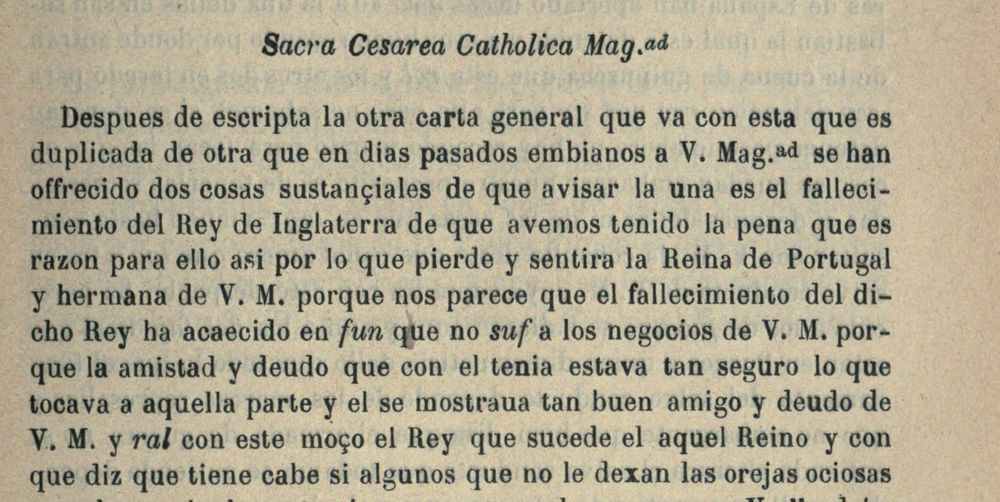
memorialhistri38realuoft.Gredilla’s text is good. Measured against the cipher, it holds through the whole letter. What it leaves out falls into three kinds. There are about twenty-five code groups printed in italics as he found them (fun, suf, ral, rip, pah xiu, top te, rol, xep, lag, fac, fap, fir, xin, dopca, nag, pij and others). There are a few groups dropped without a mark (for twice; xac in “[xac] y franceses”). And there is one confident reading that is wrong, the King of England. A full transcription of his text from the page scans is adrian1521/gredilla_1880s.txt.
03 The cipher, and the key rebuilt by alignment
PARES serves these leaves at about 1,000 pixels on the long side and no larger, so the ciphertext was transcribed from upscaled line crops. The code groups, written in ordinary letters, read reliably. The signs of the spelling alphabet read less well, and several are still rough. The transcription was then cut into chunks at each xif, the group that stands for V. M. (vuestra Majestad): 19 in the cipher as transcribed, against 21 “V. M.” in Gredilla. Between anchors, cipher and Spanish were matched word by word. The alignment never has to force a reading, and every value below comes out of it.
The system is a mixed nomenclator:
- Code groups of three letters, sometimes two, stand for words and also for syllables inside words. log is en both as a word and in s-en-tirá and fallecimi-en-to. lan is de in pier-de and de-udo. dop is ur- in urca.
- Inflection by suffix. A sign after a group changes the ending: mix la, mix= las; fom cosa, fom= cosas.
- A homophonic alphabet of letters, figures and signs spells everything else: a = α, e4, Δ; c = a, 6, σ; d = q, z; e = ℓℓ; g = C; o = +; p = R, ff; r = nt, G; s = =; t = g, d; u/v = ≠T. These values are good enough to follow every spelled word against Gredilla’s text, but at this resolution the homophones are not all separated. The table is a reading aid, not a finished key.
- A triple-barred staff and the sign P4 open and close paragraphs.
The code is one-part in blocks. The initial letter of a group follows the plaintext alphabet: r for words in a- (agora, al, alianza, amistad, antes, allá), f for c- (con, como, cosa, Consejo, contra), l/L for d–f (de, del, dicho, el, en, Francia, franceses), n and m for h–l, p for m–n (mar, mucha, negocios, no), s for o–r (otra, para, parece, por, que), t for r–t (Rey, razón, salvo, su, tiene), d for u-, x for v–y (V. M., voluntad, ya, yo). The order inside a block cannot be recovered from one letter. The block structure matters, because it limits which words an unread group can be.
| Group | Reading | Group | Reading | Group | Reading |
|---|---|---|---|---|---|
| xif | V. M. | sur | que | lan | de |
| Len | del | Loc | el | log | en |
| top | Rey / Reina | suz | Portugal* | te | de |
| fer | con | for | como | fom | cosa |
| som | por | sum | para | sem | parece |
| tup | salvo | dop | ur- (urca) | pex | negocios |
| rol / ral | agora | rum | amistad | lix / lux | Francia / franceses |
| xep | ya | tiz | tiene | roc | al |
The full table, with the evidence for each value and its confidence, is in adrian1521/NOTES.md.
04 The wrong king
Gredilla’s first sentence of news reads la una es el fallecimiento del Rey de Inglaterra, de que avemos tenido la pena que es razón. Henry VIII was alive in December 1521 and lived until 1547. The letter itself says who died:
- the loss is felt by la Reina de Portugal y hermana de V. M., that is Leonor of Austria, Charles’s sister, married to Manuel I in 1518 and widowed on 13 December 1521;
- the dead king was tan buen amigo y deudo de V. M., and now there is este moço el Rey que sucede en aquel Reino: João III, nineteen, with people about him que no le dexan las orejas ociosas;
- los Reyes de Portugal tienen [alianza] antigua con los de Francia, which the French will work on;
- Charles is asked to send someone to the new king para demostrarle el sentimiento que tiene del fallecimiento del Rey su padre, and to visit and console a la Reina.
In the cipher, the dead king is Len top (del Rey) followed by one short group, which the notes read as suz. Gredilla left the same group unread at envié al dicho [suz] una persona, where the sense is the new King of Portugal. Inglaterra is spelled nowhere. On line 6, where Gredilla correctly reads la Reina de Portugal, Portugal is spelled out letter by letter after top, with the same signs (C = g, roc = al) as the other spelled Portugal on line 16. The correction does not depend on reading that one group. Everything the letter says about the king fits Manuel and Portugal, and nothing fits England.
05 The groups read now
Most of the new readings come from the letter itself. A group Gredilla left blank in one place is often spelled out, or read by Gredilla himself, in another. The marks follow the notes: ** certain (the same group is read or spelled elsewhere in the letter), * probable (context, plus the initial-letter block the group must belong to), ? a guess.
| Gredilla (1899) | Cipher | Reading | Evidence |
|---|---|---|---|
| el fallecimiento del Rey de Inglaterra | Len top suz | del Rey de Portugal** | Section 04; Manuel I d. 13 Dec 1521 |
| que está rol | rol | agora** | Gredilla reads the same group “ahora” in porque ahora no hay recaudo |
| para xep detención | xep | para cuya detención** | cu + xep is his own “cuya” in cuya copia; xep = ya |
| sus dopca= | dopca= | sus urcas** | dop = ur- in six occurrences of urca(s) |
| (omitted, twice) | for | como** | así por lo que pierde… como porque nos parece; porque como V. M. debe ya tener noticia |
| los del fap Real | fap | los del Consejo Real** | c-block; the fixed title Consejo Real, sitting at Burgos |
| pah xiu | pah xim | mucha voluntad* | “xiu” is a misprint for xim; p-block and x-block |
| tienenla antigua | tiz rto rip | tienen alianza* antigua | rip recurs at el amor, deudo y [rip]; a-block |
| y ral con este moço | ral | agora* | next to rol; a-block |
| top te que tiene | top te | a la Reina, de* que tiene | top = Rey/Reina, te = de |
| en lag= vienen; como quiera que lag= | lag = | ellas* | d–f block; the hulks |
| guerra fir él | fir | contra* | c-block |
| a su xin | xin | voluntad* | x-block, haciendo guerra y paz a su voluntad |
| por pij que | pij | manera* | m–n block, por manera que |
| ren nod sig | sig | procurar* | o–r block; cf. para procurar de continuar |
| en fun | fun | en coyuntura? | c-block, sense only |
| en nag | nag | Italia? | h–l block, la guerra que se haze en [nag] |
| los de fac | fac | Consejo? | c-block, beside fap |
Misprints in the 1899 edition, checked on the manuscript: “xiu” is xim; “itb” is tib; “xap” is xac; and the numeral “40” after urcas [xub] is the code group yo, not a number. The letter itself counts three hulks: one at San Sebastián and las otras dos at Laredo. Gredilla also drops xac in [xac] y franceses son a unirse and prints si bien están neutrales where the cipher has si [xac] están neutrales.
06 What the letter says
Gredilla’s text, lightly normalised; bold a group now read or corrected, with its confidence mark; [brackets] still unread
La una es el fallecimiento del Rey de Portugal**, de que avemos tenido la pena que es razón, para ello así por lo que pierde y sentirá la Reina de Portugal y hermana de V. M., como** porque nos parece que el fallecimiento del dicho Rey ha acaecido en coyuntura? que no [suf] a los negocios de V. M. … y agora* con este moço el Rey que sucede en aquel Reino, y con que diz que tiene cabe sí algunos que no le dexan las orejas ociosas, no sabemos la demostración que querrá hacer; porque como** V. M. debe ya tener noticia, los Reyes de Portugal tienen alianza* antigua con los de Francia, y creemos que los franceses no estarán perezosos en solicitar por aquella vía lo que haze a su propósito.
In English, the letter runs as follows. Since writing the general letter that goes with this one, a duplicate of one sent some days ago, two matters of substance have arisen.
The King of Portugal. The governors grieve at his death, for the sake of the Queen, Charles’s sister, and because it comes at a bad moment for Charles’s affairs. With Manuel as friend and kinsman, that side was secure. Now there is a young king whose advisers do not leave his ears idle, and no one knows which way he will turn. The kings of Portugal have an old alliance with France, and the French will not be slow to use it. The governors are sending a prelate or a gentleman from Spain to visit and console the Queen. They ask Charles to do the same before the King of France takes the lead: to send a person of his household to the new king to show his sorrow at his father’s death, to ask that he succeed his father in the love, kinship and alliance between the two houses, and to promise that Charles will keep it up with great goodwill*. The same envoy should visit the Queen on Charles’s behalf.
The hulks. Storms at sea have driven some urcas, the big northern cargo ships, onto the Spanish coast. One lies at San Sebastián, detained and well guarded. Two are at Laredo, and the governors are trying to hold them, but there is no force at hand to compel them. They mean to keep whatever they can seize, cargo and all, under sequestration until Charles decides. The difficulty is that the ships sail under a safe-conduct from Charles; a copy goes with this dispatch. The councillors present, and the Consejo** Real at Burgos, hold that the safe-conduct rests only on the suspension of the marcas represalias, the letters of reprisal. Charles cannot have meant that, if [xac] were at war against* him, their hulks should go safely haciendo guerra y paz a su voluntad*. If [xac] join the French, the ships could be treated as good prize. If they stay neutral, they might be won over with [tib], or Charles might use the matter for reasons of state. In either case the French would take the hulks, by fair means or foul, for their fleet if the war between [Lag] and France goes on, and that fleet is said to be growing very large. The governors ask for orders.
Postscript. After writing, they learned that the Laredo hulks had set sail, so Charles need decide only about the one at San Sebastián, which remains and will be kept under good guard until he gives other orders.
The full corrected text, with every change marked, is adrian1521/plaintext_corrected.txt.
07 What remains uncertain
- Still unread (about ten groups): suf (que no [suf] a los negocios); xub and yo after urcas; ren nod before procurar; xac, a people (que [xac] y franceses son a unirse, si [xac] están neutrales); sif; tib; xit; Lag, one of the belligerents with France; and ne (la or mala fortuna). The Scots fit xac in sense: Albany landed in Scotland with French backing in November 1521, and reprisals were a Scots–Flemish grievance. But the group sits in the x-block, which should hold words in v–z, so this is not offered as a reading.
- The group after Len top. In this hand r and z look much alike. The working transcription writes the group as sur, which is que, and the notes read it as suz. Que makes no sense in that place, and Gredilla printed a group suz where the new king is meant, so suz = Portugal is probable, not certain. The Portugal correction itself does not rest on this group (section 04).
- The spelling alphabet is good enough to follow every spelled word against Gredilla, but its homophones are not all separated at the 1,000-pixel resolution PARES serves. Several sign readings in the transcription are marked rough.
- The probable readings (*) come from sense plus the initial-letter block. They are not confirmed by a second occurrence, and the guesses (?) are only that.
- No shared key. Adrian’s own ciphered letters with decipherments were checked, in the hope that one of them would supply the key. None does. Estado 8/112 (28 July 1520) uses a sign-and-figure cipher. PTR 2/1/94, 99, 100 and 101 (October–December 1521) use Adrian’s dotted trigraph code (leb. nud. sa. cab.), in which V. M., que, de and en have other groups. The joint letter is in a third code, probably the Admiral’s or the Constable’s. The Admiral’s 1521 cipher letters survive in clear copies (PTR 1/96/5, 9, 12, 13, 44, 45), but their originals were not found on PARES. A sibling in the same code, with its decipherment, is the way to close the open groups.
08 Sources
- Archivo General de Simancas, Estado leg. 8 no. 150, 2 ff., 4 images: PARES description 13002542.
- M. Danvila, Historia crítica y documentada de las Comunidades de Castilla, t. V = Memorial Histórico Español t. XXXVIII (Madrid, 1899), pp. 703–705, with the decipherment by Claudio Pérez Gredilla: Internet Archive, memorialhistri38realuoft.
- For comparison, from PARES: AGS Estado 8/112 and 8/113; Patronato Real 2/1/92, 94, 99, 100, 101; Patronato Real 1/96/5, 9, 12, 13, 44, 45.
The transcription of the ciphertext, the alignment script (chunks.py), Gredilla’s text as printed, the corrected text with its confidence marks and the notes on the key are in the repository (adrian1521/). The reading is Pérez Gredilla’s; this page corrects and completes it.