J+ for a sign they could not place, and that sign does not stand for one digit. Each such group was tried with all ten digits and the value chosen by a character-level language model of French; 105 groups were settled that way and both despatches now decode. 452 of 472 groups have a value. They concern the treaty of alliance Prussia signed with the Republic in April 1788: the King “could not guarantee our possessions overseas”, and the article was reworded to cover only an attack by a European power. The 1793 letter to the Secret Committee of the States-General is written in marked three-digit groups (696 groups, 513 distinct forms), for which no key has been found; it stays open.
01 The documents and the key
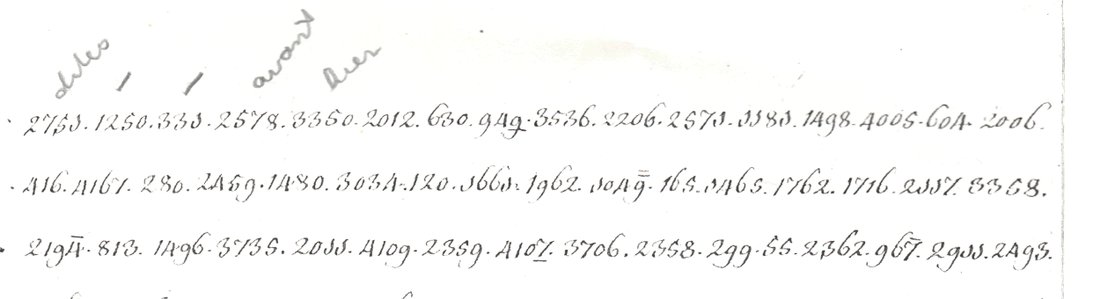
R1026 (29 December 1787) and R1027 (4 March 1788) are Van Reede’s own despatches to Laurens Pieter van de Spiegel, in dot-separated groups of one to four digits with clear French at the head and foot. R1026 carries an interlinear gloss over its first groups, dites … avant hier, which is the first check on any key. The two letters share 49 groups. R1893 (24 March 1793, to the Secret Committee, in Dutch) is different to look at: three-digit groups with strokes, carets, tildes and dots above single digits.
The key is DECODE R1024, the “Grand Chiffre” of William V (Koninklijk Huisarchief A29, inv. 301, dated 1782): a one-part French code in which the numbers run with the alphabet, up to 5000. Whole words, names (le Comte de Finkenstein, Monsieur de Herzberg), syllables and letters all have values, so rare words are spelt out: ul·er, simple·ment.
02 The control and the transcription
R1028, an undated Van Reede letter headed Chiffre de Mr de Reede, has its plaintext written out on DECODE. Its groups, decoded with R1024, give la reponse A donner au [Roi] à la communication que Sa Majesté vient de faire A leurs haut Puissance les voici le Ministre d’Angleterre A ajouter dans son rapport qu’on esperer·oit ic[i] qu’on approuver·oit A Londres…, matching the clear version word for word. The key is right and complete enough.
The same key on R1026 decoded cleanly in some lines (il doit y avoir ce matin … une conference à ce sujet) and made nonsense in others. Every nonsense word came from a group containing DECODE’s J+, which the transcriber defined as “a sign that is not represented by other signs” and used 136 times in the two letters. The first pass took it as 3. It is not one digit: 275J is 2750 dites, as the gloss says; JJ8J is 1181 le Roi; 375J in ce matin à … heures is 3751 dix. The writer’s hand has several forms of some figures, and the transcriber put the doubtful ones under one symbol.
03 Method
resolve_j.py reads the DECODE transcription, keeps plain digits as written and treats each J+ as unknown. For each group it lists every digit filling whose number is in the key, and a search that keeps the 40 best partial texts chooses among them, scored by a six-character French language model built from eighteenth-century diplomatic correspondence (the Politische Correspondenz text already in the repository). Groups without J+ are never changed. 79 groups in R1026 and 26 in R1027 were resolved this way. The model can choose a wrong but grammatical word, and it cannot repair a plain digit the transcriber misread; both kinds of error remain in the passages marked below.
04 29 December 1787 (R1026)
The decoded text, with the code’s own spelling. Square brackets are groups with no value; [?] marks stretches that stay garbled.
dites [1250] … avant hier les deux Ministres ont proposé au Roi le projet de l’alliance tel que vous l’avés, Monsieur [?] … j’ai prié Monsieur de Herzberg de détail[ler] séparement les sentiments dans le rapport et de motif[s] [?] la réponse … hier au soir [?]. Il doit y avoir ce matin à dix heures une conférence à ce sujet encore entre le Roi et ses deux Ministres; j’espère qu’il n’y aura pas de changement. Le seul [point] jusqu’ici dont il soient [?], c’est que le Roi a dit [qu’il] ne pouvoit pas garantir nos possessions d’outre-mer. Je ne l’ai pas demandé, mais bien qu’au cas [que nous] fussions attaqués [?] par une [puissance de] l’Europe [?] fournir en argent [?]; peut-être Sa Majesté entend[-elle] par garantir fournir [?]; mais quand cela seroit [4433] le Prince d’Anhalt-Schaumbourg [?] … ce point, l’article [?] que j’ai eu l’honneur de vous [?] l’Angleterre [331] à la réquisition du Comte de Finkenstein, Monsieur de Herzberg [?] le Traité [?] fixer [?] jusqu’à présent [?] a été arrêté hier, et ce que j’ai eu l’honneur de vous […]
[clear:] Depuis que ceci a été chiffré, Monsieur, j’ai [appris] au sortir d’une conférence que les deux ministres ont eu avec le Roi …
… il est à craindre que [?] a été décidé dans la conférence de [ce] matin, que sans article ul·térieur le mot de possessions d’outre-mer on dir·oit simple·ment que si la République étoit attaquée par une Puissance [européenne] … lui fourn·iroit les secours [?] … si leurs Hautes [Puissances] … ordonne·nt [?] d’après la manière dont ceci m’a été dit [?] [2800] [3160]
[clear:] Si j’ai bien compris, je n’ai pas [lieu de] m’attendre à d’autres changements. J’ai l’honneur d’être avec un très profond respect …
In English. Two days ago the two ministers, Finckenstein and Hertzberg, put the draft alliance to the King as Van de Spiegel had sent it; a further conference between the King and the ministers is set for ten this morning. The only point raised so far is that the King said he could not guarantee the Republic’s possessions overseas. Van Reede had not asked for that, only that if they were attacked in Europe the King would help with money or supplies. After the conference he adds that the article is to drop the words possessions outre-mer and say simply that if the Republic is attacked by a European power the King will furnish the aid; he expects no further change. This is the defensive treaty signed at Berlin on 15 April 1788, which guaranteed the stadholderate and the Republic’s territory in Europe; the Anglo-Dutch treaty of the same day covered the possessions overseas.
05 4 March 1788 (R1027)
[3660] [2800] les nouvelles de Russie … [ce] matin port[ent] que mes[sieurs] [?] sont fort [?] de ce que l’Impératrice doit avoir [?] la triple alliance. Monsieur de [?] n’a point [2637] encore de réponse et ne croit la recevoir qu’après que l’Impératrice aura celle qu’elle attend de Vienne à la demande qu’elle a faite à l’Empereur, s’il étoit résolu [?] … à ce qu’on croit … l’Empereur a fait la déclaration [de guerre] à la Turquie. Monsieur de [?] croit encore que l’[?] voudra attendre le retour du premier courier [50] expédié à Londres, qui a été suivi de deux autres, avant de s’expliquer sur les propositions du [?] [3153] [2751] [3660].
[clear:] N’y ayant rien de plus, Monsieur, qui puisse mériter votre attention, j’ai l’honneur de vous présenter mes respects … [A. W. van] Reede
In English. News from Russia; the Russian side is anxious about the proposed triple alliance of Britain, Prussia and the Republic. The Russian envoy has no answer yet and expects none until the Empress has Vienna’s reply to her question to the Emperor; Joseph II has made his declaration of war on Turkey (9 February 1788). A courier has gone to London, followed by two more, before anyone will declare on the proposals.
06 What remains
- Groups with no value. R1026: 1250, 2142 3068 (two groups run together), 331, 308?9, 2637, 2800, 3160; the corrected 4433 over
4 4 3 8decodes, though its value is uncertain. R1027: 3660 (twice), 2800, 3?089, 2637, 1?1021, 50, 3153, 2751. 2637, 2800 and 3660 recur in both letters and are probably names added after 1782. - Garbled stretches. Where DECODE misread a plain digit, the key gives a real but wrong word (comme ils mauvais oyent à différer, Monsieur de L L nr, probably the Russian envoy Alopeus). A new transcription from the images would clear most of them; the scans on DECODE are 1290 px wide and the hand’s variant figures are hard to separate at that size.
- Grades. The decoded groups are not graded one by one. The structural sentences quoted in English (the conference, the refusal to guarantee the overseas possessions, the reworded article, Joseph II’s declaration) rest on runs of groups without
J+and are certain; words chosen by the model are probable. - R1893, 24 March 1793, to the Secret Committee: not decoded. Three-digit groups whose single digits carry one of five marks, 696 groups in 513 distinct marked forms. That is a code of several thousand values, not the Grand Chiffre. The Fagel-family keys on DECODE (R2846, R2848, R2850, R2851) and the decrypted control R2243 do not fit it, and there is no crib. With far fewer groups than code values, a ciphertext-only attack is not feasible; it needs the Secret Committee’s key or a deciphered copy from the States-General’s secret files.
07 Sources
- DECODE (de-crypt.org) records R1026, R1027 and R1028 (Nationaal Archief 3.01.26, L. P. van de Spiegel, inv. 190, images 5275–5283); R1893 (Nationaal Archief 1.01.02, Staten-Generaal, inv. 6695, images 9360–9363); R1024, the Grand Chiffre key (Koninklijk Huisarchief A29, inv. 301, images 5238–5269, transcription June 2020).
- K. de Leeuw, Cryptology and statecraft in the Dutch Republic (thesis, Amsterdam 2000), for Dutch diplomatic code practice.
- No earlier decoding of R1026, R1027 or R1893 was found; DECODE lists no decipherment for any of the three.
Transcriptions, decoder (resolve_j.py), readings and notes: vanreede1787/.