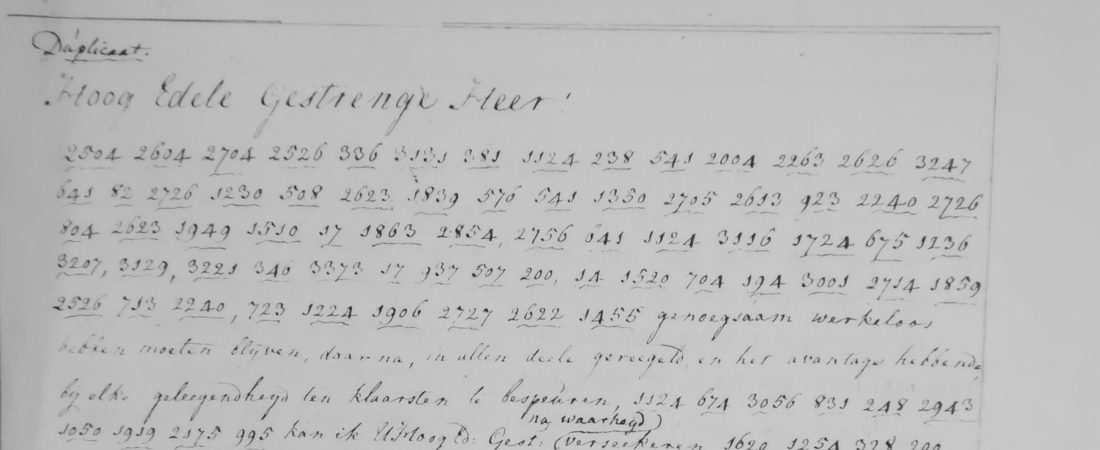
01 The four records
| Record | Date | What it is | State |
|---|---|---|---|
| R2120 | 22 Dec 1788 | Two cipher pages, 633 groups. The same pages appear as R2121 P5 and P1. | Read at the time: the decipherment is R2121 pp. 2–4 |
| R2122 | 15 Jan 1789 | A “Duplicaat”: two cipher blocks, 258 groups, inside clear Dutch | Unread |
| R2131 | 9 Feb 1793 | One cipher paragraph of 50 groups, framed by 701 … 301 | Unread |
| R1895 | 26 Aug 1799 | No. XVIII to the Burger Agent: two- and three-digit groups with ×, ″, ¯ and ~ marks | Unread; a different system |
02 The despatch of 22 December 1788
This is the clerk’s decipherment (R2121). Van Dedem reports a conference with the Reis Effendi, the Kaymakam and the Kâhya Bey. He told them that the States would not take on the Porte’s proposed loan directly, but might allow it to be raised quietly. The Porte then set out its security:
om speciaal voor de geheele Leening en de interest tot de geheele aflossing toe te verbinden al de inkomsten van de Provincie Morea, Negropont, Salonique, Volos, Urfan en Cara Agatz, als ook die van de Landen van Damascus, Sorien en Rodosto … het geheel vast jaarlijks tribut van Jenischeher
“to pledge, specially for the whole loan and the interest until full repayment, all the revenues of the provinces of Morea, Negropont, Salonica, Volos, Urfan and Cara Agatz, and those of the lands of Damascus, Sorien and Rodosto … the whole fixed yearly tribute of Jenischeher.” The Porte also offered cotton and wool from Salonica and Smyrna at preferential prices. Van Dedem suggests that the Directors of the Levant Trade, or failing them Hope & Co., should take the loan up. Some place names were left in clear inside the cipher.
03 What was tried on R2122 and R2131
- Keys. DECODE’s notes link these records to fourteen others in the same code: Kroll 1784–85, Van Haeften 1776, Schenck 1777, and Van Dedem 1789 and 1809. None of them is a key. The undated Fagel series “Cijffers zonder bestemming” (R2842–R2852, before 1793) is made of large alphabetical Dutch codebooks. In R2843 the words from a to ad alone run past 670, so it is not this code.
- The code. It is not alphabetical. For example, welke falls near 2888, landen near 1277 and als near 17. It is also strongly homophonic: in R2121’s clear text de occurs 36 times, but no group occurs more than 11 times, and 541, 641, 841 and 941 are all frequent. The fixed opening 2504 2604 2704 and the frames 701 801 … 301 401 501 601 look like nulls.
- Cribs. R2121 (Dutch, 633 groups), R1947 (8 Nov 1789, French, 498) and R2053 (1 Dec 1789, French, 196) were transcribed together with their solutions. Only 58% of R2122’s groups and 52% of R2131’s occur anywhere in them. The French and Dutch cribs share only 17% of their groups.
- Alignment. Word aligners (hard EM and leave-one-out) were run with restarts, and a variant that treats the hundreds digit as a dummy was also tried. None converged to consistent values: the same group came out as different words in different places. Without reliable values nothing in the two letters can be decoded.
04 What is needed
- The codebook of the Constantinople legation (NA 1.02.04, legatie Turkije) or Croiset’s working sheets.
- More deciphered letters in the same code, above all Dutch ones. The Kroll letters (R1948–R1952) and those of Van Haeften (R2134) and Schenck (R2141) carry solutions and have not yet been transcribed.
- For R1895: a key to Croiset’s marked codes of the Batavian period.
05 Sources
- DECODE R2120, R2121, R2122, R2131, R1895, R1947, R2053 (images require login).
- Henk Boon, Frederik Gijsbert baron van Dedem. Onze man in Constantinopel (2012), not consulted.
Transcriptions, aligners and notes: dedem1788/.