01 The record
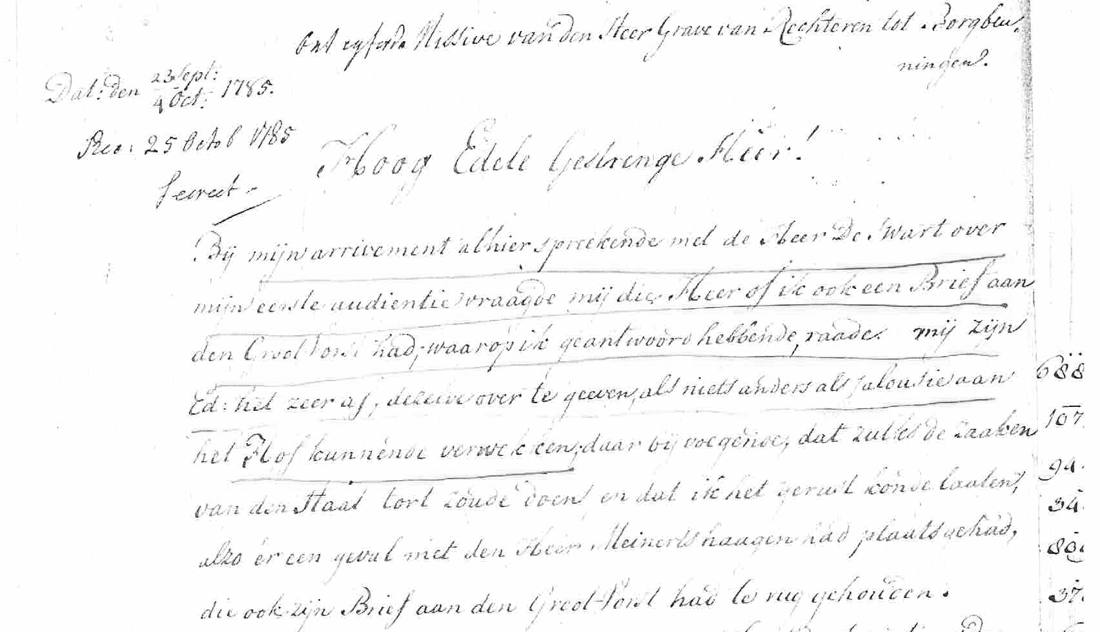
- Images 5448–5449: the decipherment, in a Griffie hand, ending “(: geteekend :) C. A. Grave van Rechteren tot Borgbeuningen”.
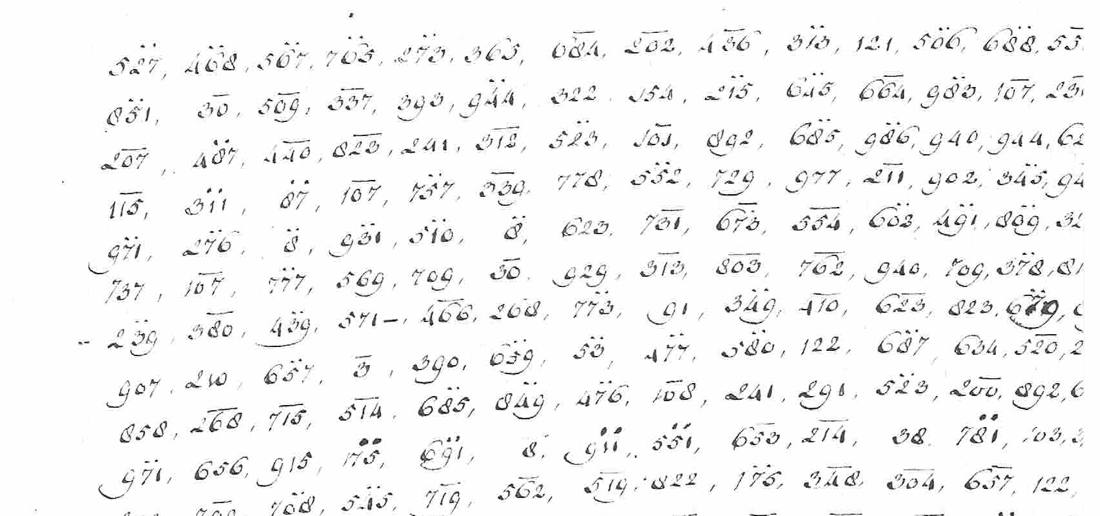
- Images 5450–5452: the cipher letter, 424 groups. Image 5451 repeats the lower rows of 5450 cut off at the margin. The groups are three-digit numbers with two dots, a bar or a dot over single digits. The marks are part of the code.
02 The decipherment
From the 1785 decipherment, original spelling:
Hoog Edele Gestrenge Heer! Bij mijn arrivement alhier sprekende met de Heer De Swart over mijn eerste audientie, vraagde mij die Heer of ik ook een Brief aan den Groot Vorst had, waarop ik geantwoord hebbende, raade mij zijn Ed: het zeer af, deezen over te geeven, als niets anders als jaloutsie aan het Hof kunnende verwekken; daar bij voegende, dat zulks de zaaken van den Staat tort zoude doen, en dat ik het gerust konde laaten, alzo er een geval met den Heer Meinertshaagen had plaats gehad, die ook zijn Brief aan den Groot Vorst had te rug gehouden.
De langduurige ondervinding van den Heer de Swart, en de kennis die hij van dit Hof heeft, gepaard met de geruststelling, dat hij er voor verantwoorde, hebben mij dit gedeelte van mijn Instructie niet laaten executeeren. Ik hoop niet, dat mij zulks ten kwaade zal worden geduid, alzo er niets anders als de vordering van ’s Lands belangen meede beoogt, en ik buiten dat wel occasie zal hebben, den Groot Vorst van de goede intentie van Haar Hoog Mog: te verzekeren.
De zekere overtuiging, waarin ik ben, dat alle mijne Brieven geopend worden, zal mij zeer geneeren in mijne depeches, wanneer er eens mogelijkheid is, om de negociatie te hervatten; wes halven verzoek te mogen weeten, of ik, wanneer de zaaken een absolut geheim vereischt, en de publiciteit van dezelve aan de belangen van den Staat, en het vertrouwen dat men in deszelfs Minister behoord te stellen, eenige belemmering zou te weege brengen, of ik alsdan, doch niet als in de hoogste noodzaakelijkheid, een Courier aan U Ho: Ed: Gest: mag afzenden, het welk te meer noodzaakelijk is, alzo in den begin van deeze mijne Commissie meer omzigtigheid als ooit moet gebruiken. Ik verzoek hierop een spoedig antwoord in Cyffer, alzo een ongecijfferd de ontdekking van het cyffer zou faciliteeren.
Ik heb de Eer &c. St Petersburg 23 Sept: / 4 Oct: 1785.
In English. When I arrived and spoke with Mr De Swart about my first audience, he asked whether I also had a letter for the Grand Duke. I said I had, and he strongly advised me not to hand it over. It could only rouse jealousy at Court and would harm the affairs of the State. I could safely keep it back, as Mr Meinertzhagen had done with his own letter to the Grand Duke. De Swart’s long experience and his knowledge of this Court, and his assurance that he would answer for it, led me to leave this part of my instructions unexecuted. I hope it will not be held against me: I had only the country’s interest in view, and I will have other occasions to assure the Grand Duke of Their High Mightinesses’ good intentions. I am certain that all my letters are opened, and this will hamper my despatches whenever the negotiation can be resumed. I therefore ask whether, when a matter needs absolute secrecy, I may send a courier to Your Honour, though only in the utmost necessity. I need all the more caution at the start of my mission. I ask for a prompt answer in cipher, since an uncoded answer would help them discover the cipher.
The Grand Duke is Paul, heir to Catherine II, who kept him out of affairs, which explains De Swart’s warning. Karl de Leeuw cites this letter as the Russian example of envoys complaining that their post was opened. He does not print its text.
03 Method
The record came from DECODE with the saved session cookie: images and the 2020 transcription (DOC_R1039_D3590_3590.txt). That transcription marks images 5448–5449 as <CLEARTEXT>, with gaps in most lines. Transcribed from the scans, they are the decipherment. The dates, the Secreet mark and the margin groups tie it to the cipher. The 310 words of plaintext against 424 groups is a normal ratio for a nomenclator that also spells syllables. As a side test, two partial Rechteren-family keys reconstructed for De Swart 1787 from the 1784 and 1786 crib pairs (R2051, R2052) were tried with the marks removed. They do not produce Dutch and disagree with each other, which confirms that the marks carry meaning.
04 What remains open
- The key was not rebuilt, and the cipher was not aligned group by group with the decipherment. The text given here is the 1785 clerk’s decipherment (grade C for the few words hard to make out in the scan, H otherwise).
- The alignment is worth doing for another target. R1039 is a 424-group known-plaintext pair in Rechteren’s code, and that code blocks the first 1,928 groups of De Swart’s letter of 29 Nov 1787 (R1040). The code itself is Nationaal Archief, legation in Russia, inv. 158, which is not online.
05 Sources
- Nationaal Archief, 1.01.02 Staten-Generaal, inv. 7407; DECODE R1039, images 5448–5452 (login).
- Karl de Leeuw, Cryptology and Statecraft in the Dutch Republic (Amsterdam, 2000), note on the interception of despatches in Russia, citing this letter.
Transcription, parsed cipher groups and notes: rechteren1785/.