01 The documents
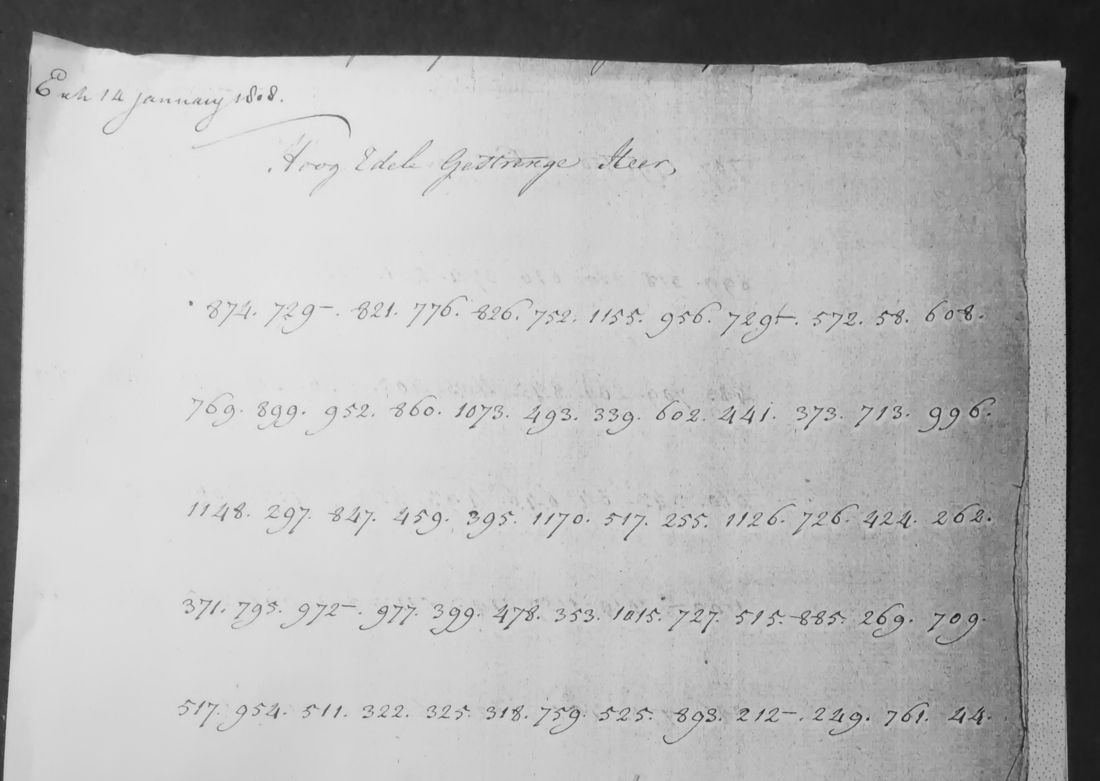
The letter is docketed “Exh 14 january 1808” and opens in clear, “Hoog Edel Gestrenge Heer,”. Nineteen rows of figures follow. It closes in clear, “Ik heb de eer met de volmaakste hoogachting te verblijven, … Uwer Excellentie’s ootmoedige gehoorzame Dienaar”, with a signature read as “G. C. van Spaen”. The annex is headed “Dusseldorf den 15 January 1808” and filed as “136. Exh 18 january 1808”. It has seven rows of figures and the same closing. DECODE’s images P1 and P2 are two photographs of this one annex page.
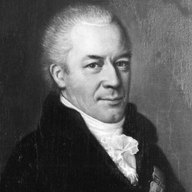
The archive inventory changes the attribution. In NA 2.01.08, inv. 281 is “Missiven van J.F.G. van Spaen en G. van Riemsdijk, commissarissen voor de overname der gecedeerde districten, de Lijmers, Huyssen, Malburgen en Zevenaar, jul 1806 – mei 1809”. G. C. van Spaen’s own letters as envoy in Berlin are inv. 244–248. The Düsseldorf letters therefore come from the Dutch commission for the territorial exchange with the Grand Duchy of Berg. Their subject is very probably that handover. A J.F.G. reading of the signature is not ruled out from the photocopy.
02 The cipher
Each group is a number of one to four digits, separated by dots. A few groups are followed by a dash, which may mark a word boundary, and a few carry a small superscript letter (729t, 793s), probably a clear ending as in other Dutch codes of the period.
| groups | distinct | |
|---|---|---|
| letter, 14 Jan | 228 | 181 |
| annex, 15 Jan | 75 | 69 |
| both | 303 | 222 |
Values run from 15 to 1339. The most frequent groups are 493 (six times), 297 (five), and 441, 424, 269 and 709 (four each). The sequence 602 441 373 occurs twice in the letter and once in the annex, and is probably a recurring name or title. Twenty-eight groups are shared between the two items. The transcription is spaen1808/transcription.txt. In this hand 3 and 5 are hard to tell apart.
03 What was tried
- DECODE keys. Every key record at a Dutch holder dated 1780–1815 or undated was checked, then every key record mentioning Holland, Berg, Westphalia or 1806–10. None is for this code. Croiset’s 1803 codebook (R1035), applied to the annex, gives disconnected Dutch words. Both it and the 1798 book (R1891) use marked three-digit groups below 1000, which this code does not.
- The “solved” annex. DECODE’s note says the annex was solved, but the record carries no transcription or document file, and the neighbouring records R1936–R1948 are other letters.
- Print. The full text of Colenbrander, Gedenkstukken der algemeene geschiedenis van Nederland V (1806–1810), was searched for Spaen, Voorstonden, Dusseldorp and Westphalen. It prints nothing from these letters.
- Ciphertext only. Not attempted beyond counting. With 303 groups from a code of 1,300 or more values, most groups occur once, and no single solution is determined.
04 What would finish it
- The DECODE record owner’s decipherment of the 15 January annex. It would give up to about 70 values. If the code is alphabetical (one-part), those values would also bracket much of the letter.
- The code of the ceded-districts commission, 1806–09, among the Buitenlandse Zaken papers (NA 2.01.08) or the Van der Goes papers.
05 Sources
- DECODE R1941: de-crypt.org/decrypt-web/RecordsView/1941 (images require login).
- Nationaal Archief, inventory of 2.01.08 Ministerie van Buitenlandse Zaken 1796–1810: PDF, inv. 244–248 and 281.
- H. T. Colenbrander, Gedenkstukken V, full text at resources.huygens.knaw.nl/gedenkstukken.
- Croiset’s 1803 codebook, DECODE R1035, tested against the annex.
Transcription, notes and profile: spaen1808/.