
01 The letter
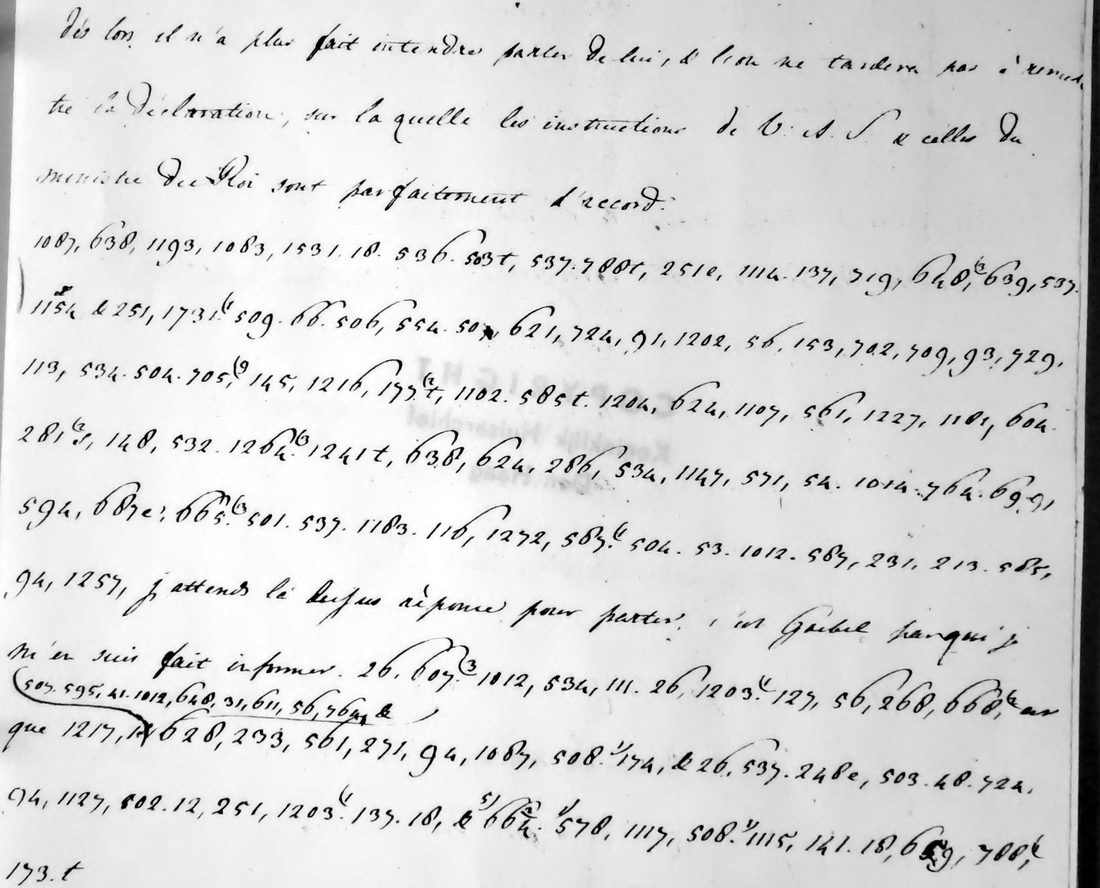
DECODE numbers the pages back to front. The first page (P2) is in clear: a letter from the Hereditary Prince of the 6th announces the Stadholder’s departure; the courier Gaebel arrived on the 9th; the Commissaires of the House kept him so that d’Yvoy could be briefed; a note went to the Batavian side, whose answer was that he hoped to speak with Damen. The second page opens in clear, “Dès lors il n’a plus fait entendre parler de lui, et l’on ne tardera pas à connaître la déclaration, sur laquelle les instructions de V. A. S. et celles du ministre du Roi sont parfaitement d’accord”, then goes into figures. The last page closes “La Haye 18 Juin 1804 … R. Fagel”.
The context is established from print. Colenbrander’s Gedenkstukken IV prints the surrounding papers: d’Yvoy’s appeal to Talleyrand of February 1804, his promise of 500,000 guilders for payments in Paris, Berlin and The Hague, Princess Wilhelmina’s letter of 14 June saying the arrangement was decided, and Fagel and d’Yvoy’s return with the signed convention on 7 August. It does not print this letter.
02 The cipher
128 groups, 99 distinct, two to four digits; 1531, 1731 and 2510 were checked at high resolution and are genuine four-digit groups. Commas separate words and dots join groups inside a word. The words &, car and que are in clear, and a boxed insertion adds a line between the rows. Small superscript marks (c, 3, 6, 9, fractions) follow some groups; their reading is uncertain. The full transcription is fagel1804/ciphertext.txt.
03 Keys tested
| Key | What it is | Result |
|---|---|---|
| R1024, Grand Chiffre (Euler, 1782) | KHA code of 4,732 transcribed entries, 51–5000, with an optional additive table | Direct lookup is nonsense; all 187 row and 187 column starts of the table fail; so do all 5,000 cyclic shifts, affine maps, complements and digit permutations, scored with a French language model (best −10.2 per character against −8.5 for the letter’s own clear French). The table also requires a start letter at the head, which the letter lacks. |
| R2233, R2235, R2240 | The other KHA keys in DECODE (1793–1801) | Small homophonic or name systems; cannot produce the groups |
| R2842–R2852 | Fagel family keys, Nationaal Archief 1.10.29 | Every range audited page by page; none goes above about 1055 |
| R1035, R1891 | Dutch legation codebooks, 1798 and 1803 | Dutch-language; the plaintext is French |
| R8963/R8964, R8984, R8987 | British Library French codes, 1798–1809 | Numbered only to 750 or less; nonsense, also modulo 1000 |
| R5160 (Uppsala) | French nomenclator, Chiffre François, de M. de Lacy | Numbered 210–841 only |
| R2237, R2239, A32-630 | Sibling letters and deciphered file of 1795–97 | Euler/Boyer small book cipher, references to about 334; a different system |
DECODE holds no second message in this code, so there is no parallel text to crib from either.
04 What would finish it
With 128 groups from a code of about 2,500 values, no statistical attack can give a unique decoding; only the codebook or a deciphered copy can. The modern KHA inventory does not match DECODE’s old number 337; the subject belongs with A31-2306–2308, the 1802–1804 compensation negotiations. The best target is A31-902, a packet of court cipher papers of the late eighteenth and early nineteenth centuries, which the Royal Collections’ catalogue backend confirms has no scans. After it come A31-2307 and A31-2308 (1804), A31-2292–2293, and Robert Fagel’s negotiation file, Nationaal Archief 1.10.29 no. 1909. A research request to the Koninklijke Verzamelingen is drafted as fagel1804/ARCHIVE_REQUEST.md.
05 Sources
- Koninklijk Huisarchief, Prins Willem V, old inv. nr. 337: DECODE R2238 (images on login).
- Grand Chiffre: DECODE R1024; K. de Leeuw, “The Black Chamber in the Dutch Republic”, Cryptologia 25 (2001).
- H.T. Colenbrander, Gedenkstukken der algemeene geschiedenis van Nederland van 1795 tot 1840, vol. IV (1908), nos. 790–804.
- Koninklijke Verzamelingen, inventory of archive A31 (Willem V): A31-902, A31-2292–2293, A31-2306–2309.
Transcription, scripts and notes: fagel1804/ in the repository.