Russel ought to be the consul: he is an American by birth, and is much better qualified than any other candidate. In a word, he is above men in general. Next to him in fitness is O'Mealy, but he is, like Warden, an Irishman.
01 The document
The letter is a "private" one, written from the spa town of Bourbon-l'Archambault where Armstrong was taking the waters. Its clear text answers Madison's private letter of 20 July: it dismisses the complaints of Fulwar Skipwith (the departing commercial agent at Paris), warns that the embargo is "not felt" in France and "forgotten" in England, and says of David Bailie Warden, secretary of the legation and candidate for the Paris consulate, only that "a letter of the same character from me to the President … will give you my opinion of the fitness of M. Warden for the consular office at Paris: to this therefore I refer." The opinion Armstrong would not put in clear follows in code, as a postscript.
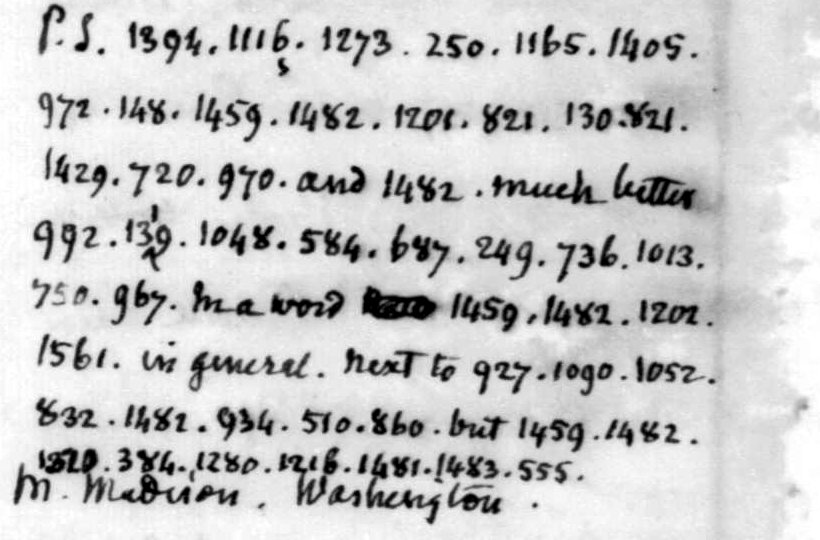
Founders Online (Early Access document 99-01-02-3466, from the forthcoming Papers of James Madison, Secretary of State Series) prints the groups as follows; the reading of the manuscript differs in one group (§6):
1394. 1116. 1273. 250. 1165. 1405.
970. 148. 1459. 1482. 1201. 821. 130. 821.
1429. 720. 970.  and  1482.  much better
992. 1319. 1048. 584. 687. 249. 736. 1013.
750. 967.  In a word  1459. 1482. 1202.
1561.  in general. Next to  927. 1090. 1052.
832. 1482. 934. 510. 860.  but  1459. 1482.
1320. 384. 1280. 1218. 1481. 1483. 555.
The second line begins "972." in the manuscript (Founders' "970." is a misprint for the).
02 The code
Armstrong's despatches from Paris between 1804 and 1810 use a single large code in which 972 = the. Ralph Weber's
survey of American diplomatic codes notes some forty letters in it among the Despatches from United States Ministers to France
(DUSMF, NARA Record Group 59, microcopy M34, rolls 13–14). It is not the code of Armstrong's letter of 20 February 1808, a distinct and
still unsolved system. Its structure, as recovered:
- Groups run from 1 to about 1600. Each stands for a whole word (Emperor 32, Spain 326, Minister 61), a syllable (con 470, tion 352, ness 832), or a single letter (s 1116, n 821, d 1001). Names are spelt out in syllables: Gu-sta-va-us, Et-ru-ria, Y-ru-jo, Dan-ish, O-mea-ly.
- The vocabulary is laid out in many short alphabetical runs, not one alphabetical sequence. For instance 1–130 is one run of words (circumstance, commerce, communicate, character … Minister … these, thousand, toward … week, without, yesterday), 130–417 a second (America, between, business, confide, contrary, country … Prince, Queen, reason, report, Russia, second, secret … which, whom, word, would, your), and above 417 the syllables come in blocks that restart the alphabet every few dozen numbers (1201 a … 1230 c; 1268 ed … 1298 ex; 1302 ide … 1348 broa; 1405 be … 1443 good; 1500s fa … man … now). Within a run the order is alphabetical, which is what allows unknown groups to be pinned between known neighbours.
- Common elements have homophones: re is 555, 561, 562, 869, 871 and 1379; on is 945 and 946; an 1210 and 1216; ing 1478 and 1594.
- Armstrong writes a point after each group; the clerk who decoded despatches at the Department wrote the plaintext in pencil above each group and a short dash above groups that continue a word already written out (Et|–|–, for Etruria).
03 Sources for the key
3.1 The known-plaintext letter of 4 May 1806
Tomokiyo had already exploited the one letter for which both the coded original and a clear copy survive — Armstrong to Madison, 4 May 1806 (Founders 99-01-02-0393), on the Spanish minister's discovery of the confidential Florida proposals — to assign about 230 groups, with a few marked doubtful. This gave a base of 68 firm values used here, among them the, of, to, is, he, a, and, by, in, s, n, and showed the alphabetical layout.
3.2 The Department's pencil decodes (M34 roll 13)
The decisive source is the microfilm itself. NARA has digitised M34 roll 13 ("Nov 12 1804 – Dec 27 1807", catalogue ID 188671172; 393 frames). Frames 0192–0201 carry a long political despatch of October 1806 (written just after Lord Lauderdale's departure from Paris, with news of "two Russian armies now entering Silesia") whose every code group has the clerk's decode written above it. A scoring pass over the roll for faint mid-grey pixels away from ink located the annotated frames; the pairs were then read off by eye, frame by frame, and recorded with a confidence grade and their frame/line reference.
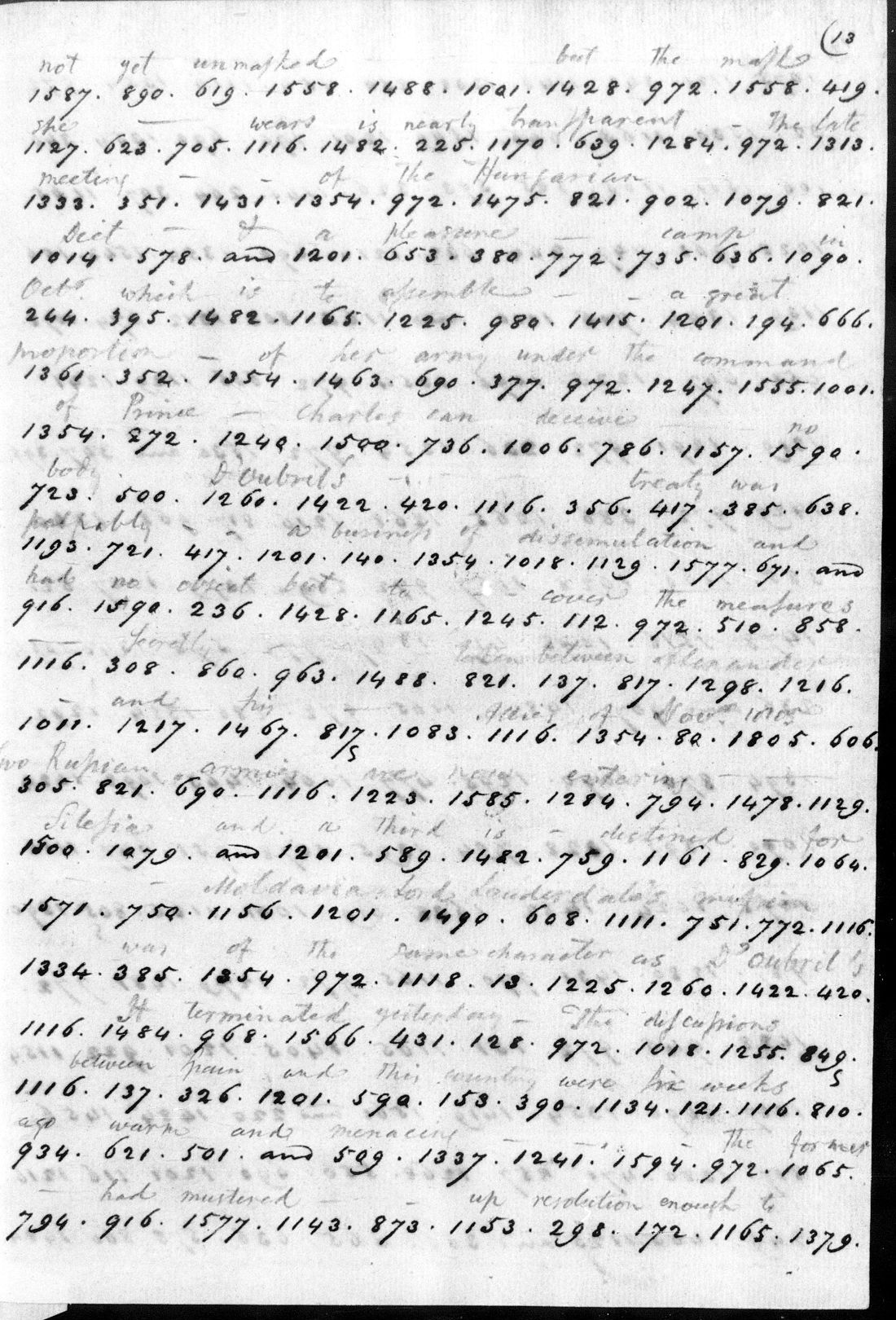
About 500 pairs were harvested this way, 352 of them read with confidence. Merged with the 4 May 1806 values the table stands at 580 distinct groups (§7). Ambiguities in the pencil (the roll is a 1940s microfilm of faint graphite) were resolved by requiring each reading to sit in its alphabetical slot and to recur consistently across frames.
3.3 Interpolation
Twenty groups needed for the postscript and the February letter were not in either source. Each was inferred from context and then checked against its alphabetical slot; all twenty fit. Examples: 1394 between 1393 purp and 1395 Italy must open a new run — and it reads ru in three independent places (ru-in, Et-ru-ria, Y-ru-jo); 250 lies between 249 other and 252 own and reads ought; 1273 between 1272 eight and 1279 Emp reads el; 384 between 383 w and 385 was reads ward; 1320 between 1319 li and 1325 long reads like; 1483 between 1482 is and 1484 it reads ish.
3.4 A control text: the letter of 22 February 1808
Armstrong's private letter of 22 February 1808 (Founders 99-01-02-2733) contains about 150 code groups embedded in a clear political survey of Europe. It shares no groups of interest with the known-plaintext letter, so it serves as an independent check. With the merged table it reads, with gaps:
The ruin of Gustavus is at last resolved. Russia is to seize Finland, while France & Denmark take possession of Sweden. Denmark cannot ha[ve] very willingly … independence. And it is certainly amongst the most cruel circumstances of the British attack on her Capital that it … her … of her … and [like]wise … of conduct, and thrown her completely into the arms of France, while the Danish Minister was this morning pouring out his complaints to me upon this subject, and stating the … of his government and the means taken by it to avert the introduction into Denmark of a general army … of Hamburg waited in the antichamber, with the intelligence that the Prince of Ponte Corvo had already entered Holstein … There is no one of even tolerable knowledge and sagacity who does not see this. Yet wonderful to tell Russia not only does not … but actually assists him in accomplishing one half of the object. Can Finland compensate for a state of things which shall put it in the power of France to lock up the Baltic …?
The sentences that come out whole — the ru-in of Gu-sta-va-us is at last resolve-d, the Dan-ish Minister was this morning po-ur-ing out his com-plain-t-s to me upon this sub-ject, a-ve-rt the in-t-ro-duct-ion into Denmark, as-sist-s him in ac-com-pli-sh-ing one half of the object — confirm the table and fix the values ru, ish, Russia (305, which the pencil on frame 0200 also gives) used in the postscript. One group there is anomalous: 946 is on in the 4 May 1806 letter but must be Gu in Gustavus (914 = gu elsewhere) — a homophone, or a slip in the manuscript or the transcription.
04 Decipherment of the postscript
| Group | Value | Source | Group | Value | Source |
|---|---|---|---|---|---|
| 1394 | Ru | inferred; ru-in, Et-ru-ria, Y-ru-jo | 1013 | di | 4 May 1806 |
| 1116 | s | pencil; 4 May 1806 | 750 | da | pencil (Mol-da-vi-a) |
| 1273 | el | inferred (1272 eight < el < 1279 Emp) | 967 | te | pencil |
| 250 | ought | inferred (249 other < ought < 252 own) | 1459 | he | pencil; 4 May 1806 |
| 1165 | to | pencil; 4 May 1806 | 1482 | is | pencil; 4 May 1806 |
| 1405 | be | pencil (four frames) | 1202 | above | slot 1201 a < above < 1209 Agent |
| 972 | the | pencil; 4 May 1806 | 1561 | men | pencil (thirty thousand men) |
| 148 | consul | slot 146 confide < consul < 151 contrary | 927 | him | 4 May 1806 |
| 1459 1482 | he is | 1090 | in | pencil; 4 May 1806 | |
| 1201 | a | pencil; 4 May 1806 | 1052 | fit | slot 1050 fi < fit < 1062 fol |
| 821 | n | pencil; 4 May 1806 | 832 | ness | pencil |
| 130 | America | slot 128 yesterday | America < 137 between (new run) | 1482 | is | |
| 821 | n | 934 | O | pencil (ag-o); 4 May 1806 (vi-o-late) | |
| 1429 | by | pencil; 4 May 1806 | 510 | mea | pencil (mea-sures) |
| 720 | bir | inferred (719 Ba < bir < 723 bo) | 860 | ly | pencil; 4 May 1806 |
| 970 | th | pencil (stre-en-th) | 1459 1482 | he is | |
| 1482 | is | 1320 | like | inferred (1319 li < like < 1325 long) | |
| 992 | qua | inferred (< 993 qui) | 384 | Ward | inferred (383 w < ward < 385 was) |
| 1319 | li | 4 May 1806 (catho-li-c) | 1280 | en | pencil; 4 May 1806 (se-en) |
| 1048 | fi(ed) | inferred (1046 fi … 1052 fit) | 1216 | an | pencil; 4 May 1806 — MS reads 1216, Founders 1218 |
| 584 | than | pencil (frame 0194) | 1481 | ir | pencil; 4 May 1806 |
| 687 | any | pencil | 1483 | ish | inferred (1482 is < ish < 1484 it); Dan-ish |
| 249 | other | pencil; 4 May 1806 | 555 | [man] | MS 555 = re; read as slip for 1555 man (see §6) |
| 736 | can | pencil (can deceive) |
green = pencil decode on roll 13 · blue = 4 May 1806 known plaintext · amber = uncertain reading or slot inference · red = inferred here from context and alphabetical position
P.S. Ru-s-el ought to be the consul: he is a-n America-n by bir-th, and is much better qua-li-fi(ed) than any other can-di-da-te. In a word he is above men in general. Next to him in fit-ness is O-mea-ly, but he is like Ward-en an Ir-ish-[man].
4.1 The people
- Warden. David Bailie Warden (1772–1845), born in County Down, a United Irishman exiled in 1799, naturalised American, Armstrong's private secretary and then secretary of legation. He was the front-runner for the vacant Paris consulate and got it; Armstrong removed him in 1810, and when Madison reinstated him in 1811 Armstrong protested in a letter of 3 March 1811 that Warden was "without a single grain of attachment to the U.S." and asked whether "our own country furnish[es] no native citizen willing & able to fill the consulate at Paris". The postscript shows the same animus three years earlier, and its cause: Warden was not American-born.
- O'Mealy. Michael O'Mealy, a Baltimore merchant resident in France since 1793 and still there in 1810 (identified in the Papers of James Madison, Secretary of State Series 10:497 n. 2). The name — of obvious Irish origin — is spelt O-mea-ly.
- Russel. Spelt Ru-s-el. The most probable candidate is Jonathan Russell of Providence, Rhode Island (1771–1832), a merchant in the European trade whom Madison did in fact appoint chargé d'affaires at Paris when Armstrong left in 1810; the identification is inferential, since no other document places him in France in 1808.
05 Method
- Collect the ciphertext. Founders Online transcriptions of Armstrong's coded letters (4 May 1806, 22 February 1808, September 1807, 30 August 1808) were gathered, and the LOC manuscript images of the 30 August letter retrieved for collation.
- Locate a Rosetta stone. The NARA catalogue entry for M34 roll 13 was downloaded (393 frames). A simple image score — the proportion of mid-grey pixels not adjacent to dark ink — ranked frames by the amount of pencil on them and pointed to frames 0192–0201.
- Harvest. Each annotated frame was cropped into thirds, contrast-enhanced, and read group by group; every pair was recorded with frame/line and a confidence grade (H/M). Groups seen on several frames were cross-checked.
- Merge and rank. A script merges the 4 May 1806 values, the harvested pairs and the inferences, ranking readings H > C > M > inferred, and renders any coded passage with unknowns and doubtful values flagged.
- Infer and verify. Remaining gaps were filled by context and checked against the alphabetical slot; the 22 February 1808 letter served as the independent control.
- Collate the manuscript. The LOC image of the postscript was enlarged to check every group against the Founders text.
06 Corrections to the printed transcription, and one residual doubt
- Founders prints
1218in the last line; the manuscript reads1216(an), which is also what the sentence requires. - Founders prints
970.at the start of the second line where the manuscript has972.(the). The fourth-line group is1319(li), as printed. A pencil s below1116on the Library of Congress copy shows that a reader in Washington began, and abandoned, a decode. - The final group is
555both in Founders and in the manuscript. 555 is re in the code (frame 0195: sco-re), which makes no sense after Irish, whereas 1555 is man (frames 0195, 0200: the command of Prince Charles, man). The reading Irishman assumes Armstrong dropped a digit; the alternative — that the postscript breaks off with "an Irish re–" — is noted for completeness. - In the 22 February letter Founders'
631(wise) in "his com-631-t-s" is almost certainly651(plain), and916(had) in "Denmark cannot 916 very willingly" is probably921(have); both are single-digit slips of the kind the microfilm hand invites.
07 Try the key
Paste code groups separated by spaces or points; clear words may be left in place. Each group is shown with its value written above it,
as the Department clerk did in pencil. Colours: green pencil decode or known plaintext, amber
uncertain, red inferred; ? = unknown group.
Reconstructed table (580 groups)
Grades: H pencil decode (roll 13), C known plaintext of 4 May 1806, M uncertain pencil reading or slot inference, I inferred here.
Source data with frame references: armstrong/pairs.txt in the repository.
08 Sources
- Library of Congress, James Madison Papers, Series 1, General Correspondence, reel 10: "J. Armstrong to James Madison, August 30, 1808. Postscript in Cipher", mjm015002; "J. Armstrong to James Madison, May 4, 1806", mjm014590.
- Founders Online, Early Access documents Madison/99-01-02-3466 (30 Aug 1808), 99-01-02-2733 (22 Feb 1808), 99-01-02-0393 (4 May 1806); Armstrong to Madison, 3 March 1811, 03-03-02-0258; John Mitchell to Madison, 4 Nov 1805, 02-10-02-0473 (n. 2, O'Mealy).
- National Archives, RG 59, Despatches from U.S. Ministers to France, M34 roll 13, NAID 188671172, frames 0192–0201.
- S. Tomokiyo, "Unsolved Historical Ciphers", cryptiana.web.fc2.com, and "Decoding Revolutionary Correspondence: Armstrong to Madison", decode20.htm.
- Ralph E. Weber, United States Diplomatic Codes and Ciphers, 1775–1938 (Chicago, 1979), pp. 154, 188.
- C. Edward Skeen, John Armstrong, Jr., 1758–1843: A Biography (Syracuse, 1981).
Code used (Python: frame scoring, table merge and renderer) and the harvested pair list are in the repository.