01 The record
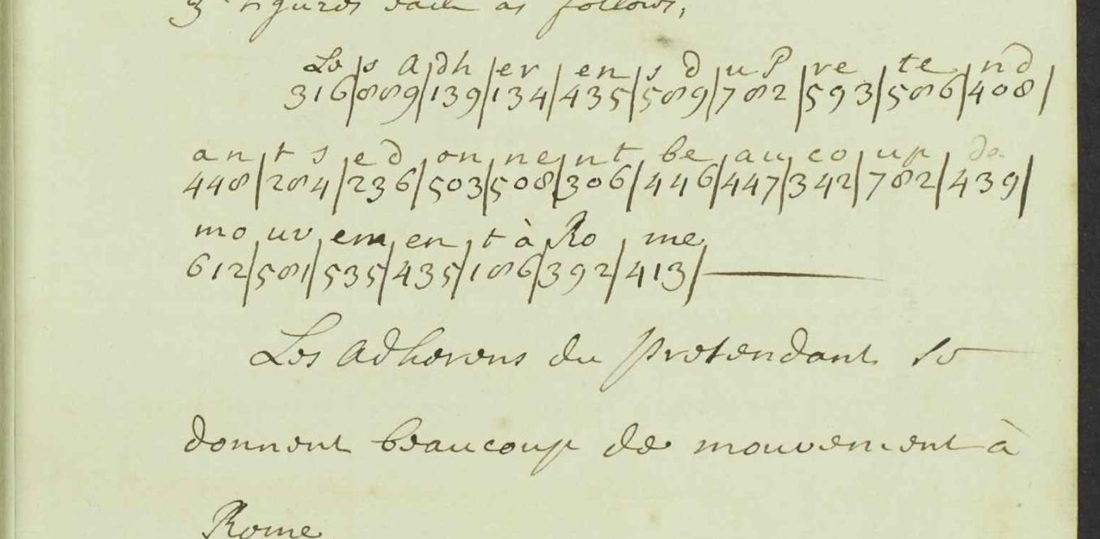
DECODE R597 (“TNA_SP106/7_Anne_(0091-0092)”) has two images. Its date, 1702–1837, is the span of the volume. Its metadata give cleartext English and plaintext French, cipher type nomenclator, symbols numerical, status “Partially decrypted”. The record note reads: “Part of letter with instructions for operating the Cipher with Baron Stosch and Mr. Walton … there are also lines unsolved. The nomenclature in question could not yet be identified.” Image 2 is f. 33 and holds the start of the text. Image 1 is the bifolium opened out, with the rest of the text on the left leaf (upside down in the scan) and the paragraph on nulls on the right.
02 The text
Transcribed from the images. The interlinear syllables are the writer's own. [?] marks a doubtful figure.
In the inclosed Cypher (which serves only to correspond with Baron Stosch and Mr Walton who reside at
RomeFlorence) is to be perceived one in Numbers consisting of 3 Figures each as follows,Le s ad her en s du Pre te nd 316|509|139|134|435|509|702|593|506|408| an t se don ne nt be au co up de 440|204|236|503|508|306|446|447|342|702?|439| mo uv em en tà Ro me 612|501|535|435|106|392|413|——Les Adherens du Pretendant se donnent beaucoup de mouvement à Rome.
Or to puzzle it more after having made use of the Key A. in black Ink, as far as [Donnent] inclusive, which answers 371. which denotes [Changement de Clef] that the Key alters, and then put the Remainder of this Sentence into the Cypher B. the Numbers in red Ink and it will stand thus.
—   be  au  co  up  de  mo  uv  em
371|436|433|342|218|446|678|417|553|
en  tà  Ro  me
453|023?|620|477|
The chief art of this Cypher consists in the Numbers running on without distinction till a distribution of them is made as above, by three in a parcel, by the person who deciphers, and that you make use of two Keys alternately at pleasure. [When you write you put no Stops, as in our Ordinary Cypher, but write thus, 371436433342218446670 4175534530236208477.]
You have several Nulls to intermix as 110. 220. &c and all above 900 are so. You make use of no Numbers under 100 or above 999.
The example sentence means “The Pretender's adherents are very busy in Rome”. That is the kind of news Stosch sent home about the court of James Francis Edward Stuart.
03 The system
- Code. Three-digit groups stand for syllables and letter pairs (le, s, ad, her, en, du, pre, te, nd …). DECODE's “letter pairs rather than words” is right. A repeated syllable keeps its group within one key (s = 509 twice, en = 435 twice in key A).
- Two keys. Key A and key B give different groups for the same syllable (be 446 / 436, au 447 / 433, mo 612 / 678). The writer switches at will, and 371 announces the switch.
- No separators. The groups run on and the decipherer cuts them into threes. This is the point where the sheet contrasts the method with “our Ordinary Cypher”, which used stops.
- Nulls. The round hundreds-and-tens groups 110, 220 and so on, and every group from 901 to 999.
04 What remains uncertain
- In key A, 702 appears for both “du” and “up”. One of the two is probably a slip by the writer or a misreading (grade C).
- In key B, the group for “tà” is written 023, which falls below the stated range of 100–999 (C).
- The run-on demonstration does not match the separated groups digit for digit (…446670… against 446|678, and …6208477 against 620|477). The writer copied it loosely (C).
- Only the 30 groups of the example are known. Keys A and B are not on the record. Whether one of the 16 SP 106 key records on DECODE is one of them has not been checked.
- The writer and the recipient are not named. The date c. 1731 is inferred from the Florence correction.
05 Sources
- The National Archives, Kew, SP 106/7, images 0091–0092, via DECODE R597 (images behind login).
- On Stosch as “John Walton”: Lesley Lewis, Connoisseurs and Secret Agents in Eighteenth-Century Rome (London, 1961).
Notes and transcription: sp106r597/ in the repository.