01 The dossier and what was on the records
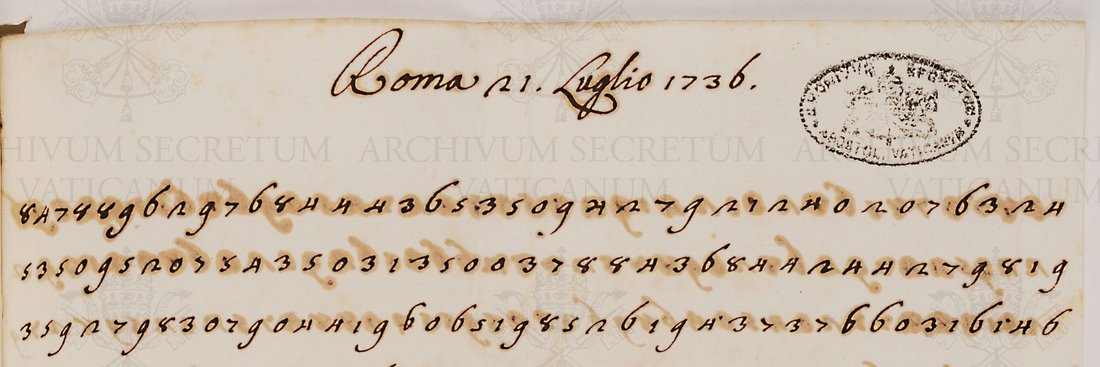
Spagna 423 is described in the Vatican index (i. 1025) as “Lett. originale e ciffre della Segretaria alla nunziatura, dal 7 gennaio 1736 al 29 dicembre 1736”. The catalogue took its “7 Jan 1736” from that heading, but the ciphered items run from 14 July to 22 December 1736. The clear dates on the transcriptions are 14 and 21 July, 4 August, September, 29 September (two), 6 October, 15 and 22 December. The dockets name the addressee as “Sig. Ab. Guiccioli, Madrid”. There are eleven items (423/1–11) across ten DECODE records.
Each record carries three attachments: the item’s raw digit transcription (Matt F and NiLan, 2015–17); Lasry’s key, “#KEY: reconstructed · ASV - S423 · George Lasry · October 24, 2020”; and a single file holding his decipherment of the whole dossier, the ciphertext split into elements with the plaintext aligned underneath.
02 The system
- An undivided digit stream. Two-digit elements stand for letters (
05|20|26= a,03|49|65= e) and for syllables and short words (93quel,52per,40non,60gli). - The digit 7 is a null, except inside a nomenclator group.
- Four-digit nomenclator groups begin with 1 (1130–1985). The corpus uses 166 distinct groups.
03 Method
Lasry’s aligned decipherment was parsed into 9,001 tokens, and each unvalued group was listed with every context it appears in. In 1718 the nomenclator ran alphabetically and the neighbouring values bracketed each gap. That does not work here: 1222 is -mente, 1245 -zione, 1882 Spagna, 1935 V.S., in no order. So each value had to be inferred from its contexts, and it was accepted only when it gave sense in all of them. The frequent groups are anchored many times over: 1222 in 44 places (somma-, diffusa-, pari-, facil-, destra-, minuta-mente), 1655 = N.S. in 21 (“N.S. è rimasto sommamente amareggiato”, “le giuste istanze di N.S.”).
04 The recovered groups
| group | value | evidence |
|---|---|---|
| 1222 | -mente | somma-, diffusa-, pari-, facil-, sicura-mente (44×) |
| 1245 | -zione | na-, situa-, esecu-, considera-, disapprova-zione |
| 1655 | N.S. | “ha N.S. lodato”; “pensando N.S. alla condotta” |
| 1935 | V.S. | “scritte da V.S. in data dei …”; “si manda a V.S. copia” |
| 1849 | S. Sede | “tumulti contro la S. Sede”; “li diritti alla S. Sede” |
| 1388 · 1882 · 1606 | Cort- · Spagna · Napoli | “alle Corti di Spagna e di Napoli” |
| 1392 · 1240 | codest- · quest- | “illuminare codesta Corte” (Madrid); “questa S. Sede”, “questa sera” (Rome) |
| 1242 · 1241 · 1259 | tutt- · molt- · altr- | “con tutta la sicurezza”; “in molte guise”; “uno per la … e l’altro per il” |
| 1320 | Brev- | “Brevi, uno per la [1828] e l’altro per il Sig. …”; “il Breve arrivi sicuramente” |
| 1863 · 1329 | Sig. · Card. | “Sig. Card. Acquaviva”; “creando un Card.” |
| 1234 · 1594 | Nunzi- · Ministr- | “i nostri Ministri, i Nunzi” |
| 1803 | princip- | “contro ogni principio di pietà”; “il cuore de’ Principi” |
| 1885 · 1802 · 1692 | stat- · prim- · port- | “la Corte è stata sorpresa”; “il primo tumulto”; “falsi rapporti”, “Portogallo” |
| 1423 · 1908 | dovre- · temp- | “non dovrebbero mai servire di esempio”; “da tempo immemorabile” |
| 1614 · 1865 · 1511 · 1820 | notizi- · grazi- · giust- · Re | “una tal notizia”; “alle grazie accordate”; “per giustificar”; “cedola Reale”, “Regalista” |
Less certain, on fewer contexts: 1208 cos-, 1210 restar, 1635 obblig-, 1925 Vescov-, 1239 ecclesiastic-, 1219 ancora, 1889 stess-, 1229 affinché, 1690 mi-, 1943 passat-, 1612 nomin-, 1608 maggior, 1238 quant-, 1231 anch-, 1693 poss-, 1818 inform-. The full list is in key_extra.txt.
05 A sample: the opening of 423/1 (14 July 1736)
Lasry’s letters with the recovered groups applied, lightly normalised; square brackets mark groups still open:
… a quanto diffusamente [1853] in piano stimo maggior di aggiungere in [1846] de’ suoi numeri degli [1953] passato. N.S. è rimasto sommamente amareggiato nell’udire che codesto [Mons.?] Molina, scordatosi degli obblighi di Vescovo e regolare, si unisca in questa [1368] [1201] dei tumulti contro la S. Sede, e per iscusa di una condotta al giudizio di ognuno molto irregolare si ponga [1389] in vista l’affare […] e le grazie accordate … le altrui violenze non dovrebbero mai servire di esempio …
His Holiness is “most bitterly grieved” that Molina, forgetting his duty as a bishop, joins in the tumults against the Holy See. Gaspar de Molina y Oviedo, Bishop of Málaga and Governor of the Council of Castile, led the Spanish side of the 1736 dispute.
06 What the despatches are about
In spring 1736 Spanish recruiters took men by force in Rome and the Papal State (“arrolamenti”, “ingaggiature”, “arrolatori”), which set off riots in Trastevere and at Velletri. Spain and Naples broke with Rome. The despatches deal with the tumults “contro la S. Sede”, Cardinal Acquaviva, the Duke of Montemar, Bishop Molina, the expulsion of the nuncio and the pensions at the Court of Naples. From October they turn to the Dataria, the padronato reale over benefices, the “Regalista” doctrines of the Madrid junta, Briefs to the King and Queen, and the nomination to cardinals’ hats (“col maggior numero di cappelli”).
07 What remains open
- 120 nomenclator groups (284 tokens), most seen once or twice. The main ones are 1591 (16×; “la Maestà” fits most contexts, but not “gli arrolamenti [1591]i”); 1596 (11×, before “Molina” and before the pair 1513-a-1382, probably “Mons.” with a title of Molina’s); 1236 (9×, a conjunction); and the date numerals 1953, 1957, 1960, 1964, 1985.
- 136 two-digit tokens that the transcribers could not read off the page (“?” in the source). These need the images, not the key.
- The values marked less certain above rest on two to four contexts each.
08 Sources
- Archivio Apostolico Vaticano, Segreteria di Stato, Spagna 423, items 1–11; DECODE records R26 (item 1), R179–R188 (images behind a login).
- George Lasry, reconstructed key “ASV - S423” and segmented decipherment, 24 October 2020, filed on the same records.
- Companion case: the Secretariat to the Nuncio in Spain, 1718–1720 (Spagna 364D), also solved by Lasry, where the nomenclator was alphabetical.
Files, parser, context viewer and the recovered values: nunzio1736/ in the repository.