01What the catalogue says, and what is actually there
The seven records are all headed TNA_SP106/10_UND_(…) (UND for undated) and all carry the same span, 1558 to 1625, which is the date range of the volume.
The cataloguer had, however, already seen what the file was, and said so in a note on the first record:
“This is clearly the worksheet of a codebreaker. This can be derived, not only from the fact that the lines of code are only partly decrypted, but also from the various code-sequences scribbled in the margin with identical codegroups in the middle. The handwriting seems to indicate that this document is probably late Tudor or early Stuart in origin, but except for Thomas Phelippes who worked for Walsingham, no other codebreakers from this period are known.”
| DECODE | shelfmark stub | pp. | what it is |
|---|---|---|---|
| R657 | ff. 128–138 | 9 | worksheets, two-figure system |
| R660 | ff. 139–140 | 2 | intercept, 15 lines, solutions above the groups |
| R664 | ff. 167–169 | 3 | intercept, ~500 groups in 45 numbered lines |
| R704 | ff. 186–187 | 2 | intercept, 46 numbered lines, ~700 groups |
| R720 | ff. 188–189 | 2 | worksheets |
| R721 | ff. 190–192 | 3 | intercept, 26 lines, ~300 groups |
| R722 | ff. 193–195 | 3 | intercept, like R704 and R721 |
| R725 | ff. 202–203, 205 | 3 | the key: “Alphabet of Letters and Wordes” |
R725 is catalogued as a key, so it falls outside the seven, and without it the seven have no key. It sits eleven folios after the last of them in the same volume, in the same hand, and gives the key of their first cipher (system A, section 04).
02The key sheet, and the cipher in the codebreaker’s own words
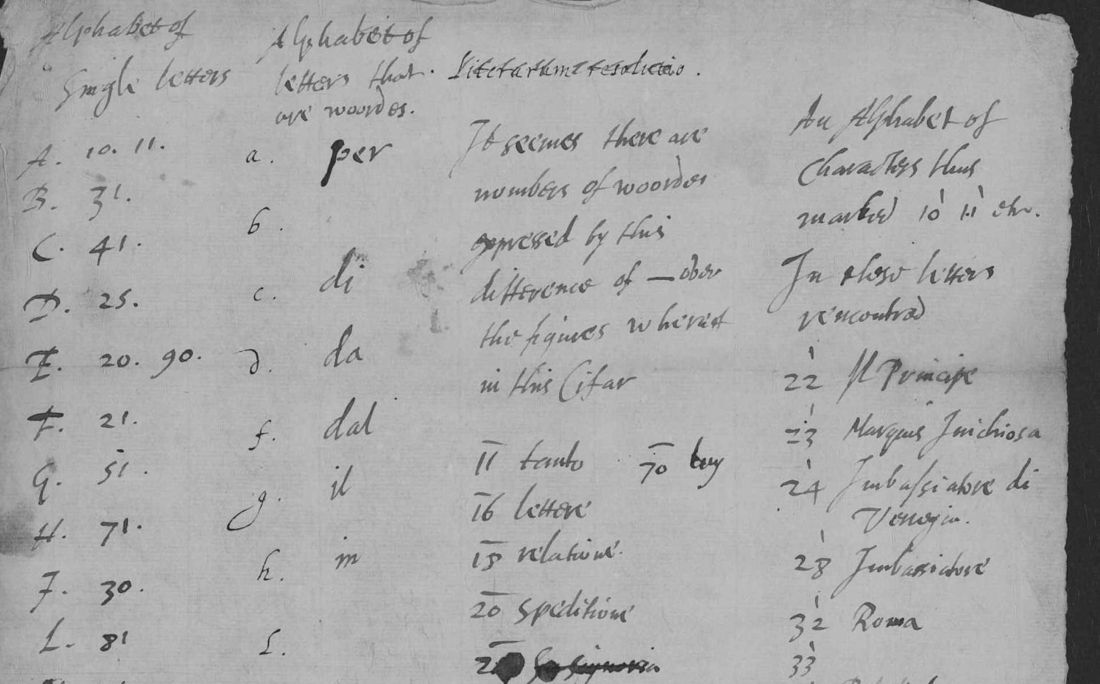
The third page of R725 is a fair copy in four headed columns. The first is “Alphabet of Single Letters”:
P 42 · Qu 72 · R 22 · S 94 · T 92 · V 50 · Z 93 · (X blank)
The rougher draft on p. 1 of the same record gives D as 29, V as 90, and adds the line “X. Z. & serve to bee Nulles”; p. 3 is the corrected state.
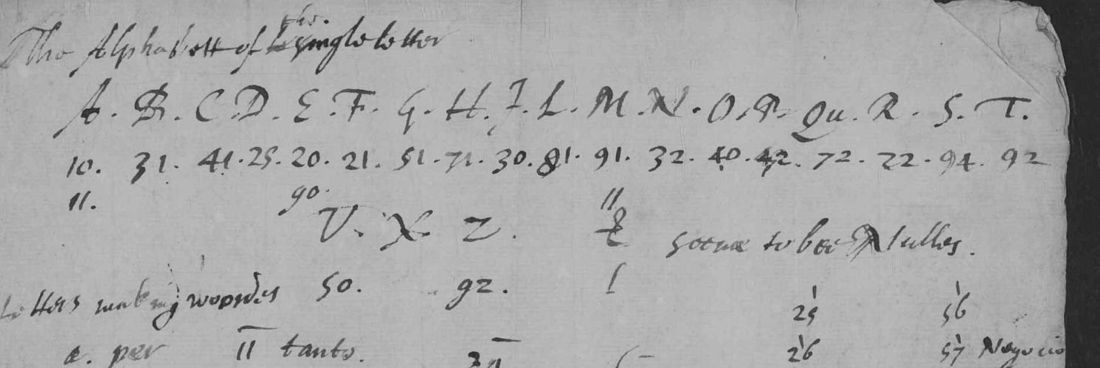
The second column, “Alphabet of letters that are woordes”, is a second device of the same cipher: a written letter standing for a whole word.
q = et · r = con · t = non · v = chi · x = si · z = che
The third column is headed Literarum resolutio, and under it the codebreaker writes the sentence that states the rule of the system:
“It seemes there are numbers of woordes expressed by this difference of — over the figures whereof in this Cifar.”
A bar over a two-figure group makes it a word instead of a letter. The values he had recovered for the barred list are 11 tanto, 16 lettere, 18 relatione, 20 spedditione, 26 V. Signoria, 27 V. Paternità, 29 Sua Signoria, 30 uno, 37 Re d’Inghilterra (the draft writes Re di Britania), 42 Padre, 52 liga.
The fourth column is headed “An Alphabet of Characters thus marked 10′ 11′ etc. In these letters encountred”: a third meaning of the same two figures, marked this time with a tick:
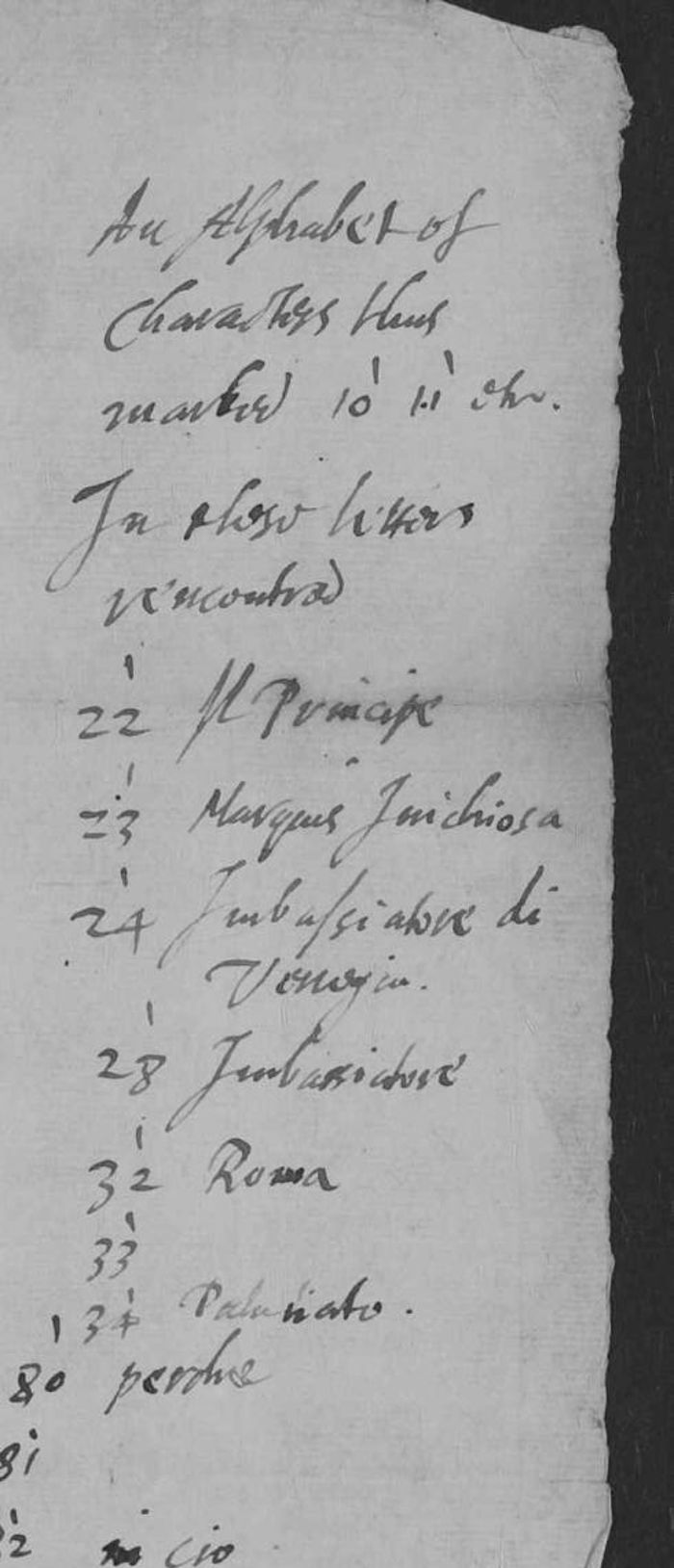
49 Cattholico · 50 Stato · 57 Negocio or Occasione · 66 acciocche · 67 C. Barberino · 69 Governo
71 havere · 73 habuto · 77 mento · 80 perche · 82 in cio · 84 questo or questa · 85 quello or quella · 89 tutte · 90 Papa · 91 Nuncio
So one two-figure group has three possible meanings, selected by a diacritic: bare, it is a letter; barred, a word of the first list; ticked, a word of the second. The codebreaker recovered this system from the intercepts.
03The vocabulary dates the file to 1623–24
DECODE dates these records “1558–1625”, the span of the volume. The words the codebreaker recovered date them closely, because they belong to one year:
- Marques Inichiosa: the Marqués de la Inojosa, Spain’s ambassador extraordinary in England from the spring of 1623 until he was recalled in the summer of 1624.
- C. Barberino: Francesco Barberini was made cardinal in October 1623, the nephew of the Pope elected that August.
- Il Principe and Re d’Inghilterra: Prince Charles and James I, with the Prince distinguished from his father, as he was in every despatch of the Spanish Match.
- Palatinato, liga, Papa, Nuncio, Imbassiatore di Venetia, Stato, Governo, Cattholico.
That is the London of 1623–24: the Prince back from Madrid, the Spanish embassy under suspicion, the Palatinate unrecovered, the papal dispensation and the Venetian ambassador at the centre of the traffic. The intercepts are Italian letters passing through or out of that embassy world, and the file is the English government’s work on them. That also puts the codebreaker outside the frame the DECODE note suggested: Phelippes died in 1625 and had long been out of favour; this is his successors’ work.
04The file holds three ciphers, not one
Going through all twenty-two ciphertext pages shows three distinct systems, which the catalogue does not separate:
| system | records | form |
|---|---|---|
| A. two-figure nomenclator | R657 worksheets; key R725 | 10 11 31 41 …, bare / barred / ticked |
| B. three-figure syllabic code | R660, R664; worksheets R720 | 533 359 515 …, inline with clear Italian |
| C. letter-and-figure syllabary | R704, R721, R722 | Z6 n54 m56 g42 … b41 b33 |
One correction to the catalogue follows. DECODE files R720 as “worksheets of a codebreaker, possibly related to the intercepted letter in R704”. R704 is written in system C, with letter-and-figure groups; R720’s worksheet is covered in three-figure groups and trial Italian word-lists. R720 belongs with R660 and R664, and not with R704.
05System B: values from the interlinear glosses
R660 and R664 are letters written half in cleartext and half in code. The writer enciphered the words that mattered and left the Italian connecting phrases in clear, which gave the English codebreaker his cribs, and gives them now. One whole line of R664 stands in the clear, and it is about the cipher itself:
“potrete continuare nel modo cominciato, osservando però il [mutamento … alle volte … col … numeri suppositi]”
The codebreaker wrote his solutions above the groups, syllable by syllable. Aligning those syllables against the figures gives the code back. About forty-five values were fixed this way, each fixed by a word that admits no other division:
252 se · 253 si · 254 so · 260 ta · 261 te · 262 ti · 263 to · 316 ta · 319 cu · 320 in · 340 lettere
344 el · 356 i · 357 l · 359 n · 366 col · 411 que · 430 a · 433 la · 434 le · 436 lo · 456 o · 459 r
461 ve · 463 volte · 468 quello · 515 da · 516 de · 518 do · 535 mi · 536 mol · 537 mu · 542 quan · 544 gua · 560 za · 568 vostre

211 433 436 154 253 319 152 560 … with del·la·lo·ro·si·cu·re·za written above: “della loro sicurezza”. Image: The National Archives, Kew, SP 106/10 f. 167, via DECODE R664 (p. 1).With these values line 38 decrypts as follows:
del la lo ro si cu re za ? n do ? la
and lines 41–42, with a word running over the line break:
et (in the clear) quel le de nu o ve se n za
“et hoggi terzo giorno quelle de nuovo senza…”
06Method, and the check that the alignment is sound
All of this depends on matching the codebreaker’s interlinear syllables to the right groups, and a one-group drift would produce plausible nonsense.
The alignment produced one apparent contradiction, and its resolution supports the rest: group 252 was glossed sen in one line and se in another, and 359 za in one line and n in two others.
Both resolve if the word senza runs over the end of line 41 (252 se + 359 n closing the line, 560 za opening line 42), which is what the manuscript shows.
After that correction no value in the table above conflicts with any other across lines 34–45.
The images came from DECODE with the project’s login; all of them are written across the page and had to be rotated before transcription. No solver was used. The codebreaker did the cryptanalysis four hundred years ago; the work here was to find the sheets on which he wrote it down, transcribe them and apply them.
07A fourth letter: the “Venetian cifar” dossier (R703 and six siblings)
Catalogue entry 66, DECODE R703 (ff. 184–185), belongs to this file and is a worksheet. Its second page is a positional index headed linea: every group from 200 to 399 with the lines where it stands (280. 2.6.9.20) and notes such as “201 is a finall sillable after an entire word”. Its first page, half upside down, carries glossed fragments (l.2 280 367 464 432, l.7 245 510 Almeno, l.14 297 506 395 e che quello, l.46 540 464) and grids of trial syllables.
The fragments come from a three-figure letter of 46 numbered lines that the first two sessions took to be missing from the DECODE images; it is R722 (section 08b). It is not R664 or R660: in R660, 540 is Spagnoli, and the index does not list the lines where R664 uses 211. The same lost letter is worked on six more records that DECODE lists separately: R661, R667 (tally grids of every group 200–599), R684, R701, R702 (with an Italian–English word list copied from a dictionary) and R720. R701 names the system in the codebreaker’s hand: “Wordes marked wth letters in the Venetian Cifar” (369º nostro, 467º questo, 420i altri, 233r esser). System B is therefore the Venetian cipher, and a superscript letter on a group marks it as a whole word.
His partial key for the letter is on R701 p. 3. It is a syllabary in which the last digit steps through the vowels:
333–336 cha che chi cho · 366–370 la le li lo lu · 375–378 da de di do
This key does not decipher the fragments. It values four of the 28 groups quoted on R703, and the codebreaker’s own glosses contradict it (R702 glosses 244 as ta). He had not broken this letter when the file stops. R703 is explained; its fragments are not deciphered. The intercept itself was found on 21 September 2026: it is R722 (below).
08The rest of the file: the codebreaker’s own table of “the Venetian Cifer”
DECODE lists seven further records from the same box as another set of anonymous ciphertexts (R658, R661, R663, R667, R684, R701, R702; catalogue item 62). None is an intercept. All are in the same hand as the rest of the file: count grids, syllable drills, Italian–English dictionary trawls, and one English political draft in clear (on cutting off “that supply of treasure that the K. of Sp. hath for the Indies”) reused as scrap paper. Two of them matter. R701 heads a list of word groups “Wordes marked with letters in the Venetian Cifer”: 369° nostro, 467° questo, 430a passata. The same words stand in the side column of R658, and R658 is the codebreaker’s table of the three-figure code of R660 and R664: every group from 136 to 565, with a count of its occurrences below it and his value above it.
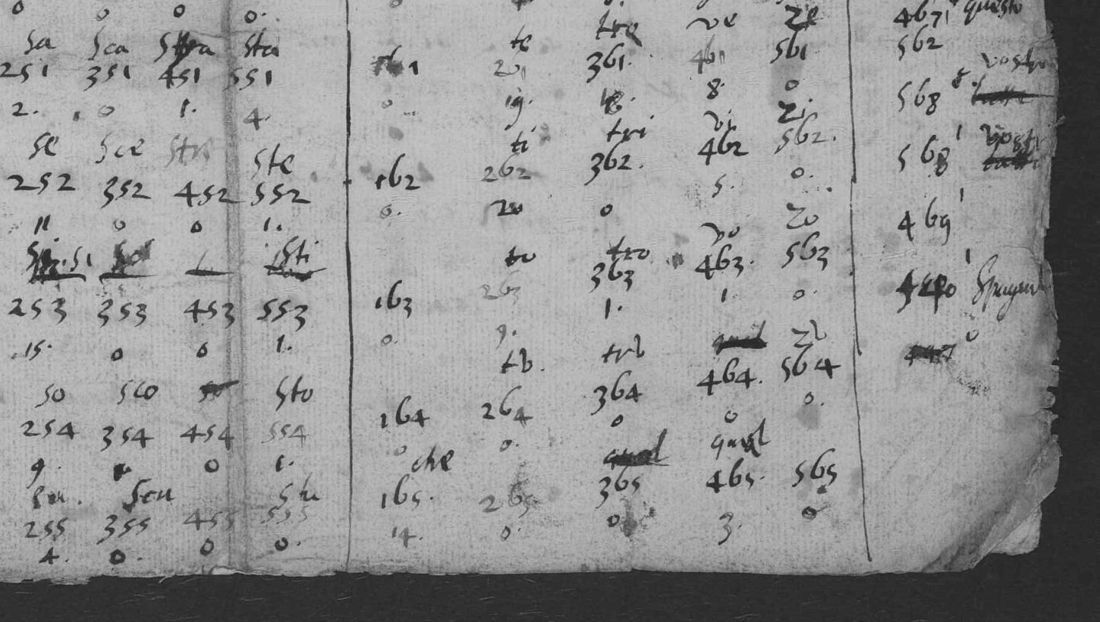
The grid shows how the code was made. Each consonant takes five consecutive rows in the order a e i o u, and each hundreds column a different consonant: 151–155 ra…ru, 251–255 sa…su, 351–355 sca…scu, 551–555 sta…stu; 260–264 ta…tu, 360–364 tra…tru, 460–463 va…vo, 560–564 za…zu; 433–437 la…lu, 142–146 na…nu, 242–246 pa…pu, 442–446 pra…pru, 542–545 qua…quo; the row x56 holds the bare vowels, x57–x59 single consonants (357 l, 359 n, 459 r), and a handful of groups are whole words (339 liga, 340 lettere, 439 per, 165 che, 465 quel), their ending given by a superscript letter. With the table, the code has 117 values, 102 of them written by the codebreaker and 15 predicted by the pattern.
The check is R702, where he wrote out group strings with his own glosses. Every one of its 46 groups is in the table, and every string decodes to his gloss:
252 359 518 253 → se·n·do·si “sendosi” · 167 252 459 253 → con·se·r·si “conservarsi”
165 245 556 253 156 526 445 534 261 459 → che·po·s·si·a·mo·pro·me·te·r “che possiamo prometter”
The same sheet glosses di 24 di maggio, del campo, per nome suo, sono capitate and efficacia: the letter he was working on was written in late May and spoke of a camp and of colonels. The table also corrects four values of section 05, which came from aligning glosses on R664 alone: 260 is ta, 262 ti, 263 to and 459 r (they had been taken as mento, to, ti and v), and 316 ta does not fit the ca…cu run it stands in.
This is a different table from the one the codebreaker was building for the lost 46-line letter of section 07 (R701 p. 3: 244 ra, 245 re, 366–370 la…lu; on R658 244 is pi, 245 po, 433–437 la…lu), though it is built the same way. The words R701 lists under “the Venetian Cifer” are the words of R658’s side column, so on the sheets’ own evidence the name belongs to the code of R664 and R660; the lost letter is in a second table of the same kind, perhaps a later key of the same correspondence.
R701 also carries a five-line text in a letter cipher (Esg frp rohxog x rygo fa ombhpeip …), which a substitution solver run against five languages did not break.
08bThe “lost” letter is R722, a Venetian secretary’s letter of 1625
Catalogue entry 58 grouped four more anonymous SP 106/10 records (R656, R662, R722, R931). R722 had been filed with the letter-plus-figure records of system C, following DECODE’s pointers, and had not been examined in the earlier sessions. It is the 46-line letter of section 07: its first line ends 540 212 una di questi matine, the fragment R703 quotes as l.1 540 212 una che, and five more worksheet fragments stand in it verbatim (280 367 464 432, 340 367 misciandosi, 245 510 Almeno, 297 506 395 … e che quello, 313 541 377 238 254). It has 48 numbered lines, half in clear Italian and half in three-figure groups, with the codebreaker’s trial syllables between the lines. The endorsement reads “Cypher of a Venetian Secretary to the Embassador of that nation in …”, with “1625” on the fold.
The clear passages give its matter: Parmi che …, Io mi credo che questi siano …, Ho visto chiaramente che V. E. …, proposito che ella procurasse, di satisfattione con honor di …, il Spinola sotto Breda, di Bruselles si è inteso …, di Roma. Spinola besieged Breda from August 1624 until 5 June 1625, so the letter is of the first half of 1625, from a Venetian secretary to the Venetian ambassador in England. Of R722 the clear text and the endorsement are transcribed; the code is not deciphered, by the codebreaker or by this project. With the whole intercept in hand, every fragment on the worksheets can now be checked against its line.
The other three records: R656 is the back of an English Exchequer draft (a sheriff’s answer naming Nosse, Rowley, Sherborne and Franke) used by the codebreaker for more line fragments of R722, e.g. l.12 313 541 377 238 254. R662 is a torn strip of his English memorandum on how the code is built (“series of sillables beginning …”, “the vowels a.e.i. for every consonant”, “the most frequent … di”). R931 does not belong to the case: it is an English royalist letter of September 1645 in a numerical code of about 260 values (“(1) septembre 1645”, “earnestly”, “reasons” in clear). None of George Lasry’s 1645–46 SP 106 keys, the Goring key of the next record, or the Charles I–Culpeper key of 1645 fits it, and it stays open.
09What is uncertain, and what remains
- The letter values of system A are C (from the codebreaker’s own fair copy, and internally consistent); the draft’s D 29 / V 90 against the fair copy’s D 25 / V 50 is the one place he corrected himself, and the fair copy is followed here.
- The system B values listed above are C where a whole word fixes them (della loro sicurezza, senza, quelle de nuovo, che, et, volte, lettere, vostre) and M for the single-syllable values seen only once (245, 316, 344, 356, 357, 459, 544).
- Groups seen but not valued on R664 f. 1: 233, 312, 367, 439, 477, 534, 551, 556, 560 in its second sense, 566. Several dozen more stand on ff. 2–3.
- The dating is C: it rests on Marques Inichiosa together with C. Barberino, and no single one of the names would carry it alone.
- The Venetian-code table (section 08) is H for the 102 values the codebreaker wrote and M for the 15 predicted from the pattern; 440 Spagn… and the value of 556 (s in R702, unclear on the grid) are M. Which of the two three-figure tables R701’s heading names is C.
- Open from catalogue 62: the short letter cipher on R701 and the English draft on R661 (not identified).
- Not done: the gloss-alignment pass over R664 ff. 2–3, R660 and the R720 worksheets, which should carry system B to a complete decipherment of both letters; the same treatment of system C on R704 and R721; the second three-figure code of R722, now that the intercept is found; R931 (1645), for want of a key; R657’s nine pages against the R725 key; and the identification of the correspondents and of the codebreaker.
10Sources
- The National Archives, Kew, State Papers 106, box 10, ff. 8, 20, 67, 125, 128–138, 139–140, 141–143, 164–166, 170–171, 175–177, 181–185, 167–169, 186–187, 188–189, 190–192, 193–195, 202–203, 205 and 251.
- DECODE (de-crypt.org) records 657, 660, 664, 704, 720, 721, 722, 656, 662, 931, the worksheets 658, 663, 661, 667, 684, 701, 702, 703 and the key 725. Images are login-only and are not reproduced beyond the details shown here.
- The partial decipherment used here is the contemporary one, written on the documents themselves; no modern edition of SP 106/10 exists. The published transcriptions of SP 106 cover volumes 1–4 only.
Working files, the full key transcription and the recovered code table are in sp106box10/. Images from DECODE are not committed.