
01 The records and the key
Inventory number 6894 of the archive of the States General holds Haga’s ciphered despatches from Constantinople. DECODE catalogues four items from it: R2113 (1 February 1620, 3 pp.), R2114 (11 May 1620, 6 pp., marked Decrypted), R2115 (4 May 1620, 4 pp.) and, as a key record, R2118, dated 1620 with the note that the date is fictitious and that the key was probably handed to Haga when he left The Hague. R2113 and R2115 were the catalogue target; R2114 was left alone, being marked Decrypted already.
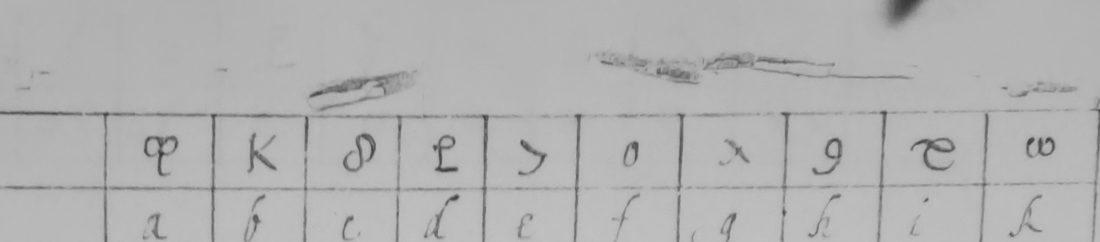
The key is two sheets. The first carries the alphabet table and the first part of the nomenclator, the second continues the numbered list to 116. The alphabet is a simple substitution in which the cipher signs are themselves letter shapes, so the ciphered words look like an odd Latin hand:

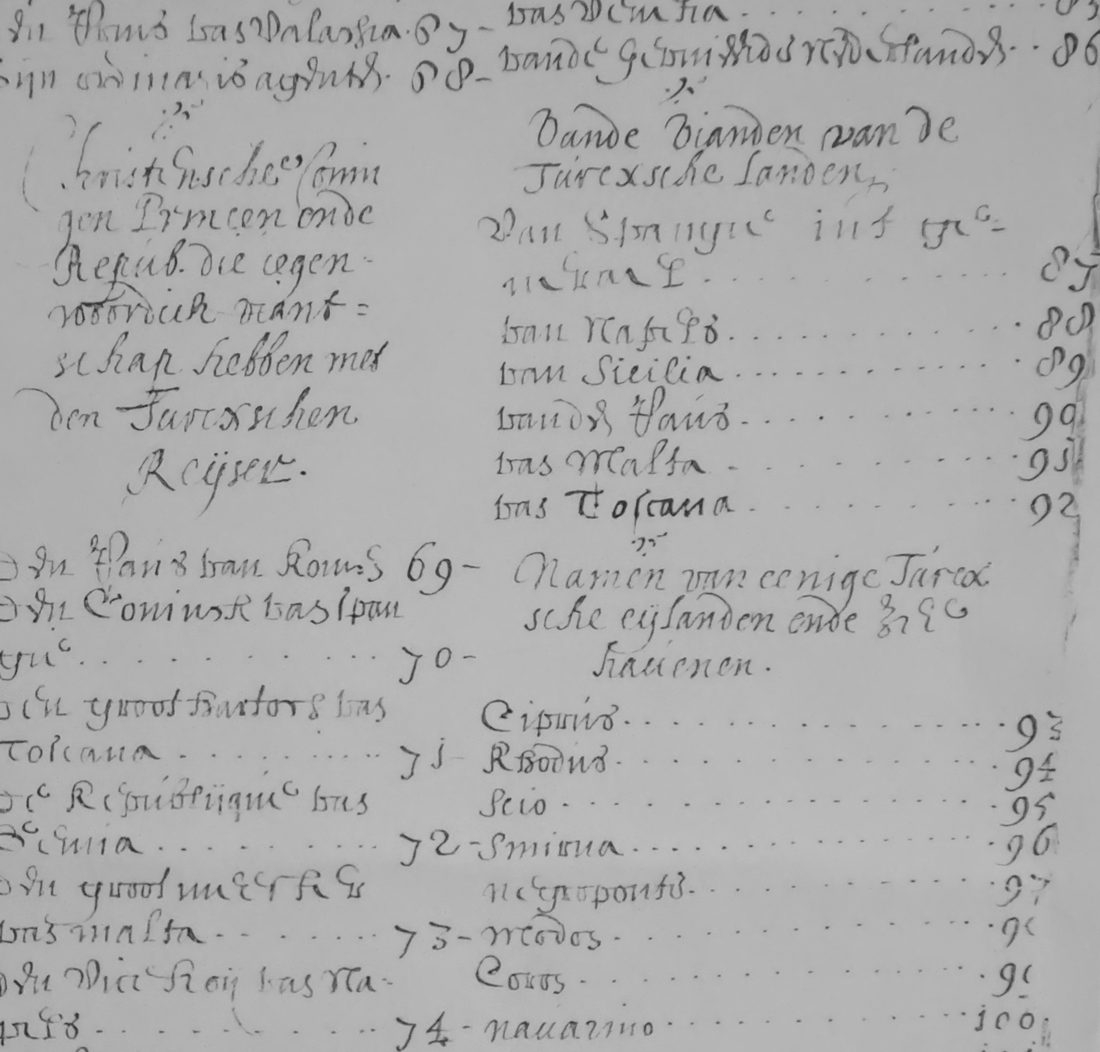
The nomenclator numbers the Sultan and his officers (1 Sultan Osman, 2 Sultan Mustafa his uncle, 3 the Vizier Azem, 4 the Capitan Bassa, 7 the Mufti, 10 the Janitsaraga), then the provincial Bassas and Beys, the cities of the empire, the Christian and Mahometan princes with their ambassadors, the fleets, and the islands and havens of both sides (93 Cyprus to 116 “de Golff”).
02 Four letters, bound out of order
Neither record is one letter, and neither is in order.
- R2113. Page 1 is the clear close of the despatch of 1 February 1620 and carries no cipher at all. Pages 3 and 2, in that order, are a different letter: page 3 breaks off in mid-sentence and page 2 takes it up, ending “In Constant. den xxxj martij 1620”. The opening page of that 31 March letter is not among the scans.
- R2115. The order is p.3 (the address “Hooge Mogende ende Genadige Heeren”), p.2, p.4 (which ends a despatch dated “In Const. den xxiiii April 1620” and begins the next), then p.1, which closes at Constantinople on 4 May 1620. So the record holds two despatches, of 24 April and 4 May.
03 31 March 1620: Transylvania, Bohemia, and the Spanish truce
The ciphered spans of the March letter run inside clear Dutch. On Transylvania, Haga reports that the Porte will let the resignation be made in favour of “sijn hoocheijts broeder”, and that the province must stay in good correspondence with Hungary so that it does not fall into the hands of Homonnai “ofte anderen {dependenten van t huijs van Oostenrijck}”. Then his own advice:
Ick oordeel dat het {bij de turcken} meerder reputatie ende estime soude geven {dat de Ongaren regem Bohemiae mede erweelden, ende met} (62) in stricte alliantie verbonden bleven.
Hungary and Bohemia united under one head, the Elector Palatine, would, he writes, let Transylvania deal with the Turks on better terms in the treaties that must follow; a legation from Hungary, Bohemia and the incorporated provinces would be welcome at the Porte. The second half of the letter turns to Spain. A Polish envoy has refused to have his lodging prepared in the usual way, which Haga calls a {bravade}; and
(44) {ende} (45) {arbeiden bij} (4) om tyt te winnen, dat hy provisie {een suspensie van wapenen tusschen de turcken}, ende de {coninckrijcken van Napels} ende {Sicilia} gepractiseert mocht worden … (3) (4) {ende} (7) {vragen mijn} curieuselijck ende ernstelijck {off} (50) geresolveert sijn {de treffves met} (70) {te verlengen}, {vrede} te maecken, ofte {de wapenen} wederom {aen te nemen}, twelck men {hier seer gaerne} soude sien, {om Spangie van weder} zyde te mogen {infesteren}.
That is the Grand Vizier, the Capitan Bassa and the Mufti asking the Dutch ambassador, in the last year of the Twelve Years’ Truce, whether the Republic means to renew it, and saying plainly that the Porte would rather it were broken, so that Spain could be attacked from both sides at once.
04 24 April and 4 May 1620: elect a new king
The April despatch reports the arrival of the envoys of the confederated Bohemian and Hungarian lands, sent from the Easter diet of Pressburg with its resolutions and with the intention of sending a formal legation and making a perpetual peace with the Sultan. They were received without delay, by the Grand Vizier and then by the Sultan, and at that audience the ambassador of the Hungarian Estates (kept back until then, the letter says, by the persuasion of the ambassador of the German Emperor) was admitted with them. The Porte answered that the ambassadors would be welcome and that it was resolved to treat and make friendship with the crown of Hungary, Bohemia and the confederated lands.
The advice is in cipher. Nothing is more needful, Haga writes, than that {de Ungarische Stenden} proceed, at the most desperate pass, {tot de electie ende croeninge van een nieuw coninck}; order has already been given {aen (19) ordre gegeven is met haer goede correspondentie te houden} and to {assisteren, sonder andere last} from here; nothing done in the name of (43) is to be believed; and (3) and (7) are to {vermanen} Transylvania that {geen vrede gemaeckt werdt} with (43), and not to wait longer over the crown of Hungary. The closing pages of 4 May are clear: the Polish ambassador has at last had his licence, the Khan of Tartary is said to have marched into Poland in person, and Ottoman preparations go on but will be slow, since neither Sultan nor Vizier goes in person.
05 Method
The DECODE JSON API gave the metadata for the whole run of records at inventory number 6894, which is how R2118 was found to be the key of the series and R2114 to be marked Decrypted. The fifteen page images were fetched with the account’s session cookie. They are photographed sideways, so every page was rotated and cut into strips of three lines before transcription. The alphabet table was transcribed from the key and tested on the first cipher words of R2113 p.2, which gave arbeiden, tusschen, suspensie and de turcken at once; the two letters were then deciphered in two parallel passes. The key’s cell for m lies outside the photographed sheet, so that letter was recovered from the text: the 4-shaped sign, confirmed by becomen, met, mijn, vermogen, teenemael and geconformeert. The nomenclator values were taken from the key and then checked against the sense of the letters, which confirms (19) Buda, (62) Transylvania, (70) Spain, (3) the Vizier Azem, (4) the Capitan Bassa, (7) the Mufti, (58) the States General and (43) the Emperor’s ambassador.
06 What remains uncertain
- Code (50). On the key, 50 is the French king’s ordinary ambassador, which does not fit “de treffves met (70) te verlengen”. Either the numbering of that column is off by a row or two as the sheet is photographed, or the code is used loosely for the Dutch side. Unresolved (I).
- Codes 37–45. Their column is cut off at the edge of the photograph of the key’s first sheet, so the headings are legible but the numbers are inferred from the order of the list. That makes (44) and (45), in the March letter, conjectural (M).
- Short cipher words. ℓ7tδℓ7d7t (R2113 p.2, line 13) decrypts literally to denvderen, perhaps meant for hinderen; the opening phrase of the ciphered advice on R2115 p.3 is not deciphered; a scatter of short words in both letters is marked with a query in the decipherment files (C or M).
- The clear Dutch was summarised, not transcribed word for word; the quotations above are from the cipher spans and their immediate surroundings.
- R2114 (11 May 1620, six pages) was not deciphered again here: DECODE marks it Decrypted, though the record carries no plaintext file.
07 Sources
- Nationaal Archief, The Hague, 1.01.02 (Staten-Generaal), inv. nr. 6894. Images and metadata via DECODE, R2113, R2115, R2114, and the key R2118. Records created by their DECODE contributor in 2021.
- The decipherments, and the alphabet and nomenclator as transcribed here:
haga1620/R2113_reading.md,haga1620/R2115_reading.md,haga1620/KEY_ALPHABET.md,haga1620/KEY_NOMENCLATOR.md.
Working files, the decipherments and the profile are in haga1620/ in the repository. Page images are not committed; the crops above are from the DECODE scans.