01 The documents
BnF fr. 3096 is a volume of original letters to François I and Montmorency of 1528–29. Nos. 62 to 67 are the Ferrara file: Sormano’s letters of March 1529 (no. 62, f. 113) and his doppio (no. 67, f. 124) carry a decipherment written between the lines by a contemporary hand; nos. 63 (ff. 115–116), 65 (ff. 119–120) and 66 (ff. 121–122) do not. Tomokiyo’s cryptiana page prints Lasry’s key for the glossed pair and lists the other three as unread. Gallica has the volume at full resolution (btv1b9060015d, views 117–127), 8,660 pixels across a two-page spread, which is about 44 pixels per sign.
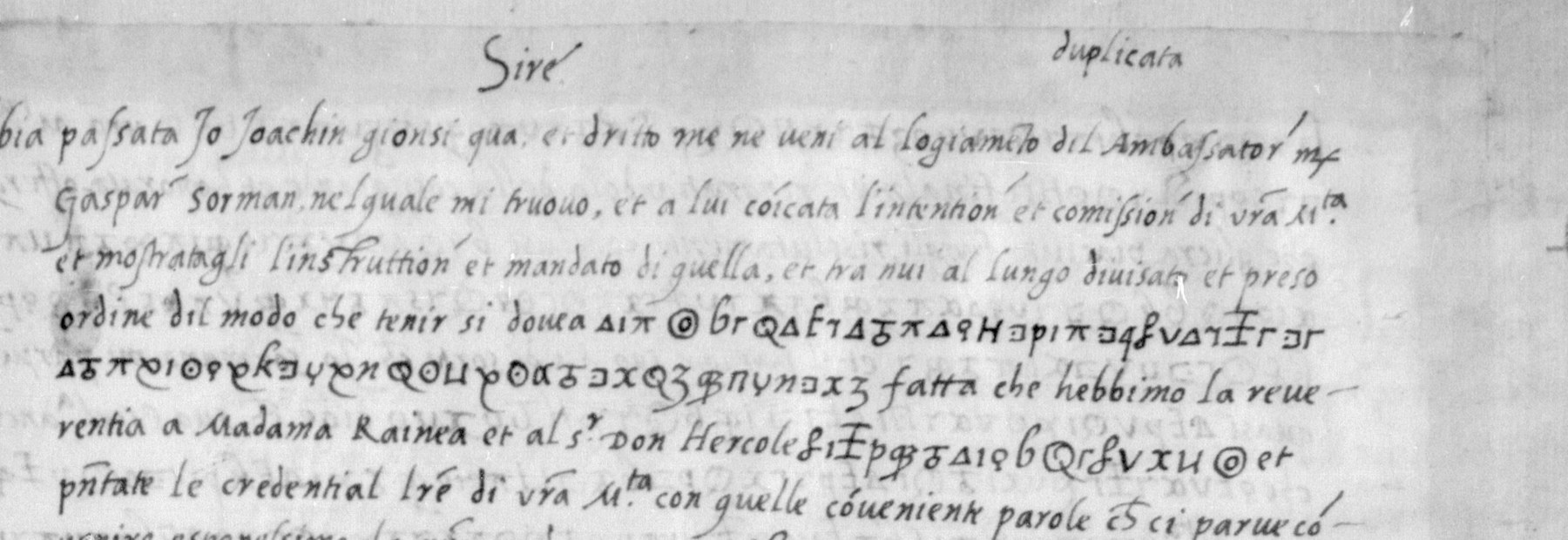
The three letters are one negotiation. No. 65 and no. 66 both open Zobia passata Io Joachin gionsi qua, both subscribe Da Ferrara alli XXIII febraro 1529, and no. 63 opens Il xxIII del presente per nostre duplicate lettere a vostra Maestà al lungo scrivessimo ciò che havevamo negociato con questo Signor Duca. So 65 and 66 are the duplicate pair sent on the 23rd and 63 is the follow-up. The catalogue’s “28 February” for no. 63 is not on the leaves that survive: the letter breaks off mid-sentence at the foot of f. 116v (difficilmente crederemo …), and f. 117 is a different paper in another hand, wholly unciphered, so its end and its date are elsewhere or lost.
Both agents write. The narrative voice moves between Io Joachin and Io Sormano in the same letter, and the passages each man puts in cipher are those about his own audiences.
02 The cipher, and what the published key lacks
One continuous alphabet of geometric signs written on the line with the clear Italian, no word breaks, cipher and clear alternating mid-sentence. Common letters have three or four homophones: a V υ п 3, e ϰ k Γ 7, i Y ⊙ ρ 4, o Ц 1 ƌ, u/v T α γ H, s Ŧ ⊐; single signs for the rest, Δ c, ▽ q, π n, Q r, x t, 6 p, S g, E h, ϙ l, ꝑ m; and two doubled letters, ⊡ ll and ≠ cc. That is Lasry’s table, and it is right: the first glossed run on f. 113r, ꜿ f T π Δ V 6 ρ x υ π Γ 1 ⊐ α 4 Δ 7 Q ƌ Δ E ϰ ⊐, reads de vn capitaneo suicero che s[i] under the gloss d’un capitaneo suizari ch’si, sign for sign.

Four things on the leaves are not in the table, and each costs a reading until it is seen:
- A null. A tall sign with a large loop and a long descender curling left (ɧ) occurs in all three letters and twice in the second glossed run of no. 62, and carries no letter. H 1 Ǝ x ɧ Q п is vostra; Δ E ɧ k is che; Δ ɧ 1 π ſ ʈ Q x ʒ is conforto. The old note “no nulls observed” is struck.
- A nomenclator. The large double circle ◎ is not the i sign ⊙ written big. It reads duca everywhere it stands: con questo ◎, fusimo col deto ◎, andai dal deto ◎, circa le cose dil regno ◎ rispondesse. It often falls where the clear hand resumes, which is why it looks like a terminator at first.
- The fourth e is a crossbarred long-s. It reads as an f to the eye and is the commonest letter form on the page; f proper is the double loop ſſ (offerta, sufficientissime). Taken as f it corrupts one letter in twelve.
- ꝓ, the p with a curled tail, is d (desiderio, dubitai, dal deto), not an i homophone; and the open C-shaped boxes that the segmenter produced by the hundred are the left half of the r sign Q cut at its tail, not a sign.
03 The pair reads itself
No. 66 is not a copy of no. 65. The two were drafted independently from the same notes, and they encipher different stretches. Where no. 65 puts a sentence in cipher, no. 66 very often has it in the clear hand, and the reverse:
| no. 65, f. 119r (cipher, read here) | no. 66, f. 121r (clear on the leaf) |
|---|---|
| maiestà. fata la reuerentia a madama Rainea et al signor don Hercole | fatta che hebbimo la reuerentia a Madama Rainea et al s[ignor] Don Hercole |
| suadesimo, confortassimo et instantemente esortasimo et pregasimo | suadessemo, confortassemo et instantementi essortassemo et pregassemo |
| nel modo et condicioni in la deta instrittion contenune [sic] | nel modo et condition in la ditta instruttion cõtenuti |
| ringratiandola della cosi grande et honorata offerta che gli era piaciuto fargli | ringratiandola della cosi grande et honorata offerta che gli era piaciuto fargli |
The right column was read off the leaf before the left was decoded, and neither was used to produce the other. It is an independent check on the key and on the glyph reading, and it settles most of what one copy leaves doubtful. It also means that any future reader with the two leaves side by side can recover most of the pair without a key at all.
04 Method: reading eighteen thousand signs
Ten page sides at 40–60 signs a line and 35 lines a side is too much to read glyph by glyph from a screen at the resolution Gallica serves, and an earlier pass had stalled at a few lines. The route that worked treats the leaf as a character-recognition problem and keeps the reading with the eye:
- Segmentation. Line bands from the row-ink profile of each side (337 lines, one physical line once split, none missed), then column-ink valleys inside each band, with runs wider than one sign cut at their thinnest points. 18,273 boxes, each cropped to a fixed 100-pixel height about the line’s x-height centre so that ascenders and descenders keep their place.
- Clustering. Per-line Otsu threshold, blur, 16×22 raster plus width and ink, PCA to 70 dimensions, k-means with 700 centres. Cluster montages ordered by centroid similarity were labelled by eye, letter or “clear hand”, 212 of them automatically from a coarser 340-centre pass, the rest by hand: two sittings of about forty montages.
- Classification. A k-nearest-neighbour classifier on the labelled glyphs (raster plus gradient-orientation histograms) reassigns every box, including the ones in mixed clusters; five-fold cross-validation on the labelled set gives 90 % letter accuracy, most of the remainder being cipher signs against fragments of the clear cursive rather than sign against sign. A five-glyph majority window then marks each line into cipher and clear runs.
- Review. For every line a sheet: the magnified strip in two segments, and below it each segmented box with its index and the classifier’s letter. 170 sheets, read in order with the Italian in mind, correcting the letter where the shape or the word required. Every reading on this page comes from that step, not from the classifier alone.

The pipeline’s value is in the sheets, not in the decoded string: the classifier’s own line for f. 119r line 4 is acioc*econclvsmns*facesc*so*ondoili…, readable only because one already knows what it should say. Where the segmenter merges two signs or the hand writes one over a descender, the sheet shows it and the eye fixes it; where the signs run for a whole side without a clear word to anchor them, as on no. 63 ff. 115v–116r, the errors compound and the reading thins to patches.
05 Reading: no. 65, 23 February 1529
Clear text roman, cipher in brackets, spelling of the leaf kept; (?) a word read from doubtful signs; {…} a ciphered stretch that resists reading; ◎ the duke
Zobia passata Io Gian Joachino gionsi qua et dritto me ne veni al logiamento del Ambassator messer Gaspar Sormano, nel quale mi truovo, et a lui comunicata l’intention et comission di vostra Maestà et mostratagli l’instruttion et mandato di quella, et tra nui al lungo divisato et preso ordine dil modo che tenir si dovea [con questo ◎ acioché conclusion si facesse secondo il desiderio di vostra Maestà. Fatta la reverentia a Madama Rainea et al signor don Hercole fusimo col detto ◎], et presentato le lettere di vostra Maestà di credenza con quelle conveniente parole che ci parve convenire, esponessimo la nostra credenza et in nome di vostra Maestà [suadesimo, confortassimo et instantemente esortasimo et pregasimo sua Signoria voler accettare quello che lei, come suo buon et affectionato figliolo, ferisse(?) et deliberasse: far l’impresa di Napoli nel modo et condicioni in la detta instruttion contenute]; et qui con molte efficacissime ragion al lungo rimostrassimo [il stabilimento de sua Signoria, suo stato et posterità, l’honor et l’utile che l’une … riportare, et la satisfaction di vostra Maestà, et finalmente il bene, et con gran gloria di sua Signoria, la finale liberatione et quiete de l’Italia]; né gli fu taciuta la grande buon’opera che in beneficio della [sua persona, stato, casa et successione vostra Maestà haveva fatto … et la quasi ferma speranza che lei riteneva in tutto ridure sua Santità … accordi et condicion che … si dicevano et sua Excellentia poteva desiderar], et le qual tutte cose, volendo lei, al lungo gli furon narrate.
Sire, benché in quello ragionamento, che fu assai lungo, [circa le cose dil regno ◎ rispondesse di sorte] che dall’hora haressimo possuto scriver quello che hora se dirà, nientedimanco concludendo lui che la cosa [per ◎ … grande ma sua … ricercava tempo per meglio pensarvi, presimo aspettar la sua final risposta, et in sto mezzo fussimo di novo con signor don Hercole et fattogli intender che hora era il tempo di operare in servicio di vostra Maestà et che la sua casa … stato ni toccava tanto … {five lines on Ercole’s own interest, read in patches}] … [avisassemo che io Sormano solo andasse, sì come andai, dal detto ◎ per rimostrargli … dì seguente dimandati fusimo da sua Signoria ◎ … et dipoi molte ragioni che a noi parsero sufficientissime, … solo per rimoverlo da ogni per lei preallegato sospetto, … ma etiam per disponerla a l’accettar di … bon animo quanto per vostra Maestà se gli offeriva]: finalmente, ringratiandola della [così grande et honorata offerta che gli era piaciuto fargli, risolutamente concluse per cosa dil mondo non voler per sé alcunamente accettare il regno et manco far l’impresa a suo nome]; et il parlar suo fu di sorte che [io Sormano mi parvi quasi chiarito di quello che io sempre dubitai, cioè che sua Excellentia, anchora che havesse dato orecchie et risposto] nel modo che io scrissi a vostra Maestà, veramente non havesse [animo d’intendere al capitaneato, del qual già molti giorni haveva ricercato]. Ben disse non solo contentarse ma con ogni instanza pregar vostra Maestà che la volesse [trattar tra lei et lei l’apontamento et accordo, circa el qual disse accettar quanto vostra Maestà facesse, persuadendosi che da quella non serà astretta far se non cosa conveniente et ragionevole].
Sire, per il gran desiderio che noi habbiamo che [questo signor Duca satisfacesse alla espettation de vostra Maestà], et in questo non volendo noi pretermetter alcun’opera et officio né lassar alcuna cosa intentata, non ostante [questa sua detta risposta, da capo fossimo col prefato signor don Hercole, veramente desideroso far servicio a vostra Maestà, … rimostrandogli che tal risposta poco concedeva(?) in alcun suo profitto; del che et lui con noi dolendosi della qualità et risposta del padre, si mostrò poco satisfatto; lo instassimo esser di novo con sua Excellentia, sperando che la non volesse perdere questa che dal tempo et da la liberalità di vostra Maestà se gli offeriva così bella occasion, come qual altra offerirse gli potesse … il suo stato … con suo poco et picolo pericolo … la sua casa et sua successione … Italia, et per satisfar a vostra Maestà] … [per conclusione si confirmò in la sopra scritta fatta risposta, et così mal satisfatto ritirandome … signor don Hercole, che con dir mi come el signor Duca in alcun modo intendere non … per sé, et quanto al capitaneato, non ostante ciò che nel sopra scritto primo ragionamento et poi era stato detto et … risposto, disse che sua Excellentia persisteva in la … forma et modo della risposta a questi dì data a me Sormano … così poco … risoluto et poco chiaro come la … fu data, toccando … accordo … componere le cose sue col …].
Sire, dalli soprascritti ragionamenti havuti con questo signor Duca pare di poter concluder che [non si possa far … fondamento che in effetto el … voler intrar o accettar el capitaneato, sul quale … provisione, circonstance et sue dependentie dal canto di sua Excellentia se … le difficultà, et a nostro giudicio … la cosa insieme con le sue provision … dependentie così difficile che paia … di difficultà, et non la volontà sia … quel che non lo facino accettar … questa nostra per aventura vana opinion] a vostra Maestà non c’è parso tacere. Io Joachin aspettarò qua il signor Marechial Triulzo, et siamo d’openione che sua Signoria, [dal prefato signor Duca molto stimata, a beneficio di questa cosa con sua Excellentia s’adoperi], il che per ben di questo negocio et servicio di vostra Maestà siamo certi farà ben volentieri. Da Ferrara alli XXIII febraro MDXXVIIII.
English
Last Thursday I, Jean Joachim, arrived here and went straight to the lodging of the ambassador messer Gaspare Sormano, where I am staying; I gave him your Majesty’s intention and commission and showed him your instruction and mandate, and having talked it over at length we settled how to proceed [with this Duke so that a conclusion might be reached as your Majesty wishes. Having paid our respects to Madame Renée and to Don Ercole we went to the Duke], presented your Majesty’s letters of credence with such fitting words as seemed right, set out our credence and in your Majesty’s name [urged, encouraged and most insistently exhorted and begged his Lordship to accept what he, as your good and affectionate son, should resolve upon: to make the enterprise of Naples in the manner and on the conditions contained in the instruction]. We showed him at length [the securing of his Lordship, his state and his posterity, the honour and the profit that would follow, your Majesty’s satisfaction, and finally, with great glory to his Lordship, the final liberation and quiet of Italy]; nor was he left ignorant of the great good that your Majesty had done [for his person, state, house and succession … and the nearly firm hope you held of bringing his Holiness wholly round … to terms and conditions that … his Excellency could desire]; all of which, since he wished it, was told him at length.
Sire, although in that conversation, which was very long, [on the matters of the kingdom the Duke answered in such a way] that we could have written then what will now be said, still, he concluding that so [great] a matter needed time for reflection, [we resolved to await his final answer, and meanwhile went again to Don Ercole and let him know that now was the time to act in your Majesty’s service, and that his house … and his state were so much concerned …]. [We agreed that I, Sormano, should go alone, as I did, to the Duke, to show him … The next day we were summoned by his Lordship the Duke … and after many reasons which seemed to us more than sufficient, … not only to remove every suspicion he alleged, … but also to dispose him to accept with good will what your Majesty offered him]: in the end, thanking you for [so great and honourable an offer, he resolutely concluded that for nothing in the world would he in any way accept the kingdom for himself, nor make the enterprise in his own name]; and his manner of speaking was such that [I, Sormano, thought myself almost certain of what I had always doubted, namely that his Excellency, though he had lent an ear and answered] as I wrote to your Majesty, never truly [meant to take up the captaincy, which he had been asked for many days before]. He did say that he would not only be content but would beg your Majesty with every insistence [to treat between yourself and him the appointment and accord, and said he would accept whatever your Majesty did, being persuaded that you would bind him to nothing but what is fitting and reasonable].
Sire, out of our great wish that [this Duke should satisfy your Majesty’s expectation], leaving nothing untried, notwithstanding [this answer we went back to Don Ercole, who truly wishes to serve your Majesty …, showing him how little such an answer served his own profit; and he, grieving with us over the nature of his father’s answer, showed himself ill satisfied; we pressed him to go again to his Excellency, hoping he would not let slip so fair an occasion as your Majesty’s liberality and the times offered him … his state … at small and little risk … his house and his succession … Italy, and to satisfy your Majesty]. [In conclusion the Duke confirmed his earlier answer, and I, Sormano, withdrew ill satisfied … Don Ercole telling me that the Duke would in no way take it on for himself, and that as to the captaincy, whatever had been said and answered before, his Excellency held to the form of the reply given me some days ago, … as little resolved and as little clear as when it was given, touching on … an accord … to settle his affairs with the Pope …].
Sire, from all these conversations with the Duke it seems we may conclude that [no reliance can be placed on his in fact meaning to enter or accept the captaincy; on which, as to the provisions, circumstances and dependencies, on his Excellency’s side the difficulties … and in our judgement … the thing, with all its provisions and dependencies, is so difficult that it seems … it is difficulty and not want of will … that keeps him from accepting; this our perhaps vain opinion] we thought it right not to hide from your Majesty. I, Joachim, shall wait here for the marshal Trivulzio, and we are of opinion that his Lordship, [much esteemed by the Duke, will exert himself with his Excellency for this business], which for the good of the affair and your Majesty’s service we are sure he will do very willingly. From Ferrara, 23 February 1529.
Madama Rainea is Renée de France, Louis XII’s daughter, married to Ercole d’Este in 1528; questo signor Duca is Alfonso I d’Este; il Marechial Triulzo is Teodoro Trivulzio, marshal of France and governor of Genoa. The capitaneato is the command of the French army in the kingdom of Naples after Lautrec’s death before the city in August 1528, when the King was looking for an Italian prince to carry the war; the crown of Naples was the bait. Alfonso’s refusal here, dressed in the want of provisions, is the first sign of the turn that ended with his abandonment of the French alliance and his accommodation with the Emperor at the Peace of Cambrai (August 1529) and the settlement of 1530.
06 Nos. 66 and 63
No. 66 tells the same story in the same order, with the clear and ciphered stretches swapped as described above, and a fuller close: non mancaremo continuamente
sollicitar sua Excellentia, et se da quella altro potremo haver se dirà. Its reading is in the repository (sormano/n66_reading.md) and its cipher runs are transcribed line by
line beside those of no. 65; nothing in it changes the account.
No. 63 is the sequel and the hardest of the three: four sides, three of them almost solid cipher, no sibling. What reads is enough for the sense. The duke had given
una poco chiara et risoluta risposta on the captaincy and repeats it; he says he cannot see that the King and his confederates are making the provisions the enterprise needs,
un esercito in campagna, money for Swiss, Spaniards and Genoese, and that all should be furnished before he commits, et tanto più hora, che già siamo — così disse — nel
buon tempo. Two things he asks the King to remember, one about the Naples enterprise itself and one about the command. Dal canto suo disse non dover mancare; the agents say they
have omitted nothing in their power, judge from the duke’s nature that the matter debba esser non poco difficile, and put their hope in Trivulzio: Sire, con tutto che per le
ragion dette siamo in … poca speranza che questo signor duca … intendere … capitaneato, pur in questa causa non volendo noi pretermetter alcuna natura d’opera et d’ufficio, se’l
signor Marechial Triulzo andando a Vinetia passarà per qua … pensiamo operar che sua Signoria …; et in sto mezzo per tri o quatro giorni anchora Io Joachin qui l’espettarò.
The letter stops at the foot of f. 116v in the middle of a clause. The full reading with the unread runs marked is sormano/n63_reading.md.
07 What remains uncertain
- In no. 65 about a dozen words are marked (?) or left in braces: the five lines on Ercole’s interest at the foot of f. 119r, three lines at the foot of f. 119v, and the run on f. 120r where the duke’s answer is repeated. All are places where the segmenter merged or split signs in a dense run; the glyph strings are in the transcription and can be re-read.
- No. 63 ff. 115v–116r: roughly half the cipher lines read only in patches. The transcription gives the classifier’s string for each; a cleaner segmentation, or a copy of the letter in another volume, would finish it.
- The b sign (τ) was not securely identified on any leaf; the few b’s in the text fall in words read from context (buon, bene, bella).
- The dates: 23 February 1529 is on the leaves for 65 and 66; no. 63 carries no date on ff. 115–116, and its last leaf has not been located.
08 Sources
- BnF, Français 3096, ff. 113, 115–116, 119–122, 124: Gallica btv1b9060015d, views 117–127.
- G. Lasry, key to the Sormano cipher (2023), published as an image on S. Tomokiyo, “French Ciphers during the Reign of Francis I” (cryptiana).
- Context: the Naples campaign and Ferrara in 1528–29 in the standard accounts of the war of the League of Cognac; Renée de France’s marriage (June 1528) and the Este–papal quarrel over Modena and Reggio, which is the accordo … col Papa the duke wanted the King to make for him.
Transcriptions (n63, n65, n66_transcription.md), readings, the key notes with the corrections (KEY.md), and the segmentation, clustering,
classification and review-sheet scripts are in the repository (sormano/). Page images are not committed.