01 Four letters, four keys
The catalogue guessed “four letters by three hands, probably three keys”. Opening each item on Gallica and matching it against Tomokiyo’s pages on the ciphers of François I shows four keys, each with a sibling letter from which Lasry built his table:
| Item | Writer, place, date | Key (Lasry’s name) | Cipher | Read |
|---|---|---|---|---|
| fr. 3083 no. 8, ff. 20–21 | Jean de Langeac, bishop of Avranches, Venice, 14 January [1529] | Avranches’ cipher 1 (the sibling is fr. 3005 f. 107) | 11 lines | all but two short groups |
| fr. 3091 no. 23, ff. 45–47 | Gabriel de Gramont, bishop of Tarbes, Rome, 11 October [1529] | Gramont’s cipher (1529) (siblings fr. 3040 f. 16, Clair. 330 f. 53) | 171 lines, all cipher | in full, 90–95 % of signs secure |
| fr. 3071 no. 7, f. 17 | Gramont, now cardinal, Rome, 21 July [1530] | Gramont’s cipher (1530) (sibling fr. 3019 f. 20) | 14 lines | about 85 % |
| fr. 3071 no. 4, ff. 9–10 | Charles Hémard de Denonville, cardinal de Mâcon, Rome, 11 April 1537 | Mascon’s cipher (sibling fr. 3053) | about 45 lines, mixed with clear text | about 90 % of the cipher |
Each is a monoalphabetic substitution with two to seven homophones for the common letters, signs for doubled letters, a handful of nulls, and a few code signs for persons. The Mâcon key uses numerals for its code signs. Lasry dated all four tables 5 November 2023, and Tomokiyo notes that the published images carry no plaintext. None of the letters is transcribed or printed elsewhere that we could find. Gallica has the volumes at full resolution: fr. 3083 is btv1b90601328, fr. 3071 btv1b9060315f, and fr. 3091 btv1b9060253s, the last filmed as two-page openings.
02 Langeac, Venice, 14 January 1529
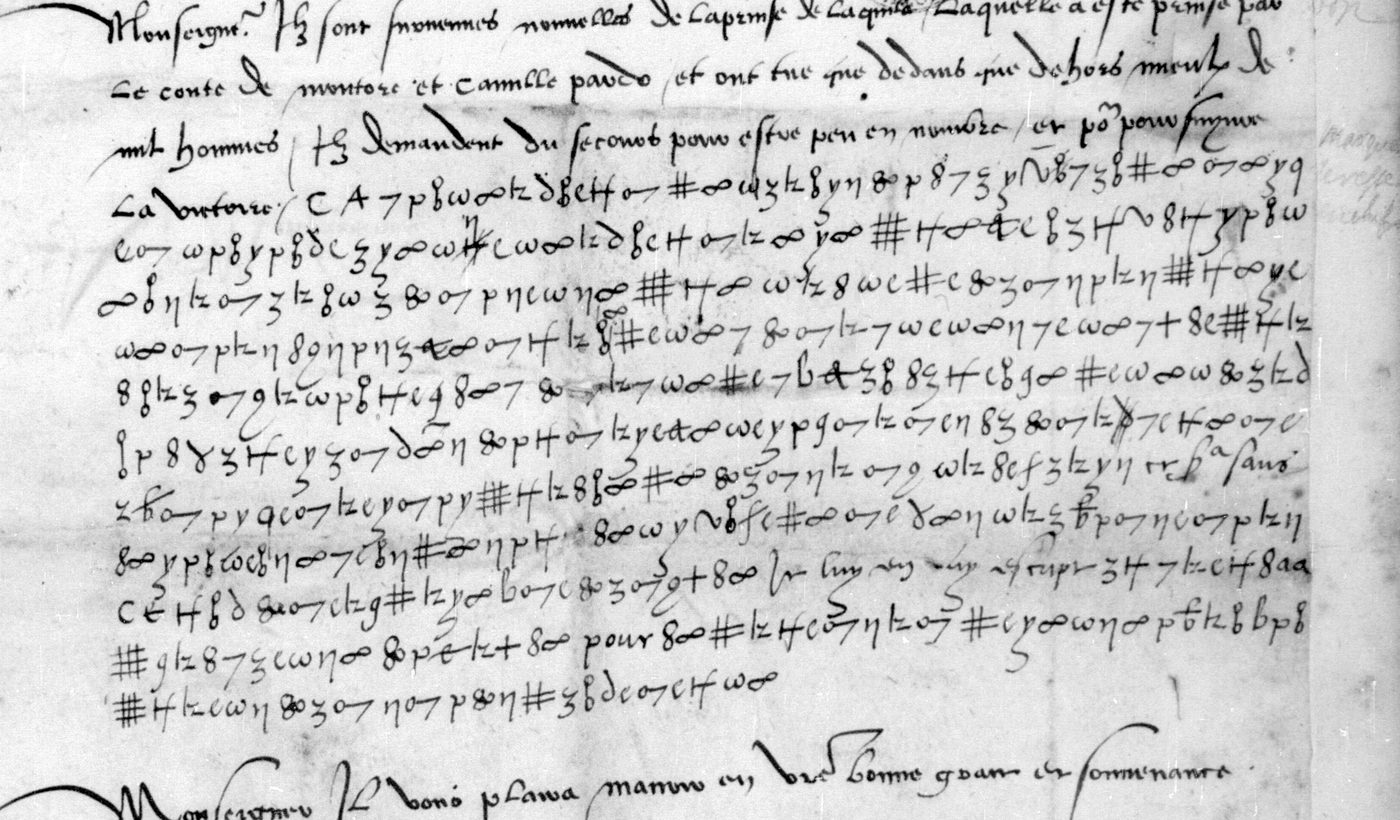
Cipher in capitals, clear in lower case, spelling of the leaf kept
MONSEIGNEVR DE SAINCT POL M’A CONMANDE RECHER[CHER] SON CONGE A CESTE SEIGNEVRIE, CE QV’ELLE N’A VOLV CONSENTIR, AINS A PROTESTE QVE S’IL SE DEPARTOIT QVE CE SEROIT LA TOTALLE RVINE DES EMPRINSES. ET ME SEMBLE QV’IL N’I A RAISON, VEV L’EMPRINSE DE MILLAN, LA VENVE DES ESPAIGNOLS AVEC ARGĒT POVR ICELLE SECOVRIR, ET LA PRIMEVERE APROCHER. IE CROY QV’IL NE DEPARTIRA SI LE FAICT […] sans LE CONSENTEMENT DE TOVS LES CONFEDERES, ET SI APORTEROIT […] VNG PREIVDICE IREPARABLE. Je luy ay escript AV MIEVLX QV’IL M’A ESTE POSSIBLE pour LE DIVERTIR DE CESTE OPINION, QVI EST PAR TROP DANGEREVSE.
The comte de Saint-Pol commanded the French army in Lombardy from the autumn of 1528 until his defeat at Landriano on 21 June 1529. So five months before Landriano the commander wanted to leave. Venice, the league’s paymaster in the north, refused his leave on the ground that the Milan enterprise was in hand, Spanish money was coming to relieve Milan, and spring was near. The King’s ambassador tried to talk him round. The year is not on the leaf, but it is fixed by Saint-Pol’s command and by the Abruzzi news in the clear text.
03 Gramont, Rome, 11 October 1529: the Pope on the way to Bologna
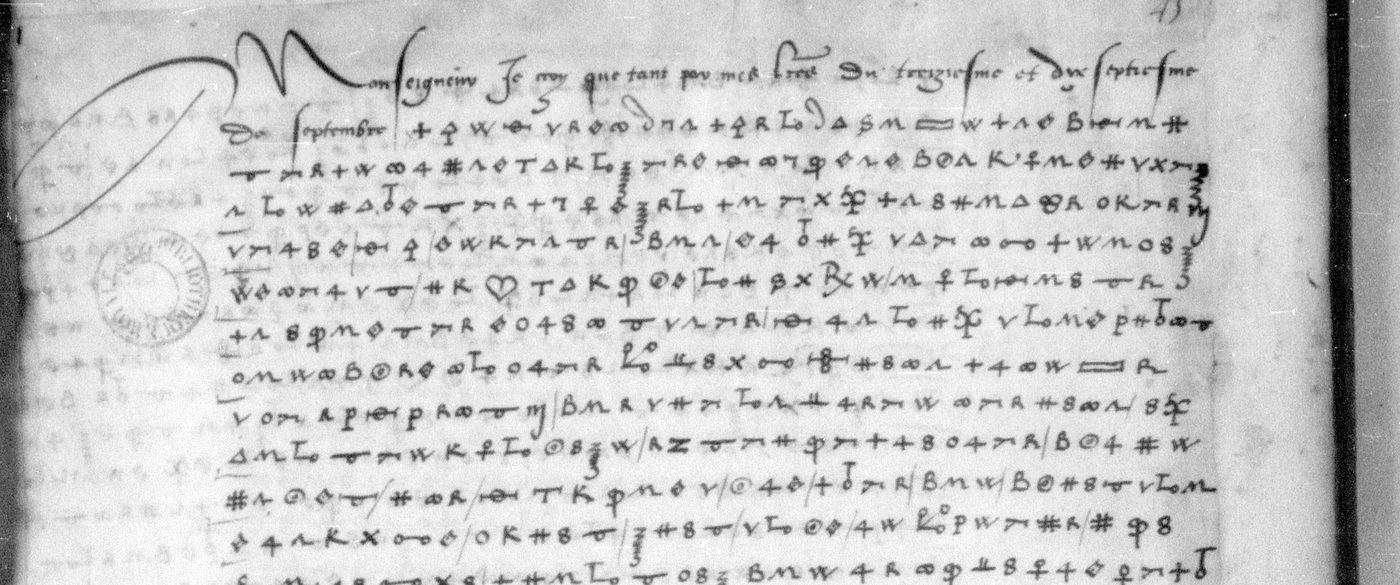
This is the long one: 171 lines and about 7,000 signs across ff. 45r–47v, closing A Romme le xime jour d’octobre over the signature G. de Gramont e. de Tarbe. The year is 1529. The Pope has just left Rome (Clement VII set out for Bologna on 7 October 1529), and Gramont leaves “demain” to join him at Perugia. The letter opens with the bull of the four décimes on the French clergy, raised for the princes’ ransom under the peace of Cambrai, and the prince of Orange is before Florence. In outline, modernised (the full reading, page by page, is in the repository):
- The council. Whatever the Emperor says or does only deepens the Pope’s distrust of that side. What won him to the King was the King’s message about the concile general, “lequel il craignoit sur toutes les choses de ce monde, combien qu’il monstrast … qu’il en ait grande envie”. Pressed, he confessed that he knew the council was being pushed to ruin him, and that he meant to grant it and then “s’arrester sur aucunes particularitez pour le differer, et que le delai lui succedast en rupture”.
- Into the King’s arms. He would “du tout se jecter entre ses bras et se fier en luy seul”. Because the times do not allow open trust, the King and his ministers may say publicly, whenever it helps, that they have little reason to trust the Pope, so long as the goodwill underneath stays whole. “Avec bonnes parolles vous aurez de luy ce que vous voudrez”. His one aim is to get the Emperor out of Italy.
- Feigning illness for the Admiral. The Emperor is bound “par ses chappitres”, the treaty of Barcelona, to bring the allies to full restitution or make war on them. Gramont has told Philippe Chabot, the Admiral, then on his embassy to Italy, to come as far forward as he can. The Pope offers to slow his journey, or to “faire le malade” in whatever town he is in, to wait for him. On 10 October he told Gramont he had already begun.
- Soothsayers and a dream. The Pope, though he should not believe “tout plein de gens qui se meslent de deviner”, greatly fears what they say of him. Several have foretold that he will be deposed or will die within the year, and that it will come “du costé dudict” [the Emperor]. The night before he left Rome he had a dream, which Gramont encloses, “lequel l’a mis en merveilleusement grande fantasie”, because he dreamed it at the kind of hour at which earlier dreams of his had come true. He told it to one man only, and Gramont asks that only the King, Madame and those they choose should know of it.
- Florence. The prince of Orange wanted to deal with [the Florentines]: restore [the Medici] to the state of Florence “comme il souloit”, in return for Pisa and Livorno being put in [the Emperor’s] hands. That is “chose grandement contraire” to what the Emperor had agreed with the Pope.
Gramont’s letter adds detail to the French side of the weeks before the congress of Bologna. The council, Florence and the Venetian and Ferrarese restitutions all serve as bargaining counters in it, and the Pope keeps a private line to France through the ambassador. The enclosed dream is not in the volume.
04 Gramont, Rome, 21 July 1530: the princes come home
By July 1530 Gramont is a cardinal, and he uses a new key. The 14 cipher lines follow a clear passage on “la bonne nouvelle” and on Francisque’s coming mission:
… [LE PAPE] A TROVVE BON QVE LEDICT FRANCISQVE Y AILLE … D’AVLTANT [QV’]ESTANT ICI IE POVRRAY OBVIER A TOVT CE QVE L’ON LVY POVRROIT MECTRE AVANT POVR LE DIVERTIR, A QVOY VOVS PVIS ASSEVRER QVE L’ON FAICT TOVTE LA DILLIGENCE POSSIBLE. MONSIEVR L’EVESQVE DE FAIANCE, NEPVEV DV CONTE DE CARPI, PARTIRA DEDANS TROIS OV QVATRE IOVRS POVR, DE LA PART DV [PAPE], […] CONGRATVLER AVEC LE [ROY] DE LA VENVE DE LA ROYNE ET DE MESSEIGNEVRS.
The Dauphin and Henri, hostages in Spain since 1526, were handed back with Queen Eleanor on the Bidassoa on 1 July 1530. That dates the letter. The nuncio is Rodolfo Pio, bishop of Faenza, nephew of Alberto Pio, count of Carpi. Gramont had been asked to go himself, and the Pope sends “Francisque” instead because the Imperials would take Gramont’s going amiss. Two of the signs Lasry lists as unknown read out of this passage: 8Δ is pape (“de la part du 8Δ”) and the key-ring sign is roy. A third, ʃʃ on a stem at the head of a word, is a null.
05 Mâcon, Rome, 11 April 1537: Paul III and the Farnese marriage
Denonville, cardinal de Mâcon, was ambassador to Paul III during the war of 1536–38. His letter alternates clear and cipher. Its code numerals, which neither published table explains, read out of the text: 20 is the Emperor (“se precipiter a la devotion du dict 20”, “se declarer partial de 20”), 30 the Pope (a contemporary hand has written “le dict pappe” above it on f. 9r), and 40 the King. What the cipher says:
- Pier Luigi Farnese, the Pope’s son, has sent men to take possession of a place read as Novarre, and has approached the captain of a fortress to see whether he can be bought. (The Farnese were invested with Novara only in 1538, so the reading of the name is one of the few that needs checking.)
- The Pope has been offered the marriage of his granddaughter, Pier Luigi’s daughter Vittoria, with Cosimo de’ Medici. Mâcon thinks that if it goes the Pope’s way he will throw himself wholly to the Emperor. Through Latino Giovenale, the Pope sends word that if the marriages are refused “il aura occasion de se declarer partial de l’Empereur: ce qu’il vous plaira considerer”.
- “La confederation du Roy avec le Turc se verifie clerement.” If the Pope declares, it is “a craindre que les Venitiens le suivissent entierement”, since it is said that “le Roy avoit promis au Turc de faire passer grosse puissance en Italie, et qu’il s’amuse en Picardie”. In April 1537 François was campaigning at Hesdin.
- The French ambassadors at Venice, the bishops of Rodez and Lavaur, are trying to win over Alessandro Vitelli, who held the fortress of Florence and was angry with the Emperor. Mâcon holds back so as not to spoil their practique. He fears that if Cosimo marries the Pope’s granddaughter, Vitelli will follow, “car le dict pape a moyen de le contenter es terres de l’Eglise mesmes, de la ville de Castelle, dont il commance a se faire tirant”.
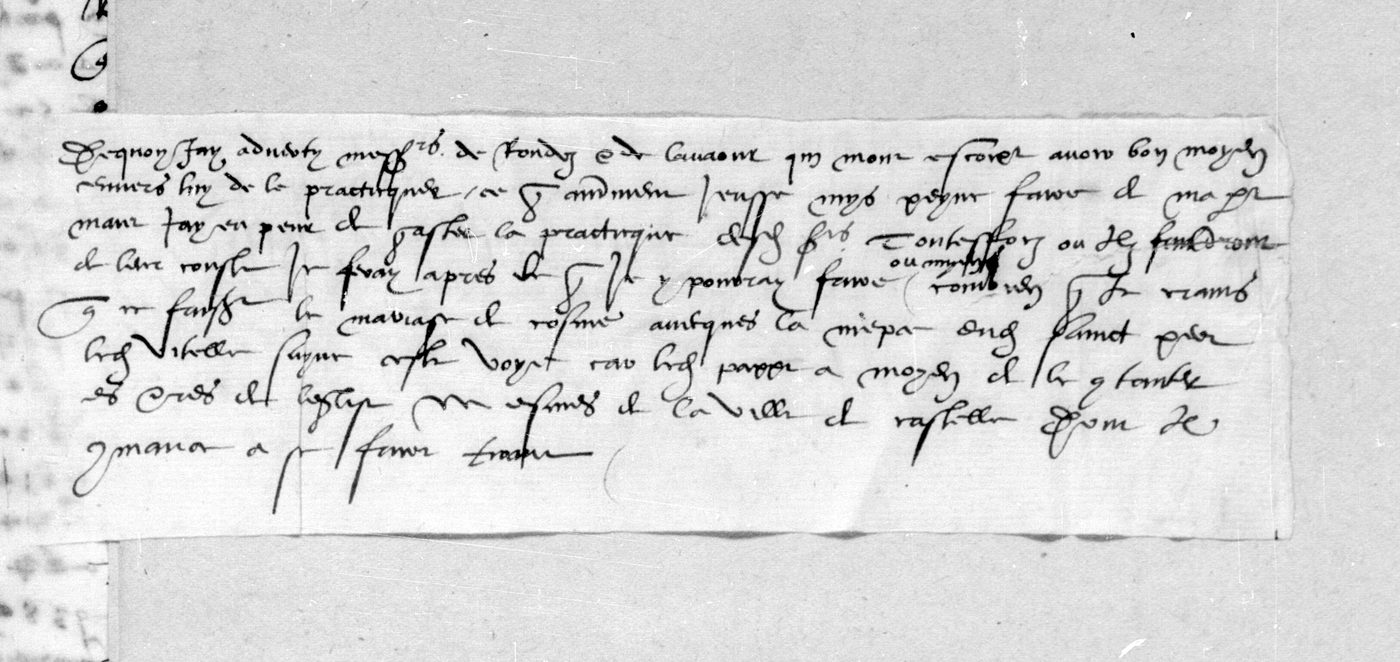
In the clear text, the duke of Mantua will not host the council summoned to Mantua for May 1537 without a paid guard. His brother, Cardinal Ercole Gonzaga, said so “en plain consistoire” (those three words are in cipher), and the Pope is thinking of moving the council. The dispatch goes by way of Venice to save the cost of a courier.
06 Method
No cryptanalysis was needed, only reading. Each key table was checked on the first line of its letter (Langeac’s block opens MONSEIGNEVR DE SAINCT POL; Gramont 1529’s first full line decodes d r R + W C 4 # L ● T Δ K Lo ʒ r R ● to tredecime v & avltre v). The short letters were then read by eye from line strips. For the long ones, each glyph was given a one-character ASCII alias and a script turned the alias strings back into letters, so that every reading can be checked against the transcription and re-run. The five pages of fr. 3091 and the three parts of the Mâcon letter were read separately and in parallel, each by a model instance working from the same brief, key and crops, and then joined. The joins fall mid-sentence and agree. The things the readers found that the tables do not say:
- In Gramont’s 1529 hand the loose ǂǂ for a and the compact # for m cannot be told apart, so # is read as a or m by context. A is the more frequent.
- A triangle or ring on a stem over a foot bar looks like ♀ (o) but is a null, Lasry’s “4 with a flag”. It occurs about twenty times. Read as o, it produces doepesche.
- The heart, which Lasry lists only as a person sign, is always the King (“escript au ♡ et à vous”). Three large signs outside the table stand where the Emperor, the Florentines and the Pope or the Medici are expected. Those identifications come from context and are marked as such.
- In the Mâcon key a dotted r is a null in most places but must be r in partant. Its R sign is easily mistaken for its C sign.
07 What remains uncertain
- Langeac: a group of three or four signs before sans and two before vng.
- Gramont 1529: single letters on each page (listed in the transcriptions), a phrase on f. 45r (fier ni a nui) and one on f. 45v (en voi[e]), the first word of f. 47v l. 7, and the identity of four code signs, which is inferred.
- Gramont 1530: the ends of the first two cipher lines and the middle of lines 5–7, about 15 %.
- Mâcon: seven signs on f. 9r l. 27–28, the word before puissance, a damaged name on l. 8, and the reading Novarre. The clear text, in a fast secretary hand, is read only loosely.
- Prior art not yet seen: B. Wirtz-Daviau’s edition of the Admiral Chabot’s 1529 embassy to Italy, which may quote Gramont’s letters from a contemporary decipherment.
08 Sources
- BnF, Français 3083, ff. 20–21: Gallica btv1b90601328, views 35–36.
- BnF, Français 3091, ff. 45–47: Gallica btv1b9060253s, views 49–52.
- BnF, Français 3071, ff. 9–10 and 17: Gallica btv1b9060315f, views 16–19 and 30.
- G. Lasry, key tables for the four ciphers (5 November 2023), published on S. Tomokiyo’s cryptiana: “George Lasry’s codebreaking” and “French Ciphers during the Reign of Francis I”, which also gives Tomokiyo’s partial tables from the siblings.
- B. Wirtz-Daviau (ed.), Le voyage et l’ambassade de l’Amiral Chabot de Brion en Italie, 1529 (not seen).
Line-by-line transcriptions with the alias strings, the readings of each letter, the brief given to the readers, and the decoders are in the repository
(gramont1529/). Page images are not committed.