At a glanceCiphertext-only break · partial (94% of the cipher)
- The letter
- Donato Acciaiuoli, Florentine orator in Rome, to Lorenzo de’ Medici, “ex Urbe die 13 junii 1478”: a clear letter with two cipher blocks on its second page.
- Where
- Archivio di Stato di Siena, Concistoro 2308, fasc. 2, no. 11; DECODE R4800, catalogued “1500–1599” with no sender or receiver.
- The cipher
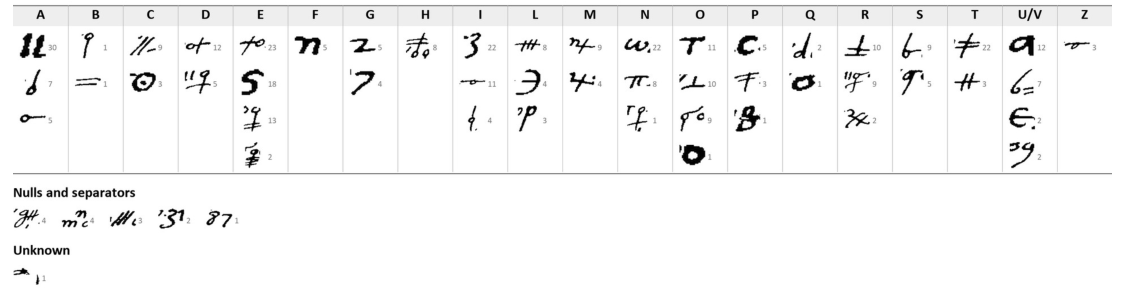
- Homophonic substitution on 57 signs: three to five signs for each vowel, one to three for the consonants, a few nulls, and the numerals 80 and 7 written as dotted numbers. No word division, no nomenclator.
- How it was deciphered
- George Lasry with CTTS and Claude, 15–17 October 2026: transcription by Claude, key recovered by Claude by crib analysis. No key or decipherment of this letter is known.
- What it says
- The lord of Faenza, like the lord of Forlì, is to stay in his lands and send two squadrons into the field; Gianfrancesco Gonzaga will come into Lorenzo’s service with at least 80 men-at-arms for 7,000 ducats.
- Still open
- One sign lost in a hole and six doubtful words.
- Credit
- George Lasry: transcription, key, reading, translation and context (report of 17 October 2026). The project transcribed the letter in September 2026 but did not break it.
The Sienese cipher file Concistoro 2308 holds pieces in many different keys; this one is a Florentine cipher, with its own page. The other pieces of the file are listed on the collection’s page.
01The letter and its key
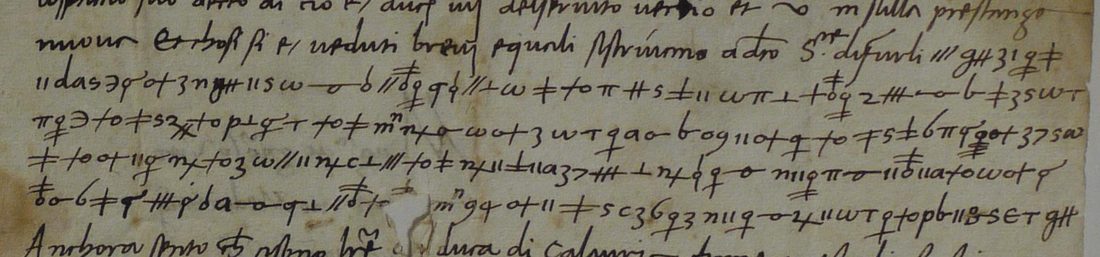
The letter is in clear except for two blocks on its second page: block A, 206 symbols in five lines, continues a clear sentence about the briefs written to the lord of Forlì; block B, 187 symbols in five lines, follows the clear words et della legha and ends in the clear Vale. The signature reads “Donatus Acc. or.”; the address on the first page, “Mag.co ac gen.so Viro Laurentio Medici tamquam fratri hon.do, Florentie”.
02What it says
George Lasry’s reading of the two blocks, quoted from his report (nulls omitted; 80 and 7 are numerals written in the cipher; ? marks a doubtful reading):
… et a quelo di Faenza, che si contenteranno, et egli stieno nele tere loro et mandino dua squadre per uno e di gente d’arme in campo. Et maraviglomi di? Faenza, havendo hauto lo aviso che ? ?v m date piu di fa, di ma non? el sapevo. Del signor Giovan Francescho da? Gonzagha si e spicato dile altre pratiche et volentieri vera a s?ervigi vostri con 80 huomini d’arme il meno, et no? fanti; domanda 7 milia ducati per queste genti et mille per la persona sua; et Bacio? viene et diravene a boca.
“… and to him of Faenza, that they will be content and that they should stay in their own lands and each send two squadrons of men-at-arms into the field. And I marvel at(?) Faenza, having had the news that ? … were given several days ago, and I did not(?) know it. As for Signor Giovan Francesco da(?) Gonzaga: he has freed himself from his other negotiations and will gladly come into your service with at least 80 men-at-arms and no(?) foot soldiers; he asks 7,000 ducats for these troops and 1,000 for his own person; and Baccio(?) is coming and will tell you of it by word of mouth.” (his translation)
Context. The letter was written seven weeks after the Pazzi conspiracy of 26 April 1478. On 1 June Sixtus IV excommunicated Lorenzo, and with Ferrante of Naples and Siena went to war on Florence; Florence pressed its Romagnol clients, Pino III Ordelaffi of Forlì and Galeotto Manfredi of Faenza, and hired condottieri. George Lasry takes block B’s Gonzaga to be Gianfrancesco Gonzaga (1446–1496), third son of Marquis Ludovico III of Mantua, who died on 12 June 1478, the day before this letter. Acciaiuoli was next sent to Louis XI and died in Milan on the way in August 1478. How a letter to Lorenzo came into the Sienese file is unexplained; interception of the courier, Siena being Florence’s enemy, is the obvious hypothesis.
03How it was deciphered
George Lasry, with CTTS and Claude, 15–17 October 2026: Claude transcribed the 393 symbols and recovered the key by crib analysis; George Lasry gives the result as “about 90 % certain”. Counted here on his reading, 357 of the 381 plaintext letters and numerals of the cipher passages stand in words without a query mark (93.7%). He marks two probable encipherer’s slips (ri where di is expected, e a for da).
The project transcribed the letter on 24 September 2026 (409 tokens under 44 sign names) and failed to break it: homophonic annealing did not converge, the Sienese key of Antonio Bichi (Rome 1478, DECODE R4752) did not fit, and the index of Florentine keys has no key for Acciaiuoli. George Lasry’s key has 57 signs: the project’s transcription had merged look-alike signs, the obstacle he names for the whole file.
04What remains
- One sign lost in a hole in block A (“? ?v m date piu di fa”).
- Six doubtful words, graded M: di?, non?, da?, s?ervigi, no?, Bacio?.
- Whether the Gonzaga condotta was concluded is unchecked in the published letters of Lorenzo (Rubinstein, vol. III).
Full texts
The transcription and the decryption of every document on this page, so that the reading can be used and checked. Short files are shown here; all are in the repository.
No. 11 (R4800), Donato Acciaiuoli to Lorenzo de' Medici, Rome, 13 June 1478 (George Lasry)
Donato Acciaiuoli, Florentine orator in Rome, to Lorenzo de' Medici, seven weeks after the Pazzi conspiracy: the lord of Faenza, like the lord of Forlì, is to stay in his lands and send two squadrons of men-at-arms into the field, and Giovan Francesco Gonzaga will gladly enter Lorenzo's service with at least 80 men-at-arms, asking 7,000 ducats for the troops and 1,000 for himself. Decryption and translation are George Lasry's (report of 17 Oct 2026, quoted whole); the transcription linked is this project's independent one of 24 Sept 2026, on which his key was checked (94.4% agreement), since his own sign-level CTTS transcription is not in the repository.
Transcription
No. 11 (DECODE R4800) -- transcription by agent B, 24 Sept 2026
=================================================================
Images: decode/img/IMG_R4800_I27945_P2.jpg (text side; the written page occupies x ~1650-3400, y ~380-1740)
        decode/img/IMG_R4800_I27945_P1.jpg (address side / dorse)
Crops:  crops/agentB/A_<y>_<seg>.jpg (block 1), B_<y>_<seg>.jpg (block 2), T_* (clear lines), z*.jpg (4-6x zooms)

What it is: Donato Acciaiuoli (Florentine orator in Rome) to Lorenzo de' Medici, "ex Urbe die 13 junii 1478".
  Pencil "1478" top left (later hand). Salutation "Mag.ce ac gen.se frater hon. etc."
  Signature lower right: "Donatus Acc. or. etc." ; pencil (modern) "Donato Acciaiuoli" and "11".
  P1 (address): "Mag.co ac gen.so Viro / [La]urentio Medici tamq(uam) / [f]ratri hon.do etc. / Florentie"
  (hole through "La-" and "f-"); pencil "Donato Acciaiuoli" at top; red wax seal remains; loose seal fragment.

Two cipher blocks: block 1 = tail of text line 6 + 4 full lines (C1-C4); block 2 = 5 full lines (D1-D5)
ending in clear "Vale". No word division: signs run on continuously. Numerals set between points occur
(".3 1.", ".8 O.", "8 7.", ".TAILP.") -- recorded with DOT tokens.

SIGN LEGEND (names used below)
------------------------------
Letter-like and digit-like signs (named as themselves):
  A      a
  B      b with straight (slanted) stem, bowl at the foot
  6      b-like with a clearly curved stem (like the digit 6). B/6 may be one sign written two ways;
         kept apart because the curvature is consistent where it occurs. "6?" = could be B.
  C      c
  C^tick? c set high with a small oblique tick above it (D1 only; tick may belong to the preceding Q)
  D      d with loop and ascender curving back left (delta-like "δ"); all d/δ forms merged
  E      epsilon-shaped E ("ε"), open to the right
  G      g with looped descender
  N      n
  P      p
  Q      q/9: loop with straight descender, no bar
  S      s
  O      o (plain small loop). In ".8 O." probably the numeral 0.
  1      single short stroke with a small hook at top (numeral 1)
  2      z/2 shape with flat foot
  3      3 with descender ("ʒ")
  4      the "4" form: short curl top left, horizontal bar, vertical crossing it and going below the line
  7      7
  8      8 / B-like double loop
  8^dot  8 with a dot above it (D1 start only; the dot may belong to the numeral "87.")
  II     two short upright strokes "11" (one sign; ii / numeral 11 / u?). Always written as a pair.
  M^n    m with a superscript n (always carries the n; a plain m never occurs)
Invented / Greek-like signs:
  OMEGA  ω
  PI     π
  TAU    T with the left end of the bar hooked ("τ")
  REV3   reversed 3 / reversed epsilon ("Э", "∋"), rounder than 3, sits on the line
  RHO    loop with a curl rising to the upper right and a descender, no bar ("ρ"/"ϱ"-like)
  OSTEM  loop attached to the left side of a tall vertical that goes above and below the line
  ODAG   loop (d/δ-like) whose ascender is crossed by two short bars above the line ("‡" standing on an o)
  QB1    loop with descender crossed by ONE bar (usually long, sloping); often with the top-right curl
  QB2    loop with descender crossed by TWO bars below the line (q with a "‡" hanging from it)
  QB3    same with THREE bars (C2, once)
  ODOT   circle with a dot inside ("⊙")
  TAILP  small loop entered by a bar from the left, long tail slanting down-left (D4, between points)
  ZX     z whose tail crosses below the line as an x (z + crossed strokes); might be two signs "2 X"
  NX     n whose last leg continues as a slanting descender crossed by a horizontal bar (crossed "ɲ")
Cross / stroke signs:
  PLUS   + : vertical crossed by ONE bar (the bar often runs on into the following o: "+o")
  DAG2   ‡ : vertical crossed by TWO bars (bars sometimes both high "Ŧ", sometimes low "±";
         treated as one sign)
  PERP   ⊥ : horizontal bar with a short vertical standing on it (vertical above the bar only)
  HASH   # : horizontal bar crossed by TWO short verticals ("H" with long bar)
  HASH3    : horizontal bar crossed by THREE short verticals
  SL2    // : two long slanted strokes
  SL3    /// : three long slanted strokes
  EQ     = : two horizontal bars, no vertical (D5, once)
  OBAR   o with a long horizontal stroke running through/over it to one or both sides ("-o-").
         Distinguished from O by a bar clearly longer than the o. Borderline: "OBAR?".
Punctuation:
  DOT    a point on the line (only around numerals)

Marks: bars on descenders/ascenders (QB1/QB2/QB3/ODAG), the superscript n (M^n), the dot (8^dot) and
tick (C^tick?) are kept as separate sign names. "?" = uncertain reading of that sign; "??" illegible.

TRANSCRIPTION
-------------
Clear text in [brackets] as read; "?" marks doubtful words. "(torn)" = right edge lost.

L1 [Mag.ce ac gen.se frater hon. etc. Adi 11 del presente vi scripsi l'ultima m(ia) ...(torn)]
L2 [hebbi lettera de 5. non ho hauto dalla S.ria V.? date per via alcuna ...(torn)]
L3 [e ui s'attendia? questo resto delle genti et mandarle uia. Lione...(torn)]
L4 [sebo? parte lunedi proximo et il Cancelliere del signore di Furli della b...(torn)]
L5 [lospruio? suo dato di no et duc(ati) iiij del presente uechio? et Io.mi? in sulla prestanga?]
L6 [mouer? et bossi si e ueduti breui equali scriuemo adto S.re di Furli]  SL3 G HASH 3 1 QB2 PLUS

BLOCK 1
C1  II D A S REV3 RHO O PLUS 3 N G? HASH II S OMEGA OBAR D SL2 ODAG QB2 Q OSTEM SL2 PERP OMEGA DAG2 PLUS O PI HASH S DAG2 II OMEGA PI PERP PLUS ODAG QB2 2 HASH3 OBAR B DAG2 3 S OMEGA TAU
C2  PI QB2 REV3 PLUS O DAG2 S ZX PLUS O P PERP QB1 TAU PLUS O DAG2 M^n NX OBAR? OMEGA O PLUS 3 OMEGA TAU QB1 A O B O G II O PLUS QB1 PLUS O DAG2 S DAG2 6 PI Q QB3 O PLUS 3 7 S OMEGA
C3  DAG2 PLUS O O PLUS II? QB1 NX PLUS O 3 OMEGA SL2 II NX C PERP SL3 PLUS O DAG2 NX II DAG2 II A 3 7 HASH PERP NX OSTEM QB1 OBAR N II QB2 PI OBAR II ODAG II A PLUS O OMEGA O PLUS RHO
C4  ODAG O 6 DAG2 RHO HASH3 RHO D A OBAR Q PERP SL2 ODAG PLUS O ODAG? M^n G Q O PLUS II DAG2 S C 3 6 QB1 3 N II QB1 OBAR 4 II OMEGA TAU QB1 PLUS O P B II 8 S E TAU G HASH

  notes: L6 the "1" after 3 is a single hooked stroke. C1 G? = g heavily blotted (perhaps written over
  another sign). C2 "M^n NX OBAR?": the bar through NX's tail runs on through the o to the omega (could
  be NX O). C3 II? = first stroke dark, second faint/brownish (could be a single 1). C4: after "PLUS O" a
  hole in the paper; above the hole a faded "‡" at ascender height = ODAG? (its loop lost in the hole);
  no other sign appears lost. C4: a stray dot between C3 and C4 above the second RHO (not counted).

[clear]
L7  [Ancora sento ch(e) e' nostri hanno l(ette)re ..(hole).. dura? di Calauria come questo di se stima]
L8  [partire dabruzi et uenire in nanzi? con .xx. squadre et Valent(ino)? se stima]
L9  [che gli uenghino dritto et d'ogni luogho ss.ente? che fanno uno grande]
L10 [auanzare di tempo per anticipare e nostri prouedimenti et della legha]

BLOCK 2
D1  8^dot 7 DOT G HASH G? Q? PLUS O HASH3 B 3 2 OMEGA TAU DAG2 7 3 PERP M^n A II OMEGA DOT 3 1 DOT N DAG2 II OMEGA SL2 QB2 B SL2 ODAG TAU QB2 II 7 PERP OMEGA OBAR II 2 ODAG D B 3 M^n QB2 SL3 Q C^tick? 3
D2  ODOT II DAG2 RHO O PLUS OBAR REV3 S D HASH3 DAG2 QB1 PLUS O DAG2 QB1 II DAG2 3 SL2 ODAG QB2 PLUS O DAG2 A TAU HASH3 PLUS O OMEGA DAG2 3 PLUS O DAG2 3 6 S ZX OBAR B 6? S QB1
D3  A 3 2 OBAR A TAU B DAG2 QB1 OBAR SL2 PERP OMEGA DOT 8 O DOT ODAG A TAU NX 3 OMEGA OBAR O PLUS II DAG2 NX PLUS O OSTEM HASH3 NX S PI RHO QB2 DAG2 OMEGA O N II OMEGA HASH 3
D4  O PLUS Q NX II OMEGA O PLUS D DOT TAILP DOT 4 OBAR P 3 OBAR QB1 A SL2 II DAG2 OSTEM C S QB1 D 6 S B DAG2 QB2 2 S OMEGA DAG2 3 PLUS O DAG2 4 OBAR REV3 QB2 C PLUS O DAG2
D5  HASH3 II DAG2 PLUS O DAG2 Q PERP OMEGA D Q A D QB1 HASH Q II ODOT OBAR RHO 6 3 S PI PLUS O QB2 DAG2 O PLUS 3 DAG2 II E S PI PLUS O II EQ TAU ODOT II [Vale]

  notes: D1 starts "8 7." -- the 8 carries a dot above; then a point. "G? Q?" = two signs written over
  each other / corrected (dark ink), followed by a bar that runs into PLUS. ".3 1." between points
  (numeral 31?). D3 ".8 O." = numeral 80? D4 ".TAILP." single sign between points (a numeral form?).
  D5 EQ = two parallel bars with no vertical.

[ex Urbe die 13 junij 1478]
[Donatus Acc. or. etc.]

STATISTICS (automatic count; DOT points excluded)
Cipher tokens: 436  (block 1 = L6 tail + C1-C4: 205; block 2 = D1-D5: 231)
Per line: L6 7, C1 48, C2 51, C3 49, C4 50, D1 52, D2 46, D3 44, D4 46, D5 43
Sign counts:
  O          39
  PLUS       36
  DAG2       33
  II         29
  3          24
  OMEGA      22
  S          18
  OBAR       16
  QB1        15
  QB2        13
  A          12
  TAU        11
  PERP       10
  B          9
  D          9
  NX         9
  ODAG       9
  Q          9
  SL2        9
  HASH       8
  PI         8
  HASH3      7
  RHO        7
  6          6
  2          5
  7          5
  G          5
  N          5
  C          4
  M^n        4
  OSTEM      4
  REV3       4
  4          3
  ODOT       3
  P          3
  SL3        3
  1          2
  8          2
  E          2
  G?         2
  ZX         2
  6?         1
  8^dot      1
  C^tick?    1
  EQ         1
  II?        1
  OBAR?      1
  ODAG?      1
  Q?         1
  QB3        1
  TAILP      1
Decryption
# George Lasry, "The cipher documents of Concistoro 2308, fasc. 2" (17 Oct 2026): no. 11 (R4800)

Quoted verbatim from the report sent by email to Daniel Bourdeau on 17 Oct 2026 (text extracted page by page from the PDF;
the key figure, the manuscript crop and the bold marking of cipher words are images or formatting and are not
reproduced in this text). Do not edit the readings below; corrections and comparisons go in NOTES.md.

```
[Contents list]
E. A Florentine cipher of 1478
• No. 11 = R4800

  — Acciaiuoli to Lorenzo de' Medici, Rome 13 June 1478, 393 symbols — solved
ciphertext-only by Lasry with CTTS and Claude (15–17 October 2026)

No. 11 (R4800): Donato Acciaiuoli to Lorenzo de' Medici, Rome, 13 June
1478
Status. Solved: about 90 % certain; a few signs and one damaged word open. 15–17 October 2026, by
George Lasry with CTTS and Claude: transcription by Claude and key recovered by Claude (crib analysis).
References
• Archivio di Stato di Siena, Concistoro 2308, fasc. 2 (Lettere in cifra), no. 11
• DECODE record R4800 (Concistoro_2308_54), https://de-crypt.org/decrypt-web/RecordsView/4800
Ciphertext
The cipher consists of 393 symbols in 10 lines on P2 (block A, 206 symbols in 5 lines; block B, 187 in 5 lines),
most of them homophones for single letters, plus nulls and two literal dotted numerals.
Key
57 distinct signs. Homophonic substitution: three to five signs for each vowel, one to three for the
consonants, a few nulls, and the numerals 80 and 7 written as dotted numbers; no nomenclator.
Signs as cut from the manuscript, with their number of occurrences; homophones stand under their letter.
Decryption

Cipher in bold, clear text plain; nulls omitted; 80 and 7 are numerals written in the cipher; two probable encipherer’s slips are
marked.
... e veduti brevi e quali scriviamo a dto S.re di Furli: et a quelo di Faenza, che si contenteranno, et egli
stieno nele tere loro et mandino dua squadre per uno e di gente d'arme in campo. Et maraviglomi di?
(cipher: ri) Faenza, havendo hauto lo aviso che ? ?v m date piu di fa, di ma non? el sapevo. Del signor
Giovan Francescho da? (cipher: e a) Gonzagha si e spicato dile altre pratiche et volentieri vera a s?ervigi
vostri con 80 huomini d'arme il meno, et no? fanti; domanda 7 milia ducati per queste genti et mille per la
persona sua; et Bacio? viene et diravene a boca. Vale
... and seen the briefs, which we are writing to the said lord of Forlì: and to him of Faenza, that they will be
content and that they should stay in their own lands and each send two squadrons of men-at-arms into
the field. And I marvel at(?) Faenza, having had the news that ? ... were given several days ago, and I did
not(?) know it.
As for Signor Giovan Francesco da(?) Gonzaga: he has freed himself from his other negotiations and will
gladly come into your service with at least 80 men-at-arms and no(?) foot soldiers; he asks 7,000 ducats
for these troops and 1,000 for his own person; and Baccio(?) is coming and will tell you of it by word of
mouth. Farewell.
Contents
From: Donato Acciaiuoli, Florentine orator
To: Lorenzo de’ Medici
Place: Rome
Date: 13 June 1478 — dated in the clear text
The letter is in clear except for two cipher blocks on P2. Block A continues a clear sentence about the briefs
being written to the lord of Forlì: the same is to be written to the lord of Faenza, that they will be content,
should stay in their own lands and each send two squadrons of men-at-arms into the field; Acciaiuoli adds
that he marvels at Faenza, having had news that something (one sign is lost in a hole) was given several days
earlier without his knowing it. Block B, which follows the clear words 'et della legha', reports on Giovan
Francesco Gonzaga: he has freed himself from his other negotiations and will gladly enter Lorenzo's service
with at least 80 men-at-arms and no foot soldiers, asking 7,000 ducats for these troops and 1,000 for his own
person; a certain Baccio(?) is on his way and will explain the matter by word of mouth.
Historical context and dating
The letter was written seven weeks after the Pazzi conspiracy of 26 April 1478. On 1 June Sixtus IV
excommunicated Lorenzo de' Medici and, with Ferrante of Naples and Siena, went to war on Florence;
Alfonso of Calabria's army entered the Chianti from Sienese territory in July [Rubinstein, Lettere di Lorenzo
de' Medici III, 1977; Martines, April Blood, 2003]. Donato Acciaiuoli (1429-1478), the Florentine orator in
Rome, was next sent to Louis XI and died in Milan on the way (August 1478) [D'Addario, DBI 1, 1960].
Florence meanwhile pressed its Romagnol clients, Pino III Ordelaffi of Forlì (Girolamo Riario took Forlì only in
1480) and Galeotto Manfredi of Faenza, and hired condottieri [Mallett, Mercenaries and Their Masters,
1974]. Block B's Gonzaga is most probably Gianfrancesco Gonzaga (1446-1496), third son of Marquis
Ludovico III of Mantua, who died on 12 June 1478, the day before this letter [Lazzarini, DBI 57, 2001];
whether the condotta was concluded is unchecked in the published Medici letters. How a letter to Lorenzo
came into the Sienese Concistoro's cipher file is unexplained; Siena was Florence's enemy in 1478, and
interception of the courier is the obvious hypothesis, but the file gives no evidence.
Sources
Lettere di Lorenzo de' Medici, vol. III (1478-1479), ed. Nicolai Rubinstein, Florence: Giunti-Barbèra, 1977
Lauro Martines, April Blood: Florence and the Plot against the Medici, Oxford: Oxford University Press, 2003
Michael Mallett, Mercenaries and Their Masters: Warfare in Renaissance Italy, London: Bodley Head, 1974

```
Translation
# George Lasry, "The cipher documents of Concistoro 2308, fasc. 2" (17 Oct 2026): no. 11 (R4800)

Quoted verbatim from the report sent by email to Daniel Bourdeau on 17 Oct 2026 (text extracted page by page from the PDF;
the key figure, the manuscript crop and the bold marking of cipher words are images or formatting and are not
reproduced in this text). Do not edit the readings below; corrections and comparisons go in NOTES.md.

```
[Contents list]
E. A Florentine cipher of 1478
• No. 11 = R4800

  — Acciaiuoli to Lorenzo de' Medici, Rome 13 June 1478, 393 symbols — solved
ciphertext-only by Lasry with CTTS and Claude (15–17 October 2026)

No. 11 (R4800): Donato Acciaiuoli to Lorenzo de' Medici, Rome, 13 June
1478
Status. Solved: about 90 % certain; a few signs and one damaged word open. 15–17 October 2026, by
George Lasry with CTTS and Claude: transcription by Claude and key recovered by Claude (crib analysis).
References
• Archivio di Stato di Siena, Concistoro 2308, fasc. 2 (Lettere in cifra), no. 11
• DECODE record R4800 (Concistoro_2308_54), https://de-crypt.org/decrypt-web/RecordsView/4800
Ciphertext
The cipher consists of 393 symbols in 10 lines on P2 (block A, 206 symbols in 5 lines; block B, 187 in 5 lines),
most of them homophones for single letters, plus nulls and two literal dotted numerals.
Key
57 distinct signs. Homophonic substitution: three to five signs for each vowel, one to three for the
consonants, a few nulls, and the numerals 80 and 7 written as dotted numbers; no nomenclator.
Signs as cut from the manuscript, with their number of occurrences; homophones stand under their letter.
Decryption

Cipher in bold, clear text plain; nulls omitted; 80 and 7 are numerals written in the cipher; two probable encipherer’s slips are
marked.
... e veduti brevi e quali scriviamo a dto S.re di Furli: et a quelo di Faenza, che si contenteranno, et egli
stieno nele tere loro et mandino dua squadre per uno e di gente d'arme in campo. Et maraviglomi di?
(cipher: ri) Faenza, havendo hauto lo aviso che ? ?v m date piu di fa, di ma non? el sapevo. Del signor
Giovan Francescho da? (cipher: e a) Gonzagha si e spicato dile altre pratiche et volentieri vera a s?ervigi
vostri con 80 huomini d'arme il meno, et no? fanti; domanda 7 milia ducati per queste genti et mille per la
persona sua; et Bacio? viene et diravene a boca. Vale
... and seen the briefs, which we are writing to the said lord of Forlì: and to him of Faenza, that they will be
content and that they should stay in their own lands and each send two squadrons of men-at-arms into
the field. And I marvel at(?) Faenza, having had the news that ? ... were given several days ago, and I did
not(?) know it.
As for Signor Giovan Francesco da(?) Gonzaga: he has freed himself from his other negotiations and will
gladly come into your service with at least 80 men-at-arms and no(?) foot soldiers; he asks 7,000 ducats
for these troops and 1,000 for his own person; and Baccio(?) is coming and will tell you of it by word of
mouth. Farewell.
Contents
From: Donato Acciaiuoli, Florentine orator
To: Lorenzo de’ Medici
Place: Rome
Date: 13 June 1478 — dated in the clear text
The letter is in clear except for two cipher blocks on P2. Block A continues a clear sentence about the briefs
being written to the lord of Forlì: the same is to be written to the lord of Faenza, that they will be content,
should stay in their own lands and each send two squadrons of men-at-arms into the field; Acciaiuoli adds
that he marvels at Faenza, having had news that something (one sign is lost in a hole) was given several days
earlier without his knowing it. Block B, which follows the clear words 'et della legha', reports on Giovan
Francesco Gonzaga: he has freed himself from his other negotiations and will gladly enter Lorenzo's service
with at least 80 men-at-arms and no foot soldiers, asking 7,000 ducats for these troops and 1,000 for his own
person; a certain Baccio(?) is on his way and will explain the matter by word of mouth.
Historical context and dating
The letter was written seven weeks after the Pazzi conspiracy of 26 April 1478. On 1 June Sixtus IV
excommunicated Lorenzo de' Medici and, with Ferrante of Naples and Siena, went to war on Florence;
Alfonso of Calabria's army entered the Chianti from Sienese territory in July [Rubinstein, Lettere di Lorenzo
de' Medici III, 1977; Martines, April Blood, 2003]. Donato Acciaiuoli (1429-1478), the Florentine orator in
Rome, was next sent to Louis XI and died in Milan on the way (August 1478) [D'Addario, DBI 1, 1960].
Florence meanwhile pressed its Romagnol clients, Pino III Ordelaffi of Forlì (Girolamo Riario took Forlì only in
1480) and Galeotto Manfredi of Faenza, and hired condottieri [Mallett, Mercenaries and Their Masters,
1974]. Block B's Gonzaga is most probably Gianfrancesco Gonzaga (1446-1496), third son of Marquis
Ludovico III of Mantua, who died on 12 June 1478, the day before this letter [Lazzarini, DBI 57, 2001];
whether the condotta was concluded is unchecked in the published Medici letters. How a letter to Lorenzo
came into the Sienese Concistoro's cipher file is unexplained; Siena was Florence's enemy in 1478, and
interception of the courier is the obvious hypothesis, but the file gives no evidence.
Sources
Lettere di Lorenzo de' Medici, vol. III (1478-1479), ed. Nicolai Rubinstein, Florence: Giunti-Barbèra, 1977
Lauro Martines, April Blood: Florence and the Plot against the Medici, Oxford: Oxford University Press, 2003
Michael Mallett, Mercenaries and Their Masters: Warfare in Renaissance Italy, London: Bodley Head, 1974

```
Key: key.md
05Sources
- Archivio di Stato di Siena, Concistoro 2308 fasc. 2 no. 11: DECODE R4800.
- George Lasry, “The cipher documents of Concistoro 2308, fasc. 2”, report sent to Daniel Bourdeau, 17 October 2026, section E (decipherment, key, translation, context).
- Lettere di Lorenzo de’ Medici, vol. III (1478–1479), ed. N. Rubinstein (Florence 1977); L. Martines, April Blood (Oxford 2003); M. Mallett, Mercenaries and Their Masters (London 1974); as cited by George Lasry.
Manuscript rights: Archivio di Stato di Siena.
George Lasry’s report section, the project’s transcription and the notes: targets/siena11/.