01Who was writing
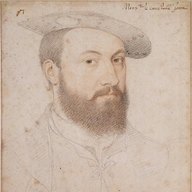
DECODE gives the sixteen fr. 3053 records a recipient (Anne de Montmorency), a place (Rome, twice Orvieto) and no sender. Tomokiyo’s page on the French ciphers of Francis I names the volume for what it is: letters of 1535–37 from the bishop, later cardinal, of Mâcon, ambassador in Rome, to Montmorency. The records confirm it in clear. R4240 ends “A Orviette le deux[iesme] jour de septembre 1536”, signed “Vostre treshumble et tresobeissant serviteur Charles e. de Mascon”; R4247’s second letter is dated Orvieto, 1 September 1536 and signed the same way; R4239 ends “A Rome le vje jour d’apvril 1537”, signed “E. Card[ina]l de Mascon”. The promotion of 22 December 1536 falls between the two.
That also settles the key. In the repository’s Gramont, Mâcon and Langeac write-up, Lasry’s table of 5 November 2023 for BnF fr. 3071 f. 9 is called “Mascon’s cipher” and identified with fr. 3053; the letter it decrypts, Rome, 11 April 1537, is five days younger than R4239. The same key serves here, with the corrections set out below.
02The eight records
| DECODE | Leaf | Date, place | Cipher | Read here |
|---|---|---|---|---|
| R4233 | f. 6 | Rome, 26 Jan 1536 o.s. (= 1537) | ~70 lines, 9 passages | ~95 %, four glosses |
| R4234 | f. 16 | Rome, Feb 1536 o.s. (= 1537) | ~155 lines, nearly the whole letter | ~94 % |
| R4235 | f. 21 | Rome, 15 Feb 1536 o.s. (= 1537) | ~60 lines | ~96 %; a clear copy on P6 |
| R4238 | f. 32 | Rome, September 1536 | ~26 lines, 3 passages | ~94 % |
| R4239 | f. 35 | Rome, 6 Apr 1537 (two letters and a postscript) | ~160 lines | ~94 %; a clear copy of letter 2 on ff. 37r–v |
| R4240 | f. 40 | Orvieto, 2 Sept 1536 | 26 lines | ~98 %, two glosses |
| R4247 | f. 77 | Orvieto, 1 Sept 1536 (two letters) | ~57 + ~26 lines | ~98 % (both letters) |
| R4248 | f. 85 | 1536 | ~20 lines, a different cipher | resolved by the f. 86 decipherment |
The eight sibling records DECODE marks “Decrypted” (R4236, R4237, R4241–R4246) were opened but not deciphered here; R4245 is not a Montmorency letter at all but Selve and Rodez writing from Venice to Mâcon. DECODE’s “Decrypted” marking on this volume means that the cipher system is known: no transcription or plaintext file is attached to any of the sixteen records.
03Orvieto, 2 September 1536: the council and the Germans
The clearest of the letters, and the one with the best control: a contemporary hand glossed its last cipher lines in the margin, and the gloss and the decryption agree word for word. Mâcon has learned “de bon lieu” that Vergerio, nuncio under Clement VII and kept on by Paul III, carried word from Ferdinand to the Germans that the Pope and the College were content that, coming to the council, they might there « dire et faire ainsi qu’ils seroient inspirez par le Sainct Esperit »; on that assurance they resolved to attend, hoping for a decisive peace. But the Pope, judging this would be « la totale ruine de l’Eglise et sainct siege apostolique », has sent an auditor to summon them on the old law and custom instead. The Germans will not consent, Mâcon hears: they say the morals of pope, cardinals and bishops must be reformed, and that cannot be done without them. Then the clear text resumes, and the ambassador leaves his master to draw the conclusion: « Je vous laisse a penser sur cela, monseigneur, que ce sera de l’assemblee dudict concille. »
04Orvieto, September 1536: Doria’s galleys, and Milan
Andrea Doria had written to the conte dell’Anguillara to hold his galleys ready to join his own when sent for. Since Doria’s cousin Antonio had lately taken one of Anguillara’s fustas, and since Anguillara’s galleys are in the Pope’s service, Mâcon inferred a reconciliation made at the Pope’s command, and therefore a secret treaty with the Emperor — and put it to Paul III to his face. The Pope answered that Anguillara had indeed shown him the letter and that he marvelled at it, given the seizure of the fusta; that he did not think Doria content with him, having last year made him pay for three months for his three galleys and pay besides for the dispensation for his wife’s son to marry Antonio de Leyva’s second daughter; and that he was wholly ignorant of the cause. Mâcon replied that it could not be so without either a treaty with the Emperor, which he could not believe, or Anguillara having taken Doria’s service; the Pope said only that he knew nothing of it.
A second block of the same letter has a man sent by cardinal Ennio Filonardi of Veroli sound the ambassador out: could the King be brought to consent that the duchy of Milan pass, from the Emperor, to the son of Pier Luigi Farnese, or else to the young Sforza? Mâcon answered that neither the King nor Messeigneurs his sons would ever consent, and that as long as the crown of France reigned it would not suffer Milan to go into other hands than its own, being their true inheritance, so it was time lost for the Pope.
The second letter of 1 September 1536 (R4247) carries the count of Pitigliano’s advice: if the Emperor winters in Milan, strike at Naples, discontented and with no strong places but on the coast, and Sicily « ne fauldroit, avec peu d’ayde, de se revolter ».
05Rome, September 1536: the Sienese exiles, and a German with an offer
The bearer of the letter is sent by the Sienese fuorusciti to press Francis I to an enterprise against Siena. Mâcon sees no prospect in it, but did not stop the journey; his fear is that if the exiles are left to themselves they will go over to duke Alessandro de’ Medici, who is working to win them and so « s’impatroniser de l’estat du dict Siennes ». In the same letter a German at Rome, who says he is of King Ferdinand’s chamber and knows his secrets and wants to enter the King’s service, gives him letters for a lansquenet captain serving with count Wilhelm von Fürstenberg; Mâcon suggests having them translated in Paris before they are delivered.
06Rome, January and February 1537: marriages, a conclave, and a marriage used as currency
The January letter (R4233) runs over the pourparlers on marriages for Pier Luigi Farnese’s children, with cardinal Trivulzio’s view on how to stop them; the imperial ambassador and Venice; cardinals Trani, Cesi and Pisani. If the French cardinals were at Rome, Mâcon writes, they could steer a conclave should some mishap befall the Pope, who is « septuagenaire et plus » and failing — and meanwhile the King has done no favour to any of the Pope’s servants, so little goodwill can be expected from them. The Pope is sending cardinal Verulano’s secretary, « ung tres mauvais garson », into Switzerland, and means to take the legation of Parma and Piacenza from Salviati and give it to Verulano; behind it Mâcon suspects « quelque dessaing sur le duché de Millan ». In Piedmont the French captains are quarrelling among themselves, Guido Rangone among them, and the grain is nearly gone.
The letter of 15 February (R4235) holds the most direct statement in these eight records, and it is one of the three checked word for word against a contemporary margin: « j’ay sceu de bon lieu que le dict [pape] vouloit entretenir le [roy] de mariage, et ayant de ce dudict seigneur bonne[s paroles], pour ce s’en prevaloir vers le dict [Empereur], pour parvenir a son intendit. » Keep it from everyone but the King, he adds, and keep the secret of the envoys’ charge — above all from the bishop of Verona, who passes for more devoted to the King than to the Emperor because he holds benefices of him.
The long February letter (R4234), almost wholly in cipher, is now decrypted throughout. Its first pages turn on the same business: the Pope means to wrong someone through an intermediary and to bring the King to consent; cardinal Cesarini writes in the same sense; the bishop “de Lodes” — Lodi, then at Venice, whose see had passed to cardinal Simonetta (first taken here as Rodez) — holds that the King should never consent. Later pages report the marriages of Pier Luigi’s sons and the match of his house with Cosimo de’ Medici, “sworn several times over”, and then his arming: so many thousand escuz paid at his departure from Rome, two thousand more assigned at Parma and Piacenza, and a levy of six thousand Italians, five thousand Swiss, five hundred light horse and a hundred men-at-arms.
The rest of the letter, decrypted in a third pass, is the fullest account in the volume of the Farnese design on Milan. Pier Luigi’s horse under Giovanni Battista Savelli is to be ready this month and the foot by March; a Sienese gentleman in his service, questioned by Mâcon, says the troops are held in Parma and Piacenza « soubz umbre et couleur de vouloir garder » them, ready to garrison the towns and fortresses of the duchy of Milan if the Farnese marriages persuade the Emperor to sell it to Pier Luigi for a great sum; and the Pope, « qui est fin », will meanwhile make a show of keeping his neutrality. Mâcon weighs the report as possibly a plant by the Imperialist cardinals Veroli and “Cesane”, but the Pope’s own admissions give him « grant presumption »; and Contarini, « imperial pour la vie », has become the Pope’s familiar. The last cipher pages (one of them with a clear copy slipped in beside it) call messire Ambroise « corruptible plus que tous les hommes que je congnoisse », fear that the King’s new demand for three tenths on the French clergy, with the calumny of the Turk, will give the Pope his pretext to declare against him, and end on Andrea Doria, whose talk of going to Spain Mâcon takes for a feint.
The rest of the 15 February letter has the Pope angling for the fortresses of Milan and saying the idea came from the King’s side; Mâcon denies it, and counsels not driving the Pope to despair. A later passage, checked against a contemporary clear copy bound in beside it, sets out the French hope: « si le Roy est fort en Italie du costé de Lombardie, facillement ledict estat de Florence se pourra reduire en l’ancienne liberté et devotion dudict seigneur Roy ».
07Rome, 6 April 1537: an estate in France for the Pope’s son
The last and longest of the deciphered letters. Paul III talks to the ambassador of the marriage of his grandson Ottavio Farnese to the Emperor’s daughter Margaret — the match celebrated in November 1538 — and insists on his neutrality while pressing for peace. A contemporary hand glossed one line of the second letter, “quant au faict de florence”, and it opens a passage on the intrigues at Rome of the exile cardinals Salviati and Ridolfi in the months after the murder of duke Alessandro de’ Medici on 6 January 1537; the clear text around it has Mâcon setting a spy on Salviati’s household.
The main business of the letter is a bid for the Pope’s son. The Imperialists have offered Pier Luigi Farnese the investiture of Novara and are pressing him to take it; Mâcon counters with « quelque honneste estat en France », arguing from the Pope’s age and from Pier Luigi’s need of an « occasion d’en eschapper » once his father is dead. Pier Luigi answers neither yes nor no: he will take nothing without the Pope’s knowledge, and now the King’s. Around it the clear pages carry the news of the season: Bohemia’s grant to the King of the Romans against the Turk, a Lutheran diet in Saxony, and the death of the marquis of Saluzzo and count Philippe Torniello by arquebus shot before the castle of Carmagnola in Holy Week.
The pages decrypted in the third pass fill in the middle: the duke of Urbino tells Ridolfi’s envoy Albizzi of « estroicte praticque » between the Pope and the Emperor’s ministers, the Emperor wanting tenths and crusade money and a league of the Italian princes; Mâcon asks for a ciphered article he can show the Pope, « afin que si la raison et l’honnesteté ne le desmeuvent des dictes praticques, que la peur l’en peust divertir »; and Novara was offered to Pier Luigi at the Pope’s own command. Meeting him in the Pope’s antechamber, Mâcon is told, « sans accepter ne refuser », to write nothing of it to the King.
08f. 85: a second cipher, deciphered at the time
The key does not fit one record, R4248. Its signs are a different set, and Mâcon’s values give nonsense; they match the second table Tomokiyo sketched from this volume, and he noted that the fragment on f. 85 is “deciphered on f. 86”, and f. 86 does carry a full contemporary clear decipherment of the passage, and it agrees with every clear connecting phrase left standing on f. 85. The writer, after a day in the country with a cardinal, had urged him that everything, and above all the conduct of the war, should pass through Montmorency’s hands, and that anything else was « fumee et vent »; the cardinal seemed persuaded, and added that the cardinal of Lorraine, in his capitulation with the Pope, had conceded things never thought of before, which they meant to undo, leaving the whole matter to Montmorency. Tabulating that second key from f. 85 against f. 86 is work left undone here.
09Method and key
The system is homophonic substitution on digit-like graphic signs, one sign per letter, with special signs for doubled letters, two nulls, and exactly three code numbers: 20 = l’Empereur, 30 = pape, 40 = roy. No other number occurs in any of the eight records, so no part of these letters is hidden behind an unknown nomenclator. What stays undecrypted does so because of the hand.
Work proceeded record by record from the DECODE page scans, cropping a line at a time at full resolution, writing each line as a string of ASCII aliases, decoding it with the
table built in gramont1529/macon_key.md, and then interpreting the output as French. Six contemporary decipherments turned up in the volume, marginal on R4233, R4235
and R4240, interlinear on R4235, R4239 and R4240. Three of them agree with the decryption word for word; they are the control this write-up rests on. One of them
also corrected the published table: over the line ꭓ£+7G 8ꭓ ǂ3Δ4G 5o ǂ10D27o74g a contemporary wrote “quant au faict de florence”, which makes the big curly X
Q and U, not N as the working table had it, and shows the QUE group written three ways indifferently. Other values fixed here: the plain saltire is N as well as L;
4 is C, R and sometimes T; 7 is N, R and B; the triple bar on a stem is RR (proved by PIE-RR-E, three times); ω is PP and the hooked
ʃ is H, both in eschapper.
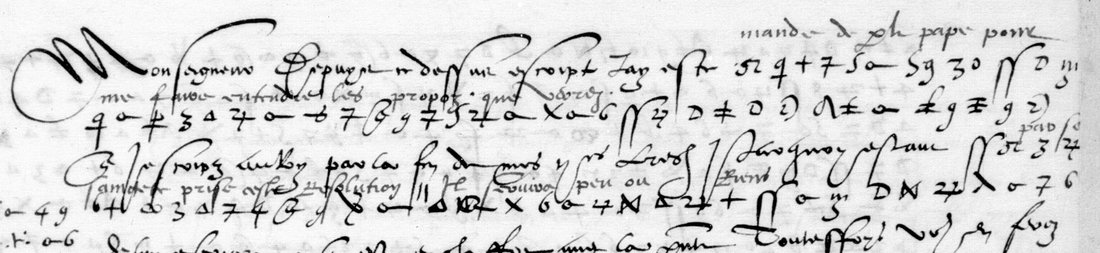
What limited the first passes to between 55 and 85 % was one family of signs. The barred crosses — ǂ, £, the long ƒ — stand for F,
P, O, U, V and D, and at first they seemed separable only by context. The limit was palaeographic; the key itself was known.
10Re-transcription by sign shape
After the first passes about a quarter of the letters were still doubtful, and nearly all the doubt sat on one family of barred signs. Cutting 1,262 glyphs out of the pages and
grouping them by shape showed why: what the transcribers had written as one sign ǂ is four or five different signs of the key: a long hooked f for O, a £ with a
looped foot for U, a two-barred stroke for P, a looped p-top for F, a barred q for M, each distinct once the line is seen at full size. Every record was then transcribed again,
sign by sign, from the BnF’s own full-resolution scans on Gallica, with each warped line straightened first, and decoded by the key and a sixteenth-century French language model.
Two more contemporary clear copies turned up in the process: ff. 37r–v, bound after R4239, are the clerk’s clear text of that record’s whole second letter, and Mâcon’s companion letter to the King of the same February day (BnF Dupuy 44, ff. 30–38) carries its own decipherment. Against every clear text the new readings differ by 3–8 % of letters, and most of that is spelling (pappe for pape, Loys for Luis). About 95 % of the cipher letters are now decrypted. The lines once called faded at the foot of R4247 are sharp on the Gallica scan: « il seroit icy fort difficille de recouvrer gens de cheval ne artillerie; bien trouverroit on tant de gens de pied, et bons, qu’on vouldroit, et beaucoup de gentilz homes forussiz, qui serviroient pour peu de chose. » R4234 now names Stefano Colonna to lead Pier Luigi’s foot and Giovanni Battista Savelli his horse; R4240 names the auditor sent to the Germans, “Vuorst”, apparently Peter van der Vorst.
11What remains
- About 5 % of the letters, inside lines that otherwise decrypt: runs where the signs 7 (N or B), 4 (C or R) or the O/U pair stay ambiguous and no clear copy covers them. The ink is legible; nothing on these pages is physically lost.
- A few short runs in R4239 (the postscript’s margin, whose contemporary gloss does not fit the signs under it) and some names: a Sienese gentleman, a count “Mer[?]le”, two German captains, “Cesane”, “Palmier”.
- The f. 85 key could be tabulated from its own contemporary decipherment on f. 86.
12Sources
- BnF, Français 3053, ff. 6, 16, 21, 32, 35, 40, 77, 85–86 — DECODE records R4233, R4234, R4235, R4238, R4239, R4240, R4247, R4248, de-crypt.org. The images require a login and are not in the public domain; they are not reproduced here and are not committed to the repository.
- S. Tomokiyo, “French Ciphers during the Reign of Francis I”, section “BnF fr.3053 (1535-1537)” — cryptiana.web.fc2.com: the identification of the volume with the cardinal of Mâcon, his reconstruction of the cipher, and the note that the f. 85 fragment is deciphered on f. 86. No plaintext.
- G. Lasry, key table for BnF fr. 3071 f. 9 (“Mascon’s cipher”), dated 5 November 2023, on cryptiana GL.htm; applied in this repository’s Gramont 1529–37 write-up. Keys only.
- Lettres et documents de Claude Dodieu, 1527–1557, edition table, rom.uga.edu — searched for these despatches; it prints the neighbouring Rome and Naples correspondence of 1535–36 but not the Mâcon letters to Montmorency.
Working files — the per-record line-by-line transcriptions, the decodings and the reading notes: rome1536/. Page images are not committed (BnF rights).