
At a glanceExisting decipherment · complete
- The letter
- An unsigned letter to Anne de Montmorency, 1536, written outside Rome after a day in the country with a cardinal; about 20 lines of cipher inside clear text.
- Where
- Bibliothèque nationale de France, fr. 3053 ff. 85–87, DECODE R4248, catalogued with the eight “unknown sender (Rome)” letters of catalogue item 180.
- The cipher
- A substitution on graphic signs with nulls (30, a triple-barred cross, 22): Tomokiyo’s second fr. 3053 table, not the cardinal de Mâcon’s key.
- How it was deciphered
- From the contemporary clear decipherment on f. 86, checked against every clear connecting phrase left in the cipher on f. 85. The key was not applied.
- What it says
- The writer urged the cardinal that all affairs, the war above all, should go through Montmorency, “et que toute autre chose estoit fumee et vent”.
- Still open
- The writer, the cardinal (“Carafe”?), a few words of the secretary hand, and the key table.
01 The record and its cipher
DECODE files R4248 with the letters of Charles Hémard de Denonville, cardinal de Mâcon, to Montmorency in BnF fr. 3053, all catalogued with no sender. Those letters are in “Mascon’s cipher” and have their own page. This one is not: its signs are a different set, and the cardinal’s values (W = LL, ~ = null, 30 = pape) give nonsense. It is a different cipher, with its own page since 14 October 2026.
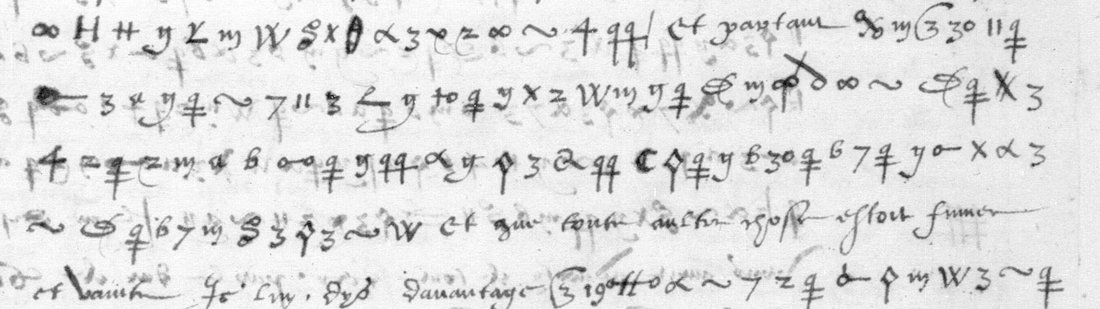
The signs match the second table Satoshi Tomokiyo sketched from this volume (nulls 30, the triple-barred cross and 22; ~ for I and J; 7 and 11 for L; W for R; 3 for O; α for U; ʃ for P), and Tomokiyo noted that the fragment on f. 85 is “deciphered on f. 86”. After the clear words et partant, the cipher ꭓ m Ɛ 3 30 11 ǂ begins JE LE CO[NSEILLOIS], as in the decipherment. The record has no date, place or signature on the DECODE images; the letter ends “Hors deux jours je seray a Rome”, and its place in the volume puts it in 1536.
02 The reading, from the decipherment on f. 86
The clear text opens: “Monsieur le cardinal Carafe [?] et moy fusmes hyer en campagne pour parler ensemble”. The legate had tried to take the writer to Rome that evening to see the Pope, and the writer asked for two days more; they talked all day, and the cardinal professed himself wholly devoted to the King’s service. Then the cipher, as f. 86 gives it:
[…] en toutes choses et particulierement celles de la guerre avoient a passer par voz mains, et partant je le conseilloie de s’adresser a faire fondement de vous seul … et que toute autre chose estoit fumee et vent. Je luy dys davantaige qu’il cognoistroit totallement le [Roy?] en ce jugement tant de la maniere de faire la guerre comme au lieu et du temps, par ce que en fin il falloit que tout homme feist son mestier et ceulx qui le font le mieulx sont les plus praticques. … Bien vous diray je que je trouve led. Sr cardinal enclin de luy mesme a suivre ce conseil, et l’ay laissé en volunté, comme il me semble en tout persuadé.
The cardinal then told him that the cardinal of Lorraine, in the capitulation he had made with the Pope, had granted things “ausquelles auparavant ilz n’avoient jamais pensé”, that they meant to undo the conditions he had passed because he had conceded more than he should, and that the whole matter would be left to Montmorency, “congnoissant ung seul fondement aux choses qui passeroient par voz mains”. The decipherment ends “Il me dist aussi” with a cue mark where the original resumes in clear. Every clear link checked on f. 85 (et partant, fumee et vent, Je luy dys davantaige, comme, car en fin il falloit, Et seroit chose trop longue de vous racompter) stands in the same place in the decipherment.
03 What remains uncertain
- A few words of the decipherment in the secretary hand: Carafe, [pouvoir?], [Roy?], partir [?], rompre [?]; about 85 % of its words were transcribed securely from the DECODE images.
- Who wrote the letter and who the cardinal was. No signature survives on the images.
- The key table: it could be rebuilt by aligning f. 85 with f. 86, since the plaintext is complete, but the reading does not need it.
Full texts
The transcription and the decryption of every document on this page, so that the reading can be used and checked. Short files are shown here; all are in the repository.
Unsigned letter to Montmorency, [1536], BnF fr. 3053 ff. 85-87, decipherment on f. 86 (DECODE R4248)
The writer, after a day in the country with 'monsieur le cardinal Carafe(?)', urged him that everything, above all the conduct of the war, should pass through Montmorency's hands and that anything else was 'fumee et vent'; the cardinal seemed persuaded, and said that the cardinal of Lorraine, in his capitulation with the Pope, had conceded things never thought of before, which they meant to undo. The decryption is the transcription of the contemporary clear decipherment on f. 86; the cipher of f. 85 was not transcribed sign by sign.
Decryption
# R4248 - letter to Montmorency (fr. 3053 f. 85, with a clear decipherment on f. 86), 1536

Images: P2-P3 = f. 85r/v (letter, clear + cipher), P5-P6 = continuation (clear), P8-P9 = f. 86 (clear decipherment).
No date or place is visible on the downloaded crops (the letter ends on P6 "Hors deux jours je seray a Rome ..." with
folio number 87 at the foot; no signature seen).

## Clear-text summary
"Monsieur le cardinal Carafe [?] et moy fusmes hyer en campagne pour parler ensemble suyvant ce que vous m'avons
[avez] au paravant advisé. Le Legat feist tout son effort pour me mener le soir a Rome pour parler avec le pappe, ce que
je le priay differer encores deux jours pour ma plus grande commodité." They talked all day; the cardinal professed
himself entirely devoted to the King's service. The writer then urged him ("je luy remonstray apres ung long
discours") - here the cipher begins. The clear links inside the cipher block read "et partant", "et que toute autre
chose estoit fumee et vent", "Je luy dys davantaige", "comme", "car en fin il falloit", "Et seroit chose trop longue de
vous racompter toutes les ...", "Il me dist aussi qu'il" etc. Later (P5/P6) in clear: the cardinal's assurances; "je
ne veulx faillir de le vous escripre"; he will be in Rome in two days to see the Emperor's (?) ministers.

## The cipher on f. 85 is NOT Mâcon's cipher
The glyph set is different: "ǂ" (triple-barred cross, very frequent, often word-final), "W", "~", "α", "∞", "Ɛ", "ꝗ",
"ʃ/∫ with loop", "φ", "#", "11", "z", "k", "30" (frequent, apparently a null here, not "pape"). With Mâcon's key
(W = LL, ~ = null, 30 = pape) it decodes to nonsense. The signs match S. Tomokiyo's second fr. 3053 table
(img/francisMacon2.png: nulls 30, ǂ, 22; I/J = ~; L = 7/11; R = W; O = 3; U = α; P = ʃ; ...) - e.g. after "et partant"
the cipher "ꭓ m Ɛ 3 30 11 ǂ" starts "JE LE CO[NSEILLOIS]" as in the decipherment. I did not rebuild the table; the
decipherment makes it unnecessary.
About 20 cipher lines: 2 on P2 (after "apres ung long discours"), ~11 on P3, ~9 on P5 (top).

## Contemporary decipherment on f. 86 (P8-P9), transcribed
f. 86 is a clear copy of the ciphered part of the letter (cipher + its clear connecting words), ending "Il me dist
aussi[..]" with a "#" mark (the cue where the original resumes):

"[...] en toutes choses et particulierement celles de la guerre avoient a passer par voz mains, et partant je le
conseilloie de s'adresser a faire fondement de vous seul, car c'est a scavoir le premier [pouvoir?], et que toute autre
chose estoit fumee et vent. Je luy dys davantaige qu'il cognoistroit totallement le [Roy?] en ce jugement tant de la
maniere de faire la guerre comme au lieu et du temps, par ce que en fin il falloit que tout homme feist son mestier et
ceulx qui le font le mieulx sont les plus praticques. Et seroit chose trop longue de vous racompter toutes les
particularitez de ce propos. Bien vous diray je que je trouve led. Sr cardinal enclin de luy mesme a suivre ce conseil,
et l'ay laissé en volunté, comme il me semble en tout persuadé. Il me dict entre autres choses c'est y digne de vous
estre escripte, que le cardinal de Lorraine par la cappitulacion faicte avec le Pape avoit accordé choses ausquelles
auparavant ilz n'avoient jamais pensé, comme de partir [?] et autres qu'il me nomma, adjoustant par apres ces mesmes
parolles qu'ilz estoient deliberez par leurs moyens [de] rompre [?] les conditions passees par led. seigneur cardinal
de Lorraine, par ce qu'ilz congnoissoient qu'il leur avoit plus concedé que n'estoit le devoir, et que eulx mesmes ne
vouloient, mais que a vous seroit remise toute l'application de qui vouldroient entierement se rendre, congnoissant ung
seul fondement aux choses qui passeroient par voz mains. Il me dist aussi [#]"

Confidence in this transcription of the decipherment: ~85% of words (secretary hand, a few words [?]).
It agrees with every clear link I checked on f. 85 ("et partant", "fumee et vent", "Je luy dys davantaige", "comme",
"car en fin il falloit", "Et seroit chose trop longue ...", "en tout persuadé. Il me dict entre autres choses").

## Key notes
- Mâcon's key does not apply to this record. Cipher = Tomokiyo's fr. 3053 "table 2" type; 30 and ǂ look like nulls.
- If wanted, the full key can be rebuilt by aligning f. 85 with f. 86 (plaintext is complete).
Translation
<!-- English translation (Claude Opus 5.5, 23 Oct 2026) of the texts in R4248.md: the opening clear passage of the letter as quoted there, and the contemporary decipherment on f. 86 (a clear copy of the ciphered part with its clear connecting words), transcribed there at about 85% confidence; [?] and [?word] kept. The rest of the clear letter (P5-P6) is only summarised in R4248.md and is not translated. -->

# R4248, letter to Montmorency, 1536 (BnF fr. 3053 ff. 85-86): English translation

## Opening (clear, f. 85r, as quoted in R4248.md)

"Monsieur the Cardinal Carafa [?] and I were in the country yesterday to talk together, according to what you had
advised us before. The Legate made every effort to take me to Rome in the evening to speak with the Pope, which I
begged him to put off for another two days for my greater convenience." [They talked all day; the cardinal professed
himself entirely devoted to the King's service. The writer then urged him] "I represented to him, after a long
discourse" — here the cipher begins.

## The ciphered part: the contemporary decipherment on f. 86

"[...] in all things, and particularly those of war, had to pass through your hands; and therefore I advised him to
set about making his foundation on you alone, for that is, namely, the first [?power], and that everything else was
smoke and wind. I told him further that he would know the [?King] entirely in this judgement, both in the manner of
making war and as to place and time, because in the end every man had to do his own trade, and those who do it best
are the most practised. And it would be too long a thing to tell you all the particulars of this talk. I will
certainly tell you that I find the said lord Cardinal inclined of himself to follow this advice, and I have left him
willing, as it seems to me, persuaded in everything. He told me, among other things, something worthy of being
written to you: that the Cardinal of Lorraine, by the capitulation made with the Pope, had granted things which they
had never thought of before, such as to leave [?] and others which he named to me; adding afterwards these very words,
that they were resolved by their means [to] break [?] the conditions agreed by the said lord Cardinal of Lorraine,
because they knew that he had conceded more to them than was his duty, and than they themselves wanted, but that to
you would be left the whole application of those who would wish to give themselves up entirely, knowing one sole
foundation for the things that would pass through your hands. He also told me [#]"
04 Sources
- BnF, Français 3053, ff. 85–87: DECODE record R4248, de-crypt.org; the volume is also on Gallica btv1b90601432.
- S. Tomokiyo, “French Ciphers during the Reign of Francis I”, section “BnF fr.3053 (1535-1537)”: the second fr. 3053 table and the note that the f. 85 fragment is deciphered on f. 86.
The transcription of the decipherment and the notes are in the repository (targets/r4248/). Page images are not committed (BnF rights).