
01 The letter and the key
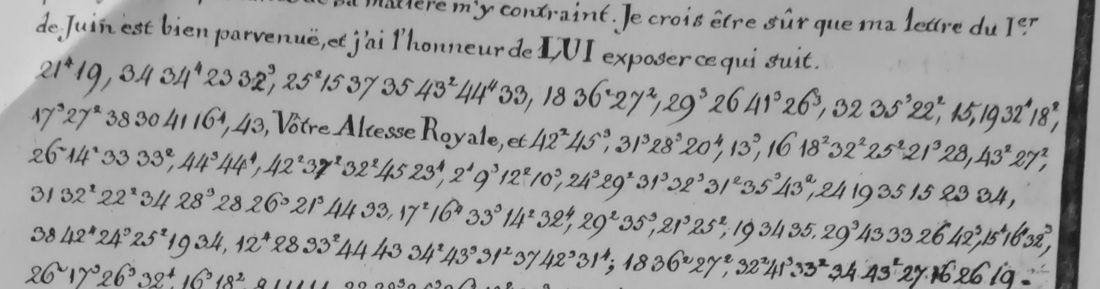
The three DECODE images are out of order. The letter begins on image 2 (“Madame! Je demande Grace à Votre Altesse Royale, du mystérieux que je mets dans cette Correspondance”), continues on image 3 and ends on image 1 with the date “La Haye ce 25 juillet 1801” and a ciphered signature. The framing sentences, the forms of address and some whole sentences are in clear; the substance is in figures.
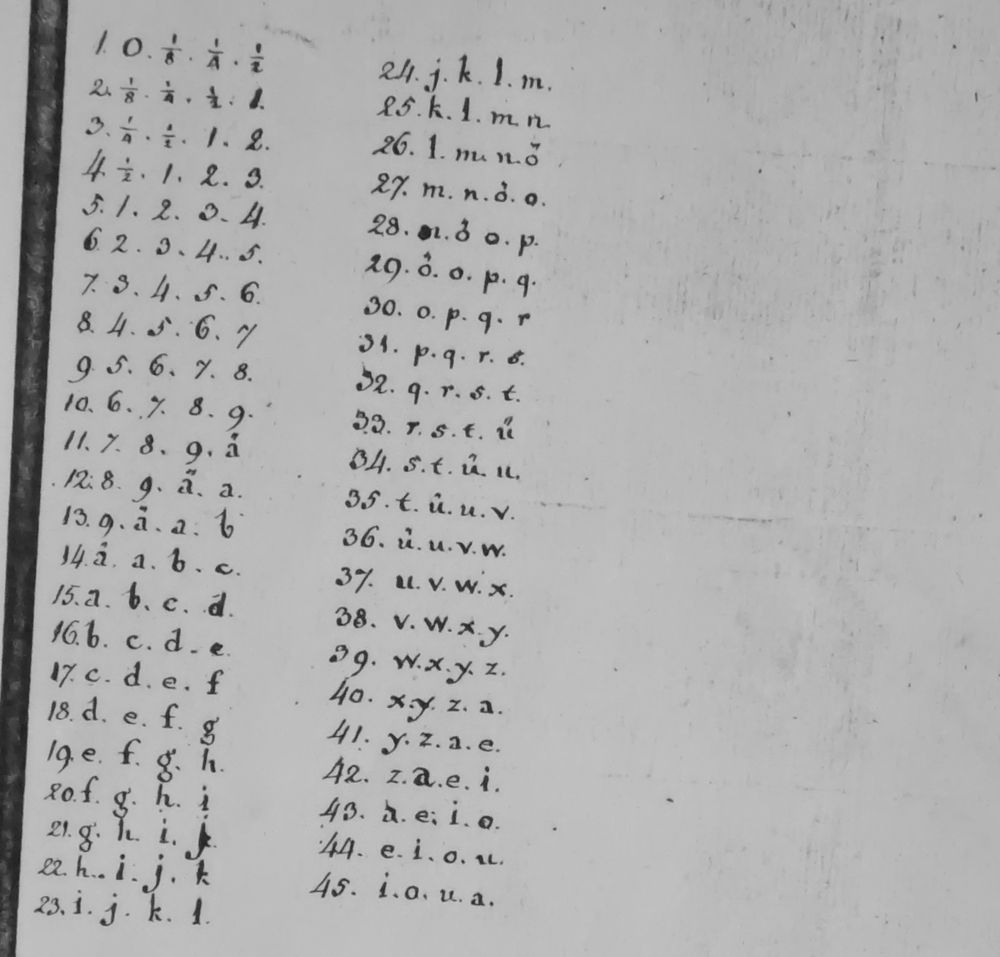
The key lists one sequence, 0 ⅛ ¼ ½ 1 2 … 9 à a b c … n ô o p q r s t û u v w x y z a e i o u a, in overlapping windows of four: row N holds values N to N+3. The writer picks a row and marks the place in it with a superscript; a bare number means the first place. So a can be written 15, 14², 13³ or 12⁴, and the vowels at the end of the sequence give a, e, i, o more choices still. DECODE’s note on R2233 describes the system correctly, but neither record gives a decipherment.
02 The decrypted text
Ciphered passages in brackets; spelling lightly modernised.
Madame! Je demande grâce à Votre Altesse Royale du mystérieux que je mets dans cette correspondance; l’importance de sa matière m’y contraint. Je crois être sûr que ma lettre du 1er de juin est bien parvenue, et j’ai l’honneur de lui exposer ce qui suit. [Je suis l’auteur d’un plan qui a été envoyé à] Votre Altesse Royale et [au roi à Berlin en mars ou avril 1798, lorsque j’étais dans les villes anséatiques, d’un rassemblement … une descente au Havre de Grâce, et fait le bombardement de Paris; une autre en Hollande; un corps attaque l’Yssel et le reste opère sur le continent; de la pacification de ce pays-ci; d’un nouveau genre de commander des armées combinées], et d’autres choses trop longues pour être transcrites ici, et qui finit par le vœu de pouvoir faire comme [Coriolan].
Puisque cette pièce a été faite après [la paix] de [Campo Formio], et que les circonstances se ressemblent, je n’ai pas voulu manquer de me faire connaître, pour offrir très-humblement mes faibles services, pour co-opérer à son exécution en général, et spécialement dans l’endroit où j’aurais déjà alors voulu me voir employé … Outre cela j’ai [offert à feu le prince Frédéric de lui amener quelques milles hommes de la brigade suisse avec l’élite des officiers, par une lettre que j’ai expédiée le matin du 14 septembre 1795, jour que je fus arrêté; sans cet accident je serais entré alors à la solde de l’Angleterre, je n’aurais point soupiré 39 mois et 5 jours dans la prison, et je ne serais pas dans le besoin où je me trouve à présent. Je ne veux pas offusquer le mérite des autres]; mais s’il m’est permis de le dire, je crois pouvoir me flatter d’avoir aussi mérité en quelque façon [pour la bonne cause], que je ne suis pas indigne pour implorer la [générosité bienfaisante du gouvernement britannique] pour en obtenir la [demi-paye] depuis le jour de [mon arrestation; j’avais comme quartier-maître 50 florins] par [mois] courant, [ou un secours] conforme à sa [magnanimité] …
… Daignez, Madame, m’accorder cette grâce avec la même bienveillance qu’il a plu à Votre Altesse Royale de s’intercéder pour moi, lorsque j’ai eu l’honneur de m’adresser à Elle en [1791, à Berlin] … et agréez [de disposer de moi …, lui fournir des occasions où je puisse donner des preuves de ma reconnaissance], ainsi que de [mon adhérence à la bonne cause], et de [mon attachement] aussi [sincère] que très [profondément respectueux à la personne et à la maison] de Votre Altesse Royale, dont [les ordres pourront me parvenir] par cette [même voie sans adresse], avec [3 marques ▽] … [Wolff]. La Haye ce 25 juillet 1801.
A royalist who had been in the Hanseatic towns in 1798 claims authorship of a two-pronged invasion plan against France and the Batavian Republic sent to the Princess and to Frederick William III. With peace in the air again in 1801, he offers to help carry it out. He recalls an offer of Swiss troops to Prince Frederick of Orange (d. 1799), cut short by his arrest on 14 September 1795 and a 39-month imprisonment, and asks the Princess to get him British half-pay as a former quartermaster.
03 Method
The key record was the next number on DECODE. The ciphered year and place (“en 3³ 9³ 11³ 3³, 15, 15² 17³ 31³ 24³ 20⁴ 27²” = “en 1791, à Berlin”) and the signature decrypted at the first test. The rest was transcribed from the three scans (1,065 groups, 119 distinct) and decoded mechanically line by line; no search was needed.
04 What remains uncertain
- Slips: a few groups come out one place off, from a superscript miswritten or misread. The signature’s 25³ gives m for l; “bienfaisante” decodes as bie?gck; “subsistance” as subsiston; “voué” as vov. Corrected from context (H).
- Two clear-text passages are summarised, not transcribed word for word. A few words after “proportionné”, “si j’ai le [c…]” and the last symbols after “3 marques” (“▽ en”?) are uncertain (C).
- Wolff is not identified. His dates (arrested 14 September 1795, about 39 months in prison, quartermaster at 50 florins a month) would be the lead.
05 Sources
- Koninklijk Huisarchief, The Hague, Wilhelmina Prinses van Pruisen, inv. 192: DECODE R2232 (the letter, 3 images) and R2233 (the key, 8 Sept 1801). Images need a DECODE login.
- Related: an Orangist at Basle to William V, 1796, decrypted with its own key from the same archive.
Transcription, key, decoder and notes: r2232/ in the repository.